

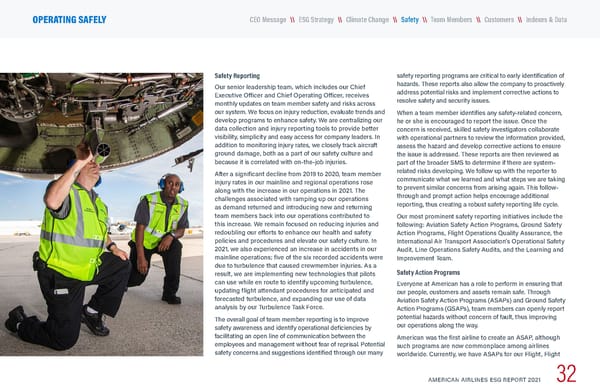
Safety Reporting Our senior leadership team, which includes our Chief Executive Officer and Chief Operating Officer, receives monthly updates on team member safety and risks across our system. We focus on injury reduction, evaluate trends and develop programs to enhance safety. We are centralizing our data collection and injury reporting tools to provide better visibility, simplicity and easy access for company leaders. In addition to monitoring injury rates, we closely track aircraft ground damage, both as a part of our safety culture and because it is correlated with on-the-job injuries. After a significant decline from 2019 to 2020, team member injury rates in our mainline and regional operations rose along with the increase in our operations in 2021. The challenges associated with ramping up our operations as demand returned and introducing new and returning team members back into our operations contributed to this increase. We remain focused on reducing injuries and redoubling our efforts to enhance our health and safety policies and procedures and elevate our safety culture. In 2021, we also experienced an increase in accidents in our mainline operations; five of the six recorded accidents were due to turbulence that caused crewmember injuries. As a result, we are implementing new technologies that pilots can use while en route to identify upcoming turbulence, updating flight attendant procedures for anticipated and forecasted turbulence, and expanding our use of data analysis by our Turbulence Task Force. The overall goal of team member reporting is to improve safety awareness and identify operational deficiencies by facilitating an open line of communication between the employees and management without fear of reprisal. Potential safety concerns and suggestions identified through our many safety reporting programs are critical to early identification of hazards. These reports also allow the company to proactively address potential risks and implement corrective actions to resolve safety and security issues. When a team member identifies any safety-related concern, he or she is encouraged to report the issue. Once the concern is received, skilled safety investigators collaborate with operational partners to review the information provided, assess the hazard and develop corrective actions to ensure the issue is addressed. These reports are then reviewed as part of the broader SMS to determine if there are system- related risks developing. We follow up with the reporter to communicate what we learned and what steps we are taking to prevent similar concerns from arising again. This follow- through and prompt action helps encourage additional reporting, thus creating a robust safety reporting life cycle. Our most prominent safety reporting initiatives include the following: Aviation Safety Action Programs, Ground Safety Action Programs, Flight Operations Quality Assurance, the International Air Transport Association’s Operational Safety Audit, Line Operations Safety Audits, and the Learning and Improvement Team. Safety Action Programs Everyone at American has a role to perform in ensuring that our people, customers and assets remain safe. Through Aviation Safety Action Programs (ASAPs) and Ground Safety Action Programs (GSAPs), team members can openly report potential hazards without concern of fault, thus improving our operations along the way. American was the first airline to create an ASAP, although such programs are now commonplace among airlines worldwide. Currently, we have ASAPs for our Flight, Flight AMERICAN AIRLINES ESG REPORT 2021 32 \\ Indexes & Data \\ Customers \\ Team Members \\ Climate Change \\ ESG Strategy CEO Message OPERATING SAFELY \\ Safety
 American Airlines ESG Report Page 32 Page 34