

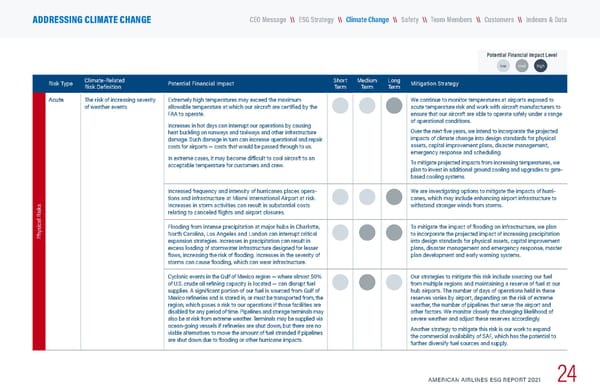
Risk Type Climate-Related Risk Definition Potential Financial Impact Short Term Medium Term Long Term Mitigation Strategy Physical Risks Acute The risk of increasing severity of weather events Extremely high temperatures may exceed the maximum allowable temperature at which our aircraft are certified by the FAA to operate. Increases in hot days can interrupt our operations by causing heat buckling on runways and taxiways and other infrastructure damage. Such damage in turn can increase operational and repair costs for airports — costs that would be passed through to us. In extreme cases, it may become difficult to cool aircraft to an acceptable temperature for customers and crew. We continue to monitor temperatures at airports exposed to acute temperature risk and work with aircraft manufacturers to ensure that our aircraft are able to operate safely under a range of operational conditions. Over the next five years, we intend to incorporate the projected impacts of climate change into design standards for physical assets, capital improvement plans, disaster management, emergency response and scheduling. To mitigate projected impacts from increasing temperatures, we plan to invest in additional ground cooling and upgrades to gate- based cooling systems. Increased frequency and intensity of hurricanes places opera - tions and infrastructure at Miami International Airport at risk. Increases in storm activities can result in substantial costs relating to canceled flights and airport closures. We are investigating options to mitigate the impacts of hurri - canes, which may include enhancing airport infrastructure to withstand stronger winds from storms. Flooding from intense precipitation at major hubs in Charlotte, North Carolina, Los Angeles and London can interrupt critical expansion strategies. Increases in precipitation can result in excess loading of stormwater infrastructure designed for lesser flows, increasing the risk of flooding. Increases in the severity of storms can cause flooding, which can wear infrastructure. To mitigate the impact of flooding on infrastructure, we plan to incorporate the projected impact of increasing precipitation into design standards for physical assets, capital improvement plans, disaster management and emergency response, master plan development and early warning systems. Cyclonic events in the Gulf of Mexico region — where almost 50% of U.S. crude oil refining capacity is located — can disrupt fuel supplies. A significant portion of our fuel is sourced from Gulf of Mexico refineries and is stored in, or must be transported from, the region, which poses a risk to our operations if those facilities are disabled for any period of time. Pipelines and storage terminals may also be at risk from extreme weather. Terminals may be supplied via ocean-going vessels if refineries are shut down, but there are no viable alternatives to move the amount of fuel stranded if pipelines are shut down due to flooding or other hurricane impacts. Our strategies to mitigate this risk include sourcing our fuel from multiple regions and maintaining a reserve of fuel at our hub airports. The number of days of operations held in these reserves varies by airport, depending on the risk of extreme weather, the number of pipelines that serve the airport and other factors. We monitor closely the changing likelihood of severe weather and adjust these reserves accordingly. Another strategy to mitigate this risk is our work to expand the commercial availability of SAF, which has the potential to further diversify fuel sources and supply. Potential Financial Impact Level low med high AMERICAN AIRLINES ESG REPORT 202s 24 \\ Indexes & Data \\ Customers \\ Team Members \\ Safety \\ ESG Strategy CEO Message ADDRESSING CLIMATE CHANGE \\ Climate Change
 American Airlines ESG Report Page 24 Page 26