

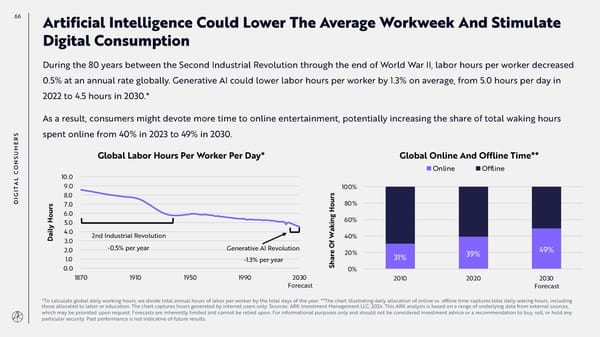
66 Artificial Intelligence Could Lower The Average Workweek And Stimulate Digital Consumption During the 80 years between the Second Industrial Revolution through the end of World War II, labor hours per worker decreased 0.5% at an annual rate globally. Generative AI could lower labor hours per worker by 1.3% on average, from 5.0 hours per day in 2022 to 4.5 hours in 2030.* As a result, consumers might devote more time to online entertainment, potentially increasing the share of total waking hours S spent online from 40% in 2023 to 49% in 2030. R E M U Global Labor Hours Per Worker Per Day* Global Online And Offline Time** S N CO Online Offline 10.0 L A 9.0 100% T I s G 8.0 r DI s 7.0 u 80% r o u 6.0 H o 60% H 5.0 ing y ak ail4.0 2nd Industrial Revolution W 40% D 3.0 f O 2.0 -0.5% per year Generative AI Revolution 49% e 20% 39% 1.0 -1.3% per year har 31% 0.0 S 0% 1870 1910 1950 1990 2030 2010 2020 2030 Forecast Forecast *To calculate global daily working hours, we divide total annual hours of labor per worker by the total days of the year. **The chart illustrating daily allocation of online vs. offline time captures total daily waking hours, including those allocated to labor or education. The chart captures hours generated by internet users only. Sources: ARK Investment Management LLC, 2024. This ARK analysis is based on a range of underlying data from external sources, which may be provided upon request. Forecasts are inherently limited and cannot be relied upon. For informational purposes only and should not be considered investment advice or a recommendation to buy, sell, or hold any particular security. Past performance is not indicative of future results.
 Annual Research Report | Big Ideas 2024 Page 65 Page 67