


Annual Research Report | Big Ideas 2024
January 31, 2024 - For informational purposes only
4 21 0 2 , 1 3 Y R A U N JA BIG IDEAS Y L N O S E S O P 2024 R U P L A N O I T A M R FO N I R FO Annual Research 4 Report 02 2 S EA D I ARK Investment Management LLC. This is not a recommendation in relation to any named particular securities/cryptocurrencies and no warranty or guarantee is provided. Any references to particular securities/cryptocurrencies G are for illustrative purposes only. There is no assurance that the Adviser will make any investments with the same or similar characteristics as any investment presented. The reader should not assume that an investment BI identified was or will be profitable. PAST PERFORMANCE IS NOT INDICATIVE OF FUTURE PERFORMANCE, FUTURE RETURNS ARE NOT GUARANTEED.
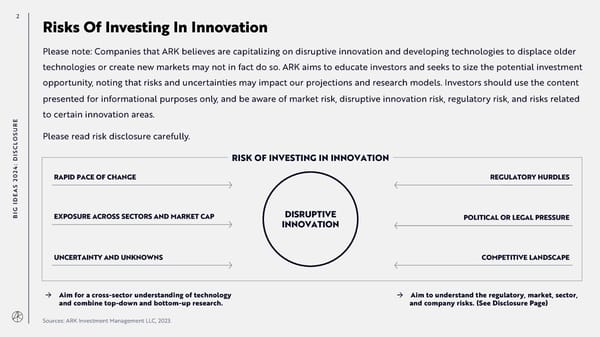
2 Risks Of Investing In Innovation Please note: Companies that ARK believes are capitalizing on disruptive innovation and developing technologies to displace older technologies or create new markets may not in fact do so. ARK aims to educate investors and seeks to size the potential investment opportunity, noting that risks and uncertainties may impact our projections and research models. Investors should use the content presented for informational purposes only, and be aware of market risk, disruptive innovation risk, regulatory risk, and risks related E to certain innovation areas. R U Please read risk disclosure carefully. OS L C S RISK OF INVESTING IN INNOVATION DI : 4 2 0 RAPID PACE OF CHANGE REGULATORY HURDLES 2 S A DE I G DISRUPTIVE BI EXPOSURE ACROSS SECTORS AND MARKET CAP POLITICAL OR LEGAL PRESSURE INNOVATION UNCERTAINTY AND UNKNOWNS COMPETITIVE LANDSCAPE à Aim for a cross-sector understanding of technology à Aim to understand the regulatory, market, sector, and combine top-down and bottom-up research. and company risks. (See Disclosure Page) Sources: ARK Investment Management LLC, 2023.
3 Big Ideas 2024 Disrupting The Norm, Defining The Future ARK Invest proudly presents "Big Ideas 2024: Disrupting the Norm, Defining the Future." A tradition since 2017, ON Big Ideas offers a comprehensive analysis of technological convergence and its potential to revolutionize I T C industries and economies. ODU R T N I : 4 ARK seeks to deliver long-term capital appreciation by investing in the leaders, enablers, and beneficiaries of 2 0 2 S disruptive innovation. With a belief that innovation is key not only to growth but also to resilience, ARK A DE I emphasizes the necessity of a strategic allocation to innovation in every investor's portfolio. This approach aims G BI to tap into the exponential growth opportunities often overlooked in broad-based indices, while simultaneously providing a hedge against the risks posed by incumbents facing disruption. We hope you enjoy Big Ideas 2024.

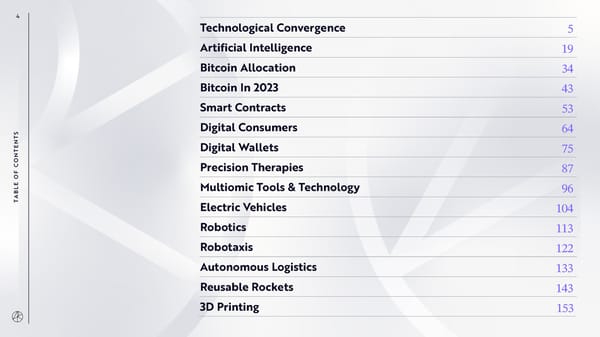
4 Technological Convergence 5 Artificial Intelligence 19 Bitcoin Allocation 34 Bitcoin In 2023 43 Smart Contracts 53 TS Digital Consumers 64 N Digital Wallets TE 75 N O C Precision Therapies 87 F O LE Multiomic Tools & Technology 96 B TA Electric Vehicles 104 Robotics 113 Robotaxis 122 Autonomous Logistics 133 Reusable Rockets 143 3D Printing 153
55 Research By: Brett Winton Chief Futurist ARK Venture Investment Committee Member Technological 4 2 0 2 S A E D I G BI Convergence Sources: ARK Investment Management LLC, 2024. Forecasts are inherently limited and cannot be relied upon. For informational purposes only and should not be considered investment advice or a recommendation to buy, sell, or hold any particular security. Past performance is not indicative of future results.
6 According to ARK’s research, convergence among disruptive technologies will define this decade. Five major technology platforms—Artificial Intelligence, Public Blockchains, Multiomic Sequencing, Energy Storage, and Robotics—are coalescing and should transform global economic activity. Technological convergence could create tectonic macroeconomic shifts more impactful than the first and second industrial revolutions. Globally, real economic growth could accelerate from 3% CE on average during the past 125 years to more than 7% during the next 7 years as robots reinvigorate N E manufacturing, robotaxis transform transportation, and artificial intelligence amplifies knowledge G R E V worker productivity. N CO Catalyzed by breakthroughs in artificial intelligence, the global equity market value associated with disruptive innovation could increase from 16% of the total* to more than 60% by 2030. As a result, the annualized equity return associated with disruptive innovation could exceed 40% during the next seven years, increasing its market capitalization from ~$19 trillion today to roughly $220 trillion by 2030. *Throughout this section, we include public blockchain value as part of all calculations and forecasts of “equity market value.” Sources: ARK Investment Management LLC, 2024. This ARK analysis is based on a range of underlying data from external sources, which may be provided upon request. Forecasts are inherently limited and cannot be relied upon. For informational purposes only and should not be considered investment advice or a recommendation to buy, sell, or hold any particular security. Past performance is not indicative of future results.
7 Public Blockchains Upon large-scale adoption, all money and contracts likely will migrate onto Public Blockchains that enableand verifydigital Multiomic scarcityand proof of ownership. The financial ecosystem is likely to reconfigure to accommodate the rise of Cryptocurrencies and Smart Contracts. These technologies Sequencing increase transparency, reduce the influence of capital and The cost to gather, sequence, and understand regulatory controls, and collapse contract execution costs. In digital biological data is falling precipitously. such a world, Digital Wallets would become increasingly Multiomic Technologies provide research necessary as more assets become money-like, and corporations scientists, therapeutic organizations and health Five Innovation and consumers adapt to the new financial infrastructure. platforms with unprecedented access to DNA, Corporate structures themselves may be called into question. RNA, protein, and digital health data. Cancer care should transform with pan-cancer blood tests. Platforms Are Artificial Intelligence Multiomic data should feed into novel Precision Therapies using emerging gene editing techniques Computational systems and software that evolve with data can that target and cure rare diseases and chronic Converging And solve intractable problems, automate knowledge work, and conditions. Multiomics shouldunlock entirely new accelerate technology’s integration into every economic sector. The Programmable Biology capabilities, including the adoption of Neural Networks should prove more momentous than design and synthesis of novel biological Defining This the introduction of the internet and potentially create 10s of trillion constructs with applications across industries, CE dollars of value. At scale these systems will require unprecedented particularly agriculture and food production. N computational resources, and AI-specific compute hardware should E Technological Era dominate the Next Gen Cloud datacenters that train and operate AI G models. The potential for end-users is clear: a constellation of AI- R driven Intelligent Devices that pervade people's lives, changing the E V way that they spend, work, and play. The adoption of artificial N intelligence should transform every sector, impact every business, CO and catalyze every innovation platform. Energy Storage Robotics Declining costs of Advanced Battery Technology should cause Catalyzed by artificial intelligence, Adaptive Robots can an explosion in form factors, enabling Autonomous Mobility operate alongside humans and navigate legacy systems that collapse the cost of getting people and things from infrastructure, changing the way products are made and place to place. Electric drivetrain cost declines should unlock sold. 3D Printing should contribute to the digitization of micro-mobility and aerial systems, including flying taxis, manufacturing, increasing not only the performance and enabling business models that transform the landscape of cities. precision of end-use parts but also the resilience of Autonomy should reduce the cost of taxi, delivery, and supply chains. Meanwhile, the world’s fastest robots, surveillance by an order of magnitude, enabling frictionless Reusable Rockets, should continue to reduce the cost of transport that could increase the velocity of e-commerce and launching satellite constellations and enable make individual car ownership the exception rather than the uninterruptible connectivity. A nascent innovation rule. These innovations combined with large-scale stationary platform, robotics could collapse the cost of distance batteries should cause a transformation in energy, substituting with hypersonic travel, the cost of manufacturing electricity for liquid fuel and pushing generation infrastructure complexity with 3D printers, and the cost of production towards the edge of the network. with AI-guided robots. Sources: ARK Investment Management LLC, 2024. This ARK analysis is based on a range of underlying data from external sources, which may be provided upon request. Forecasts are inherently limited and cannot be relied upon. For informational purposes only and should not be considered investment advice or a recommendation to buy, sell, or hold any particular security. Past performance is not indicative of future results.
8 Converging Technologies Are Generating A Historic Technological Wave Estimated Economic Impact of General Purpose Technologies (Annual Percentage Point Additions to Real GDP Growth And Consumer Surplus) 18 3D Printing Reusable Rockets Adaptiverobots Advanced Batteries Internal Combustion Engine Autonomous Mobility 13 Electricity Internet Cloud Computing Telephone Cell phones Radio GPS CE Refrigeration The Web AI N Air Conditioning E Chemicals & Synthetic G 8 PCs E-Commerce R Materials E Automobile Biotech Renewables V Railroads Fiber optics N Telegraph Assembly Line Intelligent Devices CO Photography Television Integrated Circuit Multiomic Technology Steam Engine Bicycle Jet Engine Nuclear Power Precision Therapies 3 Containerization Programmable Biology Digital Wallets Smart Contracts Cryptocurrencies -2 0 5 0 5 0 5 0 5 0 5 0 5 0 5 0 5 0 5 0 5 0 5 0 5 0 5 0 5 5 0 5 0 5 0 5 0 5 5 0 5 0 5 F 0F 8 9 0 10 15 2 2 3 3 4 4 5 5 6 7 7 8 8 9 9 0 10 15 2 2 3 3 0 4 5 5 6 7 7 8 8 0 9 0 1 1 20 253 8 9 0 18 6 0 19 4 6 9 0 25 0 17 17 17 17 18 18 18 18 18 18 18 18 18 18 18 18 18 18 18 18 18 18 18 19 19 19 19 19 19 19 19 19 19 19 19 19 19 19 19 19 19 19 20 20 20 20 20 2020203 20 Sources: ARK Investment Management LLC, 2024. This ARK analysis is based on a range of underlying sources, including Bekar et al. 2017, which may be provided upon request. The chart uses GPT 4 prompting to survey a comprehensive list of general purpose technologies using the identification framework detailed therein. Where available, academic literature is also used to assess attributable economic impact. A GPT-4 scoring rubric assesses technology-by-technology impacts. The impact measured directly is matched against the scoring to tune all scores to produce technology-by-technology estimates of economic impact (even when direct measures of economic impact are unattainable). Consistent with General Purpose Technology theory, these technologies are assumed to go through a period of investment in which economic impact is negative before productivity advances begin to realize into economic data. All technologies are assumed to have the same diffusion and realization cycle. If recent technologies are assumed to diffuse more quickly, the current wave would appear steeper. Forecasts are inherently limited and cannot be relied upon. For informational purposes only and should not be considered investment advice or a recommendation to buy, sell, or hold any particular security. Past performance is not indicative of future results.
9 AI Serves As The Central Technology Catalyst The Technology Convergence matrix illustrates the relationships between and among technologies. Cryptocurrencies Convergence Score Smart Contracts Highest Digital Wallets Precision Therapies Multiomic High Technology Programmable Biology gy Neural Mid o Networks l o n h Next Gen Tec Cloud Intelligent Devices Low Autonomous Mobility Advanced Battery Technology Renewable Lowest Rockets Adaptive Robotics 3D Printing Crypto- Smart Digital Precision Multiomic Programmable Neural Next Gen Intelligent Autonomous Advanced Renewable Adaptive 3D currencies Contracts Wallets Therapies Technology Biology Networks Cloud Devices Mobility Battery Rockets Robotics Printing Technology Catalyzing Technology More detailed version of this graphic, including detailed scoring information and justification available here. Sources: ARK Investment Management LLC, 2024. This ARK analysis is based on a range of underlying data from external sources, which may be provided upon request. Forecasts are inherently limited and cannot be relied upon. For informational purposes only and should not be considered investment advice or a recommendation to buy, sell, or hold any particular security. Past performance is not indicative of future results.
10 AI Is Accelerating Faster Than Forecasters Anticipated Expected Years Until Launch Of A General Artificial Intelligence System Pre GPT-3 average (Log Scale) 100 80 years OpenAIannounces GPT-3 Google demonstrates advanced 50 conversational agent, LLaMda2 years ChatGPTlaunches to the public s 34 years CE r a N e GPT-4 launches E Y G f o 18 years R E r V e10 N b m CO Nu 8 years If for ecast is wel l - tun e d If for ecast er r or con tin ues 1 2019 2020 2021 2022 2023 2024 2025 2026 2027 2028 2029 2030 Sources: ARK Investment Management LLC, 2024, based on data from Metaculus, including benchmark details, as of January 3, 2024. Benchmark broadly requires the successful passage of an adversarial two-hour Tuning test, broad success on a Q&A knowledge and logic benchmark, and the successful interpretation of and execution complex model car assembly instruction, all within a single system. Green lines are derived estimates for time to general purpose AI (strongly formulated) based upon forecasts for a weaker benchmark. Forecasts are inherently limited and cannot be relied upon. For informational purposes only and should not be considered investment advice or a recommendation to buy, sell, or hold any particular security. Past performance is not indicative of future results.
11 Individual Technology Advances Can Coalesce And Cascade Into Massive New Market Opportunities Neural Networks Advanced Battery Technology Autonomous Mobility Advanced AI enables robotaxis Battery electric drivetrains The combination of AI and battery to rely on fewer, less expensive + reduce robotaxi operating = electric drivetrains enables robotaxi sensors. costs by 60%. systems to scale. CE Robotaxi Manufacturing Costs RobotaxiOperating Cost Per Mile N (Per Vehicle, 2024)* By Drivetrain Type E Adaptive Robotics G R 200 E V $0.31 N In addition to better batteries and AI, CO 150 general purpose robots will require better: 100 • Electric motors Thousands, $ $0.12 • Power electronics 50 • Sensors • Power-efficient compute Waymo Tesla Internal combustion Electric As robotaxis scale, the cost of each 5 LIDARs, 29 cameras, 6 9 Cameras technology should decline according radars, 8 ultrasonic to its learning curve. sensors *Waymo manufacturing costs are estimated based upon public statements. Sources: ARK Investment Management LLC, 2024. This ARK analysis is based on a range of external sources, which may be provided upon request. Forecasts are inherently limited and cannot be relied upon. For informational purposes only and should not be considered investment advice or a recommendation to buy, sell, or hold any particular security. Past performance is not indicative of future results.
12 The Impact Of These Technologies On The Economy Should Prove Dramatic Economic Impact of Select Major Technologies (Cumulative Increase In Real GDP Attributable to Technology After Introduction) 140% 120% 100% CE N E G 80% R E V N CO 60% 40% 20% 0% Industrial robots Information Technology Adaptive robotics * Autonomous Mobility * Steam engine AI* Industrial Robots Adaptive Robotics * Steam Engine (1997 to 2007) (2023 to 2030) (1830 to 1910) (1997 to 2007) (1995 to 2005) (2023 to 2030) (2023 to 2030) (1830 to 1910) (2023 to 2030) *Adaptive Robotics, Autonomous Mobility, and AI Impact are ARK Invest estimates. AI estimate includes consumer surpluses that may not be captured in traditional economic statistics. IT productivity impact likely also undercounts consumer surplus. Industrial Robot and IT impact measures impact on US, Europe, and Japanese economies. Steam Engine impact is measured against the UK economy. Sources: ARK Investment Management LLC, 2024, based on data from Crafts 2004, O’Mahony et al. 2009, and McKinsey Global Institute 2017. Forecasts are inherently limited and cannot be relied upon. For informational purposes only and should not be considered investment advice or a recommendation to buy, sell, or hold any particular security. Past performance is not indicative of future results.
13 Technological Innovation Could Be Disruptive Enough To Dominate Global Equity Market Capitalizations 2023 2030 Annual Growth Equity Market Cap Estimate Equity Market Cap Forecast Forecast Non-innovation $98 trillion Non-innovation $140 trillion 3% Disruptive Innovation $19 trillion Disruptive Innovation $220 trillion 42% Total $117 trillion Total $360 trillion 17% Multiomic CE Sequencing N ArtificiaI Intelligence E Robotics G R 37% E Public V Energy Storage N Blockchains 50% CO Public Blockchains 48% Energy Robotics Storage 78% AI Multiomic Sequencing 39% Note: Forecasted numbers are rounded. Sources: ARK Investment Management LLC, 2024. This ARK analysis is based on a range of external sources, including the World Federation of Exchanges and the MSCI ACWI IMI Innovation Index which may be provided upon request. Forecasts are inherently limited and cannot be relied upon. For informational purposes only and should not be considered investment advice or a recommendation to buy, sell, or hold any particular security. Past performance is not indicative of future results.
14 Expectations For Public Blockchains Although the scenarios described in the table below are written in present tense, they are forecasted, possible outcomes based on ARK's views. These possible outcomes may not be realized in the future due to a number of uncertainties. The information provided should not be considered investment advice and should not form the basis of any investment decision. Technology 2040 Possibilities ARK’s 2030 Expectation of Progress Cryptocurrencies have displaced most permission-based, centrally Global money supply has grown in tandem with GDP, and cryptocurrencies now controlled monetary systems, enabling financial ecosystems to reformulate account for ~10% of the total. Little of that value accrual is attributable to the around a digital asset that can eliminate counterparty risk while continuing direct displacement of money though there are instances in emerging markets. to facilitate transaction flows. The reformulation began at the edges of the Much of the appreciation is a function of low single-digit percent allocations by Cryptocurrencies traditional financial system in geographies with broken money systems and institutional and high net worth individuals as well as corporate and nation-state in markets otherwise mis-served by traditional financial intermediaries. In treasuries. Cryptocurrencies continue to displace gold as a flight-to-safety asset, developed markets, cryptocurrencies initially served as a store of value, taking 40% share of the market. Utility use cases such as remittances and global providing little direct utility. Over time, the efficiencies of a truly neutral settlements account for ~10% and~ 5% of volumes, respectively digital currency, primarily bitcoin, have prevailed over other financial architectures. CE Most contracts have migrated to open-source protocols that enable and Global financial assets as percent of GDP have continued to increase, with less N verify digital scarcity and proof of ownership. Risk-sharing arrangements are than 5% secured by smart contracting platforms—a dynamic consistent with the E more transparent, assets of all sorts are securitized, bought, and sold more adoption curve of dialup internet. At 1%, the gross take from tokenized assets on G easily, and counterparty risks have diminished substantially. The importance decentralized protocols is less than a third of the fees that traditional financial R of traditional financial intermediaries has dwindled, even as more human institutions extract. Application protocols, which pay a larger share of fees to E V Smart Contracts activity becomes commercialized. Decentralized protocols, enabled by incentivize network participants, account for 75% of gross decentralized protocol N balance-sheet-light digital wallet platforms, facilitate most traditional revenues. The blended net take rate between application layer protocols and CO financial functions. Consumer internet services rely on business models Level 1 protocols is roughly 60bps. enabled by digital asset ownership. Every corporate entity and every consumer has adapted as centralized corporate structures themselves are called into question. Digital wallets enable nearly every person with a connected device to Roughly 90% of smartphone users rely on digital wallets to some degree. The transmit and receive money instantly, fundamentally transforming the majority uses digital wallets as the front-end for more than half of meaningful through-flow of commercial and financial experiences. Digital wallets that financial functions. Digital wallet platform providers continue to rely on traditional facilitate wholesale pricing of financial services for individual users have ecosystems to facilitate financial activities like lending but can extract lead disrupted retail banking relationships, fundamentally transforming consumer generation fees of 5-20% for delivering customers to those institutions. They also Digital Wallets relationships with financial service providers. In addition to their financial can capture 3-10% commerce facilitation fees for e-commerce activity directed functions, digital wallets are distribution platforms for a variety of digital through their platforms. services—from ride-hailing to e-commerce—and are secure repositories for digital health and other sensitive data. Traditional financial service institutions and their associated payment processing value chains have given way largely to internet-enabled digital wallets for most economic activity. Sources: ARK Investment Management LLC, 2024. In the above table, we characterize the convergent technological capabilities that we believe may manifest by 2030 and 2050. We stress that these scenarios, written in the present tense, are possible outcomes—not assured outcomes—and that the future may play out differently. This ARK analysis is based on a range of external sources, which may be provided upon request. Forecasts are inherently limited and cannot be relied upon. For informational purposes only and should not be considered investment advice or a recommendation to buy, sell, or hold any particular security.
15 Expectations For Multiomic Sequencing Although the scenarios described in the table below are written in present tense, they are forecasted, possible outcomes based on ARK's views. These possible outcomes may not be realized in the future due to a number of uncertainties. The information provided should not be considered investment advice and should not form the basis of any investment decision. Technology 2040 Possibilities ARK’s 2030 Expectation of Progress Technology enables the manipulation of molecular biological systems, Precision therapies make up 25% of newly released drugs. By improving the quality of life, catalyzing a new generation of more efficacious and durable precision lowering ancillary medical costs, and often effectively curing diseases, they command therapies. CRISPR-based gene-editing enables the manipulation of DNA average price premiums of 7x relative to traditional drugs. Combined with expected directly with increasing specificity. RNA-acting therapeutic techniques improvements in R&D efficiencies, these drugs add 15% or ~$300 billion to drug revenues in Precision Therapies restrict the area of DNA that can be transcribed into proteins. AI-advances 2030. enable the targeting of specific proteins that cause underlying disorders. These breakthroughs have shortened development timelines for and increased the efficacy of curative therapies that command higher prices than traditional therapies. Researchers are aiming to cure most rare diseases. Traditional health service spending declines, ceding economic terrain to molecular cures. CE Catalyzed by the precipitous fall in sequencing costs, researchers and At full penetration, R&D efficiency associated with drug development could double, thanks N clinicians routinely collect patients’ epigenomic, transcriptomic, and to AI-enhanced multiomic technology. By 2030, nearly all new drug development programs E proteomic data. With increasingly comprehensive digital health readouts incorporate multiomics into preclinical R&D, and ~50% incorporate AI into clinical G from intelligent devices and emerging AI tools, they align this panoply of programs. Realized returns on R&D have improved by 10% with line-of-sight to a near R multiomic data to understand, predict, and treat disease. As a result, cancer E doubling of R&D returns by 2035. Early detection multi-cancer blood tests have become V care has transformed completely: multiomic technologies detect cancer at standard of care as they have cut cancer mortality by 25% for some age cohorts. In N early stages, target treatment more precisely, and provide recurrence CO Multiomic Technologies monitoring. Regular blood-based pan-cancer tests are a standard of care for developed markets, 30% of patients benefit from the new diagnostics regime. patients in middle age. Multiomic technology has increased biotech R&D efficiency, as clinical trials target patient populations and measure outcomes more precisely and easily. Combined with AI, multiomic technology has transformed the relationship between patients and health systems. Digital health providers, diagnostic tool companies, and molecular testing companies are leading the charge. Legacy drug franchises and health service systems have lost their prominence. Wasteful healthcare spending declines as healthy lives extend. AI tools, improved genomic synthesis techniques, and scalable biological Still restricted to early stage and development projects, gene synthesis generates $10 manufacturing techniques enable novel, lower cost biological constructs billion in annual revenue. Programmable biology platforms capture 10% of precision with predictable performance, powering a renaissance in agriculture and therapy revenue. Those platforms generate another $30 billion in revenue with gross Programmable Biology materials science. Programmable biology enables breakthroughs in margins at ~70%, EBITDA margins in the 35% range, and free cash flow margins at ~20%. materials science and bio-based fuels that increase food production and reduce environmental externalities. Molecular biological primitives offer a substrate for new robust computation architectures. Sources: ARK Investment Management LLC, 2024. In the above table, we characterize the convergent technological capabilities that we believe may manifest by 2030 and 2050. We stress that these scenarios, written in the present tense, are possible outcomes—not assured outcomes—and that the future may play out differently. This ARK analysis is based on a range of external sources, which may be provided upon request. Forecasts are inherently limited and cannot be relied upon. For informational purposes only and should not be considered investment advice or a recommendation to buy, sell, or hold any particular security.
16 Expectations For Energy Storage Although the scenarios described in the table below are written in present tense, they are forecasted, possible outcomes based on ARK's views. These possible outcomes may not be realized in the future due to a number of uncertainties. The information provided should not be considered investment advice and should not form the basis of any investment decision. Technology 2040 Possibilities ARK’s 2030 Expectation of Progress Robots move people and parcels from place to place and have changed the Autonomous robotaxis have transformed global transport, as point-to-point economics of physical movement entirely. The cost of taxi, delivery, and transportation is available in nearly every country at an average price of ~$.50 per observation have fallen by an order of magnitude. Traveling by robotaxi is the mile. Given the compelling price-point and utility, robotaxis have traveled 13 norm and owning a personal vehicle the exception. Frictionless drone and trillion vehicle miles and are gaining traction. Autonomous robotaxi platforms Autonomous Mobility robot delivery has catalyzed the velocity of ecommerce. The data generated charge platform fees or take-rates of 50%+, generate ~50% operating margins, by autonomous mobility systems provide pervasive, real-time insights into the and give asset owner-operators the opportunity to generate reasonable rates of state of the world. Consumers and businesses that harness autonomous return on capital. The number of autonomous vehicles facilitating this travel is mobility platforms are benefitting, while prior incumbents in the automotive, ~100 million, and most of the incremental vehicle production is autonomous- logistics, retail, and insurance sectors have been upended. capable. CE N Declining battery costs have ignited a Cambrian explosion in mobility form As ridership shifts to electric autonomous platforms, the number of autonomous E factors, pushing electrical supply out to end-nodes on networks. Electric capable EVs sold annually is ~74 million, accounting for most of the automotive G R vehicles dominate transport as internal combustion dies. Micro-mobility and market. At an average selling price of ~$20,000, EV manufacturers generate $1.4 E aerial systems that include flying taxis enable innovative business models that trillion in annual revenue, ~20% gross margins, and ~10% EBIT margins. With V N Advanced Battery transform urban landscapes. All these innovations drive fundamental demand manufacturing consolidation, margins increase. Batteries account for ~20% of the CO Systems for electrical energy at the expense of liquid fuel. They also provide electrical value of EVs. Much like that of EVs, battery manufacturing is capital-intensive and energy more efficiently, reducing the vulnerability of grids, operational low-margin. Supplying the EV OEMs, battery manufacturers generate revenue of expenses, and the capital intensity of transmission and distribution. $300 billion per year. Stationary energy storage requires a volume of batteries Oil demand is in decline, and traditional automotive manufacturers and roughly equivalent to that consumed by EVs, generating another $300 billion in suppliers have been displaced by a smaller number of vertically integrated revenue. technology providers. Sources: ARK Investment Management LLC, 2024. In the above table, we characterize the convergent technological capabilities that we believe may manifest by 2030 and 2050. We stress that these scenarios, written in the present tense, are possible outcomes—not assured outcomes—and that the future may play out differently. This ARK analysis is based on a range of external sources, which may be provided upon request. Forecasts are inherently limited and cannot be relied upon. For informational purposes only and should not be considered investment advice or a recommendation to buy, sell, or hold any particular security.
17 Expectations For Artificial Intelligence Although the scenarios described in the table below are written in present tense, they are forecasted, possible outcomes based on ARK's views. These possible outcomes may not be realized in the future due to a number of uncertainties. The information provided should not be considered investment advice and should not form the basis of any investment decision. Technology 2040 Possibilities ARK’s 2030 Expectation of Progress Fed by massive amounts of data, computational systems and software are The cost of training AI models has fallen more than 40,000-fold which, when solving previously unsolvable problems, automating knowledge work, and combined with aggressive investments in AI hardware, has catapulted accelerating the integration of technology into all economic processes. As aggregate AI capability roughly 600,000-fold since 2023. Adopted by 50% of Neural Networks costs have plummeted, custom software is improving with every AI model knowledge workers, AI software systems have improved their productivity by 9x enhancement and connecting the world. Learning systems are blazingly fast, on average. Consistent with other software products, enterprises pay 10% of the their impact as momentous as the introduction of the microprocessor, productivity increase to access the software. transforming every sector and region. Cloud tools train the AI models that dominate software stacks and the AI hardware spend of $1.3 trillion supports $13 trillion in AI software sales and software connections that stitch together the AI-run world. The accommodates traditional software gross margins of 75%. Three types of CE infrastructure-as-a-service providers, chip manufacturers, and tool- customers support the demand for AI hardware--infrastructure-as-a-service N manufacturers that facilitate the training of neural networks have enjoyed a providers, software companies, and AI foundation model providers—which E Next Gen Cloud multi-decade demand cycle. Software development has been should generate 20% cashflow margins, consistent with those of chip G R democratized, and the companies providing API hooks that stitch together manufacturers. E V interoperable software layers experience unprecedented demand. N CO AI powers a new class of intelligent devices in the home and on the go. Consumer spending on intelligent device hardware continues its uptrend to Fixed internet-and AI-powered infrastructure exists in homes and other ~$60 per internet user per year. Time spent connected grows dramatically to social environments, transforming distribution for all media providers. End- half of waking leisure hours, or 20 trillion globally. Digital experiences continue users interface with the world in completely new ways, and data on their to monetize at a discount to in-person experiences and yield $0.25 per hour Intelligent Devices consumption preferences spawn new business models and services. spent online in revenue to platform providers. Between device spend and Commerce and wagering permeate entertainment experiences, enabling digital entertainment experiences, $5.4 trillion in revenue accrues to intelligent and catalyzing new advertising formats and content monetization. The show devices, entertainment, and social platforms. Advertising and commerce is the store. Linear TV is obsolete, as digital curation and direct consumer comprise 80% of that revenue. preference drive visual content. Linear content is ceding ground to interactive experiences, sometimes subtly. AI-mediated glasses and headsets thread through the fabric of everyday life. Sources: ARK Investment Management LLC, 2024. In the above table, we characterize the convergent technological capabilities that we believe may manifest by 2030 and 2050. We stress that these scenarios, written in the present tense, are possible outcomes—not assured outcomes—and that the future may play out differently. This ARK analysis is based on a range of external sources, which may be provided upon request. Forecasts are inherently limited and cannot be relied upon. For informational purposes only and should not be considered investment advice or a recommendation to buy, sell, or hold any particular security.
18 Expectations For Robotics Although the scenarios described in the table below are written in present tense, they are forecasted, possible outcomes based on ARK's views. These possible outcomes may not be realized in the future due to a number of uncertainties. The information provided should not be considered investment advice and should not form the basis of any investment decision. Technology 2040 Possibilities ARK’s 2030 Expectation of Progress Reusable rockets are inexpensive and have spawned new business models. Led by SpaceX’s Starship launch volumes, a 40,000 strong satellite network is Low-earth orbit constellations connect every smartphone user on earth to a in orbit, facilitating direct-to-satellite communications for nearly all censor-resistant data feed. Hypersonic point-to-point travel is becoming a smartphones and delivering broadband-type speeds to ships, RVs, airplanes, Reusable Rockets reality, disrupting long-haul flight, transforming military asset delivery, and and rural residents in developed and developing countries. Given the relative shrinking global supply chains. Extra-planetary human exploration has ease with which customers can be on-boarded—a power outlet, an antenna, begun ramping. and a clear path to the sky—most customers are engaged in an addressable market totaling $130 billion annually. Adaptive robots powered by artificial intelligence are transforming the Adaptive robots have penetrated manufacturing processes enough to increase economy. The cost of humanoid robots that are backward-compatible with productivity by 15%, and annual unit sales of humanoid robots have grown to existing infrastructure has dropped below that of human manufacturing 10% of the number of humans in the manufacturing workforce. Less expensive CE labor for many applications. Previously intractable household tasks are robots in human form-factors have begun to populate households, particularly N submitting to automation at price points that create compelling end- in developed countries. While still limited in capability, these robots address a E markets. Fleets of robots grow more performant with every AI software third of household chores, their sticker prices justified by the time that G Adaptive Robotics R upgrade. A virtuous circle of fleet data generation and AI model training household members save. Robot manufacturers enjoy margins at the higher E drives performance forward. Manufacturing productivity growth accelerates end of capital equipment suppliers, thanks to software. V N as a wider array of physical goods submit to technologically-driven cost CO declines. Robots continue to penetrate the service sector as well. The economy has entered a period of undeniable and unprecedented explosive growth. 3D printing has removed design barriers and reduced cost, weight, and time 3D printing continues to dominate the prototyping market and has penetrated to production, dramatically transforming traditional manufacturing substantial parts of the intermediate tooling market, enabling low-cost design methods.Healthcare tools created with 3D printing are personalized and iterations across injection molding and metal casting applications. Most custom-made, resulting in better experiences for both patients and doctors. important to industry growth, 3D printing has begun to see meaningful uptake 3D Printing Lighter 3D-printed aerospace parts reduce global emissions and give flight into end-use applications across aerospace and automotive, markets that to new aircraft both for earth and outer space. Replacement parts across collectively sell more than $4 trillion in equipment per year. Across all industries are printed on demand at a fraction of previous costs, ultimately industries, nearly $900 billion in end-use parts could adopt 3D printing, though short-circuiting supply-chain shortfalls. 3D printing enables artificial that penetration remains in the teens. intelligence to design parts once impossible to manufacture. Sources: ARK Investment Management LLC, 2024. In the above table, we characterize the convergent technological capabilities that we believe may manifest by 2030 and 2050. We stress that these scenarios, written in the present tense, are possible outcomes—not assured outcomes—and that the future may play out differently. This ARK analysis is based on a range of external sources, which may be provided upon request. Forecasts are inherently limited and cannot be relied upon. For informational purposes only and should not be considered investment advice or a recommendation to buy, sell, or hold any particular security.
1919 Research By: Frank Downing Jozef Soja Director of Research, Research Associate Next Generation Internet Artificial 4 2 0 2 S A E D I G Intelligence BI Scaling Global Intelligence And Redefining Work Sources: ARK Investment Management LLC, 2024. Forecasts are inherently limited and cannot be relied upon. For informational purposes only and should not be considered investment advice or a recommendation to buy, sell, or hold any particular security. Past performance is not indicative of future results.
20 With superhuman performance on a wide range of tests, AI models like GPT-4 should catalyze an unprecedented boom in productivity. Jolted by ChatGPT’s “iPhone” like moment, enterprises are scrambling to harness the potential of artificial intelligence (AI). E C N AI promises more than efficiency gains, thanks to rapidly falling costs and open- E G I L source models. If knowledge worker productivity were to quadruple by 2030, as we L E T N I believe is likely, growth in real GDP could accelerate and break records during the AL I C next five to ten years. I F I T AR Sources: ARK Investment Management LLC, 2024. Forecasts are inherently limited and cannot be relied upon. For informational purposes only and should not be considered investment advice or a recommendation to buy, sell, or hold any particular security. Past performance is not indicative of future results.
21 ChatGPTDelighted Consumers And Amazed Enterprises Building on years of progress since Google invented transformer architecture in 2017, ChatGPT catalyzed the public’s understanding of generative AI. No longer a tool just for developers, ChatGPT’s simple chat interface enabled anyone speaking any language to harness the power of large language models (LLMs). In 2023, enterprises scrambled to understand and deploy generative AI. ChatGPTUsers Hit 100 Million Users In Two Months The Number of AI Mentions Tripled On Earnings Calls E C ChatGPT WeChat TikTok Alphabet Apple Amazon Meta Microsoft N E Instagram YouTube FaceBook G I L L 100 180 E Post-ChatGPT Average T N 90 160 I s AL r 80 ns140 I e C s 70 io I U F ) nt120 I e ns60 e T iv M 100 io AR l 50 f Act o il 80 y r hl(M40 e Pre-ChatGPT Average b 60 nt 30 m o u 40 M 20 N 10 20 0 0 0 1 2 3 4 5 Q4'21 Q1'22 Q2'22 Q3'22 Q4'22 Q1'23 Q2'23 Q3'23 Years *values between 0 and 100 million users are estimates Sources: ARK Investment Management LLC, 2024. This ARK analysis is based on a range of data sources, which are available upon request. Forecasts are inherently limited and cannot be relied upon. For informational purposes only and should not be considered investment advice or a recommendation to buy, sell, or hold any particular security. Past performance is not indicative of future results.
22 AI Already Has Boosted Productivity Significantly Coding assistants like GitHub Copilot and Replit AI are early success stories that have boosted the productivity and job satisfaction of software developers. AI-powered assistants are increasing the performance of knowledge workers and, interestingly, benefiting underperforming workers relatively more than high performers. Productivity of Developers On Coding Productivity of Consultants Using Gen AI In 2023 Tasks Using Github Copilot in 2023 Task Speed Task Quality E C N 1.25x E G 1.17x I L L E T N 2.2x I 1.43x AL I C I F I T AR Without Copilot With Copilot Without Gen AI With Gen AI Without Gen AI With Gen AI Task Quality, Top 50th Percentile of Workers Task Quality, Bottom 50th Percentile of Workers Sources: ARK Investment Management LLC, 2024. The data used to analyze productivity were collected from several different studies with varying numbers of participants and definitions of task quality. The sources used are Dell’Acqua et al. 2023 and GitHub 2022. Forecasts are inherently limited and cannot be relied upon. For informational purposes only and should not be considered investment advice or a recommendation to buy, sell, or hold any particular security. Past performance is not indicative of future results.
23 Foundation Models Are Improving Across Domains With larger training datasets and more parameters, GPT-4 outperforms GPT-3.5 significantly. Increasingly, foundation models are becoming “multimodal”—supporting text, images, audio, and video—and are not only more dynamic and user friendly, but also more performant. GPT-3.5, GPT-4, and Claude 2 Results on Professional and Academic Exams GPT-3.5 GPT-4 Claude 2 GPT-4 Vision E 100% C N E 90% G I L 80% L E 70% T N e I il 60% AL nt I ce 50% C I r F e 40% I P T AR 30% 20% 10% 0% 0 al g e h y T t y s y s y s e y 2 y 2 C e e 0 g W m t n r c g c g c r 1 r 1 2 c r A i i i v r s g n b n a a o i o B u i 0 r R n x o e t t o o t t c t C s a t C t ti t s l m l m s i 2 e B i e M LS m s i i s s u a a r i E s i t o o o o ta i u g r l V E c i i i y l R a r T n H a n h n t m H AM n e AM T W S a H r t B c e h u t s n E l e t S o y o n P d c a i e fi SA E a B SA S v c s c a h l al L L c i GR t U o Ar AP e P e u C r h h r m GR n rm G AP o o Q AP o C s s o e e o AP r r W li li f S m f AP S ac AP ic E AP AP g g e * n i U M M n n d O o Un GR AP E E Co B ir AP AP AP A nv AP AP US E AP *USA Biology Olympiad, a prestigious national competition testing high school students in biology. Sources: ARK Investment Management LLC, 2024, based on data from OpenAI and Anthropic as of Jan. 9, 2024. Forecasts are inherently limited and cannot be relied upon. For informational purposes only and should not be considered investment advice or a recommendation to buy, sell, or hold any particular security. Past performance is not indicative of future results.
24 Text-To-Image Models Are Reinventing Graphic Design Eight years after researchers at the University of Toronto introduced the first modern text-to-image model, the output from image models now rivals that of professional graphic designers. A human designer can create an image—like a herd of elephants walking across a green grass field—in several hours for several hundred dollars. Text-to-image models can produce the same graphic in seconds for pennies. Professional apps like Adobe Photoshop and consumer apps like Lensa and ChatGPT are integrating image models into their products and services. E C N E A herd of elephants walking across a green grass field G I L L E T N I AL I C I F I T AR February 2016 February 2022 November 2022 December 2023 alignDRAW Midjourney v1 Midjourney v4 Midjourney v6 Sources: ARK Investment Management LLC, 2024. Images sourced from Masimov et al. 2016 and Midjourney. Forecasts are inherently limited and cannot be relied upon. For informational purposes only and should not be considered investment advice or a recommendation to buy, sell, or hold any particular security. Past performance is not indicative of future results.
25 The Cost Of Authoring The Written Word Has Collapsed Over the past century, the cost of authoring written content has been relatively constant in real terms. During the past two years, as the writing quality of LLMs has improved, the cost has collapsed. TheCost of Authoring Written Content $1,000 E C N E $100 G GPT4 32k I L L $0.16 E T Median GRE N I $10 Analytic Writing AL I C I F I T $1 Claude 2 AR $0.04 Top Decile GRE $0.10 $0 Analytic Writing Cost Per 1000 Words Written, 2023 Dollars, Log Scale$0 2 5 8 11 0 3 6 9 2 5 8 1 4 7 0 3 6 9 2 5 8 1 4 7 0 3 6 9 2 5 8 1 4 7 0 3 6 9 0 0 0 19 14 17 2 2 2 2 3 3 3 4 4 4 5 5 5 5 6 6 6 7 7 7 8 8 8 8 9 9 9 0 0 0 1 1 1 1 22 19 19 19 19 19 19 19 19 19 19 19 19 19 19 19 19 19 19 19 19 19 19 19 19 19 19 19 19 19 19 19 19 20 20 20 20 20 20 20 20 Post 1997 assumes constant words per employed writer over time Sources: ARK Investment Management LLC, 2024. This ARK analysis is based on a range of data sources as of Jan 9, 2024, which are available upon request. Forecasts are inherently limited and cannot be relied upon. For informational purposes only and should not be considered investment advice or a recommendation to buy, sell, or hold any particular security. Past performance is not indicative of future results.
26 AI Training Performance Is Improving Rapidly AI researchers are innovating across training and inference, hardware, and model designs to increase performance and lower costs. Model Training Performance Gains Other Algorithmic Innovations Moore’s Law Accelerator Optimizations Algorithmic Optimizations Increase Decrease Total • Llama2 suggests superior writing ability >5x of LLMs is fundamentally driven by E reinforcement learning from human C N E feedback (RLHF) G I L L E T N I • Optimized prompts can outperform AL I human prompts by over 50% C I F I T AR • Speculative Decoding speeds up Base = 1x inference 2-3x on certain models • Flash Attention 2 results in a 2.8x 2023 Performance NVIDIA’s Outperformance Other Software training speedup in GPT models of Moore’s Law Innovations Moore’s Law Chinchilla 2024 Performance Predicted Improvement Optimal Scaling Forecast Sources: ARK Investment Management LLC, 2024. This ARK analysis is based on a range of data sources, including Benaich 2023, Touvron et al. 2023, Yang et al. 2023, Leviathan et al. 2022, and Dao 2023, which are available upon request. Forecasts are inherently limited and cannot be relied upon. For informational purposes only and should not be considered investment advice or a recommendation to buy, sell, or hold any particular security. Past performance is not indicative of future results.
27 Training Costs Should Continue To Fall 75% Per Year According to Wright’s Law, improvements in accelerated compute hardware should reduce AI-relative compute unit (RCU) production costs by 53% per year, while algorithmic model enhancements could lower training costs further by 47% per year. In other words, the convergence of hardware and software could drive AI training costs down by 75% at an annual rate through 2030. AI Training Hardware Cost AI Software Training Cost Using Neural Networks E Actual $ / RCU Predicted $ / RCU Actual Compute Estimated Compute C $100,000.00 1.000 N E G I L $10,000.00 L 0.100 E T N $1,000.00 I ) * ) AL e e 0.010 I $100.00 C ays cal I cal D S F S - I g g T $ / RCUo $10.00 o AR (L TFS (L 0.001 $1.00 0.000 $0.10 $0.01 0.000 0 1 100 10,000 1,000,000 100,000,000 0 1 100 10,000 1,000,000 Cumulative RCUs Produced Cumulative RCUs Produced (Millions) (Log Scale) (Millions) (Log Scale) *TFS-Days is a measure of compute required to train a model. Wright’s Law states that for every cumulative doubling of units produced, cost will fall by a constant percentage. Sources: ARK Investment Management LLC, 2024. This ARK analysis is based on a range of data sources as of Jan. 9, 2024, which are available upon request. Forecasts are inherently limited and cannot be relied upon. For informational purposes only and should not be considered investment advice or a recommendation to buy, sell, or hold any particular security. Past performance is not indicative of future results.
28 As Production Use Cases Emerge, AI Focus Is Shifting To Inference Costs After focusing initially on LLM training cost optimization, researchers now are prioritizing inference costs. Based on enterprise scale use cases, inference costs seem to be falling at an annual rate of ~86%, even faster than training costs. Today, the inference costs associated with GPT-4 Turbo are lower than those for GPT-3 a year ago. GPT-3 and GPT-4 API Inference Costs Per 1,000 Tokens E GPT-4-32k: C $0.08 N GPT-4-32k Context E G Window: I L $0.07 32k Tokens L E GPT-3 Speed: T N $0.06 12 Tokens/Sec I AL I $0.05 C I F 86% Annualized Cost Decline 92% Annualized Cost Decline I T $0.04 AR $0.03 GPT-3 GPT-4 Turbo: $0.02 GPT-4 Turbo Context Window: 128k Tokens, ↑4x $0.01 Speed: GPT-3.5 Turbo 44 Tokens/Sec, ↑4x $- 11/18/2021 9/1/2022 11/6/2023 3/14/2023 11/6/2023 Date of Price Change Sources: ARK Investment Management LLC, 2024. This ARK analysis is based on a range of data sources, including Patel and Kostovic 2023, and ARK Investment Management LLC 2023, which are available upon request. Forecasts are inherently limited and cannot be relied upon. For informational purposes only and should not be considered investment advice or a recommendation to buy, sell, or hold any particular security. Past performance is not indicative of future results.
29 The Open-Source Community Is Competing With Private Models Challenging closed-source models from OpenAI and Google, the open-source community and its corporate champion, Meta, are democratizing access to generative AI. On balance, the performance of open-source models is improving faster than that of closed-source models, helped recently by models from China. Open Source vs Private Models 5-Shot MMLU Performance E Private Open Source C Private (Doesn't Outperform Previous Models on 5-Shot MMLU) Open Source (Doesn't Outperform Previous Models on 5-Shot MMLU) N E 1.0 G GPT-4 (OpenAI) I L Flan-PaLM 2 (Alphabet) Gemini Ultra (Alphabet) L ance 0.9 E Claude 2 (Anthropic) T m N r 0.8 PaLM-2 (Alphabet) I o f Qwen-72B (Alibaba, China) r Claude 1.3 (Anthropic) AL e I P 0.7 Flan-PaLM (Alphabet) C I U PaLM 540B (Alphabet) Yi-34B (01.AI, China) F L I M 0.6 Grok-1 (X.ai) T M Chinchilla 70B (Alphabet) GPT-3.5 (OpenAI) AR r 0.5 o Mixtral 8x7B (Mistral) r r GPT-3 (OpenAI, Fine-Tuned) E 0.4 Falcon 180 (TII, UAE) g LlaMA 2 70B (Meta) o GPT-2 1.5B (OpenAI, Fine-Tuned) L LlaMA 65B (Meta) e 0.3 t Flan-T5-XXL (Alphabet) u l Average Human Performance o 0.2 s Ab 0.1 - 10/27/2018 5/15/2019 12/1/2019 6/18/2020 1/4/2021 7/23/2021 2/8/2022 8/27/2022 3/15/2023 10/1/2023 4/18/2024 Note: The chart’s trendlines are fit to the most performant open- or closed-source models on 5-Shot MMLU (Massive Multitask Language Understanding) at the time of their release. Sources: ARK Investment Management LLC, 2024. This ARK analysis is based on a range of data sources as of Jan. 9, 2024, which are available upon request. Forecasts are inherently limited and cannot be relied upon. For informational purposes only and should not be considered investment advice or a recommendation to buy, sell, or hold any particular security. Past performance is not indicative of future results.
30 Language Model Performance Advances Require Nuanced Techniques GPT-4 performs significantly better than the average human on standardized education tests, from the SAT to the Advanced Sommelier exam. Yet, it lags human-level capability in commonsense reasoning, as measured by WinnoGrande. Stanford’s framework—Holistic Evaluation of Language Models (HELM)—is one of the most comprehensive, continuously updated evaluation methodologies, having tested over 80 models against a combination of 73 scenarios and 65 metrics. E Select GPT-4 Benchmark Results HELM Evaluation Metrics C N E Human Avg. GPT-4 G I Accuracy Comparison with ground truth data L L 100 E T N 90 I Calibration Probability distribution assessment AL 80 I C 70 I Robustness Stress testing with perturbed inputs F I e T r 60 AR co 50 Fairness Performance across diverse groups S 40 30 Bias Analysis of decision patterns for skew 20 10 Toxicity Detection rate of harmful content 0 USABO* Uniform Bar SAT Advanced WinoGrande Efficiency Resource usage during task execution Semifinal 2020 Exam Sommelier (commonsense) *USA Biology Olympiad, a prestigious national competition testing high school students in biology. Sources: ARK Investment Management LLC, 2024, based on data from Life Architect 2023 and Bomasani et al. 2023 as of Jan. 9, 2024. Forecasts are inherently limited and cannot be relied upon. For informational purposes only and should not be considered investment advice or a recommendation to buy, sell, or hold any particular security. Past performance is not indicative of future results.
31 Will LLMs Run Out Of Data, Limiting Their Performance? Computing power and high-quality training data appear to be the primary contributors to model performance. As models grow and require more training data, will a lack of fresh data cause model performance to plateau? Epoch AI estimates that high- quality language/data sources like books and scientific papers could be exhausted by 2024, though a larger set of untapped vision data still exists. s Untapped Data Sources E Leading LLM Training Set vs. n C e N k o • 30 quadrillion words spoken E Language Token Stock T G I 30 n annually L o L i l E l i T 25 r N d • Speech-to-text tools that I a ) u AL ns 20 Q capture the estimated 80+ I C io 0 I l trillion words spoken daily. F il ~4 I r T (T 15 AR • Synthetic data that augments ns e 10 k primary data. o T 5 • Autonomous taxis, trucks, 0 drones, and other robots that GPT-3 Llama 2 GPT-4 Tokens Posted On X Spoken Language generate large volumes of GPT-3 Llama 2 GPT-4 Tokens Posted On X Spoken Language Tokens Training Tokens Training Tokens Training Tokens Annual Estimate Tokens physical world data. Training Tokens Training Tokens Training Tokens Annual Estimate Annual Estimate Annual Estimate Sources: ARK Investment Management LLC, 2024. This ARK analysis is based on a range of data sources as of Jan 9, 2024, which are available upon request. Forecasts are inherently limited and cannot be relied upon. For informational purposes only and should not be considered investment advice or a recommendation to buy, sell, or hold any particular security. Past performance is not indicative of future results.
32 Customized AI Offerings Should Enjoy More Pricing Power As open-source alternatives emerge and costs decline, software vendors tailoring AI to end-use applications should be able to monetize them more readily. Conversely, simple generative AI applications are likely to commoditize rapidly. Take-Rate Of Notable Enterprise Software Solutions 25% E d 20% C e N r E u G t I ap 15% L C L E e T u N 10% I Val AL f I o C I % 5% F I T AR 0% Business Email Email Marketing IT Service Management CRM IT Incident Smart Transportation Cloud-Based Security Response Analytics Platforms Low Value Capture High Value Capture • Horizontal, Commoditized Tools • Verticalized, Highly Differentiated Tools • < 5% Value Captured • 20%+ Value Captured • Example: AI Meeting Summaries • Example: Autonomous Ride-hail Sources: ARK Investment Management LLC, 2024. This ARK analysis is based on a range of data sources, including Sirohi 2023 and McKinsey & Co. 2023 as of Jan. 9, 2024, which are available upon request. Forecasts are inherently limited and cannot be relied upon. For informational purposes only and should not be considered investment advice or a recommendation to buy, sell, or hold any particular security. Past performance is not indicative of future results.
33 Accelerating The Growth Of Knowledge Worker Productivity Represents A Potential Multi-Trillion Dollar Opportunity Artificial intelligence has the potential to automate most tasks in knowledge-based professions by 2030, dramatically increasing the average worker's productivity. Software solutions that automate and accelerate knowledge work tasks should be prime beneficiaries. E AI Total Addressable Market (TAM) Forecast In 2030 Impact of AI on Software Growth C N Software Vendor Value Capture % Of Productivity Gain 2.5x Uplift 4.5x Uplift 6.5x Uplift E G I 54% L $20 L CAGR E T 1% 10% 20% $18 N I AL $16 I ) 46% C I e $14 CAGR F l I ip 2.5 $0.7T $7T $14T T t $12 l ns AR u io M l ( $10 il t r 34% if T l $8 CAGR p 4.5 $1.3T $13T $26T $ U $6 y it iv $4 t c 16% Annual Growth Rate u d $2 o 6.5 $1.9T $19T $37T Pr $- 2016 2023 2030 Forecast CAGR = Compound Annual Growth Rate. Sources: ARK Investment Management LLC, 2024. This ARK analysis is based on a range of data sources, including McKinsey & Co. 2023, which are available upon request. Forecasts are inherently limited and cannot be relied upon. For informational purposes only and should not be considered investment advice or a recommendation to buy, sell, or hold any particular security. Past performance is not indicative of future results.
3434 Research By: Yassine Elmandjra David Puell Director of Digital Assets Research Associate Bitcoin 4 2 0 2 S A E D I G Allocation BI Growing The Role Of Bitcoin In Investment Portfolios Sources: ARK Investment Management LLC, 2024. Forecasts are inherently limited and cannot be relied upon. For informational purposes only and should not be considered investment advice or a recommendation to buy, sell, or hold any particular security. Past performance is not indicative of future results.
35 Important Information Bitcoin is a relatively new asset class, and the market for bitcoin is subject to rapid changes and uncertainty. Bitcoin is largely unregulated and bitcoin investments may be more susceptible to fraud and manipulation than more regulated investments. Bitcoin is subject to unique and substantial risks, including significant price volatility and lack of liquidity, and theft. Bitcoin is subject to rapid price swings, including as a result of actions and statements by influencers and the media, changes in the supply of and demand for bitcoin, and other factors. There is no assurance that bitcoin will maintain its value over the long term. The information provided on the following slides is based on ARK’s research and is not intended to be investment advice. ARK researches the utility of bitcoin as an investment in order to determine its potential future value as presented on the following slides. This material does not constitute, either explicitly or implicitly, any provision of services or products by ARK, and investors should determine for themselves whether a particular investment management service is suitable for their investment needs. ARK strongly encourages any investor considering an investment in bitcoin or any other digital asset to consult with a financial professional before investing. All statements made regarding bitcoin are strictly beliefs and points of view held by ARK and are not recommendations by ARK to buy, sell or hold bitcoin. Historical results are not indications of future results. Important Terms and Concepts ON The research presented on the following slides contains some terms and concepts that may not be familiar to some readers, so below we provide explanations to help provide a basis for evaluating I T the research. A OC • Sharpe Ratio is a well-known and well-reputed measure of risk-adjusted return on an investment or portfolio, which indicates how well an investment performs in comparison to the rate of return L L on a risk-free investment such as U.S. government treasury bonds or bills. Sharpe ratio is calculated by first calculating the expected return on an investment portfolio or individual investment A and then subtracting the risk-free rate of return. Normally, a higher Sharpe Ratio indicates good investment performance, given the risk, while a Sharpe Ratio less than 1 is considered less than N good. Sharpe ratio is used in our research to determine, hypothetically, at what allocation percentage bitcoin would maximize the risk-adjusted return of an overall portfolio consisting of other OI commonly used asset classes. C T BI • Efficient Frontier is the set of optimal portfolios that offer the highest expected return for a defined level of risk or the lowest risk for a given level of expected return. In other words, it graphically represents portfolios that maximize returns for the risk assumed. Portfolios that lie below the efficient frontier are considered sub-optimal because they do not provide enough return for the level of risk, and portfolios that cluster to the right of the efficient frontier are also considered sub-optimal because they have a higher level of risk for the defined rate of return. The Efficient Frontier chart is used in this section to illustrate that the simulated portfolio we constructed with an allocation to bitcoin lies along the efficient frontier as compared to the portfolios consisting of single asset classes which would be considered sub-optimal. • Compound Annual Growth Rate (“CAGR”) is the average annual amount an investment grows over a period of years assuming profits are reinvested during the period. In other words, it breaks an investment's total return over a number of years into a single average rate. CAGR is typically used to compare assets or portfolios over a longer time period by using an average as opposed to analyzing each year individually as returns from year to year may be uneven. We use CAGR in our research to determine the expected return of a portfolio or asset class over a period of years, typically 5 years. • Standard Deviation is a measure of risk, or volatility, in a portfolio by indicating how much the investment will deviate from its expected return. An investment with higher volatility means a higher standard deviation, and therefore more risk. We use standard deviation to determine the amount of return that would be commensurate with certain levels of risk. Sources: ARK Investment Management LLC, 2024 Forecasts are inherently limited and cannot be relied upon. For informational purposes only and should not be considered investment advice or a recommendation to buy, sell, or hold any particular security. Past performance is not indicative of future results.
36 Digital Assets Like Bitcoin Are A New Asset Class According to ARK’s research, bitcoin has emerged as an independent asset class worthy of a strategic allocation in institutional portfolios. Bitcoin Commodities Real Estate Bonds Equities (Including Gold) (Including Emerging Markets) Created during the Global Financial Earliest known private Earliest known bond was issued Origins trace back thousands of th Origins trace back to the 1600s Crisis in 2009 by an individual or property rights took by the city of Venice in the 12 History group under the pseudonym Satoshi years to commodities like gold shape in ancient century, but the concept of with the establishment of the Nakamoto being used as a store of value Greece and Rome debt/lending can be traced back Amsterdam Stock Exchange to ancient Mesopotamia ON Highly liquid and accessible to Fairly liquid and accessible through Illiquid, purchased Highly liquid. Traded on bond Highly liquid. Traded on stock I anyone with access to the internet. T Investability physical coins and ETFs through directly or through markets, accessible through exchanges, accessible through A Traded on crypto exchanges and banks and brokers. REITs brokers brokers OC through spot ETFs L L Tied to demand for a decentralized, Tied to supply and demand, Tied to interest rates, A Basis Of Value independent monetary system influenced by global economic property markets, and Tied to interest rate policies and Tied to expectations of future N credit risk cash flow OI powered by open-source software conditions local economic factors C T BI Correlation Low correlation with traditional Typically inversely correlated with Typically low to Inversely correlated recently, but Correlated with the health of Of Returns asset classes asset classes, especially during moderate correlation not always throughout economic global economy and market economic uncertainty with stocks and bonds history, with equities sentiment Decentralized and community- Governed by local and Governed by issuance terms set Governed by company Governance driven, leveraging open-source Governed by mining regulation national property laws by government or corporations management and regulated by software for decision making government agencies Scarce digital store of value, its Industrial activity, wealth Personal residence, Fixed income investment, with Company ownership, often with Use Cases currency native to the internet preservation, and hedging rental income regular interest payments and voting rights and dividends return of principal at maturity Sources: ARK Investment Management LLC, 2024 For informational purposes only and should not be considered investment advice or a recommendation to buy, sell, or hold any particular security or cryptocurrency. Past performance is not indicative of future results.
37 Bitcoin Has Outperformed Every Major Asset Over Longer Time Horizons During the last seven years, bitcoin’s annualized return has averaged ~44%, while that of other major assets has averaged 5.7%. Annualized Returns Across Major Asset Classes* Bitcoin Gold Commodities Real Estate Bonds Equities Emerging Markets 80% 70% ON 60% I T A OC 50% Average Bitcoin CAGR: ~44% L L ) A (%40% N OI C AGR30% T C Average Asset Class CAGR: 5.7% BI 20% 10% 0% -10% Last 7 Years Last 6 Years** Last 5 Years Last 4 Years Last 3 Years** *Asset classes are represented by the following instruments: SPDR S&P 500 ETF Trust (SPY, equities), Vanguard Total Bond Market Index Fund Investor Shares (VBMFX, bonds), Vanguard Real Estate Market Index Fund Investor Shares (VGSIX, real estate), SPDR Gold Trust (GLD, gold), iShares S&P GSCI Commodity-Indexed Trust ETF (GSG, commodities), and Vanguard Emerging Markets Stock Index Fund Investor Shares (VEIEX, emerging markets). The performance used to represent each asset class reflects the net asset value (NAV) performance of each ETF/fund for the time periods shown. **“Last 6 Years” includes 2018, 2021, and 2022; “Last 3 Years” includes 2021 and 2022, all years of market downturn or relatively low returns for bitcoin. Sources: ARK Investment Management LLC, 2024, based on data and calculation from PortfolioVisualizer.com, with bitcoin price data from Glassnode, as of December 31, 2023. For informational purposes only and should not be considered investment advice or a recommendation to buy, sell, or hold any particular security or cryptocurrency. Past performance is not indicative of future results.
38 Generally, Bitcoin Investors With A Long-Term Time Horizon Have Benefited Over Time Bitcoin Realized Returns “Time, Not Timing”* Days Held 500 1,000 1,500 2,000 2,500 3,000 3,500 4,000 4,500 Bitcoin’s volatility can obfuscate its long-term 2011 returns. While significant appreciation or 2012 depreciation can occur over the short term, a long- 2013 ON I 2014 T A term investment horizon has been key to investing OC t 2015 L in bitcoin. n L e A m 2016 N t s OI e C v 2017 T n Instead of “when,” the better question is “for how I BI f o 2018 e long?” t Da2019 Historically, investors who bought and held bitcoin 2020 for at least 5 years have profited, no matter when 2021 they made their purchases. 2022 2023 *Adage first put forth in this configuration by Mizuho Financial Group. Sources: ARK Investment Management LLC, 2024, based on data from Glassnode as of December 31, 2023. For informational purposes only and should not be considered investment advice or a recommendation to buy, sell, or hold any particular security or cryptocurrency. Past performance is not indicative of future results.
39 Bitcoin's Correlation To Traditional Assets Is Low Historically, bitcoin’s price movements have not correlated highly to those of other asset classes. During the past five years, the correlation of bitcoin’s returns relative to traditional asset classes has averaged only 0.27. 1,2 Asset Class Correlation Matrix (12-Month As Of December 2023) High correlation: coefficient value lies between ± 0.66 and ±1 Moderate correlation: coefficient value lies between ± 0..4 and ± 0.66 Low correlation: coefficient value lies below ± 0.4 ON I T Bitcoin Gold Commodities Real Estate Bonds Equities Emerging Markets A OC Bitcoin 0.2 0.1 0.4 0.26 0.41 0.23 L L A Gold 0.2 -0.03 0.28 0.46 0.26 0.34 N OI C Commodities 0.1 -0.03 0.42 -0.12 0.43 0.5 T BI Real Estate 0.4 0.28 0.42 0.57 0.86 0.68 Bonds 0.26 0.46 -0.12 0.57 0.48 0.46 Equities 0.41 0.26 0.43 0.86 0.48 0.73 Emerging Markets 0.23 0.34 0.5 0.68 0.46 0.73 AVERAGE 0.27 0.25 0.21 0.53 0.35 0.53 0.49 [1] A correlation of 1 connotes that assets perfectly move in tandem; 0 means their movement is completely independent from each other; -1 suggests that they move in perfectly opposite directions. [2] Asset classes are represented by the following instruments: SPDR S&P 500 ETF Trust (SPY, equities), Vanguard Total Bond Market Index Fund Investor Shares (VBMFX, bonds), Vanguard Real Estate Market Index Fund Investor Shares (VGSIX, real estate), SPDR Gold Trust (GLD, gold), iShares S&P GSCI Commodity-Indexed Trust ETF (GSG, commodities), and Vanguard Emerging Markets Stock Index Fund Investor Shares (VEIEX, emerging markets). The performance used to represent each asset class reflects the net asset value (NAV) performance of each ETF/fund for the time periods shown. Sources: ARK Investment Management LLC, 2024, based on data and calculation from PortfolioVisualizer.com, with bitcoin price data from Glassnode, as of December 31, 2023. For informational purposes only and should not be considered investment advice or a recommendation to buy, sell, or hold any particular security or cryptocurrency. Past performance is not indicative of future results.
40 Bitcoin Could Play An Important Role In Maximizing Risk-Adjusted Returns Focused on the volatility and return profiles of traditional asset classes, ARK’s research suggests that a portfolio seeking to 1 maximize risk-adjusted returns would have allocated 19.4% to bitcoin in 2023. 2,3 Simulated Optimal Portfolio Allocation Targets By Year 2023 Simulated Portfolio Optimization3,4,5 6 (Rolling 5-Year As Of End Of Every Year ) Based On Monthly Asset Class Returns (No Limit, Rolling 5-Year6) Bitcoin Gold Commodities Bonds Equities Commodities High 9.6% Bitcoin Bitcoin ON 2015 0.5% 0% 0% 82.5% 16.9% 19.4% I T A 2016 0.9% 0% 0% 62.1% 36.9% 2023 OC n Tangency L r Portfolio L 2017 0.9% 0% 0% 58.7% 40.3% u Equities A t Gold e 30.2% N R 40.7% 2018 2.4% 0% 0% 77.3% 20.2% OI d C e T ct BI 2019 3.9% 1.4% 0% 70.4% 24.2% e p x E 2020 4.3% 4.1% 0% 75.6% 15.8% Equities 2021 4.7% 7.3% 0% 65.3% 22.6% Gold Commodities Real Estate 2022 6.2% 52.8% 9.1% 0% 31.8% Bonds Emerging Markets 2023 19.4% 40.7% 9.6% 0% 30.3% Low High Standard Deviation [1] Measurement of returns of an asset against its risk (in this case, volatility). [2] Real Estate and Emerging Markets are calculated out of these tangency portfolios given their low participation in maximizing risk-adjusted returns relative to the other asset classes included in this table. [3] Asset classes are represented by the following instruments: SPDR S&P 500 ETF Trust (SPY, equities), Vanguard Total Bond Market Index Fund Investor Shares (VBMFX, bonds), Vanguard Real Estate Market Index Fund Investor Shares (VGSIX, real estate), SPDR Gold Trust (GLD, gold), iShares S&P GSCI Commodity-Indexed Trust ETF (GSG, commodities), and Vanguard Emerging Markets Stock Index Fund Investor Shares (VEIEX, emerging markets). The performance used to represent each asset class reflects the net asset value (NAV) performance of each ETF/fund for the time periods shown. [4] This simulation, also known as “efficient frontier”, is a set of theoretical investment portfolios expected to provide the highest returns at multiple levels of risk. [5] The dots under the efficient frontier in the chart represent portfolios comprised of a single asset class. [6] 5 years were used since, in our view, they represent a sample of a long-term time horizon. Sources: ARK Investment Management LLC, 2024, based on data and calculation from PortfolioVisualizer.com, with bitcoin price data from Glassnode, as of December 31, 2023. For informational purposes only and should not be considered investment advice or a recommendation to buy, sell, or hold any particular security or cryptocurrency. Past performance is not indicative of future results.
41 On A 5-Year Rolling Basis, An Allocation To Bitcoin Would Have Maximized Risk-Adjusted ReturnsDuring The Past 9 Years 1 3 According to our analysis, in 2015, the optimal allocation to maximize risk-adjusted returns—on a 5-year time horizon —would have been 0.5%. Since then, on the same basis, the average allocation to bitcoin would have been 4.8%, and in 2023 alone, 19.4%. 2 Allocation Into Bitcoin By Year To Maximize Risk-adjusted Returns 3,4 (Maximization By Sharpe Ratio, Rolling 5-Year Time Horizon ) ON 25% I T A OC 20% 19.4% L L A N OI 15% C T BI 10% 6.2% 5% Optimal Allocation: 4.8% On Average 3.9% 4.3% 4.7% 2.4% 0.5% 0.9% 0.9% 0% 2015 2016 2017 2018 2019 2020 2021 2022 2023 [1] Risk-adjusted returns given by the Sharpe ratio, which divides expected returns minus the risk-free rate by the standard deviation of the asset. [2] For asset class representation in this calculation, please refer to the previous slide. [3] 5 years were used since, in our view, they represent a sample of a long-term time horizon.. Sources: ARK Investment Management LLC, 2024, based on data and calculation from PortfolioVisualizer.com, with bitcoin price data from Glassnode, as of December 31, 2023. For informational purposes only and should not be considered investment advice or a recommendation to buy, sell, or hold any particular security or cryptocurrency. Past performance is not indicative of future results.
42 What Would Be The Impact Of An Optimal Allocation Into Bitcoin? Allocations from the $250 trillion global investable asset base into bitcoin would have a significant impact on the price. Hypothetical Impact of Institutional Investment On The Price Of Bitcoin1,2 $2,500,000 ~$2,300,000 ON $2,000,000 I T ) A D OC S L (U $1,500,000 L A ial N nt OI e t C o $1,000,000 T P BI ice r ~$550,000 P $500,000 ~$120,000 $0 1% Allocation 4.8% Average Allocation 19.4% Allocation (Average Maximum Sharpe Ratio 2015-2023, (Maximum Sharpe Ratio 2023, Rolling 5-Year Time Horizon) Rolling 5-Year Time Horizon) [1] This chart was calculated by dividing each percentage allocation of the estimated global investable asset base of $250 trillion USD (Chung 2021) by the fully diluted expected bitcoin supply of 21 million. When dividing the investable asset base by the bitcoin supply of 19.5 million as of 12/31/2023, the price potential increases to ~$127k (1% allocation), ~$615k (4.8% allocation), and ~$2.5 million (19.4% allocation). [2] Asset classes are represented by the following instruments: SPDR S&P 500 ETF Trust (SPY, equities) and Vanguard Total Bond Market Index Fund Investor Shares (VBMFX, bonds). The performance used to represent each asset class reflects the net asset value (NAV) performance of each ETF/fund for the time periods shown. Sources: ARK Investment Management LLC, 2024, based on data and calculation from PortfolioVisualizer.com, with bitcoin price data from Glassnode, as of December 31, 2023. For informational purposes only and should not be considered investment advice or a recommendation to buy, sell, or hold any particular security or cryptocurrency. Past performance is not indicative of future results.
4343 Research By: Yassine Elmandjra David Puell Director of Digital Assets Research Associate Bitcoin 4 2 0 2 S A E D I G In 2023 BI Demonstrating Resilience And Recovery After Challenges In 2022 Sources: ARK Investment Management LLC, 2024. Information as of December 31, 2023. For informational purposes only and should not be considered investment advice or a recommendation to buy, sell, or hold any particular security. Past performance is not indicative of future results.
44 In 2023, Bitcoin’s Price Surged 155%, Increasing Its Market Cap To $827 Billion Bitcoin Price, 2023 $45,000 SEC Charges Coinbase Court Rules SEC Sam Bankman- For Operating As An Must Review Unregistered Securities Grayscale’s Fried Found Guilty $40,000 Exchange Bitcoin ETF Bid Of Seven Counts ARK, 21Shares File For Bitcoin 3 ETF PayPal Launches 2 $35,000 Silicon Valley Bank USD Stablecoin 0 2 And Signature Bank N I Collapse N Genesis Binance CEO CZ OI $30,000 Files For Steps Down And C Pleads Guilty In T Bankruptcy BI Settlement With DOJ $25,000 Ripple Labs Notches Landmark Win In El Salvador Bitcoin Transactions SEC Case Launches First $20,000 Reach Record High Government As Ordinals Surge BlackRock Files Backed Bitcoin Coinbase For Bitcoin ETF Mining Pool Unveils Base Protocol $15,000 Jan-23 Feb-23 Mar-23 Apr-23 May-23 Jun-23 Jul-23 Aug-23 Sep-23 Oct-23 Nov-23 Dec-23 Sources: ARK Investment Management LLC, 2024, based on data from Glassnode as of December 31, 2023. For informational purposes only and should not be considered investment advice or a recommendation to buy, sell, or hold any particular security or cryptocurrency. Past performance is not indicative of future results.
45 Bitcoin’s Price Crossed Above Its On-Chain Market Mean For The First Time In ~4 Years An original ARK metric, the on-chain market mean has been a reliable demarcation point between risk-on and risk-off bitcoin markets. Historically, when the price of bitcoin crosses above the market mean, it typically indicates the early stages of a bull market. Bitcoin’s Break Above Its True Market Mean Signals The Onset Of A Bull Market BTC Price On-Chain Market Mean On-Chain Market Mean Ratio (AVIV) Risk-on/Risk-off Threshold 3 2 0 ) 100000 100 2 D N S I And (U 10000 N an OI e C M (AVIV) T 1000 BI t io e 10 k at d ar 100 R l M an ho e s M e hain 10 hr C t T - e n 1 k O 1 ar M And 0.1 hain ice C r - P On 0.01 0.1 Jan-11 Jan-12 Jan-13 Jan-14 Jan-15 Jan-16 Jan-17 Jan-18 Jan-19 Jan-20 Jan-21 Jan-22 Jan-23 Sources: ARK Investment Management LLC, 2024, based on data from Glassnode as of December 31, 2023. For informational purposes only and should not be considered investment advice or a recommendation to buy, sell, or hold any particular security or cryptocurrency. Past performance is not indicative of future results.
46 2023 Provided Important Answers To The Crises In 2022 Entity 2022 Crisis 2023 Resolution Luna, UST Algorithmic stablecoin UST collapsed, causing a significant sell-off in Founder Do Kwon was arrested and faces eight indictments in Manhattan’s its sister cryptocurrency, LUNA, erasing over 60 billion USD in market U.S. District Court, while his startup, Terraform Labs, faces SEC civil charges value.* for orchestrating a multi-billion-dollar securities fraud. Three Arrows LUNA’s collapse led high profile hedge fund Three Arrows Capital The Monetary Authority of Singapore banned 3AC’s co-founders from capital Capital (3AC) into a liquidity crisis, forcing it into bankruptcy. markets activity for nine years, and a court in the British Virgin Islands froze 3 their assets. 2 0 2 A bankruptcy court approved a restructuring plan for Celsius that will return Celsius N Crypto lending platform Celsius froze withdrawals and then filed for assets to customers and establish a new company focused on mining and I Network bankruptcy. staking. CEO Alex Mashinsky faces criminal charges for allegedly misleading N customers. OI C T BI After Coindesk exposed the fraudulent financial entanglement The Southern District of New York convicted Sam Bankman-Fried on seven FTX between trading firm Alameda and FTX, FTX suffered a bank run and counts of fraud related to the collapse of FTX. A bankruptcy court granted collapsed. the FTX estate approval to sell its assets. BlockFi BlockFi’s exposure to FTX forced it into bankruptcy. BlockFi received court approval to liquidate, with partial in-kind repayment to creditors. With significant loans to 3AC, crypto lender Genesis declared Crypto lender Genesis reached a settlement with parent company DCG, Genesis bankruptcy. involving $620 million in repayments. The SEC is suing Genesis for selling unregistered securities. *This data point is sourced from Corva 2022. Sources: ARK Investment Management LLC, 2024. Information as of December 31, 2023. For informational purposes only and should not be considered investment advice or a recommendation to buy, sell, or hold any particular security or cryptocurrency. Past performance is not indicative of future results.
47 Bitcoin Was A Safe Haven During The Regional Banking Collapse In early 2023, during the historic collapse of US regional banks, bitcoin’s price appreciated more than 40%, highlighting its role as a hedge against counterparty risk. As Regional Banks Collapsed, Bitcoin’s Price Appreciated ~40% KBW Regional Banking Index Bitcoin Price (USD) 120 Silicon Valley, 45,000 Signature, Silvergate, and First Republic 3 110 Bank collapsed 40,000 2 during the regional 0 2 x banking crisis N e I Ind100 35,000 N OI ing C T ank BI B 90 30,000 nal gio Bitcoin Price (USD) e 80 25,000 R W KB 70 20,000 60 15,000 Jan Feb Mar Apr May Jun Jul Aug Sep Oct Nov Dec Sources: ARK Investment Management LLC, 2024, based on data from Bloomberg and Glassnode as of December 31, 2023. For informational purposes only and should not be considered investment advice or a recommendation to buy, sell, or hold any particular security or cryptocurrency. Past performance is not indicative of future results.
48 The Surge In Inscriptions Signaled A Role For The Bitcoin Network Beyond Transaction Settlement 3 Launched in January 2023, Bitcoin Inscriptions Bitcoin Inscriptions introduced a unique numbering system for each Audio, Image, Video, Other Text/BRC-20 satoshi, the smallest unit of bitcoin, based on its 60 position in the blockchain. Each satoshi is identifiable and immutable, allowing users to ) 50 3 inscribe their data, images, or text. ns 2 io 0 l 2 il 40 (M N I ns N Unlike other blockchains that require smart io OI t C ip 30 T 1 cr BI contracts for NFTs, Bitcoin Inscriptions are on the Ins base layer of the Bitcoin blockchain. e iv 20 at l u m 2 u Ordinals have sparked debate about the impact of C 10 Inscriptions on transaction sizes and block space. In our view, Ordinals are a product of the free market 0 and represent healthy innovation on Bitcoin. Jan-23 Apr-23 Jul-23 Oct-23 [1] Short for Non-Fungible Token, it is tokenized metadata via unique identification codes recorded on a blockchain. [2] Refers to the creation of non-fungible tokens (NFTs) in the Bitcoin network by making Inscriptions, where metadata such as images or videos are attached to individual satoshis (the smallest unit of account). [3] BRC-20: A token standard that enables the minting and transaction of fungible tokens via the Ordinals protocol on the Bitcoin network. Sources: ARK Investment Management LLC, 2024, based on data from Glassnode as of December 31, 2023. For informational purposes only and should not be considered investment advice or a recommendation to buy, sell, or hold any particular security or cryptocurrency. Past performance is not indicative of future results.
49 Bitcoin’s Fundamentals Didn’t Skip A Beat During The Crisis in 2022 And Continued Apace In 2023 2 Bitcoin’s Hash Rate , A Proxy for Network Security, Bitcoin Network Stats 2022 2023 Hit An All-Time High In 2023 600 Price $16,553 $42,225 500 1 3 Market Cost Basis $380.7 $427.7 2 ($ Billions)1 0 2 400 Hash Rate2 /s N s I 254.3 523.2 3 N (EH/s , 14-Day Average) he OI 300 C Supply Of BTC Last ahas T Moved >1 Year Ago (%) 66.5% 70.2% x BI E BTC Addresses With 43.3 51.7 200 3 Non-Zero Balance (Millions) 4 Long-Term Holder Supply 14.1 14.8 100 (BTC, Millions) Transaction Count5 256.2 367.5 (Non-Inscriptions Related, Thousands) 0 Apr 22 Jul 22 Oct 22 Jan 23 Apr 23 Jul 23 Oct 23 [1] The on-chain volume-weighted average price of the market, calculated by aggregating the value of all bitcoins in circulation at the time when they last moved. Also known as realized price or realized cap. [2] The estimated computational power mining within and providing security to the Bitcoin network. [3] Number of addresses in the Bitcoin network with a balance larger that zero. [4] Bitcoin supply last moved 155 days ago or more, the threshold at which the possibility of a bitcoin remaining unmoved increases drastically. [5] Number of transactions between two addresses of the Bitcoin network. Sources: ARK Investment Management LLC, 2024, based on data from Glassnode as of December 31, 2023. For informational purposes only and should not be considered investment advice or a recommendation to buy, sell, or hold any particular security or cryptocurrency. Past performance is not indicative of future results.
50 CME*Surpassed Binance As The World’s Largest Bitcoin Futures Exchange As the demand for more regulated and secure infrastructure increased following the contagion in 2022, bitcoin’s market dynamics shifted more to the US. Bitcoin Futures Open Interest Hit a Record $4.5 Billion on the CME CME Binance FTX CME’s open interest surpassed Binance’s $5 After outpacing the CME, FTX’s for the first time. market share of open interest collapsed in late 2022. 3 2 $4 0 2 N I N OI $3 C T ns BI io l il B $ $2 $1 $0 Sep 22 Oct 22 Nov 22 Dec 22 Jan 23 Feb 23 Mar 23 Apr 23 May 23 Jun 23 Jul 23 Aug 23 Sep 23 Oct 23 Nov 23 Dec 23 *Short for Chicago Mercantile Exchange. Sources: ARK Investment Management LLC, 2024, based on data from Glassnode as of December 31, 2023. For informational purposes only and should not be considered investment advice or a recommendation to buy, sell, or hold any particular security or cryptocurrency. Past performance is not indicative of future results.
51 Bitcoin Is Evolving Into A Reliable Risk-Off Asset With increasing macroeconomic uncertainty and less trust in traditional ”flights to safety,” bitcoin has become a viable alternative. Evaluating Bitcoin As A Risk-Off Asset Safety & Capital Diversification Long-Term Liquidity & Inflation Preservation Investment Horizon Accessibility Hedge 3 Bitcoin operates on a Bitcoin's historically Despite its short- Global investors can Bitcoin’s supply will 2 0 decentralized low correlation with term volatility, access and trade be capped at 21 2 N network, traditional asset bitcoin has delivered bitcoin 24/7, which is million coins. As with I N independent of any classes is increasing significant long-term increasingly gold, scarcity OI single entity, its role as a source of price appreciation. By important in times of characterizes C T government, or diversification. design, scarcity risk-off uncertainty. bitcoin’s role as a BI central bank. Its Adding a non- increases the safe-haven asset. distributed, open- correlated asset to probability of capital source nature portfolios potentially preservation. protects it against increases returns per arbitrary asset unit of risk and seizure and provides a buffer counterparty risk. against market downturns. Sources: ARK Investment Management LLC, 2024. Information as of December 31, 2023. For informational purposes only and should not be considered investment advice or a recommendation to buy, sell, or hold any particular security or cryptocurrency. Past performance is not indicative of future results.
52 Major Catalysts Await Bitcoin In 2024 Bitcoin Spot ETF Launch Bitcoin Halving Institutional Acceptance Regulatory Developments On January 11, 2024, the launch of spot The Bitcoin halving occurs Thanks to its continued resilience and The bankruptcies of FTX and Celsius bitcoin ETFs set the stage for Bitcoin’s approximately every 4 years, cutting performance, the shift in perception have advanced the push for more growth, by offering investors a more the reward for mining new bitcoin of bitcoin—from a speculative transparent and open global crypto direct, regulated, and liquid way to blocks in half. Historically, each instrument to a strategic investment regulation, including the potential 3 gain exposure. Bitcoin spot ETFs are halving event has coincided with the in a diversified portfolio—should passage of a US bill establishing a 2 0 traded on major stock exchanges, beginnings of a bull market. Expected characterize its evolution in 2024. regulatory framework for 2 N I allowing investors to buy and sell in April 2024, this halving will reduce Exemplifying this evolution, Larry cryptocurrencies, and the N shares through their existing bitcoin’s inflation rate from ~1.8% to Fink, CEO of BlackRock, has shifted implementation of Europe's Markets OI C brokerage accounts, and should ~0.9%. his stance from bitcoin skepticism to in Crypto-Assets (MiCA) regulation, T BI reduce the learning curve and its potential as a "flight to quality." which mandates licensing for crypto operational complexities associated Bitcoin’s Circulating Supply wallet providers and exchanges in the with direct investments in bitcoin. n) EU. io 20 l il (M BTC Supply (units) in co 10 BTC Supply Cap it B f O Expected Bitcoin s nit 0 Issuance U 2009 2015 2021 2027 Sources: ARK Investment Management LLC, 2024, based on data from Glassnode as of December 31, 2023. Forecasts are inherently limited and cannot be relied upon. For informational purposes only and should not be considered investment advice or a recommendation to buy, sell, or hold any particular security or cryptocurrency. Past performance is not indicative of future results.
5353 Research By: Frank Downing Director of Research, Next Generation Internet Smart 4 2 0 2 S A E D I G Contracts BI Powering The Internet-Native Financial System Sources: ARK Investment Management LLC, 2024. Forecasts are inherently limited and cannot be relied upon. For informational purposes only and should not be considered investment advice or a recommendation to buy, sell, or hold any particular security. Past performance is not indicative of future results.
54 Deployed on public blockchains,smart contracts offer a global, automated, and auditable alternative to rent-seeking intermediaries and legacy financial infrastructure. In the aftermath of the “crypto crisis” in 2022, several digital asset solutions gained S traction, including stablecoins, tokenized treasury funds, and scaling technologies. T C A R T N O According to ARK’s research, as the value of on-chain financial assets increases, C T R A the market value associated with decentralized applications could scale 32% at an SM annual rate, from $775 billion in 2023 to $5.2 trillion in 2030. Public blockchains are digital asset ledgers openly available for participants to access and are not controlled by a single entity. Smart Contracts are programs that exist on a blockchain and execute computer code when specific conditions are met. Sources for stablecoin usage, treasury issuance, and core development are provided in the corresponding slides that follow. Sources: ARK Investment Management LLC, 2024, based on a range of external sources, which are available upon request. Forecasts are inherently limited and cannot be relied upon. For informational purposes only and should not be considered investment advice or a recommendation to buy, sell, or hold any particular security. Past performance is not indicative of future results.
55 Smart Contracts Are The Foundation Of The Internet Financial System In their infancy, smart contracts are powering a novel financial system that is native to the internet. Ignited by Ethereum, the largest smart contract blockchain, multiple networks are supporting on-chain activity and vying for market share. Smart Contract Market Value Price Performance Transaction Fees Network 2023e 2023 Top 6 Smart Contract Networks, 2023 S Ethereum $ 274 billion +90% Ethereum Tron BNB Chain Avalanche Solana Polygon PoS T C A R T N BNB Chain $ 49 billion +28% O C T R A Solana $ 44 billion +924% SM $3.7 Avalanche $ 14 billion +254% Billion Tron $ 9 billion +120% Polygon PoS $ 9 billion +28% NOTE: Networks represented are smart contract Layer 1 blockchains with >$10 million in 2023 transaction fees. Sources: ARK Investment Management LLC, 2024. This ARK analysis is based on a range of underlying data from external sources, which are available upon request. Forecasts are inherently limited and cannot be relied upon. For informational purposes only and should not be considered investment advice or a recommendation to buy, sell, or hold any particular security. Past performance is not indicative of future results.
56 Stablecoins Highlight The Value Proposition Of Smart Contracts Given hyperinflation in emerging markets and an increase in global instability, the demand for stablecoins offering digital access to the US dollar is soaring. During the past three years, the number of daily active stablecoin addresses globally has increased at an annual rate of 93%, from 171 thousand to 1.2 million. In 2023, stablecoin transfer volumes surpassed those of Mastercard. Stablecoin Daily Active Addresses Total Transfer Volume, 2023 Tron BNB Chain Ethereum (Trillions) Avalanche C-Chain Polygon PoS Solana $16 $15 S ETH L2s T $14 C A 1,400,000 R T $12 N 1,200,000 O $10 C T $10 $9 R 1,000,000 A D SM 800,000 US $8 600,000 $6 400,000 $4 200,000 $2 $2 - $0 1 1 1 1 2 2 2 2 3 3 3 3 2 2 2 2 2 2 2 2 2 2 2 2 - - - - - - - - - - - - n r l t n r l t n r l t Paypal Mastercard Stablecoins Visa Ja Ap Ju Oc Ja Ap Ju Oc Ja Ap Ju Oc NOTE: Stablecoin Daily Active Addresses are averaged for each month displayed in chart. Transfer volume estimates are used where Q4 2023 data is not yet available at time of publication. Sources: ARK Investment Management LLC, 2024. This ARK analysis is based on a range of underlying data from external sources, which are available upon request. Forecasts are inherently limited and cannot be relied upon. For informational purposes only and should not be considered investment advice or a recommendation to buy, sell, or hold any particular security. Past performance is not indicative of future results.
57 Traditional Financial Assets Are Moving On-Chain Tokenization allows treasurers to track, trade, and collateralize funds more easily on public blockchains than in traditional financial markets. In 2023, tokenized treasury funds jumped more than 7-fold to $850 million. Early funds launched on the Stellar blockchain, but Ethereum became the largest market for tokenized treasuries in 2023. Value Of Tokenized Treasury Funds Stellar Ethereum Polygon Solana S $900 T C A $800 R T N $700 O C T $600 R A SM $500 Millions $400 $300 $200 $100 $- 1-Jan-23 1-Feb-23 1-Mar-23 1-Apr-23 1-May-23 1-Jun-23 1-Jul-23 1-Aug-23 1-Sep-23 1-Oct-23 1-Nov-23 1-Dec-23 1-Jan-24 Sources: ARK Investment Management LLC, 2024. This ARK analysis is based on a range of underlying data from external sources, which are available upon request. Forecasts are inherently limited and cannot be relied upon. For informational purposes only and should not be considered investment advice or a recommendation to buy, sell, or hold any particular security. Past performance is not indicative of future results.
58 Developers Refined Protocols During The Bear Market In the face of crises and their aftermath in 2022, core developers advanced technical roadmaps and hardened protocols to support the next bull market. Ethereum moved successfully to Proof-of-Stake (PoS)* consensus, and Solana hit a new record for continuous uptime. Staked Ether Solana Network Uptime 35 350 Block propogation Transaction spam S 30 300 bug T Transaction spam C ) Withdrawals Enabled A s R n Deduplication T o 25 250 i Failed validator N l l Node error O i upgrade M C ( misconfiguration 20 200 T r R e Software h PoS Merge A t E bug SM f 15 150 O r Number Of DaysLaunch e b 10 100 m Nu 5 50 - 0 0 1 1 1 1 2 2 2 2 3 3 3 3 0 0 0 0 1 1 1 1 2 2 2 2 3 3 3 3 2 2 2 2 2 2 2 2 2 2 2 2 2 2 2 2 2 2 2 2 2 2 2 2 2 2 2 2 - - - - - - - - - - - - 2 - - - - - - - - - - - - c- r n p c r n p c r n p c r- - - c- r n p c r n p c r n p c Ma Ju Se De Ju Ju n p Ma Ju Se De Ju Ju Se De Ma Se De Ma Se De Ma Ju Se De Ma Se De Ma De *Proof-of-Stake is a method of securing public blockchains, in which network participants who wish to validate transactions on the network pledge or “stake” their assets at risk of loss if they fail to operate within the network’s rules. Chart data end 12/31/23. Sources: ARK Investment Management LLC, 2024. This ARK analysis is based on a range of underlying data from external sources, which are available upon request. Forecasts are inherently limited and cannot be relied upon. For informational purposes only and should not be considered investment advice or a recommendation to buy, sell, or hold any particular security. Past performance is not indicative of future results.
59 Layer 2 Networks Have Scaled Transactions In The Ethereum Ecosystem Since early 2021, more than 20 Layer 2 (L2)* networks have launched, enabling Ethereum to scale average daily transactions at lower fees by 4x. Despite their early success, most L2 networks are controlled centrally. The proliferation of L2s has complicated user and developer experiences. Average Daily Transactions Ethereum Mainnet Layer 2 Neworks S 5 T C ) A R ns 4 T io N l O il C (M T nt 3 R u A o SM C n 2 io act ans r 1 T 0 Qtr1 Qtr2 Qtr3 Qtr4 Qtr1 Qtr2 Qtr3 Qtr4 Qtr1 Qtr2 Qtr3 Qtr4 Qtr1 Qtr2 Qtr3 Qtr4 Qtr1 Qtr2 Qtr3 Qtr4 2019 2020 2021 2022 2023 *L2 networks aggregate transactions and settle the resulting state changes to a base-layer smart contract network like Ethereum, typically at higher throughput and lower cost compared to the base network. L2 transaction count is based on data available on Artemis Dashboard: Arbitrum, Base, Linea, Optimism, Polygon zkEVM, Scroll, StarkNet, zkSync Era, Zora Network. Chart data end 12/31/23. Sources: ARK Investment Management LLC, 2024. This ARK analysis is based on a range of underlying data from external sources, which are available upon request. Forecasts are inherently limited and cannot be relied upon. For informational purposes only and should not be considered investment advice or a recommendation to buy, sell, or hold any particular security. Past performance is not indicative of future results.
60 Lower Costs Are Boosting On-Chain Engagement As transaction costs have declined, on-chain engagement—as measured by the ratio of daily active addresses (DAUs) to monthly active addresses (MAUs)—has increased. Engagement Relative To Transaction Fees DAU / MAU 12% $6.28 $10.00 S T C 10% A R T AU $1.00 N M O C f 8% ) O $0.27 $0.28 3 T 2 R nt $0.13 $0.16 0 A ce (2 r SM e 6% $0.10 e P e F A age As r e AU 4% Av D $0.01 2% $0.003 0% $0.00 Ethereum Optimism Arbitrum Base Solana zkSync Note: DAU / MAU traditionally refers to a measure of unique users. For this analysis, we are using a measure of unique addresses as an approximation for users. They are correlated but not equivalent. Sources: ARK Investment Management LLC, 2024. This ARK analysis is based on a range of underlying data from external sources, which are available upon request. Forecasts are inherently limited and cannot be relied upon. For informational purposes only and should not be considered investment advice or a recommendation to buy, sell, or hold any particular security. Past performance is not indicative of future results.
61 Monolithic Chains Like Solana Offer An Alternative To Vertical Scaling Smart contract network designs offer tradeoffs. By prioritizing base-layer decentralization, the Ethereum ecosystem became more complex as it scaled. By prioritizing scalability in a single layer, Solana maintained a simple architecture for users and app developers and has gained traction. Vertical Scaling Horizontal Scaling DAPP 1 DAPP 2 DAPP 3 … DAPP 1 DAPP 2 DAPP 3 … S T C A R T L2 L2 L2 N … O Arbitrum Optimism Base C T R A SM L1 L1 Ethereum Solana +Minimizes L1 validation cost - Requires asset bridging between L1 +Simplifies the environment for - Raises L1 validation costs and L2, fragmenting liquidity developers and users +Supports multiple approaches for - Increases complexity for developers +Maximizes composability and - Potentially requires L2s to scaling, encouraging flexibility & and users interoperability maximally scale innovation +Leverages the network effect and - Introduces additional reliability and + Lowers fees and increases - Requires apps depend L1 execution liquidity advantages of Ethereum security considerations across L2s throughput for base layer environment mainnet transactions Sources: ARK Investment Management LLC, 2024. This ARK analysis is based on a range of underlying data from external sources, which are available upon request. Forecasts are inherently limited and cannot be relied upon. For informational purposes only and should not be considered investment advice or a recommendation to buy, sell, or hold any particular security. Past performance is not indicative of future results.
62 Smart Contracts Could Collapse The Cost Of Financial Services The value of financial assets globally ballooned from $140 trillion in 2000 to $510 trillion in 2020, thanks to a combination of global economic growth, increased financialization, and expanding equity multiples. The operating cost of the global financial system increased in tandem with the value of financial assets. At $20 trillion in total annual revenue, the aggregate financial services industry’s take rate has been 3.3% relative to the value of all financial assets. Smart contracts could lower this drag on the economy materially. S Value Of Global Global Financial Economic Impact of Financial Regulatory Compliance T Financial Assets Services Revenue C A R T N $510T $17T Cost To Current Cost Lowering O Activity C System Solution T R A Know Your SM 3.6x 3.3% agg. 3.3x Customer $1,500-$3,000+ per individual Unified digital identity take rate Verification verification verifiable across institutions Trillions Nasdaq Listing Fee $270k per listing + $52-$180k Direct DEX listing with global $140T $5T annually distribution Global Anti-Money $274 billion cost to the global Laundering financial system annually Auditable provenance of Compliance funds on global ledger 2000 2020 2000 2020 Sources: ARK Investment Management LLC, 2024. This ARK analysis is based on a range of underlying data from external sources, which are available upon request. Forecasts are inherently limited and cannot be relied upon. For informational purposes only and should not be considered investment advice or a recommendation to buy, sell, or hold any particular security. Past performance is not indicative of future results.
63 Smart Contract Networks Could Generate Fees Of $450 Billion In 2030 Smart contracts could facilitate the origination, ownership, and management of on-chain assets for a fraction of traditional financial costs. If financial assets were to migrate to blockchain infrastructure at a rate similar to the adoption of the internet, and the take rates associated with decentralized financial services were a third those of traditional financial services, smart contracts could generate annual fees of more than $450 billion and create more than $5 trillion in market value, increasing at compound annual rates of 78% and 32%, respectively, through 2030. Gross Smart Contract Fee Revenue Smart Contract Protocol Market Value S 1 $6,000 T Actuals Forecast C $5,300 A R $500 T $5,000 N $450 $450 O C T $400 R $4,000 A $350 SM ns R G $300 R io A ns G l $3,000 C A il io C r l $250 % T il 78 37% B $200 $2,000 $150 $100 $1,000 $775 $50 $1 $20 $- $11 $8 $- 2020 2021 2022 2023 2024 2025 2026 2027 2028 2029 2030 2023 2030 Estimate 12020-2021 data approximated using top 20 all-time fee generating protocols from Token Terminal Sources: ARK Investment Management LLC, 2024. This ARK analysis is based on a range of underlying data from external sources, which are available upon request. Forecasts are inherently limited and cannot be relied upon. For informational purposes only and should not be considered investment advice or a recommendation to buy, sell, or hold any particular security. Past performance is not indicative of future results.
6464 Research By: Nicholas Grous Andrew Kim Associate Portfolio Manager Analyst Digital 4 2 0 2 S A E D I G Consumers BI Transitioning Toward Digital Leisure Sources: ARK Investment Management LLC, 2024. Forecasts are inherently limited and cannot be relied upon. For informational purposes only and should not be considered investment advice or a recommendation to buy, sell, or hold any particular security. Past performance is not indicative of future results.
65 According to ARK’s research, spending on digital leisure should take share from physical options and grow 19% at an annual rate during the next seven years, from $7 trillion in 2023 to $23 trillion in 2030. Several trends are accelerating the shift to digital leisure: • Connected TV (CTV) Advertising should grow 17% at a compound annual rate, from $25 billion in S 2023 to $73 billion in 2030. R E • Social Commerce should grow 32% at an annual rate, from $730 billion today to over $5 trillion in M U S N 2030. CO • Sports Betting should remain turbocharged by the legalization of online/mobile betting. L A T I • AI-assisted Video Game Creation is the new wave in gaming, building on user-generated G DI platforms like Roblox, which has hosted more than ~470 million experiences globally—52x the combined number of PC, consoles, and mobile games. • AI-enabled Hardware could redefine personal wearable computing, especially if virtual reality (VR) continues to face challenges. Sources: ARK Investment Management LLC, 2024. This ARK analysis is based on a range of underlying data from external sources, which may be provided upon request. Forecasts are inherently limited and cannot be relied upon. For informational purposes only and should not be considered investment advice or a recommendation to buy, sell, or hold any particular security. Past performance is not indicative of future results.
66 Artificial Intelligence Could Lower The Average Workweek And Stimulate Digital Consumption During the 80 years between the Second Industrial Revolution through the end of World War II, labor hours per worker decreased 0.5% at an annual rate globally. Generative AI could lower labor hours per worker by 1.3% on average, from 5.0 hours per day in 2022 to 4.5 hours in 2030.* As a result, consumers might devote more time to online entertainment, potentially increasing the share of total waking hours S spent online from 40% in 2023 to 49% in 2030. R E M U Global Labor Hours Per Worker Per Day* Global Online And Offline Time** S N CO Online Offline 10.0 L A 9.0 100% T I s G 8.0 r DI s 7.0 u 80% r o u 6.0 H o 60% H 5.0 ing y ak ail4.0 2nd Industrial Revolution W 40% D 3.0 f O 2.0 -0.5% per year Generative AI Revolution 49% e 20% 39% 1.0 -1.3% per year har 31% 0.0 S 0% 1870 1910 1950 1990 2030 2010 2020 2030 Forecast Forecast *To calculate global daily working hours, we divide total annual hours of labor per worker by the total days of the year. **The chart illustrating daily allocation of online vs. offline time captures total daily waking hours, including those allocated to labor or education. The chart captures hours generated by internet users only. Sources: ARK Investment Management LLC, 2024. This ARK analysis is based on a range of underlying data from external sources, which may be provided upon request. Forecasts are inherently limited and cannot be relied upon. For informational purposes only and should not be considered investment advice or a recommendation to buy, sell, or hold any particular security. Past performance is not indicative of future results.
67 Streaming TV Is Displacing Linear TV In just two years, streaming’s share of overall TV consumption increased more than 10 percentage points to 39% as of July 2023, surpassing the shares of cable and broadcast, respectively. Ad spend on connected TV (CTV) is following eyeballs and is likely to grow 17% in real terms at an annual rate, from $25 billion in 2023 to $73 billion in 2030. If so, ad spend on CTV should surpass that on linear TV in 2027. US TV Viewership Share* US TV Ad Spend** S Streaming Cable Broadcast Connected TV Linear TV R E M 45% U $80 S N 40% CO e 35% L im $60 A T 30% T I V G T 25% ns DI S io $40 U 20% l il f B O 15% $ e har10% $20 S 5% 0% 1 1 1 1 2 2 2 2 2 2 3 3 3 3 3 3 $- 2 2 2 2 2 2 2 2 2 2 2 2 2 2 2 2 23 - - - - - - - - - - - - - - - - - 2018 '19 '20 '21 '22 '23E '24E '25E '26E '27E '28E '29E '30E y l p v n r y l p v n r y l p v c Ma Ju Se No Ja Ma Ma Ju Se No Ja Ma Ma Ju Se No De *The share of streaming, cable, and broadcast do not add up to 100%, as we exclude the portion of consumption that Nielsen categorizes as “Other,” which includes time spent on unmeasured sources like video-on- demand (VOD), audio streaming, gaming, and other device use. **We define linear TV as traditional TV delivered via cable, satellite, or over-the-air. We define connected TV as streamed TV delivered over-the-top through smart TVs, streaming media devices, video game consoles, and other modern hardware. Sources: ARK Investment Management LLC, 2024. This ARK analysis is based on a range of underlying data from external sources,, including Nielsen, Insider Intelligence, and MAGNA Global, which may be provided upon request. Forecasts are inherently limited and cannot be relied upon. For informational purposes only and should not be considered investment advice or a recommendation to buy, sell, or hold any particular security. Past performance is not indicative of future results.
68 Social Commerce Merchants Can Sell to Anyone—Anytime, Anywhere Social media platforms are increasing their monetization of global audiences with e-commerce. Thanks to omnichannel solutions—both physical and digital—social commerce could grow 32% at an annual rate, from $730 billion today to over $5 trillion in 2030. Global Social Commerce Sales Instagram ARK Forecast YouTube 1.5B S 2.8B MAUs* Social Commerce (LHS) Traditional E-commerce (LHS) R E Social Commerce Share (RHS) M Pinterest TikTok U 0.4B S 1.1B N $18 30% CO e $16 L u A l 25% ce T WhatsApp Facebook a $14 r I V e G 1.8B 2.2B e ) $12 20% m DI is ns m io $10 co l 15% - il E chandr $8 r T f e O M ($ $6 10% e s s $4 har Shopify o 5% S Gr $2 Business Launch – Omnichannel Selling – Payment Processing – Marketing $- 0% Analytics and Management – Logistics & Shipping – Business Funding 2018 '19 '20 '21 '22 '23E '24E '25E '26E '27E '28E '29E '30E *We estimate each platform’s monthly active users (MAUs) across its iOS and Android mobile apps. Sources: ARK Investment Management LLC, 2024. This ARK analysis is based on a range of underlying data from external sources, including Sensor Tower, which may be provided upon request. Forecasts are inherently limited and cannot be relied upon. For informational purposes only and should not be considered investment advice or a recommendation to buy, sell, or hold any particular security. Past performance is not indicative of future results.
69 Mobile Sports Betting Continues To Grow And Consolidate In The US Thanks to legalization and consumer adoption, the winners in online sports betting are pulling away from the pack. As online sports betting surged 35% during 2023, DraftKings and FanDuel offered superior user experiences that helped take share from other sportsbooks. DraftKings and FanDuel grew their share of national deposits to 75% in 2023, while the long tail of sportsbooks lost 8 percentage points of share. US Online Sports Betting Volume National Deposit Market Share S Legalized States (LHS) Future Legalizations (LHS) DraftKings and FanDuel All Other Sportsbooks R E Online Penetration (RHS) M U S $500 100% 100% N CO L $400 80% A T 22% 75% e I e G CAGR m har DI u ns $300 l S 60% io l Vo k il 50% o B al o t b $ $200 o s 40% T t 124% r f o o p CAGR 25% S $100 % 20% $- 0% 0% 1 1 1 1 2 2 2 2 3 3 3 3 2018 '19 '20 '21 '22 '23E '24E '25E '26E '27E '28E '29E '30E 0 0 0 0 2 2 2 2 2 2 2 2 2 2 2 2 2 2 2 2 - - - - - - - - - - - - - - - - r l t r l t r l t n r l t n Ju n Ju n Ju Ja Ap Ju Oc Ja Ap Oc Ja Ap Oc Ja Ap Oc Sources: ARK Investment Management LLC, 2024. This ARK analysis is based on a range of underlying data from external sources, including Yipit Data, which may be provided upon request. Forecasts are inherently limited and cannot be relied upon. For informational purposes only and should not be considered investment advice or a recommendation to buy, sell, or hold any particular security. Past performance is not indicative of future results.
70 Online Experiences Are Becoming More Immersive And Monetizable History suggests that deeper immersion leads to higher monetization. After computer graphics expanded the market beyond text- based adventure games in the 1980s, gaming revenue soared 19% at an annual rate, from $6 billion in 1985 to $24 billion in 1993. Now, multimodal AI—text, images, audio, and video—are creating more immersive and interactive experiences that should expand the market. Video Games Evolution* Gross Platform Monetization Rates** S Text Games (LHS) All Other Games (LHS) Text-based AI Streamed Audio Video Games R E Gaming Revenue (RHS) Streamed Video Dating Apps M U S 100% $45 $10 N $10.000 CO $40 r $1.40 L d 80% u A e $35 * o T e * H $0.15 $0.23 I as $1 )* $1.000 G e nu r $0.07 l $30 e ns e DI e 60% v P R e io $25 l n s R il e B io $0.0016 $0.1 $20 ing 3 at $0.100 Gam40% 2 iz 0 t f $15 Gam2 ne O ($ o e 20% $10 M $0.010 har t $0.01 S $5 e N 0% 5 7 9 1 3 5 7 9 1 3 5 7 9 1 3 5 $- 7 $0.001 19 '7 '7 '8 '8'8 '8 '8 '9 '9'9 '9 '9 '0'0 '0 $0.001 *”Text games” refer to both text-based and spreadsheet-based games. “All other games” exclude arcade game releases. Gaming revenue captures PC and console gaming revenue only **We estimate various platforms’ ability to monetize on direct consumer spend only.. ***Revenue figures have been inflation-adjusted to 2023 US Dollars. Sources: ARK Investment Management LLC, 2024. This ARK analysis is based on a range of underlying data from external sources, which may be provided upon request. Forecasts are inherently limited and cannot be relied upon. For informational purposes only and should not be considered investment advice or a recommendation to buy, sell, or hold any particular security. Past performance is not indicative of future results.
71 Thanks To AI-Assisted Creation, Gamers Could Become Developers AI-assisted game creation on user-generated content (UGC) platforms could cause an explosion in gaming content. According to our research, after normalizing for output quality, the cost of generating a single 3D asset has dropped ~99% at an annual rate to less than $0.06 since 2021. AI should democratize content creation and accelerate the growth in UGC. Roblox already has delivered more than ~470 million experiences globally, 52x the combined number of PC, console, and mobile app games. S Cost Decline In Generative AI For 3D Assets* Number Of Video Game Releases R Traditional Games Mobile Games Roblox Experiences E M $1,000 U $1E+03 S >99% 109 N t Annualized r 1.E+03 e $100 e CO $1E+02 8 Generative AI lowers the s 1.E+02 L As Cost Decline b 10 A m ) cost of UGC. T u e 107 I D ) $10 l1.E+01 G 3 $1E+01 N a le r a e c 6 Atari e c 1.E+00 DI p S iv S 10 t g introduces the t g $1 a o s $1E+00 5 l 1.E-01 o (Lo u (L 10 Atari 2600. C m 4 1.E-02 ar u 10 l $0.1 Apple launches l $1E-01 C o 103 D 1.E-03 the first iPhone. 102 $1$0E-.0021 1.E-04 Oct-21 Feb-22 May-22 Aug-22 Dec-22 Mar-23 1975 '78 '81 '84 '87 '90 '93 '96 '99 '02 '05 '08 '11 '14 '17 '20 '22 Date of Publication *We normalize the cost of 3D asset generation by each model’s CLIP R-Precision scores. Sources: ARK Investment Management LLC, 2024. This ARK analysis is based on a range of underlying data from external sources, including Nichol et al. 2022, which may be provided upon request. Forecasts are inherently limited and cannot be relied upon. For informational purposes only and should not be considered investment advice or a recommendation to buy, sell, or hold any particular security. Past performance is not indicative of future results.
72 The Market For Virtual Reality Is Nascent Despite significant headset improvements, including Apple's Vision Pro, developers have not flocked to support virtual reality (VR). Without compelling use cases, adoption has been slow. Meta Quest, for example, is offering only 2,200 apps—a fraction of the 553,000 the iPhone boasted five years after its launch. As a result, Meta has sold only 27 million Quest units, 18% of the 146 million iPhonesApple sold cumulatively five years after launch. Apple iPhone vs. Meta Quest iOS vs. Meta Quest Apps S Headset Shipments R E iOS Apps Meta Quest Apps M Apple iPhone Meta Quest U S N 160 1,000 CO ) 140 e L l A s a T c I 120 S 100 G nit) g DI U ns100 o e s (L iv io ) at l 80 nits 10 l il U u (M 60 and m s u u C 40 ho 1 20 (T 0 0 1 2 3 4 5 1 2 3 4 5 Years After Launch Years After Launch Sources: ARK Investment Management LLC, 2024. This ARK analysis is based on a range of underlying data from external sources, which may be provided upon request. Forecasts are inherently limited and cannot be relied upon. For informational purposes only and should not be considered investment advice or a recommendation to buy, sell, or hold any particular security. Past performance is not indicative of future results.
73 AI Could Redefine Personal Computing As computing transitioned, hardware cycles compressed from 35 years for the personal computer to 20 years for the smartphone, causing the consolidation of software players. More rapid adoption of AI-enabled hardware could accelerate the consolidation of software providers. Time To Penetrate 75% Of The US Population Software Expansion Operating System Consolidation S R Windows, Commodore 64 OS, E Computer 35 Windows, MacOS, Linux M Atari TOS, Amiga, Linux, MacOS… U S N CO L A BB OS, Windows Phone, iOS, T I Smartphone 20 Symbian, Android, Palm OS… iOS, Android G DI AI-Enabled GPT-4, Claude 2, Mixtral, ? Hardware ? Llama 2, Grok… 0 10 20 30 40 Years Sources: ARK Investment Management LLC, 2024. This ARK analysis is based on a range of underlying data from external sources, including DeGusta 2012, which may be provided upon request. Forecasts are inherently limited and cannot be relied upon. For informational purposes only and should not be considered investment advice or a recommendation to buy, sell, or hold any particular security. Past performance is not indicative of future results.
74 Digital Consumption Is Outpacing Economic Growth Globally, consumers spent 20% of their $34 trillion leisure budget on digitally-facilitated goods and services in 2023. Based on the shift toward digital leisure, real digital revenue* could increase 16% at an annual rate during the next seven years, from ~$1.8 trillion to $5 trillion, and account for 43% of all leisure spending in 2030. Global Digital Leisure Spend** Global Digital Platform Revenue Direct (LHS) Indirect (LHS) Share of Total Leisure Spend (RHS) Direct Indirect S R E $25 50% $6 M U 45% S N $5 CO $20 40% nd e L 35% p $4 A S T I $15 30% e ns G ns r io u io DI l 25% is l $3 il e il r L r T T $10 20% f $ o $ $2 15% e har $5 10% S $1 5% $- 0% $- 2018 '19 '20 '21 '22 '23E '24E '25E '26E '27E '28E '29E '30E 2018 '19 '20 '21 '22 '23E '24E '25E '26E '27E '28E '29E '30E *We define digital platform revenue as the gross revenues of US sports betting, global video game software and services, global digital video, and global digital audio. We also include net e-commerce platform revenue and net NFT creator fees and platform revenue on a global basis. **Direct includes spend across e-commerce, video game software, digital video, digital audio, NFTs, and US mobile sports betting. Indirect includes spend across all digital ads. Sources: ARK Investment Management LLC, 2024. This ARK analysis is based on a range of underlying data from external sources, which may be provided upon request. Forecasts are inherently limited and cannot be relied upon. For informational purposes only and should not be considered investment advice or a recommendation to buy, sell, or hold any particular security. Past performance is not indicative of future results.
7575 Research By: Andrew Kim Analyst Digital 4 2 0 2 S A E D I G Wallets BI Closing The Loop With Two-Sided Networks Sources: ARK Investment Management LLC, 2024. Forecasts are inherently limited and cannot be relied upon. For informational purposes only and should not be considered investment advice or a recommendation to buy, sell, or hold any particular security. Past performance is not indicative of future results.
76 Vertical software refers to a suite of solutions tailored to the needs of specific industries. Leading vertical software platforms are expanding rapidly into financial services for consumers and merchants. With two-sided networks, such software could facilitate closed loop transactions from consumer to merchant, merchant to employee, and employee to merchant. ARK believes that digital wallets on these platforms will enable fully closed payment ecosystems. S T E L L A Block, Shopify, and Toast are compelling platforms likely to use digital wallets as W L A T I the nucleus of their consumer, merchant, and employee ecosystems. According to G DI our research, closed loop consumer payments, merchant banking, and employee payroll/payments could increase their revenues by 22-33% at an annual rate during the next seven years, from $7 billion in 2023 to $27-$50 billion in 2030.* *In this exercise, we forecast the core revenues of Block, Shopify, and Toast to grow 22% at an annual rate over the next seven years. Summing the mentioned revenue opportunities on top of our core revenues forecast increases the annual growth rate from 22% to 33% over the next seven years. We primarily model Block’s historical revenue and future revenue opportunity across its Square merchant ecosystem and do not incorporate Cash App or Afterpay revenues independent of Square. Sources: ARK Investment Management LLC, 2024. This ARK analysis is based on a range of underlying data from external sources, which may be provided upon request. Forecasts are inherently limited and cannot be relied upon. For informational purposes only and should not be considered investment advice or a recommendation to buy, sell, or hold any particular security. Past performance is not indicative of future results.
77 Vertical Software Platforms Are Consolidating Financial Services In addition to enabling core business operations, vertical software providers like Block, Shopify, and Toast are consolidating financial services for merchants. With digital wallets at their core, and partnering with sponsor banks and fintech companies or activating their own banking charters, vertical platforms should eliminate myriad merchant interactions with less efficient legacy financial institutions. Consumer* Merchant S Digital Credit Working T Payroll Checking** Savings Debit Card Capital Bill Pay*** E Wallet Card L Financing L A W L A Block T I G DI Shopify Toast *We consider Block’s Cash App and Toast’s MyToast mobile app as consumer digital wallets, and we consider Shopify’s Shop mobile app and Toast’s Toast Takeout mobile app as digital wallets in their early stages. **We consider Shopify Balance as both a checking and savings vehicle for merchants. ***Given xtraCHEF’s invoice automation features, we believe Toast will soon offer direct bill pay on its platform. Sources: ARK Investment Management LLC, 2024. This ARK analysis is based on a range of underlying data from external sources, which may be provided upon request. Forecasts are inherently limited and cannot be relied upon. For informational purposes only and should not be considered investment advice or a recommendation to buy, sell, or hold any particular security. Past performance is not indicative of future results.
78 Vertical Software Platforms Are Consolidating Consumer Services Vertical software platforms are not only enabling vast merchant networks but also building consumer networks using digital wallets. By scaling merchant and consumer networks simultaneously, vertical software platforms are becoming operating systems for these two-sided networks. Consumer* Merchant Payments Checking Savings Debit Buy Now Personal E- Loyalty Digital S Card** Pay Later Lending commerce Wallet T E L L A Block W L A T I G DI Shopify Toast *We consider Block’s Cash App and Toast’s MyToast mobile app as consumer digital wallets, and we consider Shopify’s Shop mobile app and Toast’s Toast Takeout mobile app as digital wallets in their early stages. **We consider the Toast Pay Card a form of consumer debit cards. Sources: ARK Investment Management LLC, 2024. This ARK analysis is based on a range of underlying data from external sources, which may be provided upon request. Forecasts are inherently limited and cannot be relied upon. For informational purposes only and should not be considered investment advice or a recommendation to buy, sell, or hold any particular security. Past performance is not indicative of future results.
79 Two-Sided Networks Can Close The Financial Loop Between Consumers And Merchants Closed-loop payment ecosystems incorporate in-network money transfers in three ways: from consumers to merchants, from merchants to employees, and from employees—cum consumers—to merchants. To build these payment ecosystems, platforms must have: 1) large and engaged two-sided networks, 2) end-to-end visibility over merchant operations and finances, and 3) vertical industry expertise. S Consumer Merchants T E L L A W L A In-Network $ Vertical $ In-Network T I G Consumer Software Merchant DI Digital Wallet Platform Digital Wallet In-Network Payroll Service $ Provider $ Employees Sources: ARK Investment Management LLC, 2024. Forecasts are inherently limited and cannot be relied upon. For informational purposes only and should not be considered investment advice or a recommendation to buy, sell, or hold any particular security. Past performance is not indicative of future results.
80 Digital Wallets Are Likely To Disintermediate Consumer-To-Business (C2B) Payment Ecosystems Transactions funded with digital wallet balances bypass banks and card networks, saving interchange fees for payment facilitators, merchants, and consumers. In ARK’s view, vertical software platforms with scaled consumer and merchant ecosystems will leverage digital wallets to facilitate closed-loop transactions.* BEFORE: C2B Card Payment Authorization AFTER: C2B Closed-Loop Payment Authorization S Steps: Card Network Steps: Card Network T 9 3 E L L A PSP Take Rate: 5 6 PSP Take Rate: W 1.1% 4 2.3% L 3 A T I Funding G Issuing Bank Acquiring Bank Issuing Bank Acquiring Bank DI Source 9 2 1 7 In-Network In-Network Consumer 1 Payment Service 8 Merchant Consumer 2 Payment Service 3 Merchant Provider Digital Wallet Provider Transaction Authorization Transaction Settlement *Payment processes and associated fee estimates are rendered for illustrative purposes only. Sources: ARK Investment Management LLC, 2024. This ARK analysis is based on a range of underlying data from external sources, which may be provided upon request. Forecasts are inherently limited and cannot be relied upon. For informational purposes only and should not be considered investment advice or a recommendation to buy, sell, or hold any particular security. Past performance is not indicative of future results.
81 Closed-Loop Payment Volume In The US Could Increase 24-Fold By 2030 According to ARK’s research, total C2B digital wallet payments should increase 20% at an annual rate during the next seven years, from ~$2 trillion in 2023 to ~$7 trillion in 2030. As a percent of the total, closed-loop payments should increase from ~4% to 25%, taking the payments revenue forecast for Block’s Square, Shopify, and Toast from $3.5 billion to ~$21 billion, a 29% annualized rate of gain.** US Digital Wallet Transaction Volume* US Payment Revenue For Block's Square, Shopify, And Toast S Open Loop Closed Loop % of PCE (RHS) Net Payment Revenue Closed Loop Payment Revenue Opportunity T E L L n ) A $8 30% io ns $25 W t ) p io L $7 l A ns 25% m il T u B $20 I io G l $6 ns ($ il 20% CAGR DI r 20% o e 29% CAGR T C $5 nu $15 ($ nal e e $4 15% o v m s e r R u e $10 l $3 P nt 10% Vo e f B $2 o 2 aym $5 C $1 5% nt P ce r B $- 0% e 2 P C $- 2018 '19 '20 '21 '22 '23E '24E '25E '26E '27E '28E '29E '30E 2019 '20 '21 '22 '23E '24E '25E '26E '27E '28E '29E '30E *We define closed-loop transactions as any consumer-to-buyer (C2B) digital wallet transaction that does not involve third-party issuers or card networks except for digital wallet balance top-ups. **Closed-loop payment revenue is represented on a gross basis and will be shared between the software platforms and all enabling market participants such as other fintechs or sponsoring financial institutions. We primarily model Block’s historical revenue and future revenue opportunity across its Square merchant ecosystem and do not incorporate Cash App or Afterpay revenues independent of Square. Sources: ARK Investment Management LLC, 2024. This ARK analysis is based on a range of underlying data from external sources, including Worldplay 2019, 2020, 2021, 2022, 2023, which may be provided upon request. Forecasts are inherently limited and cannot be relied upon. For informational purposes only and should not be considered investment advice or a recommendation to buy, sell, or hold any particular security. Past performance is not indicative of future results.
82 Digital Wallets Could Disintermediate Merchant Banking Vertical software platforms can serve merchants with financial services. With digital wallets, these platforms not only enhance convenience but also monetize deposits, reducing the number of steps from payment authorization to merchant settlement from 16 to 5 and more than doubling the platform take rate.* BEFORE: Status Quo Merchant Settlement AFTER: Closed-Loop Merchant Settlement Steps: Card Network Steps: Card Network 9 + 7 = 16 3 + 2 = 5 S T E PSP Take Rate: PSP Take Rate: L 14 13 12 15 L 1.1% 2.3% 2.4% A W L Consumer Bank Consumer A Acquiring Bank Issuing Bank Acquiring Bank T I Account Digital Wallet G DI 11 16 4 In-Network Merchant 10 Payment Service Merchant Bank Merchant 5 Payment Service Provider Account Digital Wallet Provider Transaction Authorization Transaction Settlement *Payment processes and associated fee estimates are rendered for illustrative purposes only. Sources: ARK Investment Management LLC, 2024. This ARK analysis is based on a range of underlying data from external sources, which may be provided upon request. Forecasts are inherently limited and cannot be relied upon. For informational purposes only and should not be considered investment advice or a recommendation to buy, sell, or hold any particular security. Past performance is not indicative of future results.
83 Merchant Digital Wallet Revenue Could Double By 2030 If net deposit yields were to equal those of large commercial banks, the merchant banking revenue associated with Block’s Square, Shopify, and Toast could scale 40% at an annual rate during the next seven years, from $700 million in 2023 to $7 billion in 2030. At $7 billion, the three platforms would 5x their share of total commercial payments revenue in the US from ~0.3% today to ~1.6% in 2030. Addressable US Merchant Banking Revenue For Block's Square, Shopify, And Toast* S Merchant Lending Incremental Banking Revenue T E L $8 L A W ) $7 L ns A io $6 T l I il G B DI $5 ($ e $4 nu e $3 v e R $2 s s o $1 Gr $- 2019 '20 '21 '22 '23E '24E '25E '26E '27E '28E '29E '30E *Our incremental banking revenue forecast intends to capture both net interest income and noninterest revenue associated with merchant deposits and lending that are not already included in our forecast for Block, Shopify, and Toast’s working capital financing business. Both line items are represented on a gross basis and will be shared between the software platforms and all enabling market participants such as other fintechs or sponsoring financial institutions. This forecast does not directly include revenue from instant transfers, corporate card issuance and spend management, or bill pay. We primarily model Block’s historical revenue and future revenue opportunity across its Square merchant ecosystem and do not incorporate Cash App or Afterpay revenues independent of Square. Sources: ARK Investment Management LLC, 2024. This ARK analysis is based on a range of underlying data from external sources, including McKinsey & Company 2018, 2019, 2020, 2021, 2022, 2023, which may be provided upon request. Forecasts are inherently limited and cannot be relied upon. For informational purposes only and should not be considered investment advice or a recommendation to buy, sell, or hold any particular security. Past performance is not indicative of future results.
84 Digital Wallets Could Disintermediate The Payroll Banking Opportunity Vertical software platforms probably will use digital wallets to link merchants directly to employees, adding monetization opportunities with little to no cost of customer acquisition.* BEFORE: Status Quo Payroll AFTER: Closed-Loop Payroll Steps: ACH Network Steps: ACH Network 9 + 7 + 5 = 21 3 + 2 + 3 = 8 S PSP Take Rate: PSP Take Rate: T 19 20 E 1.1% 2.4% 2.8% L L A W Payroll Service Merchant Bank Payroll Service Merchant Bank L Provider** A Provider Account Account T I G 6 DI 18 21 In-Network In-Network Merchant 17 Payment Service Employee Bank Merchant Digital Payment Service Employee Provider Account Wallet 7 Provider 8 Digital Wallet Transaction Authorization Transaction Settlement *Payment processes and associated fee estimates are rendered for illustrative purposes only. **In this example, we assume the PSP offers a first-party or white-labeled third-party payroll solution. Sources: ARK Investment Management LLC, 2024. This ARK analysis is based on a range of underlying data from external sources, which may be provided upon request. Forecasts are inherently limited and cannot be relied upon. For informational purposes only and should not be considered investment advice or a recommendation to buy, sell, or hold any particular security. Past performance is not indicative of future results.
85 Employee Digital Wallets Represent A Potential $25 Billion Revenue Opportunity Like their consumer counterparts, employee digital wallets could evolve into full-scale financial apps customized for specific industries. Employee payroll and payments could become compelling monetization streams for Block, Shopify, and Toast. According to our research, employee digital wallets could generate $25 billion of gross revenue on the $1 trillion in addressable payroll opportunities in 2030.* If these platforms were to capture 100% of this opportunity, employee digital wallet revenue could grow 123% at an annual rate during the next seven years. S T E US Employee Digital Wallet Revenue Opportunity For Block, Shopify, And Toast** L L A Payroll Software Revenue Employee Debit Revenue Employee Credit Revenue W L ) A $30 T ns I G io $25 DI l il B $20 ($ 123% CAGR $15B e $15 nu e v $10 e R $6B s $5 s o ~$100M $5B Gr $- 2023E 2030E *Our forecasted ~$1 trillion in annual payroll aggregates our forecasts for Block, Shopify, and Toast’s merchant base, employee base, and average payroll across addressable verticals such as retail, accommodations and food services, other consumer services, professional services, and other consumer entertainment. **All revenue is represented on a gross basis and will be shared between the software platforms and all enabling market participants such as other fintechs or sponsoring financial institutions. Payroll software revenue does not include float revenue, and we do not adjust for duplicate employee debit and credit revenues that may already be embedded in consumer payment revenue. We primarily model Block’s historical revenue and future revenue opportunity across its Square merchant ecosystem and do not incorporate Cash App or Afterpay revenues independent of Square. Sources: ARK Investment Management LLC, 2024. This ARK analysis is based on a range of underlying data from external sources, which may be provided upon request. Forecasts are inherently limited and cannot be relied upon. For informational purposes only and should not be considered investment advice or a recommendation to buy, sell, or hold any particular security. Past performance is not indicative of future results.
86 Digital Wallets Could Generate $23 Billion In Vertical Software Revenue According to ARK’s research, the core revenue of Block’s Square, Shopify, and Toast should increase 22% at an annual rate during the next seven years, from $7 billion in 2023 to $27 billion in 2030. Closed loop consumer payments, merchant banking, and employee payroll/payments could generate an additional $23 billion, accelerating revenue growth from 22% to 33% at an annual rate by 2030. US Revenue Opportunities For Block’s Square, Shopify, And Toast* Core Revenues Closed Loop Payments Merchant Banking Payroll Software Employee Payments S T E $60 L L A $50 W L A T ns $40 33% CAGR I io G l DI il $30 B $ $20 $10 $- 2019 '20 '21 '22 '23E '24E '25E '26E '27E '28E '29E '30E *Core revenues include software revenue, net open-loop payment revenue, merchant lending revenue, and revenue attributable to all other extant business lines. Merchant banking revenue includes both net interest income and noninterest revenue attributable to merchant deposits and lending not already captured by our forecast for Block, Shopify, and Toast’s working capital financing business. All revenue segments excluding net open-loop payment revenue, closed-loop payment revenue, and employee payment revenue are represented on a gross basis, and all revenue will be shared between the software platforms and all enabling market participants such as other fintechs or sponsoring financial institutions. We use our status quo forecasts the software platforms’ net take rates to estimate net employee payment revenue and do not explicitly estimate incremental cost synergies from employee closed-loop payments. We view all revenue segments except for core revenues not as explicit forecasts but as addressable opportunities in the US for Block’s Square, Shopify, and Toast. We primarily model Block’s historical revenue and future revenue opportunity across its Square merchant ecosystem and do not incorporate Cash App or Afterpay revenues independent of Square. Sources: ARK Investment Management LLC, 2024. This ARK analysis is based on a range of underlying data from external sources, which may be provided upon request. Forecasts are inherently limited and cannot be relied upon. For informational purposes only and should not be considered investment advice or a recommendation to buy, sell, or hold any particular security. Past performance is not indicative of future results.
8787 Research By: Alexandra Urman Pierce Jamieson Rong Guo Analyst Analyst Research Associate Precision 4 2 0 2 S A E D I G Therapies BI Curing Disease More Efficiently And Less Expensively Sources: ARK Investment Management LLC, 2024. Forecasts are inherently limited and cannot be relied upon. For informational purposes only and should not be considered investment advice or a recommendation to buy, sell, or hold any particular security. Past performance is not indicative of future results.
88 During the past twenty years, new modalities for precision therapies, CRISPR gene editing, RNA therapeutics and targeted protein degradation have proliferated. Innovative therapies powered by artificial intelligence (AI), CRISPR gene editing, and new sequencing technologies have increased returns on research and development (R&D), while enabling undruggable targets to become druggable. S E PI A R E Increasingly, precision therapies are becoming multiomic and curative, with H T N mechanisms of action spanning DNA, RNA, proteins, and more. Based on ARK's O I S I C research, the enterprise value of companies focused on precision therapies could E PR appreciate 28% at an annual rate during the next seven years, from ~$820 billion in 2023 to ~$4.5 trillion by 2030. Sources: ARK Investment Management LLC, 2024. This ARK analysis is based on a range of external sources, which may be provided upon request. Forecasts are inherently limited and cannot be relied upon. For informational purposes only and should not be considered investment advice or a recommendation to buy, sell, or hold any particular security. Past performance is not indicative of future results.
89 New Therapeutic Modalities Are Proliferating During the last thirty years, the number of therapeutic modalities with entirely new mechanisms of action has proliferated. Not only have they expanded the number of treatable diseases, but they have also improved efficacy and safety. In 2023, more than 25% of clinical trials were harnessing new therapeutic modalities. Discovery of New Modalities Based On Base/Prime Editors* Investigational New Drug Application Approval TPDs γδ T-cells mRNA Vaccines S CRISPR/Cas9 E iPSCs PI A R TALENS E H CAR-T T N ZFNs O I siRNA/RNAi S I Antibiotics C RNA Aptamers E Small Molecules Penicillin (1928) PR Aspirin (1899) ASOs Antibody-Drug Conjugates Proteins Small Peptides Monoclonal Antibodies Insulin (1921) Oxytocin (1953) TILs Prodrugs 1900 1920 1940 1960 1980 2000 2020 Watson & Crick Recombinant Single Molecule Real *This timeline is not exhaustive. (1953) DNA (1972) Polymerase Sequencing by Time Sequencing (2011) Sanger Sequencing Chain Reaction Synthesis (1996) (1977) (1982) Sources: ARK Investment Management LLC, 2024. This ARK analysis is based on a range of external sources, including Biomedtracker, which may be provided upon request. Forecasts are inherently limited and cannot be relied upon. For informational purposes only and should not be considered investment advice or a recommendation to buy, sell, or hold any particular security. Past performance is not indicative of future results.
90 Precision Therapies Could Reverse The Downtrend In Returns On Research And Development (R&D) Given regulatory bottlenecks and legacy drug discovery methods, the return on therapeutic R&D has been falling for nearly 25 years. According to our research, novel therapeutic modalities and R&D methods, coupled with regulatory approval of “precision” therapies, could reverse the downward trend in return on investment in the pharmaceutical industry. AverageAnnualR&DAndIncrementalRevenueAttributableTo DrugsReleased S E $180 R&D Devoted to Drugs Released Incremental Revenue Yield PI A R $160 E H T N $140 O I S $120 I C E PR ns $100 io l il $80 B $60 $40 $20 $0 1981 to 1985 1986 to 1990 1991 to 1995 1996 to 2000 2001 to 2005 2006 to 2010 2011 to 2015 2016 to 2020 2021 to 2023* *Shorter time frame. Data impacted due to COVID. Sources: ARK Investment Management LLC, 2024. This ARK analysis is based on a range of external sources, including Biomedtracker and Ycharts, which may be provided upon request. Forecasts are inherently limited and cannot be relied upon. For informational purposes only and should not be considered investment advice or a recommendation to buy, sell, or hold any particular security. Past performance is not indicative of future results.
91 Precision Therapies Could Reverse The Downtrend In Returns On R&D Given regulatory bottlenecks and legacy drug discovery methods, returns on therapeutic R&D declined on balance for ~35 years through 2020. Regulations permitting novel therapeutic modalities and R&D methods enabling “precision” therapies could reverse the downtrend during the next five to ten years. Ratio Of Incremental Revenue To Related R&D Spend S 1.8 E PI 1.6 A R E 1.4 H T N 1.2 O I S I io C at 1 E R PR 0.8 0.6 0.4 0.2 0 1981 to 1985 1986 to 1990 1991 to 1995 1996 to 2000 2001 to 2005 2006 to 2010 2011 to 2015 2016 to 2020 2021 to 2023* 2030 forecast Sources: ARK Investment Management LLC, 2024. This ARK analysis is based on a range of external sources, including Biomedtracker and Ycharts, which may be provided upon request. Forecasts are inherently limited and cannot be relied upon. For informational purposes only and should not be considered investment advice or a recommendation to buy, sell, or hold any particular security. Past performance is not indicative of future results.
92 Precision Therapies Are Helping Treat Diseases That Were Previously Undruggable Precision therapies, including RNA-based medicines and “targeted protein degraders” (TPDs), are expanding not only the number of druggable proteins in the human genome, but also the number of treatable tissue types. TPDs Are Expanding The Druggable Proteome Precision Therapies Are Reducing s FDA Approved Druggable Undruggable t The Number Of Duplicative Trials ne100% ge 3 Ge ar S T E e PI ing 80% u A d 44% R o niq2 E C U H - -77% in 60% 79% r T e e t p N o O r s I P 40% ial S r 1 I an T C 56% E m 20% e PR u iv H 17% f 4% icat o l 0% p 0 % Conventional TPD-Enabled u General Precision D The human genome contains ~20,000 protein-coding genes, of which Advanced precision therapy trials are testing a wider variety of biological only 864 (4.3%) are associated with drugs that the FDA has approved. targets than was possible with status quo treatments, lowering the number Human Protein Atlas estimates that 79% (~15,800) of human proteins are of duplicative trials by 77%. As a result, scientists are testing more biological undruggable. Our research indicates that TPDs and adjacent technologies targets per dollar of R&D, increasing the probability of identifying unique could treat 56% (~11,200) of human protein-coding genes. and successful therapies. Data are as of December of 2023 Sources: ARK Investment Management LLC, 2024. This ARK analysis is based on a range of external sources, which may be provided upon request. Forecasts are inherently limited and cannot be relied upon. For informational purposes only and should not be considered investment advice or a recommendation to buy, sell, or hold any particular security. Past performance is not indicative of future results.
93 The Value Of Curing Rare Diseases Like Sickle Cell Anemia Is High Among precision therapies, gene editing medicines like CRISPR-Cas9 have the potential to cure rare genetic diseases such as Sickle Cell Disease (SCD). SCD is an inherited red blood cell disorder that affects more than 100,000 people in the US and 20 million people globally, primarily in Africa. Today, therapeutics account for ~16% of the total spent on treating SCD disease in the US, but they have done little more than manage symptoms, as the life expectancy of SCD patients is only 56% that of the general population. S SCD Healthcare Costs Over Average Patient Lifetime Reasonable Cost For Sickle Cell Disease Cure E PI Therapeutics Other Costs A R E $2.5 H $2.5 T N O I $2.0 $2.0 S I C E ns ns PR io $1.5 io $1.5 l l il il M $1.0 M $1.0 $0.5 $0.5 Other Costs $0.0 Therapeutics 1 3 5 7 9 11 13 15 17 19 21 23 25 27 29 31 33 35 37 39 41 43454749 51 53 $0.0 Age Current Direct Cost Quality of Life Years Gained* New Therapy Cost Forecast *Quality of Life Years Gained = Health Utility * Duration For Health Utility, 0 means dead and 1 means full health Data are as of December of 2023. Sources: ARK Investment Management LLC, 2024. This ARK analysis is based on a range of external sources, which may be provided upon request. Forecasts are inherently limited and cannot be relied upon. For informational purposes only and should not be considered investment advice or a recommendation to buy, sell, or hold any particular security. Past performance is not indicative of future results.
94 Curing All Rare Diseases Would Be Valuable The US healthcare system spends approximately $450 billion per year on the treatment of rare diseases. To manage patients with rare diseases throughout their lifetimes, the cost could mount to $20 trillion, of which less than half would be for medication. Theoretically, curing all rare diseases would shift most of the costs to medication, obviating the need for in- and out-patient disease management, underscoring the value of a cure. Forecasted Value of Rare Disease Cures Aggregate US Rare Disease Healthcare Costs To Healthcare System Over 50 Years S $25 E Medication Costs Other Costs PI A R E $25 $20 H T N O $20 I S $15 I s C n E ns $15 o i io l PR l l i il Tr r $10 T $10 $5 $5 $- 1 3 5 7 9 11 13 15 17 19 21 23 25 27 29 31 33 35 37 39 41 43 45 47 49 51 $0 Years Avoided Direct Costs Value of QALYs Gained* Total Value *Quality of Life Years Gained = Health Utility * Duration For Health Utility, 0 means dead and 1 means full health Data are as of December of 2023 Sources: ARK Investment Management LLC, 2024. This ARK analysis is based on a range of external sources, including Orphanet 2023, which may be provided upon request. Forecasts are inherently limited and cannot be relied upon. For informational purposes only and should not be considered investment advice or a recommendation to buy, sell, or hold any particular security. Past performance is not indicative of future results.
95 Sizing the Opportunity: Precision Therapies Based on our research, as technologies like CRISPR gene editing, sequencing, and artificial intelligence (AI) create precision therapies, the enterprise value of precision therapy companies should appreciate at a ~28% compound annual growth rate (CAGR)during the next seven years, from ~$820 billion in 2023 to ~$4 trillion by 2030. Precision Therapy Enterprise Value Should Appreciate 28% Annual Rate Through 2030 S Cell Therapies Gene Editing/Therapy RNA Therapeutics Antibodies Precision Small Molecules E PI A $5.0 R CAGR E $4.5 H 21% T N $4.0 O 11% I S I $3.5 C 16% E ns $3.0 PR io 46% l $2.5 il r T $2.0 $1.5 34% $1.0 $0.5 $0.0 2023 2030 Forecast Sources: ARK Investment Management LLC, 2024. This ARK analysis is based on a range of external sources, including S&P Capital IQ Data and Biomedtracker, which may be provided upon request. Forecasts are inherently limited and cannot be relied upon. For informational purposes only and should not be considered investment advice or a recommendation to buy, sell, or hold any particular security. Past performance is not indicative of future results.
9696 Research By: Pierce Jamieson Nemo Marjanovic Analyst Research Associate MultiomicTools 4 2 0 2 S A E D I And Technology G BI Translating Biological Insights Into Better Healthcare And Economic Value Sources: ARK Investment Management LLC, 2024. Forecasts are inherently limited and cannot be relied upon. For informational purposes only and should not be considered investment advice or a recommendation to buy, sell, or hold any particular security. Past performance is not indicative of future results.
97 Over the past decade, the number of biological tools and techniques has proliferated, their capability having improved remarkably. Among others, three enabling technologies stand out: high-throughput proteomics, artificial intelligence, and single-cell sequencing. Their convergence is increasing productivity and efficiency, enhancing precision in Y G healthcare applications, and unlocking substantial economic value. O L O HN C E According to ARK’s research, these technologies could reduce research and development T D N (R&D) spending per drug by more than 25%, potentially increasing the enterprise value of A S L O the precision therapy space 26% at a compound annual rate during the next seven years, O T C from ~$820 billion in 2023 to ~$4.5 trillion in 2030. MI O I T L MU Sources: ARK Investment Management LLC, 2024. This ARK analysis is based on a range of external sources, which may be provided upon request. Forecasts are inherently limited and cannot be relied upon. For informational purposes only and should not be considered investment advice or a recommendation to buy, sell, or hold any particular security. Past performance is not indicative of future results.
98 Proteomic Throughput And Depth Are Improving Exponentially Advances in mass spectrometry and bioinformatics have improved proteomic analysis dramatically over the past decade, increasing resolution, accuracy, and the capacity to analyze multiple samples simultaneously. Not only have these developments enabled detailed exploration of the proteome in health and disease, but they also have accelerated the discovery of cancer biomarkers and the development of targeted therapies. Y G O 100,000 Throughput (LHS) 10,000 L 120% CAGR O Depth (RHS) HN r C u 1,000 e E o l T H p D r 10,000 am N e ) S P t A u 100 / d h) S e ins t L yz ghp e p O u t e O o o T 10 r (D Analhr P C 1,000 (T 40% CAGR e MI ins u e O t 1 niq I o T r U L P MU 100 0 2011 2012 2013 2014 2015 2016 2017 2018 2019 2020 2021 2022 2023 SRM XL-MS Parallel Real-Time Single ITRAQ SWATH-MS Reaction Ion-Mobility Real-Time AI/ML*** Single-Cell Molecule Proteomic TMT* HRAM** Monitoring Mass Spec Search Techniques Proteomics Sequencing *SRM: Single reaction monitoring; XL-MS: cross-linking mass-spectrometry; ITRAQ: isobaric tagging; TMT: tandem mass spectrometry. **SWATH-MS: sequential window acquisition of all theoretical fragment ion spectra mass spectrometry. ***AI/ML: Artificial Intelligence/Machine Learning. Sources: ARK Investment Management LLC, 2024. This ARK analysis is based on a range of external sources, including Peters-Clarke et al. 2023, and Zhang and Cui 2022, which may be provided upon request. Forecasts are inherently limited and cannot be relied upon. For informational purposes only and should not be considered investment advice or a recommendation to buy, sell, or hold any particular security. Past performance is not indicative of future results.
99 Wright’s Law* Has Predicted The Cost Decline Of Proteomics As the number of proteomes analyzed by mass spectrometry has increased, costs have dropped dramatically, unlocking new possibilities in medical research and diagnostics. Our research suggests that for untargeted proteomics using mass spectrometry, the cost per sample is declining 23% at an annual rate, or ~11% for each cumulative doubling in the number of proteomes sequenced. Proteomic discoveries are paving the way for the identification of novel biomarkers, enabling the earlier detection Y and treatment for unique cancer subtypes. G O L O HN Wright's Law Has Predicted The Cost Decline For Untargeted Proteomics US Trials With Patient Biomarkers C E T 475 $10,000 D N A 425 S L 2011 +9% CAGR O $1,000 2013 s375 (2010-2021) O ial T r e T C l 2021 MI p f325 O 2023 O am $100 r I S e T / b275 L t m s MU o u C N225 $10 175 $1 125 1 2 3 4 5 6 7 8 9 0 1 1 1 1 1 1 1 1 1 21 100 101 102 103 104 105 106 107 108 1 20 20 20 20 2020 20 20 20 20 20 22 23 20 20 20 20 Cumulative Proteomes Sequenced Year Wright’s Law states that for every cumulative doubling of units produced, costs will fall by a constant percentage. Sources: ARK Investment Management LLC, 2024. This ARK analysis is based on a range of external sources, which may be provided upon request. Forecasts are inherently limited and cannot be relied upon. For informational purposes only and should not be considered investment advice or a recommendation to buy, sell, or hold any particular security. Past performance is not indicative of future results.
100 Single-Cell RNA Sequencing Is Revolutionizing Our Understanding Of Cancer While traditional gene expression analysis using RNA-seq can measure only the expression of genes in a mixture of different cell types, single-cell RNA-seq (scRNA-Seq) can delineate the expression of different cell types in a complex tissue sample. Theoretically, linking gene expression to specific cells increases the accuracy of measuring by 10x and cuts costs per gigabyte Y G by 76%. O L O HN C Cancerous Tissue E T No expression changes are D RNA Sample N q evident in cancerous tissue A Se - S RNA Expression relative to normal cells. L k O Bul Gene 1 O Gene 2 T C Cancer Normal Gene 3 MI Gene 4 O S I in T gle L - MU Cell R n NA io Cancerous mutations are s s e causing overexpression of r p x “Gene 4” in “Cell Type 3” E Multiple Cell Types Cancer + - + - + - + - Cell Type Cell Type Cell Type Cell Type 1 2 3 4 Sources: ARK Investment Management LLC, 2024. Illustration created with BioRender.com, based on data from Hwang et al. 2018. For informational purposes only and should not be considered investment advice or a recommendation to buy, sell, or hold any particular security. Past performance is not indicative of future results. Forecasts are inherently limited and cannot be relied upon.
101 AI And Automation Are Empowering Drug Discovery The implementation of Artificial Intelligence/ Forecasted Reduction In Cost/Approval Attributable To AI/Automation Machine Learning (AI/ML) in the drug discovery $1,000 $900mm -$135mm process has increased the number of potential ) $900 M $800 -$45mm -$280mm active compounds that drug developers can t M $700 AI-Enabled $ os( Automated $600 Library Y C l screen from virtual and physical libraries. Screening Preclinical G e $500 Approval $440mm O g ova Workflows a r Cost L r p $400 O Ap Savings From Ave $300 Probability Of Precision HN High-throughput automated workflows like r Therapy C Pe $200 Approval Approval E Improvement T drug microsynthesis and in-vitro/in-vivo assays $100 Cost D $0 N are critical to leveraging AI-enabled drug A S L discovery. O O Forecasted Probability Forecasted Cost Per Approval T C Within the next decade, companies 30% Of Clinical Success $1,000 MI O 25% I implementing AI/ML drug discovery methods ($MM)$800 T 0.5x L 20% 2.1x MU and automated workflows are likely to double $600 their probability of clinical success from Phase 1 15% Percent10% $400 to approval. Earlier in the process, eliminating $200 compounds and increasing productivity should 5% 0% Cost/Drug Approval $0 cut the cost of a single drug approval in half. Legacy Precision Legacy Precision Sources: ARK Investment Management LLC, 2024. This ARK analysis is based on a range of external sources, including Recursion 2024, , Paul et al. 2010, Schreiber 2022, and Dreiman 2021, which may be provided upon request. Forecasts are inherently limited and cannot be relied upon. For informational purposes only and should not be considered investment advice or a recommendation to buy, sell, or hold any particular security. Past performance is not indicative of future results.
102 Drug Development Costs Could Drop Precipitously Advances in fundamental biology, artificial intelligence, automation, and trial design should lower preclinical drug development costs significantly. They enable methods that eliminate less-promising candidates early in the drug development process, prevent downstream misallocation of R&D capital, and create a larger chemical search space early in the discovery phase. During the next decade, companies leveraging these techniques fully could lower costs per approval by almost 50%, in part by more than doubling the odds of success for those drug candidates that do enter clinical Y trials. G Efficiency Innovations O R&D Cost Per Drug Approval Clinical Success Probability L O (Including Failures) HN Innovative Trial Design 30% C $1,000 E + Adaptive Clinical Trial Design T + Precision Biomarkers D + Decentralized/Virtual Trials $900 N 25% A $800 S Fundamental Biology L O + Single-Cell Biology $700 -48% O + Proteomic Techniques ) 20% T 2.1x + Virtual Compound Libraries C $600 MI + Biomarker Development Millions 15% O + Humanized animal models $500 I ($ T L Automation $400 MU + Automated Liquid Handling 10% + Automated Invivomics $300 + Automated Microsynthesis Probability Of Clinical Success + CRISPR “Perturb-Seq” Screens $200 5% + Organ-on-a-chip Technology $100 Artificial Intelligence + AI-Enabled Pathway Analysis $0 0% + AI-Enabled Toxicity Prediction Legacy Precision Legacy Precision + In-Silico Molecular Modeling + ML-Driven Compound Screens Sources: ARK Investment Management LLC, 2024. This ARK analysis is based on a range of external sources, which may be provided upon request. Forecasts are inherently limited and cannot be relied upon. For informational purposes only and should not be considered investment advice or a recommendation to buy, sell, or hold any particular security. Past performance is not indicative of future results.
103 Technological Advances Should Lower R&D Costs For Each Drug During the past decade, R&D spending per drug in development has declined by 3% at an annual rate. According to our research, this decline should continue, if not accelerate, thanks to groundbreaking advancements in fundamental biology, single-cell sequencing, proteomics, automation and artificial intelligence. Together, these efficiencies should contribute $1.5 trillion, or ~40%, to the increase in enterprise value for precision therapies by 2030. Y G O L Precision Therapy Sales O Projected Average Annual R&D Spending HN Could Grow 30% Annually Into 2030 C Per Drug In Development Pipeline E $700 T D $12 s N e $600 A al Historical S Historical PT Sales S $11 L O ARK Projection al $500 Projected O $10 T ns ) Market Expectation C io Annu $400 l ns MI il $9 s io O M ie l I il T $ ap B $300 L , $8 r al he ($ MU b T o $7 n $200 Gl io $6 cis $100 e r P $5 1 2 3 4 5 6 7 8 9 $- 1 1 1 1 1 1 1 1 1 2122 23 2425 26 2728 29 0 20 3 0 2 4 6 8 0 2 4 6 8 0 20 20 2020 20 2020 2020 20 20 0 0 0 0 0 1 1 1 1 1 20 22 24 26 28 3 20 20 2020 20 2020 20 20 20 20 20 20 20 20 20 20 20 20 20 20 20 20 20 20 Sources: ARK Investment Management LLC, 2024. This ARK analysis is based on a range of external sources, which may be provided upon request. Forecasts are inherently limited and cannot be relied upon. For informational purposes only and should not be considered investment advice or a recommendation to buy, sell, or hold any particular security. Past performance is not indicative of future results.
101044 Research By: Sam Korus Daniel Maguire, ACA Director of Research, Research Associate Autonomous Technology & Robotics Electric 4 2 0 2 S A E D I G Vehicles BI Lower Battery Costs Powering EV Adoption Sources: ARK Investment Management LLC, 2024. Forecasts are inherently limited and cannot be relied upon. For informational purposes only and should not be considered investment advice or a recommendation to buy, sell, or hold any particular security. Past performance is not indicative of future results.
105 After increasing in response to supply chain disruptions, battery costs now are falling in line with Wright’s Law, leading to lower electric vehicle (EV) sticker prices. If robotaxi platforms proliferate, EVs could account for 95-100% of vehicle ES sales in 2030. L IC VEH ARK forecasts that electric vehicle sales will scale 33% at an annual rate IC R T during the next seven years, from roughly 10 million in 2023 to 74 million in EC EL 2030. Sources: ARK Investment Management LLC, 2024. This ARK analysis is based on a range of underlying data from external sources, which may be provided upon request. Forecasts are inherently limited and cannot be relied upon. For informational purposes only and should not be considered investment advice or a recommendation to buy, sell, or hold any particular security. Past performance is not indicative of future results.
106 Electric Vehicles Continue To Take Share From Internal Combustion Engine Vehicles Global Vehicle Sales Growth Internal Combustion Engine Battery Electric Vehicles 120% 113% 100% ES L IC 80% 70% VEH 59% 60% IC hange R C T EC nt 40% 33% 28% EL ce r e 18% P 20% 9% 1% 0% -2% -4% -4% -20% -15% -40% 2018 2019 2020 2021 2022 2023e Sources: ARK Investment Management LLC, 2024. This ARK analysis is based on a range of underlying data from external sources, including EVVolumes.com, which may be provided upon request. Forecasts are inherently limited and cannot be relied upon. For informational purposes only and should not be considered investment advice or a recommendation to buy, sell, or hold any particular security. Past performance is not indicative of future results.
107 The Auto Industry Is Likely To Consolidate If EV adoption continues to gain traction, traditional automakers may be forced to restructure and consolidate. GM Delays EV Truck Production At Michigan Global Battery Electric Vehicle Sales Plant By Year Market Share* —Reuters Oct 17, 2023 15% ES L VW Group Delays EV Battery Plant In Europe IC VEH Amid “Sluggish” EV Demand 10% IC R T “There is for the time being no business rationale for nt EC ce deciding on further sites,” Volkswagen Group CEO Oliver r EL e P Blume said. 5% —InsideEVs Nov 2, 2023 Ford Will Cut Weekly Production Of F-150 0% Lightning In Response To Slowing Demand 2013 2014 2015 2016 2017 2018 2019 2020 2021 2022 2023e —The Verge Dec 11, 2023 *BEV market share is calculated relative to all “light vehicles”, which are vehicles with a maximum Gross Vehicle Weight Rating (GVWR) of < 8,500 lbs. Sources: ARK Investment Management LLC, 2024, based on data from EVVolumes.com 2023, Hawkins 2023, Mihalascu 2023, Shepardson & Klayman 2023, Rosevear 2023, Transport Policy 2023. Forecasts are inherently limited and cannot be relied upon. For informational purposes only and should not be considered investment advice or a recommendation to buy, sell, or hold any particular security. Past performance is not indicative of future results.
108 Wright’s Law Has Modeled The Decline In Battery Costs Accurately According to Wright’s Law, for every cumulative doubling in the number of kWh produced, battery costs will fall by 28%. Lithium iron phosphate (LFP) cells are taking share from nickel-rich cells, illustrating the difficulty of forecasting commodity prices as battery chemistries change over time. Battery Cost Decline Global LFP Cathode Chemistry * * Share Of Passenger EV Sales Nickel Cells Nickel Forecast LFP Cells LFP Forecast $10,000 45% ES L 40% IC VEH 35% $1,000 IC R 30% T EC 25% EL $100 $/kWh 20% 15% $10 10% 5% $1 0% 100,000 1,000,000 10,000,000 100,000,000 1,000,000,000 10,000,000,000 2019 2023 Cumulative kWh *Combination of modeled and historical data. Sources: ARK Investment Management LLC, 2024. This ARK analysis is based on a range of underlying data from external sources, including Bloomberg New Energy Finance 2023, which may be provided upon request. Forecasts are inherently limited and cannot be relied upon. For informational purposes only and should not be considered investment advice or a recommendation to buy, sell, or hold any particular security. Past performance is not indicative of future results.
109 Wright’s Law Points To Faster EV Charging Rates The EV charging rate seems to be a good proxy for overall performance, including efficiency, range, and power. In the past five years, charging rates for 200 miles of range have improved nearly three-fold, from 40 minutes to 12, and could drop another three-fold to 4 minutes over the next five years. As EV charging reaches acceptable rates, manufacturers are likely to optimize for other features, including autonomous driving, safety, and entertainment. EV Charging Rates For 200 Miles Of Range ES Historical Data Points 2027 Forecast L IC 10,000 VEH s 1915: 2,314 minutes e IC t 1,000 R inu T s M e EC il 2018: 40 minutes f M 100 EL O r 1999: 188 minutes 2022:15 minutes e b 200 10 m ge u 2021: 20 minutes N har 2023:12 minutes icalC 1 t To e 2027(e): 4 minutes r o 0 he T 0 1 10 100 1,000 10,000 100,000 1,000,000 10,000,000 100,000,000 Cumulative Units Of Electric Vehicle Production Sources: ARK Investment Management LLC, 2024. This ARK analysis is based on a range of underlying data from external sources, which may be provided upon request. Forecasts are inherently limited and cannot be relied upon. For informational purposes only and should not be considered investment advice or a recommendation to buy, sell, or hold any particular security. Past performance is not indicative of future results.
110 Many EV Manufacturers Are Struggling To Scale Profitably In the absence of an EV supply chain, Tesla had little choice but to vertically integrate. Now that the supply chain is evolving, other auto manufacturers will reach profitability if they scale. Many are pulling back from the market, however, because the— already profitable—market leaders are cutting prices aggressively. Global Luxury BEV Unit Sales At Various Price Points* 450,000 400,000 Model Y (China) ES L ) 350,000 IC 3 2 0 VEH 2 300,000 g IC Au Model Y (US) R T f 250,000 Model Y (Europe) O Non-luxury top EC As selling BYD Model 3 (US) EL 200,000 models in China M for context T Model 3 (China) (T 150,000 s nit U 100,000 Model 3 (Europe) Zeekr001 (China) 50,000 Nio ET5 (China) Audi Q4 e-tron (Europe) - $- $50,000 $100,000 $150,000 $200,000 $250,000 Price *Data may not be exhaustive. “TTM” (trailing twelve months). “BEV” (battery electric vehicle). Sources: ARK Investment Management LLC, 2024. This ARK analysis is based on a range of underlying data from external sources, including Piper Sandler 2023, which may be provided upon request. Forecasts are inherently limited and cannot be relied upon. For informational purposes only and should not be considered investment advice or a recommendation to buy, sell, or hold any particular security. Past performance is not indicative of future results.
111 EVs Have Hit Price-Parity With Internal Combustion Engine Vehicles As battery costs continue to decline, EV prices should fall, potentially driving exponential growth in unit sales. US New Vehicle Transaction Price Vehicle Price vs Addressable Market New-Vehicle Transaction Price (Average) New-Vehicle Transaction Price Before Supply Chain Bottlenecks Linear (New-Vehicle Transaction Price Before Supply Chain Bottlenecks) 100% $85,000 P 90% R S 80% ES Luxury Car M L y $75,000 B IC 70% e VEH Full-Size Pickup Truck har S 60% IC $65,000 R e T ice Luxury Compact nu 50% r e EC P v $55,000 SUV/Crossover e EL R 40% age Electric Vehicle r e e Tesla Model Y l $45,000 ab 30% Av s Tesla Model 3 s e r 20% d $35,000 Ad 10% $25,000 Compact Car 0% 125 100 75 50 25 0 2012 2014 2016 2018 2020 2022 2024 2026 $125 $100 $75 $50 $25 $0 2023 US Dollars (Thousands)* *Older data points adjusted to 2023 dollars using CPI. Segment average transaction prices are as of September 2023 as reported by Cox Automotive. Tesla Model Y LR price taken from Tesla website as of December 2023. Sources: ARK Investment Management LLC, 2024, based on data from Cox Automotive 2023.. Forecasts are inherently limited and cannot be relied upon. For informational purposes only and should not be considered investment advice or a recommendation to buy, sell, or hold any particular security. Past performance is not indicative of future results.
112 Internal Combustion Engine Vehicles Should Lose Significant Share If EVs continue to gain share, as we believe they will, then used cars and new EVs will make more economic sense than new internal combustion engine (ICE) vehicles, perhaps causing a death spiral for incumbent auto manufacturers. As EV and used car prices fall, consumers could delay purchases, waiting for even lower price points. Auto Sales Historical EV Sales ARK EV Forecast ARK ICE Forecast IHS Markit Forecast ES 120 L IC 100 VEH ) IC ns 80 R io T l EC il (M EL 60 s nit U 40 20 2016 2017 2018 2019 2020 2021 2022 2023e 2024 2025 2026 2027 2028 2029 2030 Actual Forecast Note: Sources: ARK Investment Management LLC, 2024. This ARK analysis is based on a range of underlying data from external sources, which may be provided upon request. Forecasts are inherently limited and cannot be relied upon. For informational purposes only and should not be considered investment advice or a recommendation to buy, sell, or hold any particular security. Past performance is not indicative of future results.
113113 Research By: Sam Korus Daniel Maguire, ACA Director of Research, Research Associate Autonomous Technology & Robotics 4 2 0 2 S Robotics A E D I G BI Generalizing Automation Thanks To The Convergence Of AI Software And Hardware Sources: ARK Investment Management LLC, 2024. Forecasts are inherently limited and cannot be relied upon. For informational purposes only and should not be considered investment advice or a recommendation to buy, sell, or hold any particular security. Past performance is not indicative of future results.
114 The convergence of AI and hardware should enable generalizable robotics. Robots are outperforming humans in factory settings and should do so in many domains. As hardware and software costs decline according to Wright’s Law, AI should continue to improve productivity and create a new market opportunity for generalizable robotics that, at scale, exceeds $24 trillion in revenue annually. S IC T O B RO Wright’s Law states that for every cumulative doubling of units produced, costs will fall by a constant percentage. Sources: ARK Investment Management LLC, 2024. This ARK analysis is based on a range of underlying data from external sources, which may be provided upon request. Forecasts are inherently limited and cannot be relied upon. For informational purposes only and should not be considered investment advice or a recommendation to buy, sell, or hold any particular security. Past performance is not indicative of future results.
115 Thanks To AI And Computer Vision, Robots Should Be Able To Operate Cost-Effectively In Unstructured Environments Unstructured Environment Humanoid Robots* Large Military Drones Consumer Drones S Autonomous Vehicles** IC T O Construction e B AgTech Robots v e Robots i RO v s i n ns e e $1,400,000 $1,200,000 $1,000,000 $800,000 $600,000 $200,000 $150,000 $100,000 $50,000 $0 p p x e Ex Collaborative In Medical/Surgical Robots Traditional Industrial Robots Robots Warehouse Robots Home Structured Environment Appliances The points in each category represent real world products with the exception of humanoid robots and autonomous vehicles *These figures are estimated costs of humanoid robots that we expect to hit the market. **These figures are for both current operating and future robotaxis. Sources: ARK Investment Management LLC, 2024. This ARK analysis is based on a range of underlying data from external sources, which may be provided upon request. Forecasts are inherently limited and cannot be relied upon. For informational purposes only and should not be considered investment advice or a recommendation to buy, sell, or hold any particular security. Past performance is not indicative of future results.
116 Lower Prices Are Stimulating Demand For Industrial Robots Industrial robot costs have been dropping 50% for every cumulative doubling in production. Industrial Robots: Price Elasticity Of Demand 1996-2002 2002-2010 2010-2015 2016-2018 2009, 2019 and 2020 2021 2022 600,000 2022 500,000 2021 S 400,000 2018 IC s 2017 T e 2020 O al S B 2019 RO nit 300,000 2016 U 2015 200,000 2014 2011 2013 2007 2012 100,000 2010 2006 2008 2005 1996 1997 1999 2000 2001 2003 2004 - 1998 2002 2009 $120 $100 $80 $60 $40 $20 $0 e Unit Price Thousands Sources: ARK Investment Management LLC, 2024, based on data from The International Federation of Robotics 2023. Forecasts are inherently limited and cannot be relied upon. For informational purposes only and should not be considered investment advice or a recommendation to buy, sell, or hold any particular security. Past performance is not indicative of future results.
117 Increased Performance Is Stimulating Demand For Industrial Robots Advances in computer vision and deep learning have improved robot performance 33-fold in seven years. Robots are already surpassing human performance by greater than a factor of two and it’s unclear where the upper limit will be. Items Picked And Placed Per Hour 1,200 1,000 S IC T 800 O B RO 600 Number 400 200 - Robot Robot Robot Robot Human Robot 2015 2016 2018 2019 2022 2022 Sources: ARK Investment Management LLC, 2024. This ARK analysis is based on a range of underlying data from external sources, which may be provided upon request. Forecasts are inherently limited and cannot be relied upon. For informational purposes only and should not be considered investment advice or a recommendation to buy, sell, or hold any particular security. Past performance is not indicative of future results.
118 Collaborative Robots Are Entering The Sweet Spot Of The Adoption Curve Collaborative robots and humans are likely to operate together, whether on the road, in factories, or at home. Historically, * S-curves reach tipping points when the adoption of new technologies approaches 10-20% market share. Industrial Robot Sales Unit Sales Of Collaborative Robots Collaborative Robots Traditional Robots As A Percent Of Total Industrial Robot Sales 600 12% S 500 10% IC T O s B 400 RO nit 8% U nt ce and300 r 6% s e u P ho T 200 4% 100 2% 0 0% 2017 2018 2019 2020 2021 2022 2017 2018 2019 2020 2021 2022 *S-Curve refers to the typical technology adoption curve, which looks like an "S" when plotted over time. Sources: ARK Investment Management LLC, 2024. This ARK analysis is based on a range of underlying data from external sources, including International Federation of Robotics 2023 and Citi Research 2023, which may be provided upon request. Forecasts are inherently limited and cannot be relied upon. For informational purposes only and should not be considered investment advice or a recommendation to buy, sell, or hold any particular security. Past performance is not indicative of future results.
119 Many Companies Are Likely To Deploy More Robots Than Humans Robots are freeing humans from tedious physical tasks. Amazon Robots And Employees Robots Employees (at start of year) 1,800 1,608 1,541 1,600 S 1,400 1,298 IC T 1,200 1,082* O s B RO and 1,000 s u ho 798 T 800 648 600 566 520 400 341 350 231 200 265e 200 88 117 154 100 140e 1 15 30 45 - 2013 2014 2015 2016 2017 2018 2019 2020 2021 2022 2023 *Modeled/annualized. Figures denoted with an “e” are ARK estimates. Sources: ARK Investment Management LLC, based on data from Amazon 2023 as of June 26, 2023. Forecasts are inherently limited and cannot be relied upon. For informational purposes only and should not be considered investment advice or a recommendation to buy, sell, or hold any particular security. Past performance is not indicative of future results.
120 Automation’s Impact On Productivity Has Transformed Industries Time To Do Laundry Time To Manufacture A Car Time From Click To Ship At An Amazon Warehouse 16 14 80 14 12 70 12 60 S 10 IC 10 s 50 T e O -87% 8 t -78% B 8 inu RO Hours Hours -88% M 40 6 6 30 4 4 20 2 2 10 0 0 0 Before After Before After Before After Washing Machines Washing Machines Assembly Line Assembly Line Kiva Robot Kiva Robots Sources: ARK Investment Management LLC, 2024. This ARK analysis is based on a range of underlying data from external sources, which may be provided upon request. Forecasts are inherently limited and cannot be relied upon. For informational purposes only and should not be considered investment advice or a recommendation to buy, sell, or hold any particular security. Past performance is not indicative of future results.
121 Generalizable Robotics Represent A Potential $24+ Trillion Global Revenue Opportunity Household Robotics Manufacturing Robotics ARK Forecasts Global Manufacturing GDP ~2.3 Hours of Unpaid Work per Day At ~$28.5 Trillion In 2030 × Productivity Uplift S ~2.8 Billion Working Age Population 10% 25% 50% 100% 200% 400% IC T O 10% 286 714 1,429 2,857 5,715 11,430 B × e RO t a R 20% 571 1,429 2,857 5,715 11,430 22,860 ~$10.75 Weighted Average Hourly Wage e k Ta × 50% 1,429 3,572 7,144 14,287 28,575 57,149 ½ Value Attributed to Free Time vs Paid Time Revenue Opportunity* = (Billions) = ~$12.5 Trillion Opportunity ~$12+ Trillion Opportunity (Average Of The Green Cells) *Note: the cells highlighted in green represent what ARK believes to be a reasonable or likely outcome. Sources: ARK Investment Management LLC, 2024. This ARK analysis is based on a range of underlying data from external sources, which may be provided upon request. Forecasts are inherently limited and cannot be relied upon. For informational purposes only and should not be considered investment advice or a recommendation to buy, sell, or hold any particular security. Past performance is not indicative of future results.
121222 Research By: Tasha Keeney, CFA Daniel Maguire, ACA Director of Investment Analysis Research Associate & Institutional Strategies 4 2 0 2 Robotaxis S A E D I G BI Transforming Urban Transit Safely And Affordably Sources: ARK Investment Management LLC, 2024. Forecasts are inherently limited and cannot be relied upon. For informational purposes only and should not be considered investment advice or a recommendation to buy, sell, or hold any particular security. Past performance is not indicative of future results.
123 Thanks to breakthroughs in AI, robotaxis are beginning to revolutionize urban travel and could accelerate the unraveling of the auto loan sector. Safer than human drivers, robotaxis hold the promise of safer and cleaner streets. Robotaxi platform pioneers should enjoy the higher prices associated with early adoption. IS X A T O According to ARK’s research, robotaxi platforms could redefine personal mobility B RO and generate $28 trillion in enterprise value during the next five to ten years. Sources: ARK Investment Management LLC, 2024. This ARK analysis is based on a range of underlying data from external sources, which may be provided upon request. Forecasts are inherently limited and cannot be relied upon. For informational purposes only and should not be considered investment advice or a recommendation to buy, sell, or hold any particular security. Past performance is not indicative of future results.
124 Autonomous Ride-Hail Is Likely To Increase Access To Convenient Point-to-Point Transportation Adjusted for inflation, the cost of owning and operating a personal car has not changed since the Model T rolled off the first assembly line more than 100 years ago. ARK estimates that autonomous taxis at scale could cost consumers as little as $0.25 per mile, spurring widespread adoption. Cost Per Mile Of A Personally Owned Vehicle (2020 $) IS $1.70 X A T O B RO $0.70 $0.70 $0.70 $0.25 2030 1871 1934 1950 2016 2021 Sources: ARK Investment Management LLC, 2024. This ARK analysis is based on a range of underlying data from external sources, which may be provided upon request. Forecasts are inherently limited and cannot be relied upon. For informational purposes only and should not be considered investment advice or a recommendation to buy, sell, or hold any particular security. Past performance is not indicative of future results.
125 Robotaxi Passenger Trips Annualized At A ~2 Million Mile Rate Late Last Year Robotaxis are operating in ~20 cities globally, with fully driverless commercial options in at least 7 cities. In 2023, Baidu was operating at a run rate of 1.6 million autonomous trips,* triple those of Waymo. Cruise has ceased US operations. With access to 50x more driving data than Baidu and 280x more than Waymo, Tesla has a massive data advantage as it prepares to launch its robotaxi service, the largest AI project in the world. Autonomous Rides Autonomous Miles IS Run Rate Run Rate X A T 1.8 800 O ) B ) 1.6 d 700 d e RO e iz iz 1.4 al 600 al 1.2 (Annu 500 (Annu1.0 s 400 s e e 0.8 il il M 300 M 0.6 n n io io l 200 l 0.4 il il M M 0.2 100 0.0 - Baidu Waymo Tesla Cruise Baidu Waymo Tesla Cruise *This includes only the 55% of rides that are fully autonomous at Baidu. The chart on the right assumes 5 miles per trip for Waymo, Cruise, and Baidu. Tesla miles in righthand chart are FSD miles and still require a human behind the wheel. Sources: ARK Investment Management LLC, 2024. This ARK analysis is based on a range of underlying data from external sources, which may be provided upon request. Forecasts are inherently limited and cannot be relied upon. For informational purposes only and should not be considered investment advice or a recommendation to buy, sell, or hold any particular security. Past performance is not indicative of future results.
126 Autonomous Vehicles Are Safer Than Human-Driven Vehicles In 2015, ARK estimated that the rate of autonomous vehicle accidents would be ~80% lower than that associated with human drivers, reducing the ~40,000 auto-related fatalities per year in the US and the ~1.35 million globally. Current data support our original estimates. In full self driving (FSD) mode on surface streets, a Tesla appears to be ~5x safer than a Tesla in manual mode, and ~16x safer than the national average. Waymo’s autonomous cars are ~2-3x safer than the national average, while Cruise—now sidelined by regulators—seems to have underperformed the national average considerably. IS Miles Between Crashes On Surface Streets Only X A T (Thousands) O B RO 3,200 588 476 192 43 Tesla in FSD Human Driven Tesla Waymo National Average Cruise Human-Driven Tesla (avg 2022) (2023) (avg 2022) (2023) (2021) (2023) ARK Adjusted Company Adjusted ARK Adjusted Company Adjusted Sources: ARK Investment Management LLC, 2024. This ARK analysis is based on a range of underlying data from external sources, including CDC 2024, Kusano 2023, NHTSA 2023, Tesla 2023, 2024, and Zhang, 2023, which may be provided upon request. Forecasts are inherently limited and cannot be relied upon. For informational purposes only and should not be considered investment advice or a recommendation to buy, sell, or hold any particular security. Past performance is not indicative of future results.
127 Autonomous Electric Transport Should Save The ~10,000 US Lives Per Year Lost To Vehicle Emissions Air pollution from gas-powered passenger vehicles is associated with 9,700 deaths in the US annually. According to ARK’s research, autonomous electric vehicles should prevent ~10,000 deaths in 2030.* Incremental Lives Saved In The US By Lower Emissions Associated With Electric And Autonomous Vehicles 12,000 IS X 10,000 A d T e O id B o RO Av 8,000 hs at e 6,000 D f O r e 4,000 b m u N 2,000 - 2024 2025 2026 2027 2028 2029 2030 *This analysis is based on ARK’s autonomous electric vehicle adoption forecast and adjusted for population growth. Sources: ARK Investment Management LLC, 2024. This ARK analysis is based on a range of underlying data from external sources, including Thakrar et al. 2020, which may be provided upon request. Forecasts are inherently limited and cannot be relied upon. For informational purposes only and should not be considered investment advice or a recommendation to buy, sell, or hold any particular security. Past performance is not indicative of future results.
128 Large Language Models and Generative AI Should Accelerate The Progress In Robotics Trained by GPT-4 to perform robotics tasks, a neural network performed better than human expert coders on 83% of tasks, with the margin of improvement averaging 52%. Large Language Models (LLMs) enable text-based training, validation, and self-explanations, which should facilitate regulatory approval. Multimodal models can train autonomous vehicles with images and text, which could result in better performance. Generative AI can train and validate autonomous vehicle safety through simulation. IS LLM-Driven Reinforcement Learning Outperforms Expert Human Coders Task Legend: X A T Across Various Robotics Tasks, Environments, And Morphologies Task 1: To open the cabinet door O Task 2: To make the hand spin the object B RO Eureka (LLM-based reward design with little manual input, zero-shot rewards) toward a target. L2R (LLM-based reward design with manual reward templates, few-shot examples) Task 3: To make the humanoid run as fast as Human possible. 12.65 Task 4: To make the ant run forward as fast as 12.64 2.07 2.06 possible. 1.66 Task 5: To make the shadow hand spin the 1.42 object toward a target. 1.24 1.09 Task 6: To make the quadruped follow 0.88 0.99 1.06 1.00 1.00 1.00 1.00 randomly chosen x, y and yaw target velocities. 0.56 Task 7: To make the quadcopter reach and hover near a fixed position. -2.04 -1.04 Task 8: To balance a pole upright on a cart. Human Normalized Score Task 9: To stabilize a ball on the table-top. Task 1 Task 2 Task 3 Task 4 Task 5 Task 6 Task 7 Task 8 Task 9 Note: Yaw is rotation along the vertical axis of an aircraft. Sources: ARK Investment Management LLC, 2024. This ARK analysis is based on a range of underlying data from external sources, including Ma et al. 2023 and Wayve 2023, which may be provided upon request. Forecasts are inherently limited and cannot be relied upon. For informational purposes only and should not be considered investment advice or a recommendation to buy, sell, or hold any particular security. Past performance is not indicative of future results.
129 Ride-Hail Is Likely To Create An $11 Trillion Addressable Market At $0.25 cents per mile, autonomous transportation could serve a wider population than human-driven ride-hail does today. In the meantime, based on the value that consumers place on their time, demand at higher price points could be significant. Ride-Hail Addressable Market* $4.50 Price Points ($): $4B $34B: Existing addressable market for 4.00 3.00 2.00 1.10 0.60 0.50 0.25 $4.00 ride-hail companies in Western markets charging $2-$4 per mile IS $3.50 X A $3.00 $30B T O e $1T: Addressable ridership in Western markets at ~$1 B il M$2.50 RO r e P $2.00 $100B ice $2.4T: Non-commuting miles in higher income r countries priced at ~$0.60 per mile P$1.50 $1.00 $2.75T: Long tail of demand priced at human driven ride- hail prices of $0.50 per mile in lower income countries $5T: Low cost, accessible autonomous $0.50 travel at $0.25 per mile $0.00 0 1 5 10 30 Miles (Trillions) *$11 Trillion is the addressable market, not the revenue we expect in 2030, as we do not expect autonomy to penetrate all addressable miles. Sources: ARK Investment Management LLC, 2024. This ARK analysis is based on a range of underlying data from external sources, which may be provided upon request. Forecasts are inherently limited and cannot be relied upon. For informational purposes only and should not be considered investment advice or a recommendation to buy, sell, or hold any particular security. Past performance is not indicative of future results.
130 Platforms Facilitating The First 50% Of Urban Autonomous Miles Should Generate The Bulk Of Earnings Autonomous Platforms’ Share Of Earnings Potential Vs. Penetration Of Urban Miles 120% 100% IS 80% X A T O B RO nings60% ar E f O 40% e har S 20% 0% 0% 10% 20% 30% 40% 50% 60% 70% 80% 90% 100% Penetration Of Urban Miles Sources: ARK Investment Management LLC, 2024. This ARK analysis is based on a range of underlying data from external sources, which may be provided upon request. Forecasts are inherently limited and cannot be relied upon. For informational purposes only and should not be considered investment advice or a recommendation to buy, sell, or hold any particular security. Past performance is not indicative of future results.
131 Autonomous Electric Vehicle Adoption Could Disrupt The US Auto Loan Industry During the past three years, interest rate hikes have increased new vehicle monthly car loan payments by ~27%, from $581 to $739. As a result, the number of subprime auto loans delinquent by 60+ days recently hit an all-time high. Thanks to Wright’s Law, EV prices should continue to fall, shifting more miles onto electric platforms and decreasing the value of gas-powered vehicles. As a result, the ~$1.6 trillion in auto loans currently sitting on financial institution balance sheets, issued predominantly for gas-powered vehicles, could be at risk over the next 10 years. Auto Loan 60+ Delinquency Auto Vehicle Fleet Composition IS (Trillions Of Dollars)* X Subprime Prime A Motor Vehicle Loans Owned And Securitized By Banks T O 6% B Motor Vehicle Loans On Consumer Balance Sheets (ARK Estimate) RO 5% ans4% o L f 3% O nt $1.3 T ce 2% $1.6 T r e P 1% 0% 3 4 5 6 7 8 9 1 2 3 4 5 6 7 8 9 1 2 3 4 5 6 7 8 9 0 0 1 1 1 1 1 1 1 1 1 21 9 9 9 9 9 9 9 0 0 0 0 0 0 0 0 0 0 1 20 20 2223 191919 19191919 20202020 2020202020 2020 20 20202020 20202020 202020 Note: Wright’s Law states that for every cumulative doubling of units produced, costs will fall by a constant percentage. *Motor Vehicle Loans Owned and Securitized data as of Q3 2023. ARK Investment Management LLC, 2024. This ARK analysis is based on a range of underlying data from external sources, as of January 3, 2024, which may be provided upon request. Forecasts are inherently limited and cannot be relied upon. For informational purposes only and should not be considered investment advice or a recommendation to buy, sell, or hold any particular security. Past performance is not indicative of future results.
132 Autonomous Platform Providers Could Create ~$28 Trillion In Enterprise Value In 2030 At 15x EBIT in 2030, autonomous platform providers could scale to $28 trillion in enterprise value, or ~9x that of all auto manufactures in 2023. Revenue, Earnings, And Enterprise Value Revenue, Earnings And Enterprise Value 2023 Actual Auto Manufacturers 2030 ARK Estimates Autonomous Electric Fleet Owners Autonomous Platform Providers IS Auto Manufacturers X $14,000 A T O $12,000 $30,000 28,100 B RO $10,000 $25,000 ns io $8,000 $20,000 l ns il B io $6,000 l $ il $15,000 B $ $4,000 $2,750 $3,100 $10,000 $2,000 $5,000 3,200 3,800 2,200 $200 900 100 4001,900 1,400 $- $0 Revenue EBIT Enterprise Value Revenue (Net) EBIT Enterprise Value Numbers are rounded. EBIT = Earnings Before Interest and Taxes. Autonomous Platform Operators = Autonomous Ride-hail Companies, such as Waymo or Tesla. The chart on the left includes all publicly listed automakers with available CAPIQ data on Enterprise Value, Revenue, and Operating Income. Sources: ARK Investment Management LLC, 2024. This ARK analysis is based on a range of underlying data from external sources, which may be provided upon request. Forecasts are inherently limited and cannot be relied upon. For informational purposes only and should not be considered investment advice or a recommendation to buy, sell, or hold any particular security. Past performance is not indicative of future results.
133133 Research By: Tasha Keeney, CFA Daniel Maguire, ACA Director of Investment Analysis Research Associate & Institutional Strategies Autonomous 4 2 0 2 S A E D I G Logistics BI Reducing Costs And Reshaping Supply Chains Sources: ARK Investment Management LLC, 2024 Forecasts are inherently limited and cannot be relied upon. For informational purposes only and should not be considered investment advice or a recommendation to buy, sell, or hold any particular security. Past performance is not indicative of future results.
134 Autonomous logistics should reduce the cost of moving goods by 15-fold during the next five to ten years. Autonomous drones and robots have made millions of deliveries, while autonomous trucking companies have logged tens of millions of miles and are beginning to remove safety drivers. S C I AI is proving superior to human pilots and drivers, encouraging regulators to T S I G allow truly autonomous operations that will change shopping behavior. O L S U O M O Autonomous vehicles should impact health care by accelerating the delivery of N O T life-saving supplies, particularly in emerging markets. AU According to ARK’s research, autonomous delivery revenues could scale from essentially nil today to $900 billion in 2030. Sources: ARK Investment Management LLC, 2024 Forecasts are inherently limited and cannot be relied upon. For informational purposes only and should not be considered investment advice or a recommendation to buy, sell, or hold any particular security. Past performance is not indicative of future results.
135 Autonomous Vehicles That Roll And Fly Could Lower Supply Chain Costs Dramatically According to our research, autonomous vehicles should operate at higher utilization rates than human-in-the-loop systems, creating more cost-effective last-mile delivery systems. Truckload Delivery Cost Local Batch Delivery Cost Local Small Item Delivery Cost (Per Ton-Mile) (Per Trip) (Per Trip) S C I T S I G O L S U O M -57% O N O -83% T $0.07 -94% AU $2.40 $5.40 $0.03 $0.35 $0.40 Human-Driven Rolling Integrated Human-Driven Drone Human-Driven Autonomous Human-Driven Robot Vehicle Delivery Diesel Truck Electric Truck Delivery Traffic Robot Delivery App Delivery Delivery Note: Drone price per mile has been updated with our latest assumptions for replacement costs, launching and charging infrastructure, insurance, and labor costs. Fees for drone and robot delivery are shown net of infrastructure costs (outside of charging and launch/land), which we believe could either be born by the drone or robot delivery operators or shared with logistics or retail partners. ARK Investment Management LLC, 2024. This ARK analysis is based on a range of underlying data from external sources as of December 7, 2023, which may be provided upon request. Forecasts are inherently limited and cannot be relied upon. For informational purposes only and should not be considered investment advice or a recommendation to buy, sell, or hold any particular security. Past performance is not indicative of future results.
136 Proprietary Data Is Likely To Determine Commercial Success In Autonomous Logistics Companies with more real-world data should have a competitive advantage. Verticalization and manufacturing partnerships also will be critical to success. Drones Autonomous Trucks Rolling Robots S C Cumulative Number Of Commercial Flights Cumulative Miles Traveled Cumulative Number of Deliveries I T S I * G Nuro 20,000 O Aurora 895,000 L * Amazon 200 S U Serve O Matternet 20,000 Robotics 70,000 M Embark 1,500,000 O N DroneUp 110,000 O Kiwibot T Gatik * 300,000 AU Manna Drone 150,000 1,500,000 Meituan 184,000 Pony.ai 1,900,000 Starship 5,000,000 Wing 350,000 890,000 Kodiak 2,500,000 Alibaba 29,000,000 Zipline Fully Autonomous Human In The Loop Fully Autonomous Human In The Loop Fully Autonomous Human In The Loop Note: All truck miles traveled are latest available real-world reported miles; Gatik Class 6 trucks have operated commercially without a safety driver in some instances and the dashed navy lines are a representation of this. *Figures estimated based on available data. Robot delivery companies have different package capacities per robot, so some can make more deliveries per run than others. Sources: ARK Investment Management LLC, 2024. This ARK analysis is based on a range of underlying data from external sources as of January 11, 2024, which may be provided upon request. Forecasts are inherently limited and cannot be relied upon. For informational purposes only and should not be considered investment advice or a recommendation to buy, sell, or hold any particular security. Past performance is not indicative of future results.
137 AI Pilot Performance Seems Superior To That Of Human Pilots AI pilots have immense data advantages over humans. Zipline drones have logged more commercial flight miles than would have been possible by humans. In head-to-head simulated F-16 dogfights with a human expert fighter pilot, Shield AI won 5-0.* In drone races, AI trained by deep reinforcement learning outperformed professional human pilots 15 out of 25 times, with lap times ~10% faster. S C I Competitive Wins Flight Hours T S I G AI Pilot Human O 769,000 L S 15 U O M O 10 N 65,800 O 1,500 T AU 5 FAA Airline Pilot Commercial Human Zipline Commercial 0 Training Requirement Pilot Flight Hours Hours (Fleet (Career Maximum Per Cumulative) F-16 Dogfight Drone Racing Federal Age and Flight Simulated Competition Hour Restrictions) (US Defense Advanced Research (University of Zurich Researchers vs. Projects Agency (DARPA) Challenge, International Drone Racing Shield AI vs. Expert F-16 Pilot, 2020)* Champions, 2023) *Note: Heron Systems, now part of Shield AI, won the dogfight. ARK Investment Management LLC, 2024. This ARK analysis is based on a range of underlying data from external sources as of December 7, 2023, which may be provided upon request. Numbers are rounded. Forecasts are inherently limited and cannot be relied upon. For informational purposes only and should not be considered investment advice or a recommendation to buy, sell, or hold any particular security. Past performance is not indicative of future results.
138 Autonomous Drones Should Reduce Food Delivery Costs, Thanks To Regulatory Approvals Boosted during and after COVID, food delivery fees have doubled the average cost of baseline menu orders. Beyond line-of-sight drones without visual observers should reduce food delivery costs dramatically, thanks to recent FAA approvals. S Food Delivery Costs (Pre-Tax) Drone Delivery Price C I (10-mile Trip) T S I Meal Delivery Cost $24 G O L $18 S U r $16 O e ~50% M d O r $14 O N O r $12 T e P $12 AU s $10 ar l l $8 o ~90% D age $6 r $4 e Av $2 $0.35 $0 Meal App Delivery Self Pickup Drones Rolling With Line of Sight With Visual Observer Autonomous With Line-Of-Sight (at scale) Robots (at scale) Note: Numbers are rounded. ARK Investment Management LLC, 2024. This ARK analysis is based on a range of underlying data from external sources as of December 7, 2023, which may be provided upon request. Forecasts are inherently limited and cannot be relied upon. For informational purposes only and should not be considered investment advice or a recommendation to buy, sell, or hold any particular security. Past performance is not indicative of future results.
139 Drones Are Saving Lives In geographies without road infrastructure, Zipline drones can deliver blood in fewer than 15 minutes, improving the mortality associated with post-partum hemorrhages by 80%. Postpartum Hemorrhage Mortality Rate Before And After Drone Delivery Of Blood Transfusions In Rwanda S C 4.0% I T S I G 3.5% O L S U 3.0% O M O 2.5% N O T AU 2.0% 1.5% 1.0% 0.5% 0.0% Before Drone Delivery Drone delivery > 30 minutes Drone delivery 15-30 minutes Drone delivery < 15 minutes Drone Delivery > 30 Minutes Drone Delivery 15-30 Minutes Drone Delivery < 15 Minutes Sources: ARK Investment Management LLC, 2024, based on data from Jeon et al. 2022. Forecasts are inherently limited and cannot be relied upon. For informational purposes only and should not be considered investment advice or a recommendation to buy, sell, or hold any particular security. Past performance is not indicative of future results.
140 Autonomous Food And Parcel Delivery Could Create A $1-2 Trillion Addressable Market Addressable Market For Last Mile Autonomous Food and Parcel Delivery* $250B: Addressable Market For Parcel and Food Delivery In High-Cost Markets at $3.50-15.50 Per Trip S $3.50-$15.50 C I T S I G O L S U ip O r M T O r N Pe $450B: Additional Demand in High-Cost O T e Markets Based On Consumer’s Value of Time ic AU Pr $2.00-$2.90 $400B: Additional Demand For Parcel and Food Delivery In Low-Cost Markets at $0.60-1.50 Per Trip $0.60-$1.50 $200B: Additional Demand in Low-Cost Markets for Autonomous Delivery of $0.35-0.40 Per Trip $0.35-$0.40 250B 700B 1.1T 1.3T Cumulative Number Of Delivery Trips *Numbers in the graph are rounded. $1-2 Trillion is the addressable opportunity, but total revenues / market size by 2030 will depend on penetration rates, which are detailed in slides below. ARK Investment Management LLC, 2024. This ARK analysis is based on a range of underlying data from external sources as of December 7, 2023, which may be provided upon request. Forecasts are inherently limited and cannot be relied upon. For informational purposes only and should not be considered investment advice or a recommendation to buy, sell, or hold any particular security. Past performance is not indicative of future results.
141 Global Autonomous Delivery Revenue Could Reach $900 Billion by 2030 Robot and drone food and parcel delivery fees could reach $450 billion in 2030, as affordable technology-enabled delivery reshapes consumer habits. Meanwhile, autonomous trucking revenues could reach $450 billion in 2030, as autonomous trucks coupled with drones and robotics transform the way that businesses transport goods cost effectively and quickly. Autonomous Delivery Revenue S ($ Billions, 2030) C I T S Parcels Food All Goods I G O L S U O M 150 O N O T AU 450 300 Robots & Drones Trucks Last Mile Middle Mile Note: ARK updates its research models often and most recently adjusted the adoption curve for autonomous technology, which resulted in a lower market forecast than previously estimated. ARK Investment Management LLC, 2024. This ARK analysis is based on a range of underlying data from external sources as of December 7, 2023, which may be provided upon request. Forecasts are inherently limited and cannot be relied upon. For informational purposes only and should not be considered investment advice or a recommendation to buy, sell, or hold any particular security. Past performance is not indicative of future results.
142 Autonomous Logistics Could Double The Enterprise Value Of Precision Agriculture Thanks to continued automation and yield improvements enabled by breeding, transgenics, and agricultural biologics, the operating cost per bushel produced—a metric incorporating both cost and yield—could decline by ~30% across major US crops.* Agricultural companies with per-acre business models could generate autonomous platform fees on the cost savings from the S technology, achieving software-like margins. As a result, their collective enterprise value could roughly double to ~$600 billion at C I scale.** T S I US Farm Operating Cost Per Bushel for Major Crops* Global Agricultural And Farm Machinery G O L Farm Operating Costs Per Bushel Enterprise Value S U Autonomous Platform Fee Per Bushel O M $4.50 $700 O N $4.00 $600 O -30% T $3.50 AU $3.00 $500 ~2X $/Bushel $2.50 $ Billions$400 $2.00 $300 $1.50 $200 $1.00 $0.50 $100 $- $0 2022 At Scale 2023 At Scale (ARK Estimate) (ARK Estimate) *This analysis focuses on “Major Crops”—Corn, Soybean, and Wheat—which ARK defines as the top three crops in the US based on bushel production. Numbers are rounded. **When accounting for different cost compositions and adoption rates globally. This assumes a 50% autonomous platform fee and a 19X EV/EBITDA multiple on autonomous service earnings. Sources: ARK Investment Management LLC, 2024. This ARK analysis is based on a range of underlying data from external sources, using the latest available data as of January 4, 2024, which may be provided upon request. Forecasts are inherently limited and cannot be relied upon. For informational purposes only and should not be considered investment advice or a recommendation to buy, sell, or hold any particular security. Past performance is not indicative of future results.
141433 Research By: Sam Korus Daniel Maguire, ACA Director of Research, Research Associate Autonomous Technology & Robotics Reusable 4 2 0 2 S A E D I G Rockets BI Opening Outer Space For Business Sources: ARK Investment Management LLC, 2024. Forecasts are inherently limited and cannot be relied upon. For informational purposes only and should not be considered investment advice or a recommendation to buy, sell, or hold any particular security. Past performance is not indicative of future results.
144 Reusable rockets are lowering launch costs dramatically, opening outer space for business and creating new services like direct-to-device satellite connectivity. According to ARK’s research, satellite connectivity revenues could reach $130 billion in 2030, still just a fraction of the roughly $2 trillion in telecommunications revenue. S T Longer term, hypersonic flight point-to-point could generate revenues of ~$35 billion E K C in 2030, and potentially reach $350 billion at scale. RO E L B A S U RE Sources: ARK Investment Management LLC, 2024. This ARK analysis is based on a range of underlying data from external sources, including CompaniesMarketcap.com 2024, which may be provided upon request. Forecasts are inherently limited and cannot be relied upon. For informational purposes only and should not be considered investment advice or a recommendation to buy, sell, or hold any particular security. Past performance is not indicative of future results.
145 Reusable Rockets Should Lower Launch Costs By An Order Of Magnitude…Or Two! SpaceX’s reusable rocket, Falcon 9, put an end to soaring launch costs. By reusing one Falcon 9 booster 19 times, SpaceX increased its annual launch cadence nearly 60% to 96 in 2023. Rocket Launch Costs SpaceX Launch Costs* Soyuz Atlas V Falcon 9 Historical 2023e Forecast S $250 $100,000 T s E ar K $210 l C l o RO D $10,000 $200 E 3 L 2 B s 0 $164 2 A ar , S l it U l b $1,000 o $150 r D RE O 15 $118 h 0 t 2 ar $100 , E ns $100 io w l o L il $71 $71 $10 o M t $ g $50 k / $ $1 1 100 10,000 1,000,000 100,000,000 $- Cumulative Upmass 2006 2015 (kg) *Forecast timeline dependent on the speed of development of SpaceX's Starship. Sources: ARK Investment Management LLC, 2024. This ARK analysis is based on a range of underlying data from external sources, which may be provided upon request. Forecasts are inherently limited and cannot be relied upon. For informational purposes only and should not be considered investment advice or a recommendation to buy, sell, or hold any particular security. Past performance is not indicative of future results.
146 SpaceX Is Refurbishing Rockets In Record Time When the Space Shuttle cost ~$1.5 billion per launch, industry experts assumed that a reusable rocket would be impossible economically. SpaceX then flipped the script. According to ARK’s research, the first stage of the Falcon 9 cost
147 Lower Satellite Launch Costs Should Enable Continuous Global Coverage With Low Latency While latency precluded geostationary orbit (GEO) satellites from offering a compelling broadband internet solution, now thousands of low-cost, low earth orbit (LEO) satellites can provide service with low latency, continuous global coverage, and direct-to-mobile device connectivity. S LEO T E ~300 miles K C
148 Starship Will Help The Starlink Constellation Achieve Its Potential Starship’s payload capacity to LEO is ~5x that of the Falcon 9. While impressive, given the five-year life of its satellites, Starship still will have to fly every 3.5 days to maintain its target constellation of 42,000 Starlink satellites. As of January 2024, SpaceX has a constellation of ~5,400 satellites. Spacecraft Upmass Falcon 9 Annual UpmassCapability Starship Annual Upmass SpaceX Ex-SpaceX By Launch Cadence Capability By Launch S 1,600 20,000 Cadence T E K 1,400 C RO 15,000 E 1,200 L s B s A Upmass Necessary To Maintain A 42,000 Satellite Constellation S 1,000 and U and s RE s u 10,000 u ho ho 800 T T g g k k 600 ~80% 5,000 400 200 - 3.8 2.5 1 0.5 3.5 - (2023 Cadence) (2024 Goal) 2023e Days Between Launches Days Between Launches Sources: ARK Investment Management LLC, 2024. This ARK analysis is based on a range of underlying data from external sources, including Brycetech 2023a, 2023b, 2023c, and McDowell 2024 as of January 23, 2024, which may be provided upon request. Forecasts are inherently limited and cannot be relied upon. For informational purposes only and should not be considered investment advice or a recommendation to buy, sell, or hold any particular security. Past performance is not indicative of future results.
149 Small Launch Providers Proliferated But May Not Be The Winners In Space After capital spending booms, industries tend to consolidate. In the space industry, while launch capability is critical, the larger opportunity could be in the services enabled by low launch costs. Today, only 16 of the 186 small launch providers created since 1996 are operational. New Small Launch Providers Founded Stage Of Small Launch Providers Created Since 1996 30 Retired Cancelled S Concept Dormant T E K 25 In Development >5 Years In Development
150 Antenna Costs Continue To Decline SpaceX currently produces user terminals for less than the $599 it charges customers. Lower antenna costs should enable SpaceX to scale Starlink profitably. Starlink Antenna Costs Starlink Subscribers $10,000 2,500,000 S 2.3 million T 2,000,000 Dec. 2023 E K C RO E ) L t e 1,500,000 B s A o cal S C U S $1,000 nitg RE U o Number (L 1,000,000 $450 2028e 500,000 $100 - 1 100 10,000 1,000,000 100,000,000 0 200 400 600 800 1000 1200 Cumulative Production Launch: February 2021 Days Since Starlink Launch (Log Scale) Sources: ARK Investment Management LLC, 2024, based on data from SpaceX as of September 2023. Forecasts are inherently limited and cannot be relied upon. For informational purposes only and should not be considered investment advice or a recommendation to buy, sell, or hold any particular security. Past performance is not indicative of future results.
151 Satellite Connectivity Revenues Could Exceed $130 Billion Per Year ARK believes direct to device capability will be adopted by all telecom operators over time. Addressable Subscribers* Annual Revenue* Annual Addressable Market* Satellite Subscribers As Percent Of Cellular Subscribers Direct to Device 8 billion $6 ~$48 Billion s r 100.000% e ib cr Global Households s b Without Access To 600 Million $60 ~$40 Billion u S S 10.000% T Broadband ar E l SpaceX direct to device with K u l C l T-Mobile, when at scale e C RO RVs 11 Million $1,620 ~$18 Billion f E O ) 1.000% L e B nt A ce cal S r S U e g Recreational Boats 8.5 million $1,620 ~$14 Billion P o RE (L As 0.100% s r e Commercial ib 25 Thousand $225,000 ~$6 Billion cr Aircraft Fleet s b 0.010% u S e Cruise Ships, it l l Warships, 100 Thousand $60,000 ~$6 Billion e at 0.001% Commercial Ships S 1997 2007 2017 2027 Total: ~$132 Billion Forecast *Forecasts. Source: ARK Investment Management LLC, 2024. This ARK forecast is based on a range of data sources, which may be provided upon request. Forecasts are inherently limited and cannot be relied upon. For informational purposes only and should not be considered investment advice or a recommendation to buy, sell, or hold any particular security. Past performance is not indicative of future results.
152 By 2030, Hypersonic Flight Could Be A ~$35 Billion Market, Ready To Scale To ~$350 Billion Longer Term Building Blocks Of Addressable Market Forecast According to the US Department of Transportation, leisure travelers are willing to spend 60%-90% of their estimated hourly household income Total number of airline passengers worldwide: 6.7 billion to save one hour.* 5% of flights are long-haul S Compared to conventional flights that can take 28 hours roundtrip, ARK T estimates that hypersonic flights could take just 6 hours, saving each Number of passengers on long-haul flights: ~335 million E K C traveler ~22 hours. RO 5% of passengers are first-class E L B Given the typical cost and potential time savings, ARK’s research A Number of passengers flying first-class: ~16 million S U suggests that a first-class passenger should be willing to spend $44,000 RE roundtrip for a hypersonic flight. 50% adoption at maturity If launch costs decline in line with ARK’s expectations, early adopters of Number of passengers flying hypersonic: ~8 million hypersonic flight could generate $35 billion revenue by 2030. $44,000 roundtrip ticket Starship Roundtrip Price 110kg $200/kg 2 $44,000 Annual addressable market: ~$350 billion to LEO *Forecast. Sources: ARK Investment Management LLC, 2024. This ARK forecast is based on a range of data sources, including Brycetech and Saic 2021, which may be provided upon request. Forecasts are inherently limited and cannot be relied upon. For informational purposes only and should not be considered investment advice or a recommendation to buy, sell, or hold any particular security. Past performance is not indicative of future results.
151533 Research By: Tasha Keeney, CFA Daniel Maguire, ACA Director of Investment Analysis Research Associate & Institutional Strategies 4 2 0 2 S 3D Printing A E D I G BI Reshaping Manufacturing Sources: ARK Investment Management LLC, 2024. Forecasts are inherently limited and cannot be relied upon. For informational purposes only and should not be considered investment advice or a recommendation to buy, sell, or hold any particular security. Past performance is not indicative of future results.
154 In automotive manufacturing, 3D printing has lowered both the part count and the product development timeline dramatically. As a result, automakers can carry less inventory and save on tooling costs. In healthcare, 3D printing is making novel surgeries possible with customized guides, tools, and implants. G 3D printing also should provide positive environmental benefits relative to traditional N I T N I manufacturing. R P 3D Thus far, companies using 3D printing have benefited more than the 3D printing equipment manufacturers. In the future, data feedback loops could change that dynamic. According to ARK’s research, 3D printing revenues could scale ~40% at an annual rate during the next seven years, from ~$18 billion today to ~$180 billion in 2030. Note numbers are rounded. Sources: ARK Investment Management LLC, 2024. Forecasts are inherently limited and cannot be relied upon. For informational purposes only and should not be considered investment advice or a recommendation to buy, sell, or hold any particular security. Past performance is not indicative of future results.
155 Thanks To 3D Printing, Automotive Production Has Entered Unchartered Territory Reportedly, Tesla is experimenting with 3D printed sand molds to cast auto underbodies that could substitute one part for 400 parts, lowering automotive development timelines and mold design validation costs by 50% and 97%, respectively. 3D printing could play a role in the production of every car. 400 parts à 1 casting Vehicle Development Time Design Validation Cost G 2.0 N 3-4 Years I T N I R 1.5 P -50% 3D 18-24 ns Months io1.0 l il -97% M $ 0.5 0.0 Historical Average Metal Mold 3D Printed Sand Mold Average With 3D Printing Imagery sourced from Lambert 2022. Sources: ARK Investment Management LLC, 2024, based on data from Shirouzu 2023. Forecasts are inherently limited and cannot be relied upon. For informational purposes only and should not be considered investment advice or a recommendation to buy, sell, or hold any particular security. Past performance is not indicative of future results.
156 3D Printing Has Played A Role In Medical Breakthroughs In fewer than 24 hours after identifying the donor, Across a range of surgeries, 3D printed tools, guides, and models Materialise 3D printed pivotal surgical tools and guides increased performance, as measured by surgical accuracy and used in the world’s first eye transplant. Speed to operation results, by ~40-50% and reduced operating time on average by is critical to preserving donor tissue deprived of blood ~30%. supply. During Surgeries, 3D Printed Tools, Guides, and Models Shorten Time And Improve Accuracy Preoperative Planning +/- Standard Error G Surgical Tool/Guide N I 80% T N I t R n 60% P e 3D m 40% e v o 20% r p m 0% I t n -20% e c r Pe-40% -60% Donor Performance Time Patient Note: Time Savings and Accuracy Improvements Provided by 3D Printed Surgical Guides and Preoperative Planning Aides: bars represent the average percent improvement in time or performance as described in Bergmann et al. 2017 and Woodard et al. 2019, N=6-9 for each sample group. Error bars represent +/- standard error. The above analysis was conducted across medical fields; however, oral maxillofacial surgery and musculoskeletal studies were the most prevalent. Sources: ARK Investment Management LLC, 2024. This ARK analysis is based on a range of underlying data from external sources, including Diment et al. 2017, Meara et al. 2015, and Dobson 2020 as of January 17, 2024, which may be provided upon request. Forecasts are inherently limited and cannot be relied upon. For informational purposes only and should not be considered investment advice or a recommendation to buy, sell, or hold any particular security. Past performance is not indicative of future results.
157 Thus Far, 3D Printing Has Benefited Users More Than Suppliers SpaceX uses 3D printing every day to make parts for Starship’s Raptor engines. Today, the operating margins of SpaceX’s launch and satellite business are superior to those of any 3D printing supplier. Industrial companies benefiting from 3D printing could vertically integrate to sustain their competitive advantages. Velo3D And SpaceX 2023 Estimates In Thousands A SpaceX Super Heavy Booster With 33 Raptor Engines: G Velo3D SpaceX N I $180,000 T N I R P 3D $108 $103 $9,000 -$71 $3,000 Enterprise Value Revenue EBIT Velo3D is a 3D-printer manufacturer specializing in support-free powder bed fusion. Sources: ARK Investment Management LLC, 2024, based on data from S&P Capital IQ, 2024. SpaceX Heavy Booster Illustration sourced from Ali 2021. Forecasts are inherently limited and cannot be relied upon. For informational purposes only and should not be considered investment advice or a recommendation to buy, sell, or hold any particular security. Past performance is not indicative of future results.
158 Software-Defined 3D Printers Could Real Time Printing Data From Sent To 3D Printer Shift Some Economics Back To Sensors on Customer Printers: Manufacturer Geometry Printer Manufacturers Temperature Moisture With sensor-equipped 3D printers, 3D printing equipment manufacturers can collect data from customer print jobs and Over-The-Air Updates Improve improve their fleets of printers in the field with over-the-air Each Print software updates. This data feedback loop could help 3D G Margin Structure N printing companies capture more economics than they do I T N 3D Printing Manufacturers Vs. Mature Tools Company I today. R P Gross Margin EBITDA Margin 3D While companies may be reluctant to share data, AI-enabled 50% 40% manufacturing solutions should create better outcomes for 30% 3D printing equipment companies and their customers 20% 10% 0% -10% -20% -30% Average of 3D Printer Manufacturers Illinois Tool Works (Latest 12 Months) (Latest 12 Months) EBITDA: Earnings before interest, taxes, depreciation, and amortization. Sources: ARK Investment Management LLC, 2024, based on data from S&P Capital IQ, 2024. Forecasts are inherently limited and cannot be relied upon. For informational purposes only and should not be considered investment advice or a recommendation to buy, sell, or hold any particular security. Past performance is not indicative of future results.
159 3D Printing Revenues Could Grow ~40% At An Annual Rate To $180 Billion By 2030 Revenue By Industry 3D Printing Revenue Forecast Select Industries Using 3D Printing $200 (Latest 12 Months As of 1/18/24) $180 $4.0 $3.5 $160 $3.0 G ns $2.5 $140 io N l $2.0 I il T r T $1.5 N I ns $120 $ R $1.0 P io l 3D il B $100 $0.5 $ $- $80 Automobiles and Aerospace and Health Care Footwear $60 Components Defense Equipment and Supplies $40 Tesla SpaceX Stryker Nike $20 Company Volkswagen Lockheed Martin Align Adidas Examples: Ford $- General Motors 2023 2024 2025 2026 2027 2028 2029 2030 BMW Note numbers are rounded. Sources: ARK Investment Management LLC, 2024 and S&P Capital IQ, 2024. This ARK analysis is based on a range of underlying data from external sources as of January 17, 2024, which may be provided upon request. Forecasts are inherently limited and cannot be relied upon. For informational purposes only and should not be considered investment advice or a recommendation to buy, sell, or hold any particular security. Past performance is not indicative of future results.
161600 4 2 0 2 S A Works Cited E D I G BI
161 Ali, I. 2021. “SpaceX ramps up Raptor engine production as Starship booster engine count will rise to 32 this year.” Hwang et al. 2018. “Single-cell RNA sequencing technologies and bioinformatics pipelines.” Exp Mol Med. Teslaoracle. Insider Intelligence Inc. 2023a. “Time Spent with Connected TV, US.” ARK Investment Management LLC. 2023. “Big Ideas 2023.” Insider Intelligence Inc. 2023b. “Time Spent with TV, US.” Artemis Terminal Dashboard. 2023. “Chains: Arbitrum, Base, Linea, Optimism, Polygon zkEVM, Scroll, StarkNet, zkSync Era, Zora Network.” Insider Intelligence Inc. 2023c. “TV Viewers, US.” Bekar, C. et al. 2017. “General Purpose Technologies in Theory, Applications and Controversy: A Review.” CORE. Insider Intelligence Inc. 2023d. “Connected TV Households, US.” Benaich, N. 2023 “State of AI Report.” Air Street Capital. Insider Intelligence Inc. 2023e. “Connected TV Ad Spending, US.” Biomedtracker. 2023. International Federation of Robotics. 2023. “World Robotics: Industrial Robots 2023.” Bloomberg. 2023. Jeon et al. 2022. “Leapfrogging for Last-mile Delivery in Health Care: Drone Delivery for Blood Products in Rwanda.” Available at SSRN. Bomasani, R. et al. 2023. “Language Models Are Changing AI: The Need for Holistic Evaluation.” Center for Research on Foundation Models. Stanford University. Kusano, K. D. 2023. “Comparison of Waymo Rider-Only Crash Data to Human Benchmarks at 7.1 Million Miles.” arXiv. Brycetech. 2023a. “Global Orbital Space Launches, Q1 2023.” Lambert, F. 2022. “Tesla releases impressive footage of robot pulling still smoking casting from Giga Press.” Electrek. Brycetech. 2023b. “Global Orbital Space Launches, Q2 2023.” Leviathan, Y. et al. 2022 “Fast Inference from Transformers via Speculative Decoding.” arXiv. Brycetech. 2023c. “Global Orbital Space Launches, Q3 2023.” Life architect. 2023. “AI + IQ testing (human vs AI).” D CDC. 2024. “Road Traffic Injuries and Deaths—A Global Problem.” Ma et al. 2023 “Eureka: Human-Level Reward Design via Coding Large Language Models.” arXiv. E IT Chung, G. 2021. “Global Investable Assets Reach Record $250 Trillion.” Institutional Investor. Magna Global. 2023. “Global Advertising Forecast - December 2023 Release.” S&P Global Market Intelligence. C CompaniesMarketcap.com 2024. “Top publicly traded telecommunication companies by revenue.” Masimov, E. et al. 2016. “Generating Images from Captions with Attention.” ICLR Conference Paper. RK McDowell, J. 2024. “Starlink Launch Statistics.” Jonathan’s Space Pages. Corva, F. 2022. “How Far We’ve Fallen: Lessons Learned in the Aftermath of the Terra (LUNA) Ecosystem Crash.” Nasdaq. WO Crafts, N. 2004. “Steam as a General Purpose Technology: A Growth Accounting Perspective.” The Economic Journal. McKinsey & Company. 2018. “2018 McKinsey Global Payments Report.” Cui, M. and Zhang, L. 2022. “High-throughput proteomics: a methodological mini-review.” Lab Invest. McKinsey & Company. 2019. “2019 McKinsey Global Payments Report.” Dao, T. 2023. “FlashAttention-2: Faster Attention with Better Parallelism and Work Partitioning.” Center for Research on Foundation Models. McKinsey & Company. 2020. “2020 McKinsey Global Payments Report.” Stanford University. McKinsey & Company. 2021. “2021 McKinsey Global Payments Report.” DeGusta, M. 2012. “Are Smart Phones Spreading Faster than Any Technology in Human History?” MIT Technology Review. McKinsey & Company. 2022. “2022 McKinsey Global Payments Report.” Dell'Acqua, F. et al. 2023. “Navigating the Jagged Technological Frontier: Field Experimental Evidence of the Effects of AI on McKinsey & Company. 2023a. “2023 McKinsey Global Payments Report.” Knowledge Worker Productivity and Quality.” Working Paper 24-013. Harvard Business School. Diment, L. et al. 2017. "Clinical efficacy and effectiveness of 3D printing: a systematic review." BMJ Publishing Group Ltd. McKinsey & Company. 2023b. “The Global Banking Annual Review 2023: The Great Banking Transition.” Dobson, G. 2020. "Trauma of major surgery: A global problem that is not going away." National Library of Medicine. McKinsey & Company. 2023. “Economic potential of generative AI.” Dreiman, G. et al. 2021. “Changing the HTS Paradigm: AI-Driven Iterative Screening for Hit Finding.” SLAS Discov. McKinsey & Co. 2023. “Unleashing developer productivity with generative AI.” EVVolumes. 2023. “The Electric Vehicle World Sales Database.” McKinsey Global Institute. 2017. “A Future that Works.” Gao, Steven. 2024. “Online Gambling - December 2023.” Yipit Data. Meara, J.G. et al. 2015. "Global Surgery 2030." The Lancet Commission on Global Surgery. Glassnode. 2023. Metaculus. 2023. “When will the first general AI system be devised, tested, and publicly announced?” Hawkins, A. J. 2023. “Ford will cut weekly production of F-150 Lightning in response to slowing demand.” The Verge. Midjourney. 2023.
162 Mihalascu, D. 2023.” “VW Group Delays EV Battery Plant In Europe Amid ‘Sluggish’ EV Demand.” Inside EVs. Shepardson, D. & Klayman, B. 2023. “GM delays EV truck production at Michigan plant by year.” Reuters. Nasa. 2023. “Space Shuttle Launches.” Shirouzu, T. 2023. “Tesla reinvents carmaking with quiet breakthrough.” The Japan Times. NHTSA. 2023. “NHTSA Estimates for 2022 Show Roadway Fatalities Remain Flat After Two Years of Dramatic Increases.” United State Department of Transportation. Sirohi, A. 2023. “What is the Average Email Marketing ROI?” Constant Contact. Nichol, A. et al. 2022. “Point-E: A System for Generating 3D Point Clouds from Complex Prompts.” ArXiv. SpaceX. 2023a.”Cores.” Reddit. Nielsen. 2021a. “The Gauge Shows Streaming Is Taking a Seat at the Table.” Nielsen. SpaceX. 2023b. “B1049.” Reddit. Anthropic. 2024 Nielsen. 2021b. “The Gauge Shows Seasonality, Sports and Streaming Content Drive Shifts in Viewing.” Nielsen. Starlink. 2023. “Starlink Specifications.” Nielsen. 2022. “Streaming Claims Largest Piece of TV Viewing Pie in July.” Nielsen. Tesla. 2023. “Tesla Investor Day: Master Plan 3.” Keynote. Nielsen. 2023a. “Streaming Grabs a Record 38.7% of Total TV Usage in July, with Acquired Titles Outpacing New Originals.” Nielsen. Tesla. 2024. “Tesla Vehicle Safety Report.” Nielsen. 2023b. “Sports and News Boost Broadcast and Cable Viewing in August; Streaming Declines as Kids Head Back to Thakrar et al. 2020 “Reducing Mortality from Air Pollution in the United States by Targeting Specific Emission Sources.” School. Environ. Sci. Technol. Lett. Nielsen. 2023c. “Sports Gave Broadcast Channels a Second Straight Month of Viewing Gains in September.” Token Terminal. 2023. Nielsen. 2023d. “Sports Continues to Fuel Broadcast Gains in October; Streaming Surrenders Almost a Full Share Point.” Touvron, H. et al. 2023. “Llama 2: Open Foundation and Fine- Tuned Chat Models.” arXiv. Nielsen. 2023e. “Broadcast Programming Sets the Table for Thanksgiving.” D Transport Policy. 2023. “Vehicle Definitions.” E Nielsen. 2024. “TV Usage Rises in December; Video Gaming Drives Big Gains.” IT Wayve. 2023. “LINGO-1: Exploring Natural Language for Autonomous Driving.” C NEONE. 2023. “Why is satellite latency high?” Worldpay Inc. 2019. “2019 Global Payments Report.” Worldpay. 2019. RK O’Mahony, M. and Timmer, M. P. 2009. “Output, Input and Productivity Measures at the Industry Level: The Eu Klems Database.” The Economic Journal. Worldpay Inc. 2020. “2020 Global Payments Report.” WO OpenAI. 2024. Worldpay Inc. 2021. “2021 Global Payments Report.” Orphanet. 2023 Worldpay Inc. 2022. “2022 Global Payments Report.” Patel D. and Kostotovic, A. 2023. “TPUv5e: The New Benchmark in Cost-Efficient Inference and Training for
161633 For more research on disruptive innovation visit www.ark-invest.com ©2021-2026, ARK Investment Management LLC. No part of this material may be reproduced in any form, or referred to in any other publication, without the express written permission of ARK Investment Management LLC (“ARK”). Please note, companies that ARK believes are capitalizing on disruptive innovation and developing technologies to displace older technologies or create new markets may not in fact do so and/or may face political or legal attacks from competitors, industry groups, or local and national governments. ARK aims to educate investors and to size the potential opportunity of Disruptive Innovation, noting that risks and uncertainties may impact our projections and research models. Investors should use the content presented for informational purposes only, and be aware of market risk, disruptive innovation risk, regulatory risk, and risks related to Deep Learning, Digital Wallets, Battery Technology, Autonomous Technologies, Drones, DNA Sequencing, CRISPR, Robotics, 3D Printing, Bitcoin, Blockchain Technology, etc. Cryptocurrency Risk. Cryptocurrencies (also referred to as “virtual currencies” and “digital currencies”) are digital assets designed to act as a medium of exchange. Cryptocurrency is an emerging asset class. There are thousands of cryptocurrencies, the most well-known of which is bitcoin. Cryptocurrency generally operates without central authority (such as a bank) and is not backed by any government. Cryptocurrency is not legal tender. Federal, state and/or foreign governments may restrict E the use and exchange of cryptocurrency, and regulation in the U.S. is still developing. The market price of bitcoin and other cryptocurrencies have been subject to extreme R fluctuations. Similar to fiat currencies (i.e., a currency that is backed by a central bank or a national, supra-national or quasi-national organization), cryptocurrencies are U S susceptible to theft, loss and destruction. Cryptocurrency exchanges and other trading venues on which cryptocurrencies trade are relatively new and, in most cases, largely O L unregulated and may therefore be more exposed to fraud and failure than established, regulated exchanges for securities, derivatives and other currencies. Cryptocurrency C S exchanges may stop operating or permanently shut down due to fraud, technical glitches, hackers or malware, which may also affect the price of cryptocurrencies. DI Cryptocurrency Tax Risk. Many significant aspects of the U.S. federal income tax treatment of investments in bitcoin and other cryptocurrencies are uncertain and still evolving. The content of this presentation is for informational purposes only and is subject to change without notice. This presentation does not constitute, either explicitly or implicitly, any provision of services or products by ARK and investors are encouraged to consult counsel and/or other investment professionals as to whether a particular investment management service is suitable for their investment needs. All statements made regarding companies or securities are strictly beliefs and points of view held by ARK and are not endorsements by ARK of any company or security or recommendations by ARK to buy, sell or hold any security. Historical results are not indications of future results. Certain of the statements contained in this presentation may be statements of future expectations and other forward-looking statements that are based on ARK's current views and assumptions and involve known and unknown risks and uncertainties that could cause actual results, performance or events to differ materially from those expressed or implied in such statements. The matters discussed in this presentation may also involve risks and uncertainties described from time to time in ARK's filings with the U.S. Securities and Exchange Commission. ARK assumes no obligation to update any forward-looking information contained in this presentation. Certain information was obtained from sources that ARK believes to be reliable; however, ARK does not guarantee the accuracy or completeness of any information obtained from any third party. ARK and its clients as well as its related persons may (but do not necessarily) have financial interests in securities or issuers that are discussed. ARK Investment Management LLC