

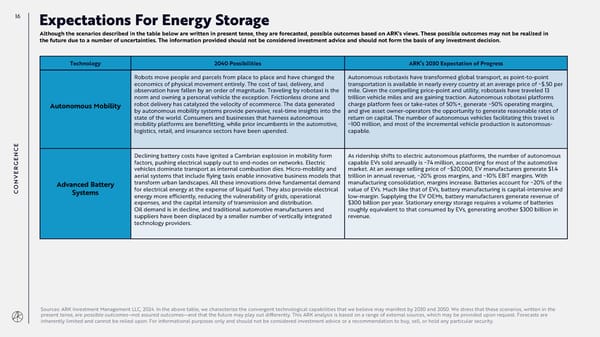
16 Expectations For Energy Storage Although the scenarios described in the table below are written in present tense, they are forecasted, possible outcomes based on ARK's views. These possible outcomes may not be realized in the future due to a number of uncertainties. The information provided should not be considered investment advice and should not form the basis of any investment decision. Technology 2040 Possibilities ARK’s 2030 Expectation of Progress Robots move people and parcels from place to place and have changed the Autonomous robotaxis have transformed global transport, as point-to-point economics of physical movement entirely. The cost of taxi, delivery, and transportation is available in nearly every country at an average price of ~$.50 per observation have fallen by an order of magnitude. Traveling by robotaxi is the mile. Given the compelling price-point and utility, robotaxis have traveled 13 norm and owning a personal vehicle the exception. Frictionless drone and trillion vehicle miles and are gaining traction. Autonomous robotaxi platforms Autonomous Mobility robot delivery has catalyzed the velocity of ecommerce. The data generated charge platform fees or take-rates of 50%+, generate ~50% operating margins, by autonomous mobility systems provide pervasive, real-time insights into the and give asset owner-operators the opportunity to generate reasonable rates of state of the world. Consumers and businesses that harness autonomous return on capital. The number of autonomous vehicles facilitating this travel is mobility platforms are benefitting, while prior incumbents in the automotive, ~100 million, and most of the incremental vehicle production is autonomous- logistics, retail, and insurance sectors have been upended. capable. CE N Declining battery costs have ignited a Cambrian explosion in mobility form As ridership shifts to electric autonomous platforms, the number of autonomous E factors, pushing electrical supply out to end-nodes on networks. Electric capable EVs sold annually is ~74 million, accounting for most of the automotive G R vehicles dominate transport as internal combustion dies. Micro-mobility and market. At an average selling price of ~$20,000, EV manufacturers generate $1.4 E aerial systems that include flying taxis enable innovative business models that trillion in annual revenue, ~20% gross margins, and ~10% EBIT margins. With V N Advanced Battery transform urban landscapes. All these innovations drive fundamental demand manufacturing consolidation, margins increase. Batteries account for ~20% of the CO Systems for electrical energy at the expense of liquid fuel. They also provide electrical value of EVs. Much like that of EVs, battery manufacturing is capital-intensive and energy more efficiently, reducing the vulnerability of grids, operational low-margin. Supplying the EV OEMs, battery manufacturers generate revenue of expenses, and the capital intensity of transmission and distribution. $300 billion per year. Stationary energy storage requires a volume of batteries Oil demand is in decline, and traditional automotive manufacturers and roughly equivalent to that consumed by EVs, generating another $300 billion in suppliers have been displaced by a smaller number of vertically integrated revenue. technology providers. Sources: ARK Investment Management LLC, 2024. In the above table, we characterize the convergent technological capabilities that we believe may manifest by 2030 and 2050. We stress that these scenarios, written in the present tense, are possible outcomes—not assured outcomes—and that the future may play out differently. This ARK analysis is based on a range of external sources, which may be provided upon request. Forecasts are inherently limited and cannot be relied upon. For informational purposes only and should not be considered investment advice or a recommendation to buy, sell, or hold any particular security.
 Annual Research Report | Big Ideas 2024 Page 15 Page 17