

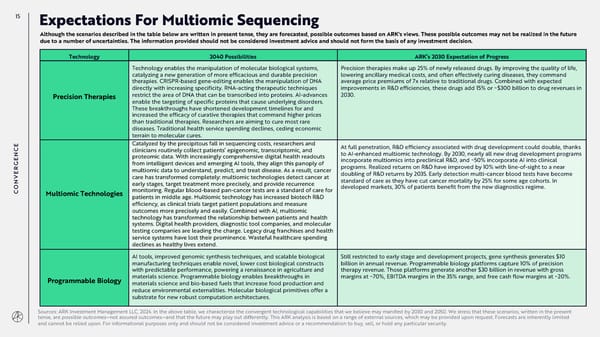
15 Expectations For Multiomic Sequencing Although the scenarios described in the table below are written in present tense, they are forecasted, possible outcomes based on ARK's views. These possible outcomes may not be realized in the future due to a number of uncertainties. The information provided should not be considered investment advice and should not form the basis of any investment decision. Technology 2040 Possibilities ARK’s 2030 Expectation of Progress Technology enables the manipulation of molecular biological systems, Precision therapies make up 25% of newly released drugs. By improving the quality of life, catalyzing a new generation of more efficacious and durable precision lowering ancillary medical costs, and often effectively curing diseases, they command therapies. CRISPR-based gene-editing enables the manipulation of DNA average price premiums of 7x relative to traditional drugs. Combined with expected directly with increasing specificity. RNA-acting therapeutic techniques improvements in R&D efficiencies, these drugs add 15% or ~$300 billion to drug revenues in Precision Therapies restrict the area of DNA that can be transcribed into proteins. AI-advances 2030. enable the targeting of specific proteins that cause underlying disorders. These breakthroughs have shortened development timelines for and increased the efficacy of curative therapies that command higher prices than traditional therapies. Researchers are aiming to cure most rare diseases. Traditional health service spending declines, ceding economic terrain to molecular cures. CE Catalyzed by the precipitous fall in sequencing costs, researchers and At full penetration, R&D efficiency associated with drug development could double, thanks N clinicians routinely collect patients’ epigenomic, transcriptomic, and to AI-enhanced multiomic technology. By 2030, nearly all new drug development programs E proteomic data. With increasingly comprehensive digital health readouts incorporate multiomics into preclinical R&D, and ~50% incorporate AI into clinical G from intelligent devices and emerging AI tools, they align this panoply of programs. Realized returns on R&D have improved by 10% with line-of-sight to a near R multiomic data to understand, predict, and treat disease. As a result, cancer E doubling of R&D returns by 2035. Early detection multi-cancer blood tests have become V care has transformed completely: multiomic technologies detect cancer at standard of care as they have cut cancer mortality by 25% for some age cohorts. In N early stages, target treatment more precisely, and provide recurrence CO Multiomic Technologies monitoring. Regular blood-based pan-cancer tests are a standard of care for developed markets, 30% of patients benefit from the new diagnostics regime. patients in middle age. Multiomic technology has increased biotech R&D efficiency, as clinical trials target patient populations and measure outcomes more precisely and easily. Combined with AI, multiomic technology has transformed the relationship between patients and health systems. Digital health providers, diagnostic tool companies, and molecular testing companies are leading the charge. Legacy drug franchises and health service systems have lost their prominence. Wasteful healthcare spending declines as healthy lives extend. AI tools, improved genomic synthesis techniques, and scalable biological Still restricted to early stage and development projects, gene synthesis generates $10 manufacturing techniques enable novel, lower cost biological constructs billion in annual revenue. Programmable biology platforms capture 10% of precision with predictable performance, powering a renaissance in agriculture and therapy revenue. Those platforms generate another $30 billion in revenue with gross Programmable Biology materials science. Programmable biology enables breakthroughs in margins at ~70%, EBITDA margins in the 35% range, and free cash flow margins at ~20%. materials science and bio-based fuels that increase food production and reduce environmental externalities. Molecular biological primitives offer a substrate for new robust computation architectures. Sources: ARK Investment Management LLC, 2024. In the above table, we characterize the convergent technological capabilities that we believe may manifest by 2030 and 2050. We stress that these scenarios, written in the present tense, are possible outcomes—not assured outcomes—and that the future may play out differently. This ARK analysis is based on a range of external sources, which may be provided upon request. Forecasts are inherently limited and cannot be relied upon. For informational purposes only and should not be considered investment advice or a recommendation to buy, sell, or hold any particular security.
 Annual Research Report | Big Ideas 2024 Page 14 Page 16