

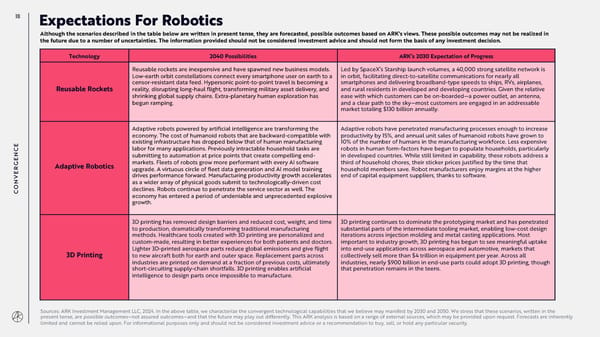
18 Expectations For Robotics Although the scenarios described in the table below are written in present tense, they are forecasted, possible outcomes based on ARK's views. These possible outcomes may not be realized in the future due to a number of uncertainties. The information provided should not be considered investment advice and should not form the basis of any investment decision. Technology 2040 Possibilities ARK’s 2030 Expectation of Progress Reusable rockets are inexpensive and have spawned new business models. Led by SpaceX’s Starship launch volumes, a 40,000 strong satellite network is Low-earth orbit constellations connect every smartphone user on earth to a in orbit, facilitating direct-to-satellite communications for nearly all censor-resistant data feed. Hypersonic point-to-point travel is becoming a smartphones and delivering broadband-type speeds to ships, RVs, airplanes, Reusable Rockets reality, disrupting long-haul flight, transforming military asset delivery, and and rural residents in developed and developing countries. Given the relative shrinking global supply chains. Extra-planetary human exploration has ease with which customers can be on-boarded—a power outlet, an antenna, begun ramping. and a clear path to the sky—most customers are engaged in an addressable market totaling $130 billion annually. Adaptive robots powered by artificial intelligence are transforming the Adaptive robots have penetrated manufacturing processes enough to increase economy. The cost of humanoid robots that are backward-compatible with productivity by 15%, and annual unit sales of humanoid robots have grown to existing infrastructure has dropped below that of human manufacturing 10% of the number of humans in the manufacturing workforce. Less expensive CE labor for many applications. Previously intractable household tasks are robots in human form-factors have begun to populate households, particularly N submitting to automation at price points that create compelling end- in developed countries. While still limited in capability, these robots address a E markets. Fleets of robots grow more performant with every AI software third of household chores, their sticker prices justified by the time that G Adaptive Robotics R upgrade. A virtuous circle of fleet data generation and AI model training household members save. Robot manufacturers enjoy margins at the higher E drives performance forward. Manufacturing productivity growth accelerates end of capital equipment suppliers, thanks to software. V N as a wider array of physical goods submit to technologically-driven cost CO declines. Robots continue to penetrate the service sector as well. The economy has entered a period of undeniable and unprecedented explosive growth. 3D printing has removed design barriers and reduced cost, weight, and time 3D printing continues to dominate the prototyping market and has penetrated to production, dramatically transforming traditional manufacturing substantial parts of the intermediate tooling market, enabling low-cost design methods.Healthcare tools created with 3D printing are personalized and iterations across injection molding and metal casting applications. Most custom-made, resulting in better experiences for both patients and doctors. important to industry growth, 3D printing has begun to see meaningful uptake 3D Printing Lighter 3D-printed aerospace parts reduce global emissions and give flight into end-use applications across aerospace and automotive, markets that to new aircraft both for earth and outer space. Replacement parts across collectively sell more than $4 trillion in equipment per year. Across all industries are printed on demand at a fraction of previous costs, ultimately industries, nearly $900 billion in end-use parts could adopt 3D printing, though short-circuiting supply-chain shortfalls. 3D printing enables artificial that penetration remains in the teens. intelligence to design parts once impossible to manufacture. Sources: ARK Investment Management LLC, 2024. In the above table, we characterize the convergent technological capabilities that we believe may manifest by 2030 and 2050. We stress that these scenarios, written in the present tense, are possible outcomes—not assured outcomes—and that the future may play out differently. This ARK analysis is based on a range of external sources, which may be provided upon request. Forecasts are inherently limited and cannot be relied upon. For informational purposes only and should not be considered investment advice or a recommendation to buy, sell, or hold any particular security.
 Annual Research Report | Big Ideas 2024 Page 17 Page 19