

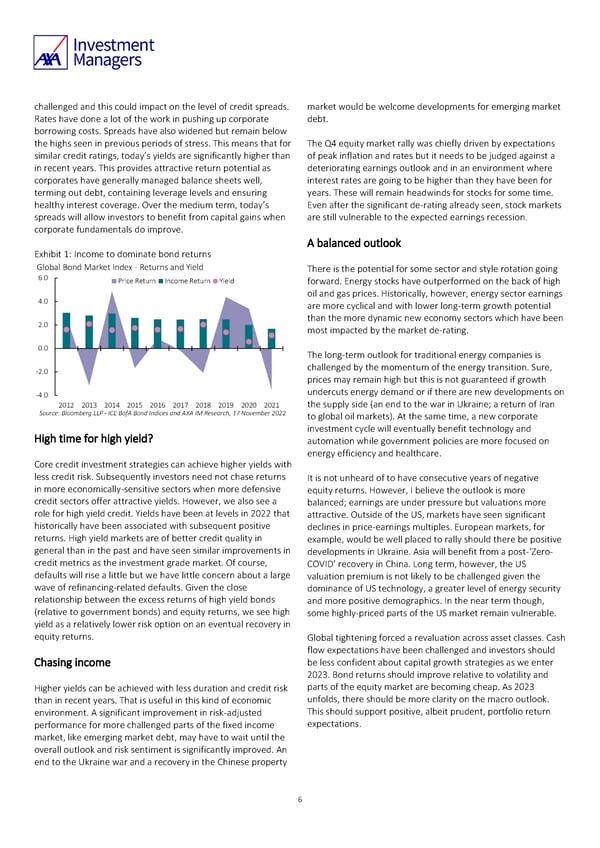
challenged and this could impact on the level of credit spreads. market would be welcome developments for emerging market Rates have done a lot of the work in pushing up corporate debt. borrowing costs. Spreads have also widened but remain below the highs seen in previous periods of stress. This means that for The Q4 equity market rally was chiefly driven by expectations similar credit ratings, today’s yields are significantly higher than of peak inflation and rates but it needs to be judged against a in recent years. This provides attractive return potential as deteriorating earnings outlook and in an environment where corporates have generally managed balance sheets well, interest rates are going to be higher than they have been for terming out debt, containing leverage levels and ensuring years. These will remain headwinds for stocks for some time. healthy interest coverage. Over the medium term, today’s Even after the significant de-rating already seen, stock markets spreads will allow investors to benefit from capital gains when are still vulnerable to the expected earnings recession. corporate fundamentals do improve. A balanced outlook Exhibit 1: Income to dominate bond returns Global Bond Market Index - Returns and Yield There is the potential for some sector and style rotation going 6.0 Price Return Income Return Yield forward. Energy stocks have outperformed on the back of high oil and gas prices. Historically, however, energy sector earnings 4.0 are more cyclical and with lower long-term growth potential 2.0 than the more dynamic new economy sectors which have been most impacted by the market de-rating. 0.0 The long-term outlook for traditional energy companies is -2.0 challenged by the momentum of the energy transition. Sure, prices may remain high but this is not guaranteed if growth -4.0 undercuts energy demand or if there are new developments on 2012 2013 2014 2015 2016 2017 2018 2019 2020 2021 the supply side (an end to the war in Ukraine; a return of Iran Source: Bloomberg LLP - ICE BofA Bond Indices and AXA IM Research, 17 November 2022 to global oil markets). At the same time, a new corporate investment cycle will eventually benefit technology and High time for high yield? automation while government policies are more focused on energy efficiency and healthcare. Core credit investment strategies can achieve higher yields with less credit risk. Subsequently investors need not chase returns It is not unheard of to have consecutive years of negative in more economically-sensitive sectors when more defensive equity returns. However, I believe the outlook is more credit sectors offer attractive yields. However, we also see a balanced; earnings are under pressure but valuations more role for high yield credit. Yields have been at levels in 2022 that attractive. Outside of the US, markets have seen significant historically have been associated with subsequent positive declines in price-earnings multiples. European markets, for returns. High yield markets are of better credit quality in example, would be well placed to rally should there be positive general than in the past and have seen similar improvements in developments in Ukraine. Asia will benefit from a post-‘Zero- credit metrics as the investment grade market. Of course, COVID’ recovery in China. Long term, however, the US defaults will rise a little but we have little concern about a large valuation premium is not likely to be challenged given the wave of refinancing-related defaults. Given the close dominance of US technology, a greater level of energy security relationship between the excess returns of high yield bonds and more positive demographics. In the near term though, (relative to government bonds) and equity returns, we see high some highly-priced parts of the US market remain vulnerable. yield as a relatively lower risk option on an eventual recovery in equity returns. Global tightening forced a revaluation across asset classes. Cash flow expectations have been challenged and investors should Chasing income be less confident about capital growth strategies as we enter 2023. Bond returns should improve relative to volatility and Higher yields can be achieved with less duration and credit risk parts of the equity market are becoming cheap. As 2023 than in recent years. That is useful in this kind of economic unfolds, there should be more clarity on the macro outlook. environment. A significant improvement in risk-adjusted This should support positive, albeit prudent, portfolio return performance for more challenged parts of the fixed income expectations. market, like emerging market debt, may have to wait until the overall outlook and risk sentiment is significantly improved. An end to the Ukraine war and a recovery in the Chinese property 6
 AXA IM Outlook 2023 full report Page 5 Page 7