

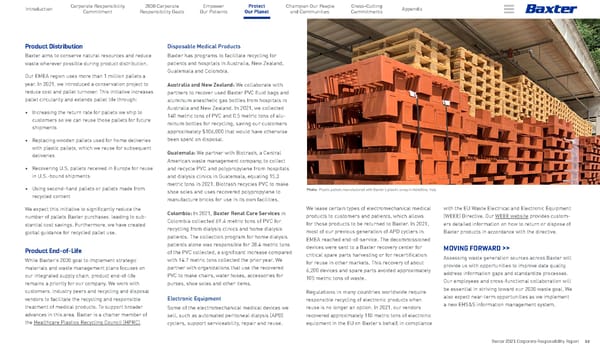
Baxter 2021 Corporate Responsibility Report 32 Protect Our Planet Corporate Responsibility Commitment Introduction 2030 Corporate Responsibility Goals Empower Our Patients Appendix Champion Our People and Communities Cross-Cutting Commitments Product Distribution Baxter aims to conserve natural resources and reduce waste wherever possible during product distribution. Our EMEA region uses more than 1 million pallets a year. In 2021, we introduced a conservation project to reduce cost and pallet turnover. This initiative increases pallet circularity and extends pallet life through: • Increasing the return rate for pallets we ship to customers so we can reuse those pallets for future shipments • Replacing wooden pallets used for home deliveries with plastic pallets, which we reuse for subsequent deliveries • Recovering U.S. pallets received in Europe for reuse in U.S.-bound shipments • Using second-hand pallets or pallets made from recycled content We expect this initiative to significantly reduce the number of pallets Baxter purchases, leading to sub- stantial cost savings. Furthermore, we have created global guidance for recycled pallet use. Product End-of-Life While Baxter’s 2030 goal to implement strategic materials and waste management plans focuses on our integrated supply chain, product end-of-life remains a priority for our company. We work with customers, industry peers and recycling and disposal vendors to facilitate the recycling and responsible treatment of medical products. To support broader advances in this area, Baxter is a charter member of the Healthcare Plastics Recycling Council (HPRC). Disposable Medical Products Baxter has programs to facilitate recycling for patients and hospitals in Australia, New Zealand, Guatemala and Colombia. Australia and New Zealand: We collaborate with partners to recover used Baxter PVC fluid bags and aluminum anesthetic gas bottles from hospitals in Australia and New Zealand. In 2021, we collected 140 metric tons of PVC and 0.5 metric tons of alu - minum bottles for recycling, saving our customers approximately $106,000 that would have otherwise been spent on disposal. Guatemala: We partner with Biotrash, a Central American waste management company, to collect and recycle PVC and polypropylene from hospitals and dialysis clinics in Guatemala, equaling 15.3 metric tons in 2021. Biotrash recycles PVC to make shoe soles and uses recovered polypropylene to manufacture bricks for use in its own facilities. Colombia: In 2021, Baxter Renal Care Services in Colombia collected 69.4 metric tons of PVC for recy cling from dialysis clinics and home dialysis patients. The collection program for home dialysis patients alone was responsible for 38.4 metric tons of the PVC collected, a significant increase compared with 14.7 metric tons collected the prior year. We partner with organizations that use the recovered PVC to make chairs, water hoses, accessories for purses, shoe soles and other items. Electronic Equipment Some of the electromechanical medical devices we sell, such as automated peritoneal dialysis (APD) cyclers, support serviceability, repair and reuse. We lease certain types of electromechanical medical products to customers and patients, which allows for those products to be returned to Baxter. In 2021, most of our previous generation of APD cyclers in EMEA reached end-of-service. The decommissioned devices were sent to a Baxter recovery center for critical spare parts harvesting or for recertification for reuse in other markets. This recovery of about 6,200 devices and spare parts avoided approximately 105 metric tons of waste. Regulations in many countries worldwide require responsible recycling of electronic products when reuse is no longer an option. In 2021, our vendors recovered approximately 110 metric tons of electronic equipment in the EU on Baxter’s behalf, in compliance with the EU Waste Electrical and Electronic Equipment (WEEE) Directive. Our WEEE website provides custom- ers detailed information on how to return or dispose of Baxter products in accordance with the directive. MOVING FORWARD >> Assessing waste generation sources across Baxter will provide us with opportunities to improve data quality, address information gaps and standardize processes. Our employees and cross-functional collaboration will be essential in striving toward our 2030 waste goal. We also expect near-term opportunities as we implement a new EHS&S information management system. Photo: Plastic pallets manufactured with Baxter’s plastic scrap in Valtellina, Italy.
 Baxter Corporate Responsibility Report Page 31 Page 33