

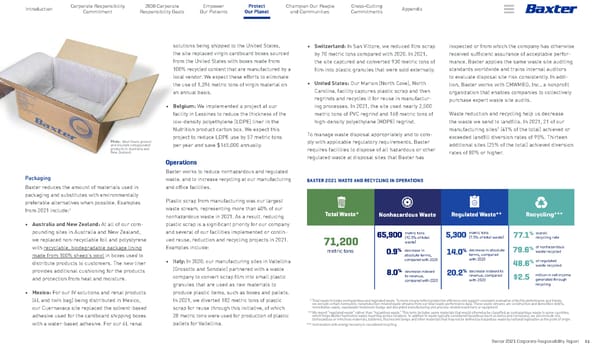
Baxter 2021 Corporate Responsibility Report 31 Protect Our Planet Corporate Responsibility Commitment Introduction 2030 Corporate Responsibility Goals Empower Our Patients Appendix Champion Our People and Communities Cross-Cutting Commitments Packaging Baxter reduces the amount of materials used in packaging and substitutes with environmentally preferable alternatives when possible. Examples from 2021 include: 1 • Australia and New Zealand: At all of our com - pounding sites in Australia and New Zealand, we replaced non-recyclable foil and polystyrene with recyclable, biodegradable package lining made from 100% sheep’s wool in boxes used to distribute products to customers. The new liner provides additional cushioning for the products and protection from heat and moisture. • Mexico: For our IV solutions and renal products (6L and twin bag) being distributed in Mexico, our Cuernavaca site replaced the solvent-based adhesive used for the cardboard shipping boxes with a water-based adhesive. For our 6L renal solutions being shipped to the United States, the site replaced virgin cardboard boxes sourced from the United States with boxes made from 100% recycled content that are manufactured by a local vendor. We expect these efforts to eliminate the use of 1,396 metric tons of virgin material on an annual basis. • Belgium: We implemented a project at our facility in Lessines to reduce the thickness of the low-density polyethylene (LDPE) liner in the Nutrition product carton box. We expect this project to reduce LDPE use by 57 metric tons per year and save $165,000 annually. Operations Baxter works to reduce nonhazardous and regulated waste, and to increase recycling at our manufacturing and office facilities. Plastic scrap from manufacturing was our largest waste stream, representing more than 40% of our nonhazardous waste in 2021. As a result, reducing plastic scrap is a significant priority for our company and several of our facilities implemented or contin - ued reuse, reduction and recycling projects in 2021. Examples include: • Italy: In 2020, our manufacturing sites in Valtellina (Grosotto and Sondalo) partnered with a waste company to convert scrap film into small plastic granules that are used as raw materials to produce plastic items, such as boxes and pallets. In 2021, we diverted 182 metric tons of plastic scrap for reuse through this initiative, of which 28 metric tons were used for production of plastic pallets for Valtellina. • Switzerland: In San Vittore, we reduced film scrap by 70 metric tons compared with 2020. In 2021, the site captured and converted 930 metric tons of film into plastic granules that were sold externally. • United States: Our Marion (North Cove), North Carolina, facility captures plastic scrap and then regrinds and recycles it for reuse in manufactur - ing processes. In 2021, the site used nearly 2,500 metric tons of PVC regrind and 168 metric tons of high-density polyethylene (HDPE) regrind. To manage waste disposal appropriately and to com - ply with applicable regulatory requirements, Baxter requires facilities to dispose of all hazardous or other regulated waste at disposal sites that Baxter has inspected or from which the company has otherwise received sufficient assurance of acceptable perfor - mance. Baxter applies the same waste site auditing standards worldwide and trains internal auditors to evaluate disposal site risk consistently. In addi - tion, Baxter works with CHWMEG, Inc., a nonprofit organization that enables companies to collectively purchase expert waste site audits. Waste reduction and recycling help us decrease the waste we send to landfills. In 2021, 21 of our manufacturing sites 2 (41% of the total) achieved or exceeded landfill diversion rates of 95%. Thirteen additional sites (25% of the total) achieved diversion rates of 80% or higher. BAXTER 2021 WASTE AND RECYCLING IN OPERATIONS * Total waste includes nonhazardous and regulated waste. To more closely reflect production efficiency and support consistent evaluation of facility performance and trends, we exclude certain nonroutine, nonproduction-related waste streams from our total waste performance data. These waste streams are construction and demolition debris, remediation waste, wastewater treatment sludge and discarded manufacturing and process-related machinery or equipment. ** We report “regulated waste” rather than “hazardous waste.” This term includes some materials that would otherwise be classified as nonhazardous waste in some countries, which helps Baxter harmonize waste reporting across locations. In addition to waste typically considered hazardous (such as toxics and corrosives), we also include oils, biohazardous or infectious materials, batteries, fluorescent lamps and other materials that may not be defined as hazardous waste by national legislation at the point of origin. *** Incineration with energy recovery is considered recycling. 71,200 metric tons Total Waste * Nonhazardous Waste Regulated Waste ** 5,300 metric tons (7.5% of total waste) 14.0 % decrease in absolute terms, compared with 2020 20.2 % decrease indexed to revenue, compared with 2020 65,900 metric tons (92.5% of total waste) 0.9 % decrease in absolute terms, compared with 2020 8.0 % decrease indexed to revenue, compared with 2020 Recycling *** 79.6 % of nonhazardous waste recycled 77.1 % overall recycling rate 48.6 % of regulated waste recycled $2.5 million in net income generated through recycling Photo: Wool liners protect and insulate compounded products in Australia and New Zealand.
 Baxter Corporate Responsibility Report Page 30 Page 32