

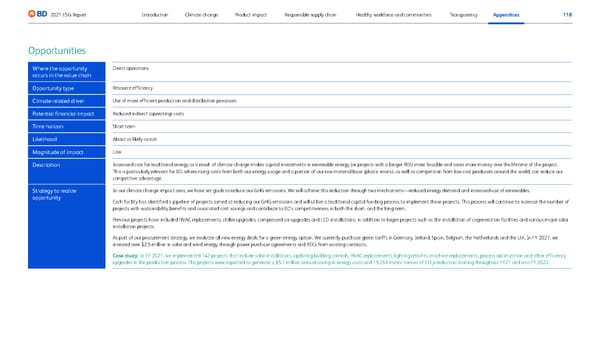
118 2021 ESG Report Transparency Appendices Responsible supply chain Product impact Climate change Introduction Healthy workforce and communities Opportunities Where the opportunity occurs in the value chain Direct operations Opportunity type Resource efficiency Climate-related driver Use of more efficient production and distribution processes Potential financial impact Reduced indirect (operating) costs Time horizon Short-term Likelihood About as likely as not Magnitude of impact Low Description Increased cost for traditional energy as a result of climate change makes capital investments in renewable energy (or projects with a longer ROI) more feasible and saves more money over the lifetime of the project. This is particularly relevant for BD, where rising costs from both our energy usage and a portion of our raw-material base (plastic resins), as well as competition from low-cost producers around the world, can reduce our competitive advantage. Strategy to realize opportunity In our climate change impact area, we have set goals to reduce our GHG emissions. We will achieve this reduction through two mechanisms—reduced energy demand and increased use of renewables. Each facility has identified a pipeline of projects aimed at reducing our GHG emissions and will utilize a traditional capital funding process to implement these projects. This process will continue to increase the number of projects with sustainability benefits and associated cost savings and contribute to BD’s competitiveness in both the short- and the long-term. Previous projects have included HVAC replacements, chiller upgrades, compressed-air upgrades and LED installations, in addition to larger projects such as the installation of cogeneration facilities and various major solar installation projects. As part of our procurement strategy, we evaluate all new energy deals for a green-energy option. We currently purchase green tariffs in Germany, Ireland, Spain, Belgium, the Netherlands and the U.K. In FY 2021, we invested over $2.5 million in solar and wind energy through power purchase agreements and RECs from existing contracts. Case study: In FY 2021, we implemented 142 projects that include solar installations, updating building controls, HVAC replacements, lighting retrofits, machine replacements, process optimization and other efficiency upgrades in the production process. The projects were expected to generate a $5.1 million annual saving in energy costs and 19,266 metric tonnes of CO 2 e reduction starting throughout FY21 and into FY 2022.
 BD ESG Report Page 117 Page 119