

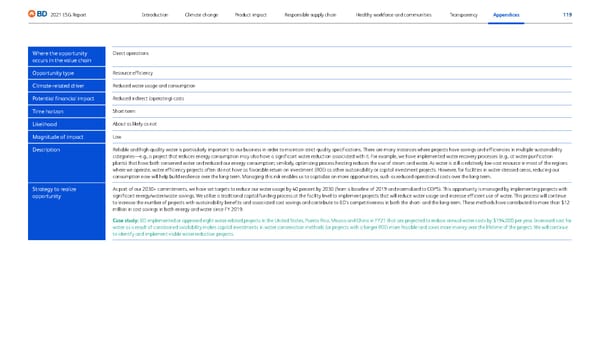
119 2021 ESG Report Transparency Appendices Responsible supply chain Product impact Climate change Introduction Healthy workforce and communities Where the opportunity occurs in the value chain Direct operations Opportunity type Resource efficiency Climate-related driver Reduced water usage and consumption Potential financial impact Reduced indirect (operating) costs Time horizon Short-term Likelihood About as likely as not Magnitude of impact Low Description Reliable and high-quality water is particularly important to our business in order to maintain strict quality specifications. There are many instances where projects have savings and efficiencies in multiple sustainability categories—e.g., a project that reduces energy consumption may also have a significant water reduction associated with it. For example, we have implemented water recovery processes (e.g., at water purification plants) that have both conserved water and reduced our energy consumption; similarly, optimizing process heating reduces the use of steam and water. As water is still a relatively low-cost resource in most of the regions where we operate, water efficiency projects often do not have as favorable return on investment (ROI) as other sustainability or capital investment projects. However, for facilities in water-stressed areas, reducing our consumption now will help build resilience over the long-term. Managing this risk enables us to capitalize on more opportunities, such as reduced operational costs over the long-term. Strategy to realize opportunity As part of our 2030+ commitments, we have set targets to reduce our water usage by 40 percent by 2030 (from a baseline of 2019 and normalized to COPS). This opportunity is managed by implementing projects with significant energy/water/waste savings. We utilize a traditional capital funding process at the facility level to implement projects that will reduce water usage and increase efficient use of water. This process will continue to increase the number of projects with sustainability benefits and associated cost savings and contribute to BD’s competitiveness in both the short- and the long-term. These methods have contributed to more than $12 million in cost savings in both energy and water since FY 2019. Case study: BD implemented or approved eight water-related projects in the United States, Puerto Rico, Mexico and China in FY21 that are projected to reduce annual water costs by $194,000 per year. Increased cost for water as a result of constrained availability makes capital investments in water conservation methods (or projects with a longer ROI) more feasible and saves more money over the lifetime of the project. We will continue to identify and implement viable water reduction projects.
 BD ESG Report Page 118 Page 120