

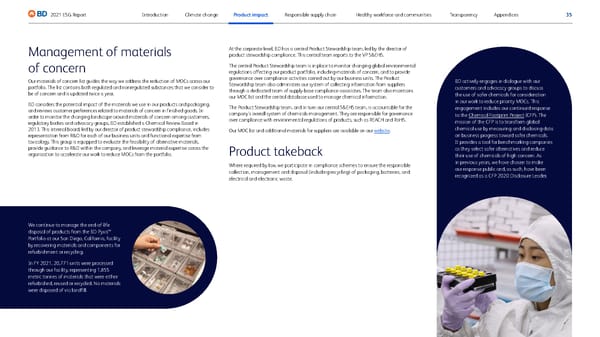
35 2021 ESG Report Appendices Transparency Healthy workforce and communities Responsible supply chain Climate change Introduction Product impact Management of materials of concern Our materials of concern list guides the way we address the reduction of MOCs across our portfolio. The list contains both regulated and nonregulated substances that we consider to be of concern and is updated twice a year. BD considers the potential impact of the materials we use in our products and packaging, and reviews customer preferences related to materials of concern in finished goods. In order to monitor the changing landscape around materials of concern among customers, regulatory bodies and advocacy groups, BD established a Chemical Review Board in 2013. This internal board, led by our director of product stewardship compliance, includes representation from R&D for each of our business units and functional expertise from toxicology. This group is equipped to evaluate the feasibility of alternative materials, provide guidance to R&D within the company, and leverage material expertise across the organization to accelerate our work to reduce MOCs from the portfolio. At the corporate level, BD has a central Product Stewardship team, led by the director of product stewardship compliance. This central team reports to the VP S&EHS. The central Product Stewardship team is in place to monitor changing global environmental regulations affecting our product portfolio, including materials of concern, and to provide governance over compliance activities carried out by our business units. The Product Stewardship team also administers our system of collecting information from suppliers through a dedicated team of supply-base compliance associates. The team also maintains our MOC list and the central database used to manage chemical information. The Product Stewardship team, and in turn our central S&EHS team, is accountable for the company’s overall system of chemicals management. They are responsible for governance over compliance with environmental regulations of products, such as REACH and RoHS. Our MOC list and additional materials for suppliers are available on our website . Product takeback Where required by law, we participate in compliance schemes to ensure the responsible collection, management and disposal (including recycling) of packaging, batteries, and electrical and electronic waste. BD actively engages in dialogue with our customers and advocacy groups to discuss the use of safer chemicals for consideration in our work to reduce priority MOCs. This engagement includes our continued response to the Chemical Footprint Project (CFP). The mission of the CFP is to transform global chemical use by measuring and disclosing data on business progress toward safer chemicals. It provides a tool for benchmarking companies as they select safer alternatives and reduce their use of chemicals of high concern. As in previous years, we have chosen to make our response public and, as such, have been recognized as a CFP 2020 Disclosure Leader. We continue to manage the end-of-life disposal of products from the BD Pyxis™ Portfolio at our San Diego, California, facility by recovering materials and components for refurbishment or recycling. In FY 2021, 20,771 units were processed through our facility, representing 1,855 metric tonnes of materials that were either refurbished, reused or recycled. No materials were disposed of via landfill.
 BD ESG Report Page 34 Page 36