

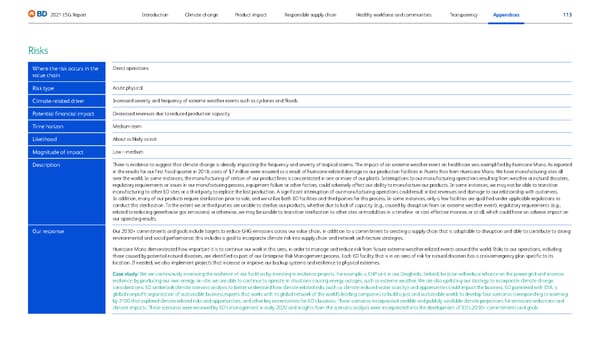
113 2021 ESG Report Transparency Appendices Responsible supply chain Product impact Climate change Introduction Healthy workforce and communities Risks Where the risk occurs in the value chain Direct operations Risk type Acute physical Climate-related driver Increased severity and frequency of extreme weather events such as cyclones and floods Potential financial impact Decreased revenues due to reduced production capacity Time horizon Medium-term Likelihood About as likely as not Magnitude of impact Low – medium Description There is evidence to suggest that climate change is already impacting the frequency and severity of tropical storms. The impact of an extreme weather event on healthcare was exemplified by hurricane Maria. As reported in the results for our first fiscal quarter in 2018, costs of $7 million were incurred as a result of hurricane-related damage to our production facilities in Puerto Rico from Hurricane Maria. We have manufacturing sites all over the world. In some instances, the manufacturing of certain of our product lines is concentrated in one or more of our plants. Interruptions to our manufacturing operations resulting from weather or natural disasters, regulatory requirements or issues in our manufacturing process, equipment failure or other factors, could adversely affect our ability to manufacture our products. In some instances, we may not be able to transition manufacturing to other BD sites or a third party to replace the lost production. A significant interruption of our manufacturing operations could result in lost revenues and damage to our relationship with customers. In addition, many of our products require sterilization prior to sale, and we utilize both BD facilities and third parties for this process. In some instances, only a few facilities are qualified under applicable regulations to conduct this sterilization. To the extent we or third parties are unable to sterilize our products, whether due to lack of capacity (e.g., caused by disruption from an extreme weather event), regulatory requirements (e.g., related to reducing greenhouse gas emissions) or otherwise, we may be unable to transition sterilization to other sites or modalities in a timeline- or cost-effective manner, or at all, which could have an adverse impact on our operating results. Our response Our 2030+ commitments and goals include targets to reduce GHG emissions across our value chain, in addition to a commitment to creating a supply chain that is adaptable to disruption and able to contribute to strong environmental and social performance; this includes a goal to incorporate climate risk into supply chain and network architecture strategies. Hurricane Maria demonstrated how important it is to continue our work in this area, in order to manage and reduce risk from future extreme-weather-related events around the world. Risks to our operations, including those caused by potential natural disasters, are identified as part of our Enterprise Risk Management process. Each BD facility that is in an area of risk for natural disasters has a crisis/emergency plan specific to its location. If needed, we also implement projects that increase or improve our backup systems and resilience to physical extremes. Case study: We are continuously increasing the resilience of our facilities by investing in resilience projects. For example, a CHP unit in our Drogheda, Ireland, location will reduce reliance on the power grid and increase resilience; by producing our own energy on-site, we are able to continue to operate in situations causing energy outages, such as extreme weather. We are also updating our strategy to incorporate climate-change considerations. BD undertook climate scenario analysis to better understand how climate-related risks (such as climate-induced water scarcity) and opportunities could impact the business. BD partnered with BSR, a global nonprofit organization of sustainable business experts that works with its global network of the world’s leading companies to build a just and sustainable world, to develop four scenarios corresponding to warming by 2100 that explored climate-related risks and opportunities, and other key uncertainties for BD’s business. These scenarios incorporated credible and publicly available climate projections for emissions reductions and climate impacts. These scenarios were reviewed by BD’s management in early 2020 and insights from the scenario analysis were incorporated into the development of BD’s 2030+ commitments and goals.
 BD ESG Report Page 112 Page 114