

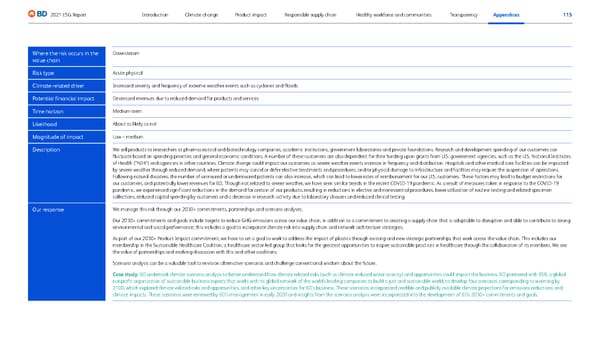
115 2021 ESG Report Transparency Appendices Responsible supply chain Product impact Climate change Introduction Healthy workforce and communities Where the risk occurs in the value chain Downstream Risk type Acute physical Climate-related driver Increased severity and frequency of extreme weather events such as cyclones and floods Potential financial impact Decreased revenues due to reduced demand for products and services Time horizon Medium-term Likelihood About as likely as not Magnitude of impact Low – medium Description We sell products to researchers at pharmaceutical and biotechnology companies, academic institutions, government laboratories and private foundations. Research and development spending of our customers can fluctuate based on spending priorities and general economic conditions. A number of these customers are also dependent for their funding upon grants from U.S. government agencies, such as the U.S. National Institutes of Health (“NIH”) and agencies in other countries. Climate change could impact our customers as severe weather events increase in frequency and distribution. Hospitals and other medical care facilities can be impacted by severe weather through reduced demand, where patients may cancel or defer elective treatments and procedures, and/or physical damage to infrastructure and facilities may require the suspension of operations. Following natural disasters, the number of uninsured or underinsured patients can also increase, which can lead to lower rates of reimbursement for our U.S. customers. These factors may lead to budget restrictions for our customers, and potentially lower revenues for BD. Though not related to severe weather, we have seen similar trends in the recent COVID-19 pandemic. As a result of measures taken in response to the COVID-19 pandemic, we experienced significant reductions in the demand for certain of our products, resulting in reductions in elective and nonessential procedures, lower utilization of routine testing and related specimen collections, reduced capital spending by customers and a decrease in research activity due to laboratory closures and reduced clinical testing. Our response We manage this risk through our 2030+ commitments, partnerships and scenario analyses. Our 2030+ commitments and goals include targets to reduce GHG emissions across our value chain, in addition to a commitment to creating a supply chain that is adaptable to disruption and able to contribute to strong environmental and social performance; this includes a goal to incorporate climate risk into supply chain and network architecture strategies . As part of our 2030+ Pr oduct Impact commitment, we have to set a goal to work to address the impact of plastics through existing and new strategic partnerships that work across the value chain . T his includes our membership in the Sustainable Healthcare Coalition, a healthcare sector-led group that looks for the greatest opportunities to inspire sustainable practices in healthcare through the collaboration of its members. We see the value of partnerships and evolving discussion with this and other coalitions. Scenario analysis can be a valuable tool to envision alternative scenarios and challenge conventional wisdom about the future. Case study: BD undertook climate scenario analysis to better understand how climate-related risks (such as climate-induced water scarcity) and opportunities could impact the business. BD partnered with BSR, a global nonprofit organization of sustainable business experts that works with its global network of the world’s leading companies to build a just and sustainable world, to develop four scenarios corresponding to warming by 2100, which explored climate-related risks and opportunities, and other key uncertainties for BD’s business. These scenarios incorporated credible and publicly available climate projections for emissions reductions and climate impacts. These scenarios were reviewed by BD’s management in early 2020 and insights from the scenario analysis were incorporated into the development of BDs 2030+ commitments and goals.
 BD ESG Report Page 114 Page 116