

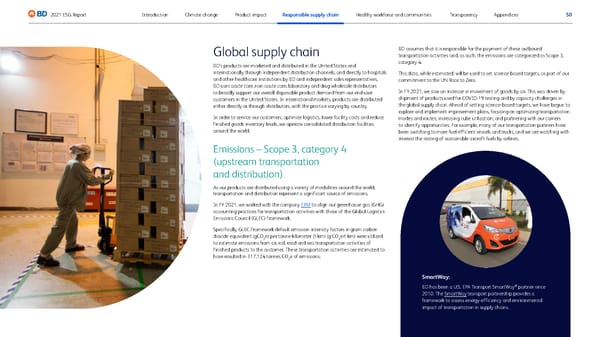
50 2021 ESG Report Appendices Transparency Healthy workforce and communities Product impact Climate change Introduction Responsible supply chain Global supply chain BD’s products are marketed and distributed in the United States and internationally through independent distribution channels, and directly to hospitals and other healthcare institutions by BD and independent sales representatives. BD uses acute care, non-acute care, laboratory and drug wholesale distributors to broadly support our overall disposable product demand from our end-user customers in the United States. In international markets, products are distributed either directly or through distributors, with the practice varying by country. In order to service our customers, optimize logistics, lower facility costs and reduce finished goods inventory levels, we operate consolidated distribution facilities around the world. Emissions – Scope 3, category 4 (upstream transportation and distribution) As our products are distributed using a variety of modalities around the world, transportation and distribution represent a significant source of emissions. In FY 2021, we worked with the company ERM to align our greenhouse gas (GHG) accounting practices for transportation activities with those of the Global Logistics Emissions Council (GLEC) Framework. Specifically, GLEC Framework default emission-intensity factors in gram carbon dioxide equivalent (gCO 2 e) per tonne-kilometer (t-km) (g CO 2 e/t-km) were utilized to estimate emissions from air, rail, road and sea transportation activities of finished products to the customer. These transportation activities are estimated to have resulted in 317,124 tonnes CO 2 e of emissions. BD assumes that it is responsible for the payment of these outbound transportation activities and, as such, the emissions are categorized as Scope 3, category 4. This data, while estimated, will be used to set science-based targets, as part of our commitment to the UN Race to Zero. In FY 2021, we saw an increase in movement of goods by air. This was driven by shipment of products used for COVID-19 testing and by capacity challenges in the global supply chain. Ahead of setting science-based targets, we have begun to explore and implement improvement plans, focusing on optimizing transportation modes and routes; increasing cube utilization; and partnering with our carriers to identify opportunities. For example, many of our transportation partners have been switching to more fuel-efficient vessels and trucks, and we are watching with interest the testing of sustainable aircraft fuels by airlines. SmartWay: BD has been a U.S. EPA Transport SmartWay ® partner since 2010. The SmartWay transport partnership provides a framework to assess energy-efficiency and environmental impact of transportation in supply chains.
 BD ESG Report Page 49 Page 51