

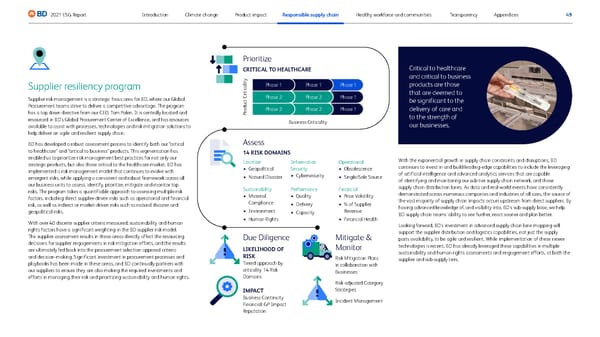
49 2021 ESG Report Appendices Transparency Healthy workforce and communities Product impact Climate change Introduction Responsible supply chain Supplier resiliency program Supplier risk management is a strategic focus area for BD, where our Global Procurement teams strive to deliver a competitive advantage. The program has a top down directive from our CEO, Tom Polen. It is centrally located and resourced in BD’s Global Procurement Center of Excellence, and has resources available to assist with processes, technologies and risk mitigation solutions to help deliver an agile and resilient supply chain. BD has developed a robust assessment process to identify both our “critical to healthcare” and “critical to business” products. This segmentation has enabled us to prioritize risk management best practices for not only our strategic products, but also those critical to the healthcare market. BD has implemented a risk management model that continues to evolve with emergent risks, while applying a consistent and robust framework across all our business units to assess, identify, prioritize, mitigate and monitor top risks. The program takes a quantifiable approach to assessing multiple risk factors, including direct supplier-driven risks such as operational and financial risk, as well as indirect or market-driven risks such as natural disaster and geopolitical risks. With over 40 discrete supplier criteria measured, sustainability and human rights factors have a significant weighting in the BD supplier risk model. The supplier assessment results in these areas directly affect the resourcing decisions for supplier engagements in risk mitigation efforts, and the results are ultimately fed back into the procurement selection approval criteria and decision-making. Significant investment in procurement processes and playbooks has been made in these areas, and BD continually partners with our suppliers to ensure they are also making the required investments and efforts in managing their risk and prioritizing sustainability and human rights. Prioritize Assess Due Diligence Mitigate & Monitor LIKELIHOOD OF RISK Tiered approach by criticality 14 Risk Domains IMPACT Business Continuity Financial: GP Impact Reputation 14 RISK DOMAINS CRITICAL TO HEALTHCARE Location • Geopolitic al • Natur al Disaster Performance • Quality • Deliv ery • C apacity Financial • Pric e Volatility • % of Supplier R evenue • F inancial Health Information Security • C ybersecurity Sustainability • Mat erial Compliance • En vironment • Human Rights Oper ational • Obsolesc ence • Single/Sole Sour ce Risk Mitigation Plans in collaboration with Businesses Risk-adjusted Category Strategies Incident Management Product Criticality Business Criticality Phase 1 Phase 2 Phase 2 Phase 1 Phase 2 Phase 2 Phase 1 Phase 1 Phase 1 Critical to healthcare and critical to business products are those that are deemed to be significant to the delivery of care and to the strength of our businesses. With the exponential growth in supply chain constraints and disruptions, BD continues to invest in and build leading-edge capabilities to include the leveraging of artificial intelligence and advanced analytics services that are capable of identifying and monitoring our sub-tier supply chain network, and those supply chain distribution lanes. As data and real-world events have consistently demonstrated across numerous companies and industries of all sizes, the source of the vast majority of supply chain impacts occurs upstream from direct suppliers. By having advanced knowledge of, and visibility into, BD’s sub-supply base, we help BD supply chain teams’ ability to see further, react sooner and plan better. Looking forward, BD’s investment in advanced supply chain lane mapping will support the supplier distribution and logistics capabilities, not just the supply parts availability, to be agile and resilient. While implementation of these newer technologies is recent, BD has already leveraged these capabilities in multiple sustainability and human rights assessments and engagement efforts, at both the supplier and sub-supply tiers.
 BD ESG Report Page 48 Page 50