

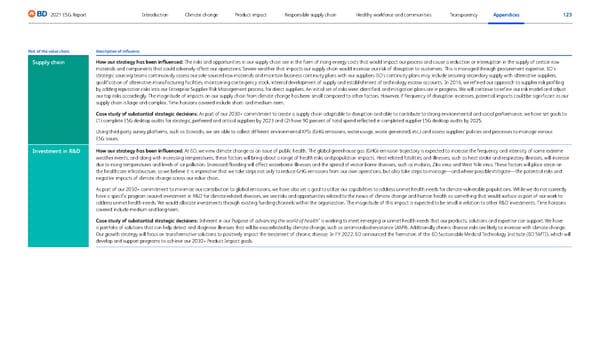
123 2021 ESG Report Transparency Appendices Responsible supply chain Product impact Climate change Introduction Healthy workforce and communities Part of the value chain Description of influence Supply chain How our strategy has been influenced: The risks and opportunities in our supply chain are in the form of rising energy costs that would impact our process and cause a reduction or interruption in the supply of certain raw materials and components that could adversely affect our operations. Severe weather that impacts our supply chain would increase our risk of disruption to customers. This is managed through procurement expertise. BD’s strategic sourcing teams continuously assess our sole-sourced raw materials and maintain business continuity plans with our suppliers. BD’s continuity plans may include securing secondary supply with alternative suppliers, qualification of alternative manufacturing facilities, maintaining contingency stock, internal development of supply and establishment of technology escrow accounts. In 2016, we refined our approach to supplier risk profiling by adding reputation risks into our Enterprise Supplier Risk Management process, for direct suppliers. An initial set of risks were identified, and mitigation plans are in progress. We will continue to refine our risk model and adjust our top risks accordingly. The magnitude of impacts on our supply chain from climate change has been small compared to other factors. However, if frequency of disruption increases, potential impacts could be significant as our supply chain is large and complex. Time horizons covered include short- and medium-term. Case study of substantial strategic decisions: As part of our 2030+ commitment to create a supply chain adaptable to disruption and able to contribute to strong environmental and social performance, we have set goals to (1) complete ESG desktop audits for strategic, preferred and critical suppliers by 2023 and (2) have 90 percent of total spend reflected in completed supplier ESG desktop audits by 2025. Using third-party survey platforms, such as Ecovadis, we are able to collect different environmental KPIs (GHG emissions, water usage, waste generated, etc.) and assess suppliers’ policies and processes to manage various ESG issues. Investment in R&D How our strategy has been influenced: At BD, we view climate change as an issue of public health. The global greenhouse gas (GHG) emission trajectory is expected to increase the frequency and intensity of some extreme weather events, and along with increasing temperatures, these factors will bring about a range of health risks and population impacts. Heat-related fatalities and illnesses, such as heat stroke and respiratory illnesses, will increase due to rising temperatures and levels of air pollution. Increased flooding will affect waterborne illnesses and the spread of vector-borne diseases, such as malaria, Zika virus and West Nile virus. These factors will place strain on the healthcare infrastructure, so we believe it is imperative that we take steps not only to reduce GHG emissions from our own operations, but also take steps to manage—and where possible mitigate—the potential risks and negative impacts of climate change across our value chain. As part of our 2030+ commitment to minimize our contribution to global emissions, we have also set a goal to utilize our capabilities to address unmet health needs for climate-vulnerable populations. While w e do not currently have a specific program around investment in R&D for climate-related diseases, we see risks and opportunities related to the nexus of climate change and human health as something that would surface as part of our work to address unmet health needs. We would allocate investments through existing funding channels within the organization. The magnitude of this impact is expected to be small in relation to other R&D investments. Time horizons covered include medium and long-term. Case study of substantial strategic decisions: Inherent in our Purpose of advancing the world of health ™ is working to meet emerging or unmet health needs that our products, solutions and expertise can support. We have a portfolio of solutions that can help detect and diagnose illnesses that will be exacerbated by climate change, such as antimicrobial resistance (AMR). Additionally chronic disease risks are likely to increase with climate change. Our growth strategy will focus on transformative solutions to positively impact the treatment of chronic disease. In FY 2022, BD announced the formation of the BD Sustainable Medical Technology Institute (BD SMTI), which will develop and support programs to achieve our 2030+ Product Impact goals.
 BD ESG Report Page 122 Page 124