

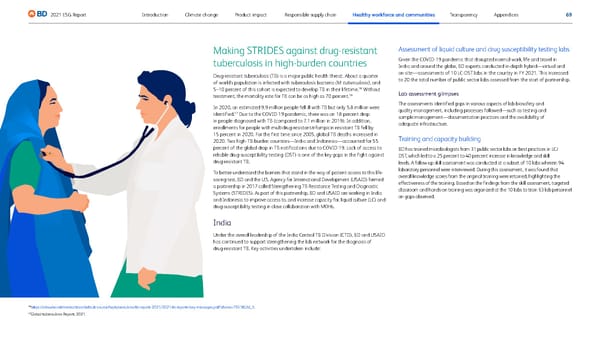
69 2021 ESG Report Transparency Responsible supply chain Product impact Climate change Introduction Healthy workforce and communities Appendices Assessment of liquid culture and drug susceptibility testing labs Given the COVID-19 pandemic that disrupted normal work, life and travel in India and around the globe, BD experts conducted in-depth hybrid—virtual and on-site—assessments of 10 LC-DST labs in the country in FY 2021. This increased to 20 the total number of public sector labs assessed from the start of partnership. Lab assessment glimpses The assessments identified gaps in various aspects of lab biosafety and quality management, including processes followed—such as testing and sample management—documentation practices and the availability of adequate infrastructure. Training and capacity building BD has trained microbiologists from 31 public sector labs on best practices in LC/ DST, which led to a 25 percent to 40 percent increase in knowledge and skill levels. A follow-up skill assessment was conducted at a subset of 10 labs wherein 94 laboratory personnel were interviewed. During this assessment, it was found that overall knowledge scores from the original training were retained, highlighting the effectiveness of the training. Based on the findings from the skill assessment, targeted classroom and hands-on training was organized at the 10 labs to train 63 lab personnel on gaps observed. Making STRIDES against drug-resistant tuberculosis in high-burden countries Drug-resistant tuberculosis (TB) is a major public health threat. About a quarter of world’s population is infected with tuberculosis bacteria (M. tuberculosis) , and 5–10 percent of this cohort is expected to develop TB in their lifetime. 16 Without treatment, the mortality rate for TB can be as high as 70 percent. 16 In 2020, an estimated 9.9 million people fell ill with TB but only 5.8 million were identified. 17 Due to the COVID-19 pandemic, there was an 18 percent drop in people diagnosed with TB (compared to 7.1 million in 2019). In addition, enrollments for people with multidrug-resistant/rifampicin-resistant TB fell by 15 percent in 2020. For the first time since 2005, global TB deaths increased in 2020. Two high-TB-burden countries—India and Indonesia—accounted for 55 percent of the global drop in TB notifications due to COVID-19. Lack of access to reliable drug-susceptibility testing (DST) is one of the key gaps in the fight against drug-resistant TB. To better understand the barriers that stand in the way of patient access to this life- saving test, BD and the U.S. Agency for International Development (USAID) formed a partnership in 2017 called Strengthening TB Resistance Testing and Diagnostic Systems (STRIDES). As part of this partnership, BD and USAID are working in India and Indonesia to improve access to, and increase capacity for, liquid culture (LC) and drug-susceptibility testing in close collaboration with MOHs. India Under the overall leadership of the India Central TB Division (CTD), BD and USAID has continued to support strengthening the lab network for the diagnosis of drug-resistant TB. Key activities undertaken include: 16 https://cdn.who.int/media/docs/default-source/hq-tuberculosis/tb-report-2021/2021-tb-reports-key-messages.pdf?sfvrsn=7951fb2d_5. 17 Global tuberculosis Report, 2021.
 BD ESG Report Page 68 Page 70