

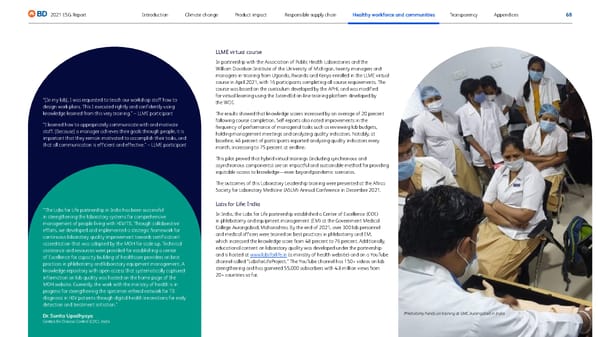
68 2021 ESG Report Transparency Responsible supply chain Product impact Climate change Introduction Healthy workforce and communities Appendices Phlebotomy hands-on training at GMC Aurangabad in India LLME virtual course In partnership with the Association of Public Health Laboratories and the William Davidson Institute of the University of Michigan, twenty managers and managers-in-training from Uganda, Rwanda and Kenya enrolled in the LLME virtual course in April 2021, with 16 participants completing all course requirements. The course was based on the curriculum developed by the APHL and was modified for virtual learning using the ExtendEd on-line training platform developed by the WDI. The results showed that knowledge scores increased by an average of 20 percent following course completion. Self-reports also noted improvements in the frequency of performance of managerial tasks such as reviewing lab budgets, holding management meetings and analyzing quality indicators. Notably, at baseline, 46 percent of participants reported analyzing quality indicators every month, increasing to 75 percent at endline. This pilot proved that hybrid virtual trainings (including synchronous and asynchronous components) are an impactful and sustainable method for providing equitable access to knowledge—even beyond pandemic scenarios. The outcomes of this Laboratory Leadership training were presented at the Africa Society for Laboratory Medicine (ASLM) Annual Conference in December 2021. Labs for Life: India In India, the Labs for Life partnership established a Center of Excellence (COE) in phlebotomy and equipment management (EM) at the Government Medical College Aurangabad, Maharashtra. By the end of 2021, over 300 lab personnel and medical officers were trained on best practices in phlebotomy and EM, which increased the knowledge score from 48 percent to 76 percent. Additionally, educational content on laboratory quality was developed under the partnership and is hosted at www.labsforlife.in (a ministry of health website) and on a YouTube channel called “LabsforLifeProject.” The YouTube channel has 150+ videos on lab strengthening and has garnered 55,000 subscribers with 4.8 million views from 20+ countries so far. “[In my lab], I was requested to teach our workshop staff how to design work plans. This I executed rightly and confidently using knowledge learned from this very training.” – LLME participant “I learned how to appropriately communicate with and motivate staff. [Because] a manager achieves their goals through people, it is important that they remain motivated to accomplish their tasks, and that all communication is efficient and effective.” – LLME participant “The Labs for Life partnership in India has been successful in strengthening the laboratory systems for comprehensive management of people living with HIV/TB. Through collaborative efforts, we developed and implemented a strategic framework for continuous laboratory quality improvement towards certification/ accreditation that was adopted by the MOH for scale up. Technical assistance and resources were provided for establishing a center of Excellence for capacity building of healthcare providers on best practices in phlebotomy and laboratory equipment management. A knowledge repository with open access that systematically captured information on lab quality was hosted on the home page of the MOH website. Currently, the work with the ministry of health is in progress for strengthening the specimen referral network for TB diagnosis in HIV patients through digital health innovations for early detection and treatment initiation.” Dr. Sunita Upadhyaya Centers for Disease Control (CDC), India
 BD ESG Report Page 67 Page 69