

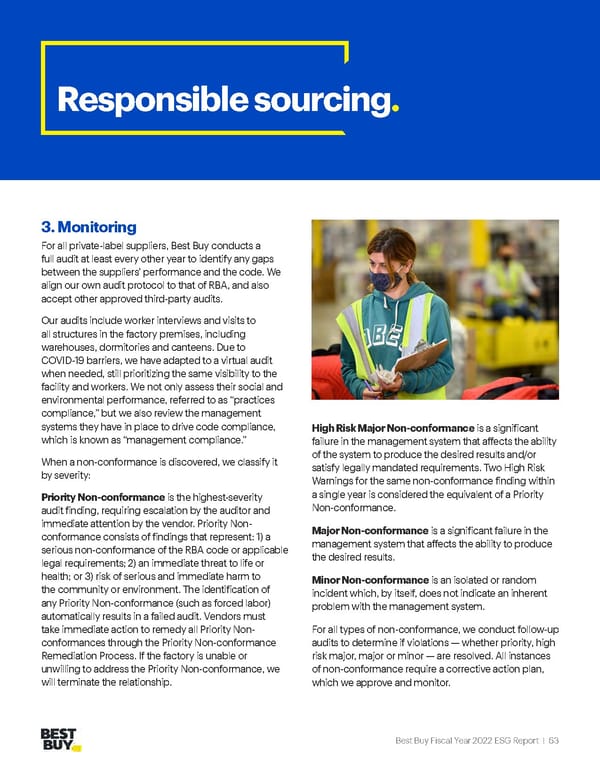
Best Buy Fiscal Year 2022 ESG Report | 63 Responsible sourcing . 3. Monitoring For all private-label suppliers, Best Buy conducts a full audit at least every other year to identify any gaps between the suppliers’ performance and the code. We align our own audit protocol to that of RBA, and also accept other approved third-party audits. Our audits include worker interviews and visits to all structures in the factory premises, including warehouses, dormitories and canteens. Due to COVID-19 barriers, we have adapted to a virtual audit when needed, still prioritizing the same visibility to the facility and workers. We not only assess their social and environmental performance, referred to as “practices compliance,” but we also review the management systems they have in place to drive code compliance, which is known as “management compliance.” When a non-conformance is discovered, we classify it by severity: Priority Non-conformance is the highest-severity audit finding, requiring escalation by the auditor and immediate attention by the vendor. Priority Non- conformance consists of findings that represent: 1) a serious non-conformance of the RBA code or applicable legal requirements; 2) an immediate threat to life or health; or 3) risk of serious and immediate harm to the community or environment. The identification of any Priority Non-conformance (such as forced labor) automatically results in a failed audit. Vendors must take immediate action to remedy all Priority Non- conformances through the Priority Non-conformance Remediation Process. If the factory is unable or unwilling to address the Priority Non-conformance, we will terminate the relationship. High Risk Major Non-conformance is a significant failure in the management system that affects the ability of the system to produce the desired results and/or satisfy legally mandated requirements. Two High Risk Warnings for the same non-conformance finding within a single year is considered the equivalent of a Priority Non-conformance. Major Non-conformance is a significant failure in the management system that affects the ability to produce the desired results. Minor Non-conformance is an isolated or random incident which, by itself, does not indicate an inherent problem with the management system. For all types of non-conformance, we conduct follow-up audits to determine if violations — whether priority, high risk major, major or minor — are resolved. All instances of non-conformance require a corrective action plan, which we approve and monitor.
 Best Buy ESG Report Page 62 Page 64