

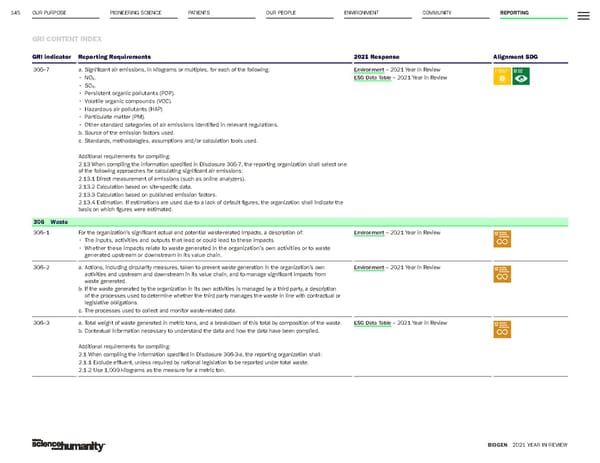
OUR PURPOSE PIONEERING SCIENCE 145 GRI CONTENT INDEX BIOGEN 2021 YEAR IN REVIEW PATIENTS OUR PEOPLE ENVIRONMENT COMMUNITY REPORTING GRI indicator Reporting Requirements 2021 Response Alignment SDG 305–7 a. Significant air emissions, in kilograms or multiples, for each of the following: • NO X . • SO X . • Persistent organic pollutants (POP). • Volatile organic compounds (VOC). • Hazardous air pollutants (HAP) • Particulate matter (PM). • Other standard categories of air emissions identified in relevant regulations. b. Source of the emission factors used. c. Standards, methodologies, assumptions and/or calculation tools used. Additional requirements for compiling: 2.13 When compiling the information specified in Disclosure 305-7, the reporting organization shall select one of the following approaches for calculating significant air emissions: 2.13.1 Direct measurement of emissions (such as online analyzers). 2.13.2 Calculation based on site-specific data. 2.13.3 Calculation based on published emission factors. 2.13.4 Estimation. If estimations are used due to a lack of default figures, the organization shall indicate the basis on which figures were estimated. Environment – 2021 Year in Review ESG Data Table – 2021 Year in Review 306 Waste 306–1 For the organization’s significant actual and potential waste-related impacts, a description of: • The inputs, activities and outputs that lead or could lead to these impacts. • Whether these impacts relate to waste generated in the organization’s own activities or to waste generated upstream or downstream in its value chain. Environment – 2021 Year in Review 306–2 a. Actions, including circularity measures, taken to prevent waste generation in the organization’s own activities and upstream and downstream in its value chain, and to manage significant impacts from waste generated. b. If the waste generated by the organization in its own activities is managed by a third party, a description of the processes used to determine whether the third party manages the waste in line with contractual or legislative obligations. c. The processes used to collect and monitor waste-related data. Environment – 2021 Year in Review 306–3 a. Total weight of waste generated in metric tons, and a breakdown of this total by composition of the waste. b. Contextual information necessary to understand the data and how the data have been compiled. Additional requirements for compiling: 2.1 When compiling the information specified in Disclosure 306-3-a, the reporting organization shall: 2.1.1 Exclude effluent, unless required by national legislation to be reported under total waste. 2.1.2 Use 1,000 kilograms as the measure for a metric ton. ESG Data Table – 2021 Year in Review
 Biogen Year In Review Page 144 Page 146