

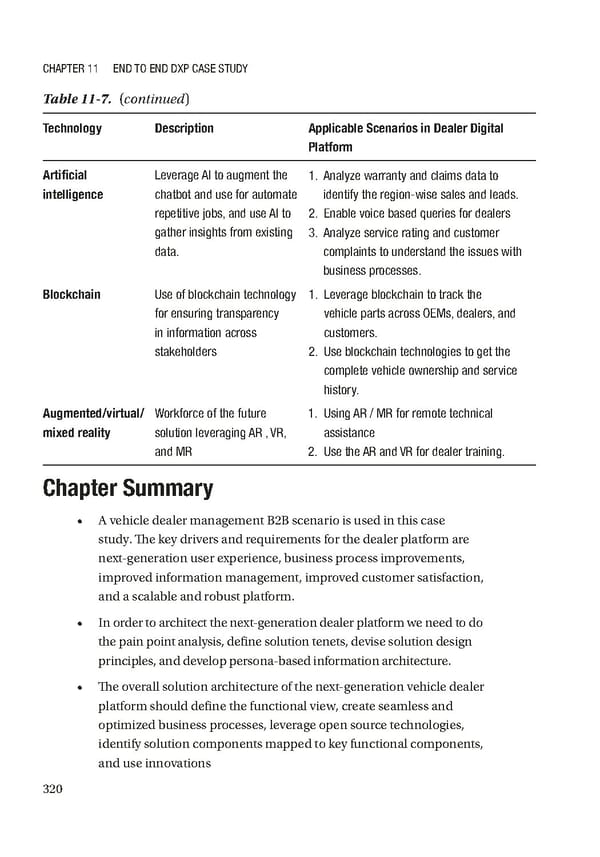
Chapter 11 end to end dXp Case study Table 11-7. (continued) Technology Description Applicable Scenarios in Dealer Digital Platform Artificial Leverage aI to augment the 1. analyze warranty and claims data to intelligence chatbot and use for automate identify the region-wise sales and leads. repetitive jobs, and use aI to 2. enable voice based queries for dealers gather insights from existing 3. analyze service rating and customer data. complaints to understand the issues with business processes. Blockchain use of blockchain technology 1. Leverage blockchain to track the for ensuring transparency vehicle parts across oeMs, dealers, and in information across customers. stakeholders 2. use blockchain technologies to get the complete vehicle ownership and service history. Augmented/virtual/ Workforce of the future 1. using ar / Mr for remote technical mixed reality solution leveraging ar , Vr, assistance and Mr 2. use the ar and Vr for dealer training. Chapter Summary • A vehicle dealer management B2B scenario is used in this case study. The key drivers and requirements for the dealer platform are next-generation user experience, business process improvements, improved information management, improved customer satisfaction, and a scalable and robust platform. • In order to architect the next-generation dealer platform we need to do the pain point analysis, define solution tenets, devise solution design principles, and develop persona-based information architecture. • The overall solution architecture of the next-generation vehicle dealer platform should define the functional view, create seamless and optimized business processes, leverage open source technologies, identify solution components mapped to key functional components, and use innovations 320
 Building Digital Experience Platforms Page 330 Page 332