

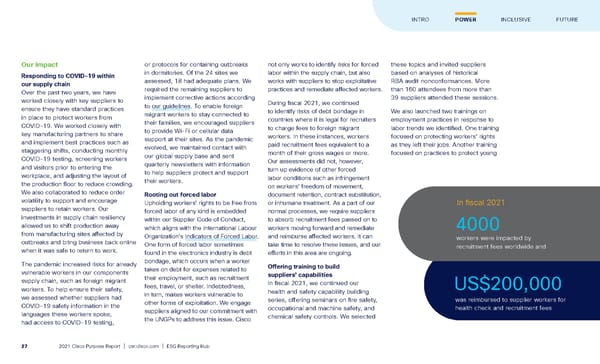
Our impact Responding to COVID-19 within our supply chain Over the past two years, we have worked closely with key suppliers to ensure they have standard practices in place to protect workers from COVID-19. We worked closely with key manufacturing partners to share and implement best practices such as staggering shifts, conducting monthly COVID-19 testing, screening workers and visitors prior to entering the workplace, and adjusting the layout of the production floor to reduce crowding. We also collaborated to reduce order volatility to support and encourage suppliers to retain workers. Our investments in supply chain resiliency allowed us to shift production away from manufacturing sites affected by outbreaks and bring business back online when it was safe to return to work. The pandemic increased risks for already vulnerable workers in our components supply chain, such as foreign migrant workers. To help ensure their safety, we assessed whether suppliers had COVID-19 safety information in the languages these workers spoke, had access to COVID-19 testing, or protocols for containing outbreaks in dormitories. Of the 24 sites we assessed, 18 had adequate plans. We required the remaining suppliers to implement corrective actions according to our guidelines . To enable foreign migrant workers to stay connected to their families, we encouraged suppliers to provide Wi-Fi or cellular data support at their sites. As the pandemic evolved, we maintained contact with our global supply base and sent quarterly newsletters with information to help suppliers protect and support their workers. Rooting out forced labor Upholding workers’ rights to be free from forced labor of any kind is embedded within our Supplier Code of Conduct, which aligns with the International Labour Organization’s Indicators of Forced Labor . One form of forced labor sometimes found in the electronics industry is debt bondage, which occurs when a worker takes on debt for expenses related to their employment, such as recruitment fees, travel, or shelter. Indebtedness, in turn, makes workers vulnerable to other forms of exploitation. We engage suppliers aligned to our commitment with the UNGPs to address this issue. Cisco not only works to identify risks for forced labor within the supply chain, but also works with suppliers to stop exploitative practices and remediate affected workers. During fiscal 2021, we continued to identify risks of debt bondage in countries where it is legal for recruiters to charge fees to foreign migrant workers. In these instances, workers paid recruitment fees equivalent to a month of their gross wages or more. Our assessments did not, however, turn up evidence of other forced labor conditions such as infringement on workers’ freedom of movement, document retention, contract substitution, or inhumane treatment. As a part of our normal processes, we require suppliers to absorb recruitment fees passed on to workers moving forward and remediate and reimburse affected workers. It can take time to resolve these issues, and our efforts in this area are ongoing. Offering training to build suppliers’ capabilities In fiscal 2021, we continued our health and safety capability building series, offering seminars on fire safety, occupational and machine safety, and chemical safety controls. We selected these topics and invited suppliers based on analyses of historical RBA audit nonconformances. More than 160 attendees from more than 39 suppliers attended these sessions. We also launched two trainings on employment practices in response to labor trends we identified. One training focused on protecting workers’ rights as they left their jobs. Another training focused on practices to protect young In fiscal 2021 4000 workers were impacted by recruitment fees worldwide and US$200,000 was reimbursed to supplier workers for health check and recruitment fees FUTURE INTRO POWER INCLUSIVE 2021 Cisco Purpose Report | csr.cisco.com | ESG Reporting Hub 27
 Cisco Purpose Report Page 27 Page 29