

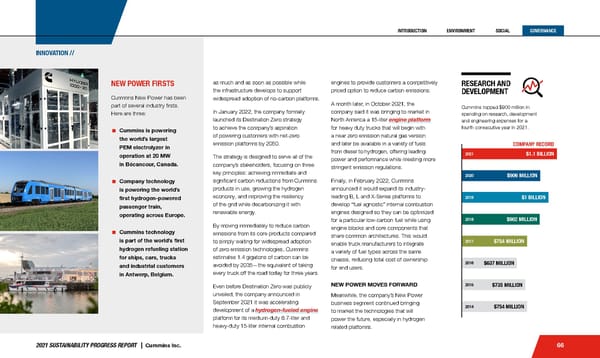
2021 SUSTAINABILITY PROGRESS REPORT | Cummins Inc. 66 RESEARCH AND DEVELOPMENT Cummins topped $900 million in spending on research, development and engineering expenses for a fourth consecutive year in 2021. $754 MILLION $902 MILLION $1 BILLION $906 MILLION $1.1 BILLION 2017 2018 2019 2020 2021 $754 MILLION $735 MILLION $637 MILLION 2016 2014 2015 2016 COMPANY RECORD engines to provide customers a competitively priced option to reduce carbon emissions. A month later, in October 2021, the company said it was bringing to market in North America a 15-liter engine platform for heavy duty trucks that will begin with a near zero emission natural gas version and later be available in a variety of fuels from diesel to hydrogen, offering leading power and performance while meeting more stringent emission regulations. Finally, in February 2022, Cummins announced it would expand its industry- leading B, L and X-Series platforms to develop “fuel agnostic” internal combustion engines designed so they can be optimized for a particular low-carbon fuel while using engine blocks and core components that share common architectures. This would enable truck manufacturers to integrate a variety of fuel types across the same chassis, reducing total cost of ownership for end users. NEW POWER MOVES FORWARD Meanwhile, the company’s New Power business segment continued bringing to market the technologies that will power the future, especially in hydrogen related platforms. as much and as soon as possible while the infrastructure develops to support widespread adoption of no-carbon platforms. In January 2022, the company formally launched its Destination Zero strategy to achieve the company’s aspiration of powering customers with net-zero emission platforms by 2050. The strategy is designed to serve all of the company’s stakeholders, focusing on three key principles: achieving immediate and significant carbon reductions from Cummins products in use, growing the hydrogen economy, and improving the resiliency of the grid while decarbonizing it with renewable energy. By moving immediately to reduce carbon emissions from its core products compared to simply waiting for widespread adoption of zero emission technologies, Cummins estimates 1.4 gigatons of carbon can be avoided by 2035—the equivalent of taking every truck off the road today for three years. Even before Destination Zero was publicly unveiled, the company announced in September 2021 it was accelerating development of a hydrogen-fueled engine platform for its medium-duty 6.7-liter and heavy-duty 15-liter internal combustion NEW POWER FIRSTS Cummins New Power has been part of several industry firsts. Here are three: Cummins is powering the world’s largest PEM electrolyzer in operation at 20 MW in Bécancour, Canada. Company technology is powering the world’s first hydrogen-powered passenger train, operating across Europe. Cummins technology is part of the world’s first hydrogen refueling station for ships, cars, trucks and industrial customers in Antwerp, Belgium. INNOVATION //
 Cummins Sustainability Progress Report Page 66 Page 68