

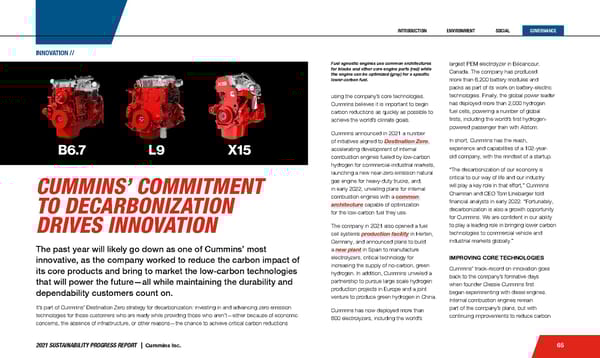
2021 SUSTAINABILITY PROGRESS REPORT | Cummins Inc. 65 largest PEM electrolyzer in Bécancour, Canada. The company has produced more than 6,200 battery modules and packs as part of its work on battery-electric technologies. Finally, the global power leader has deployed more than 2,000 hydrogen fuel cells, powering a number of global firsts, including the world’s first hydrogen- powered passenger train with Alstom. In short, Cummins has the reach, experience and capabilities of a 102-year- old company, with the mindset of a startup. “The decarbonization of our economy is critical to our way of life and our industry will play a key role in that effort,” Cummins Chairman and CEO Tom Linebarger told financial analysts in early 2022. “Fortunately, decarbonization is also a growth opportunity for Cummins. We are confident in our ability to play a leading role in bringing lower carbon technologies to commercial vehicle and industrial markets globally.” IMPROVING CORE TECHNOLOGIES Cummins’ track-record on innovation goes back to the company’s formative days when founder Clessie Cummins first began experimenting with diesel engines. Internal combustion engines remain part of the company’s plans, but with continuing improvements to reduce carbon using the company’s core technologies. Cummins believes it is important to begin carbon reductions as quickly as possible to achieve the world’s climate goals. Cummins announced in 2021 a number of initiatives aligned to Destination Zero , accelerating development of internal combustion engines fueled by low-carbon hydrogen for commercial-industrial markets, launching a new near-zero emission natural gas engine for heavy-duty trucks, and, in early 2022, unveiling plans for internal combustion engines with a common architecture capable of optimization for the low-carbon fuel they use. The company in 2021 also opened a fuel cell systems production facility in Herten, Germany, and announced plans to build a new plant in Spain to manufacture electrolyzers, critical technology for increasing the supply of no-carbon, green hydrogen. In addition, Cummins unveiled a partnership to pursue large scale hydrogen production projects in Europe and a joint venture to produce green hydrogen in China. Cummins has now deployed more than 600 electrolyzers, including the world’s CUMMINS’ COMMITMENT TO DECARBONIZATION DRIVES INNOVATION The past year will likely go down as one of Cummins’ most innovative, as the company worked to reduce the carbon impact of its core products and bring to market the low-carbon technologies that will power the future—all while maintaining the durability and dependability customers count on. It’s part of Cummins’ Destination Zero strategy for decarbonization: investing in and advancing zero emission technologies for those customers who are ready while providing those who aren’t—either because of economic concerns, the absence of infrastructure, or other reasons—the chance to achieve critical carbon reductions INNOVATION // Fuel agnostic engines use common architectures for blocks and other core engine parts (red) while the engine can be optimized (gray) for a specific lower-carbon fuel.
 Cummins Sustainability Progress Report Page 65 Page 67