

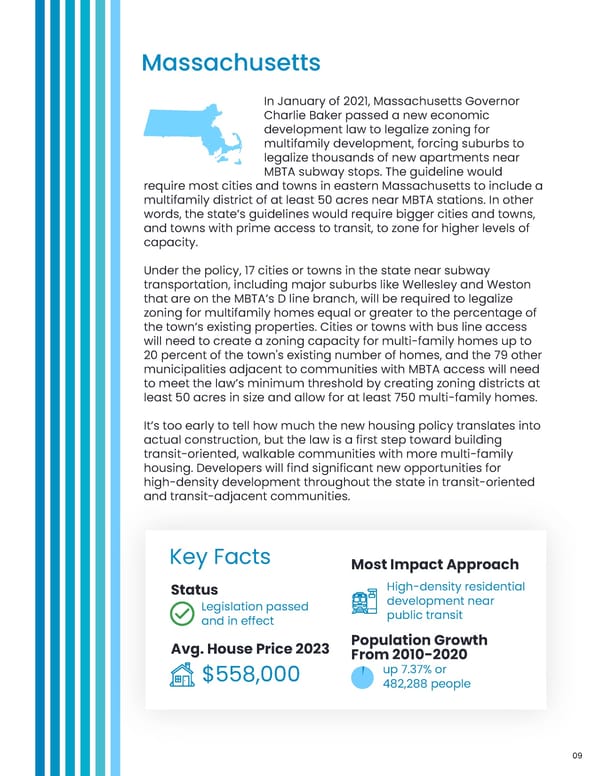
Massachusetts In January of 2021, Massachusetts Governor Charlie Baker passed a new economic development law to legalize zoning for multifamily development, forcing suburbs to legalize thousands of new apartments near MBTA subway stops. The guideline would require most cities and towns in eastern Massachusetts to include a multifamily district of at least 50 acres near MBTA stations. In other words, the state’s guidelines would require bigger cities and towns, and towns with prime access to transit, to zone for higher levels of capacity. Under the policy, 17 cities or towns in the state near subway transportation, including major suburbs like Wellesley and Weston that are on the MBTA’s D line branch, will be required to legalize zoning for multifamily homes equal or greater to the percentage of the town’s existing properties. Cities or towns with bus line access will need to create a zoning capacity for multi-family homes up to 20 percent of the town's existing number of homes, and the 79 other municipalities adjacent to communities with MBTA access will need to meet the law’s minimum threshold by creating zoning districts at least 50 acres in size and allow for at least 750 multi-family homes. It’s too early to tell how much the new housing policy translates into actual construction, but the law is a first step toward building transit-oriented, walkable communities with more multi-family housing. Developers will find significant new opportunities for high-density development throughout the state in transit-oriented and transit-adjacent communities. Key Facts Most Impact Approach Status High-density residential Legislation passed development near and in effect public transit Avg. House Price 2023 Population Growth From 2010-2020 $558,000 up 7.37% or 482,288 people 09
 Driving The Next Decade of Development, State-By-State Page 8 Page 10