

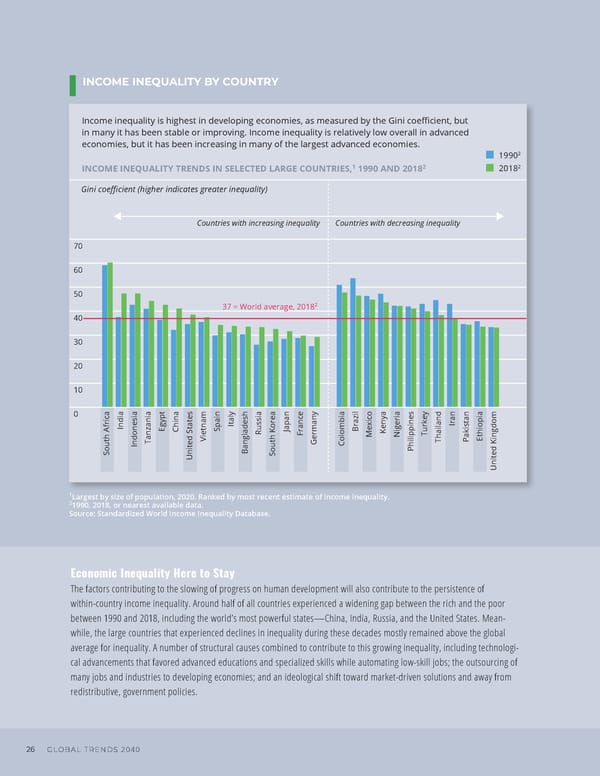
INCOME INEQUALITY BY COUNTRY Income inequality is highest in developing economies, as measured by the Gini coefficient, but in many it has been stable or improving. Income inequality is relatively low overall in advanced economies, but it has been increasing in many of the largest advanced economies. 2 1990 1 2 2 INCOME INEQUALITY TRENDS IN SELECTED LARGE COUNTRIES, 1990 AND 2018 2018 Gini coefficient (higher indicates greater inequality) Countries with increasing inequality Countries with decreasing inequality 70 60 50 2 37 = World average, 2018 40 30 20 10 0 Iran India EgyptChina SpainItaly Russia JapanFrance Brazil Kenya Turkey IndonesiaTanzania Vietnam Germany ColombiaMexico Nigeria Thailand PakistanEthiopia South Africa United States BangladeshSouth Korea Philippines United Kingdom 1Largest by size of population, 2020. Ranked by most recent estimate of income inequality. 21990, 2018, or nearest available data. Source: Standardized World Income Inequality Database. Economic Inequality Here to Stay The factors contributing to the slowing of progress on human development will also contribute to the persistence of within-country income inequality. Around half of all countries experienced a widening gap between the rich and the poor between 1990 and 2018, including the world’s most powerful states—China, India, Russia, and the United States. Mean- while, the large countries that experienced declines in inequality during these decades mostly remained above the global average for inequality. A number of structural causes combined to contribute to this growing inequality, including technologi- cal advancements that favored advanced educations and specialized skills while automating low-skill jobs; the outsourcing of many jobs and industries to developing economies; and an ideological shift toward market-driven solutions and away from redistributive, government policies. 26 GLOBAL TRENDS 2040
 GlobalTrends 2040 Page 33 Page 35