

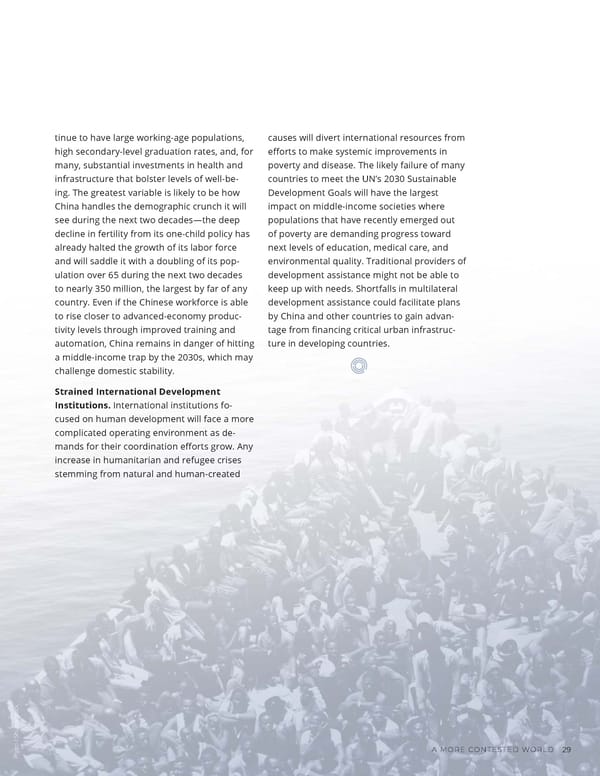
tinue to have large working-age populations, causes will divert international resources from high secondary-level graduation rates, and, for e昀昀orts to make systemic improvements in many, substantial investments in health and poverty and disease. The likely failure of many infrastructure that bolster levels of well-be- countries to meet the UN’s 2030 Sustainable ing. The greatest variable is likely to be how Development Goals will have the largest China handles the demographic crunch it will impact on middle-income societies where see during the next two decades—the deep populations that have recently emerged out decline in fertility from its one-child policy has of poverty are demanding progress toward already halted the growth of its labor force next levels of education, medical care, and and will saddle it with a doubling of its pop- environmental quality. Traditional providers of ulation over 65 during the next two decades development assistance might not be able to to nearly 350 million, the largest by far of any keep up with needs. Shortfalls in multilateral country. Even if the Chinese workforce is able development assistance could facilitate plans to rise closer to advanced-economy produc- by China and other countries to gain advan- tivity levels through improved training and tage from 昀椀nancing critical urban infrastruc- automation, China remains in danger of hitting ture in developing countries. a middle-income trap by the 2030s, which may challenge domestic stability. Strained International Development Institutions. International institutions fo- cused on human development will face a more complicated operating environment as de- mands for their coordination e昀昀orts grow. Any increase in humanitarian and refugee crises stemming from natural and human-created A MORE CONTESTED WORLD 29 Photo / Shutterstock
 GlobalTrends 2040 Page 36 Page 38