

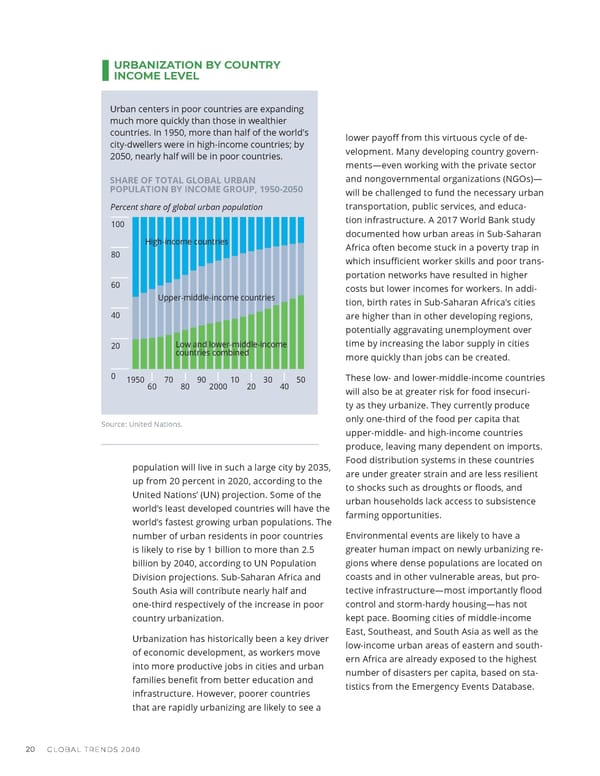
URBANIZATION BY COUNTRY INCOME LEVEL Urban centers in poor countries are expanding much more quickly than those in wealthier countries. In 1950, more than half of the world's lower payo昀昀 from this virtuous cycle of de- city-dwellers were in high-income countries; by velopment. Many developing country govern- 2050, nearly half will be in poor countries. ments—even working with the private sector SHARE OF TOTAL GLOBAL URBAN and nongovernmental organizations (NGOs)— POPULATION BY INCOME GROUP, 1950-2050 will be challenged to fund the necessary urban Percent share of global urban population transportation, public services, and educa- 100 tion infrastructure. A 2017 World Bank study High-income countries documented how urban areas in Sub-Saharan 80 Africa often become stuck in a poverty trap in which insu昀케cient worker skills and poor trans- portation networks have resulted in higher 60 costs but lower incomes for workers. In addi- Upper-middle-income countries tion, birth rates in Sub-Saharan Africa’s cities 40 are higher than in other developing regions, potentially aggravating unemployment over 20 Low and lower-middle-income time by increasing the labor supply in cities countries combined more quickly than jobs can be created. 0 1950 70 90 10 30 50 These low- and lower-middle-income countries 60 80 2000 20 40 will also be at greater risk for food insecuri- ty as they urbanize. They currently produce Source: United Nations. only one-third of the food per capita that upper-middle- and high-income countries produce, leaving many dependent on imports. Food distribution systems in these countries population will live in such a large city by 2035, are under greater strain and are less resilient up from 20 percent in 2020, according to the to shocks such as droughts or 昀氀oods, and United Nations’ (UN) projection. Some of the urban households lack access to subsistence world’s least developed countries will have the farming opportunities. world’s fastest growing urban populations. The number of urban residents in poor countries Environmental events are likely to have a greater human impact on newly urbanizing re- is likely to rise by 1 billion to more than 2.5 billion by 2040, according to UN Population gions where dense populations are located on coasts and in other vulnerable areas, but pro- Division projections. Sub-Saharan Africa and South Asia will contribute nearly half and tective infrastructure—most importantly 昀氀ood one-third respectively of the increase in poor control and storm-hardy housing—has not country urbanization. kept pace. Booming cities of middle-income Urbanization has historically been a key driver East, Southeast, and South Asia as well as the of economic development, as workers move low-income urban areas of eastern and south- ern Africa are already exposed to the highest into more productive jobs in cities and urban number of disasters per capita, based on sta- families bene昀椀t from better education and tistics from the Emergency Events Database. infrastructure. However, poorer countries that are rapidly urbanizing are likely to see a 20 GLOBAL TRENDS 2040
 GlobalTrends 2040 Page 27 Page 29