

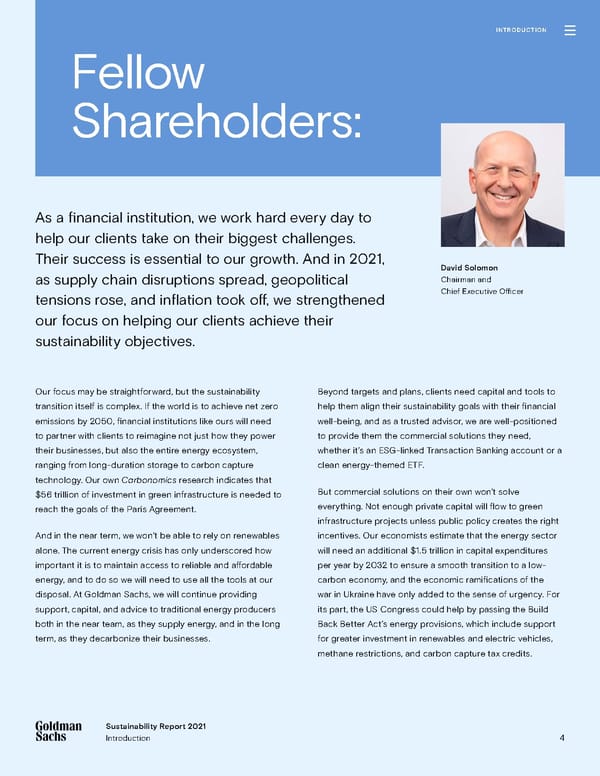
INTRODUCTION 4 Sustainability Report 2021 Introduction Fellow Shareholders: David Solomon Chairman and Chief Executive Officer Our focus may be straightforward, but the sustainability transition itself is complex. If the world is to achieve net zero emissions by 2050, financial institutions like ours will need to partner with clients to reimagine not just how they power their businesses, but also the entire energy ecosystem, ranging from long-duration storage to carbon capture technology. Our own Carbonomics research indicates that $56 trillion of investment in green infrastructure is needed to reach the goals of the Paris Agreement. And in the near term, we won’t be able to rely on renewables alone. The current energy crisis has only underscored how important it is to maintain access to reliable and affordable energy, and to do so we will need to use all the tools at our disposal. At Goldman Sachs, we will continue providing support, capital, and advice to traditional energy producers both in the near team, as they supply energy, and in the long term, as they decarbonize their businesses. Beyond targets and plans, clients need capital and tools to help them align their sustainability goals with their financial well-being, and as a trusted advisor, we are well-positioned to provide them the commercial solutions they need, whether it’s an ESG-linked Transaction Banking account or a clean energy-themed ETF. But commercial solutions on their own won’t solve everything. Not enough private capital will flow to green infrastructure projects unless public policy creates the right incentives. Our economists estimate that the energy sector will need an additional $1.5 trillion in capital expenditures per year by 2032 to ensure a smooth transition to a low- carbon economy, and the economic ramifications of the war in Ukraine have only added to the sense of urgency. For its part, the US Congress could help by passing the Build Back Better Act’s energy provisions, which include support for greater investment in renewables and electric vehicles, methane restrictions, and carbon capture tax credits. As a financial institution, we work hard every day to help our clients take on their biggest challenges. Their success is essential to our growth. And in 2021, as supply chain disruptions spread, geopolitical tensions rose, and inflation took off, we strengthened our focus on helping our clients achieve their sustainability objectives. Letter to Our Shareholders
 Goldman Sachs Group Sustainability Report Page 3 Page 5