

Goldman Sachs Group Sustainability Report
Progress Through Performance SUSTAINABILITY REPORT 2021 Advancing the climate transition and inclusive growth across the full financial system
2 Contents 3 Introduction: Performance that matters — advancing our purpose through sustainability 4 Letter to Our Shareholders 6 Activating the Power of the Financial System for a Sustainable Future 15 Climate Transition: Accelerating the next industrial revolution 16 Executive Summary 17 Introduction 20 Driving Transition 27 Accelerating Innovation 33 Mobilizing Capital 37 Closing the Gap Through Partnerships 39 Meeting the Net Zero Challenge in Asia 42 Driving Sustainability in Our Own Business 46 Looking Ahead: Climate Change and Biodiversity 48 Inclusive Growth: An economy that works better for all 49 Executive Summary 50 Introduction 54 One Million Black Women 63 Defining and Executing on Our Strategy 74 Leveraging Partnerships to Unlock Sustainable Economic Growth 79 Driving Change Across Our Firm 85 What to Expect Next 87 Governance: Managing our progress 88 Governance at Our Firm 90 2021 Transaction Breakdown and Highlights 93 Key Metrics & Indicators: Measuring our progress 94 Environmental Indicators 98 Recognition 100 SASB Index 108 Sustainability Issuance Report 2021
3 Introduction SECTION 1 3
INTRODUCTION 4 Sustainability Report 2021 Introduction Fellow Shareholders: David Solomon Chairman and Chief Executive Officer Our focus may be straightforward, but the sustainability transition itself is complex. If the world is to achieve net zero emissions by 2050, financial institutions like ours will need to partner with clients to reimagine not just how they power their businesses, but also the entire energy ecosystem, ranging from long-duration storage to carbon capture technology. Our own Carbonomics research indicates that $56 trillion of investment in green infrastructure is needed to reach the goals of the Paris Agreement. And in the near term, we won’t be able to rely on renewables alone. The current energy crisis has only underscored how important it is to maintain access to reliable and affordable energy, and to do so we will need to use all the tools at our disposal. At Goldman Sachs, we will continue providing support, capital, and advice to traditional energy producers both in the near team, as they supply energy, and in the long term, as they decarbonize their businesses. Beyond targets and plans, clients need capital and tools to help them align their sustainability goals with their financial well-being, and as a trusted advisor, we are well-positioned to provide them the commercial solutions they need, whether it’s an ESG-linked Transaction Banking account or a clean energy-themed ETF. But commercial solutions on their own won’t solve everything. Not enough private capital will flow to green infrastructure projects unless public policy creates the right incentives. Our economists estimate that the energy sector will need an additional $1.5 trillion in capital expenditures per year by 2032 to ensure a smooth transition to a low- carbon economy, and the economic ramifications of the war in Ukraine have only added to the sense of urgency. For its part, the US Congress could help by passing the Build Back Better Act’s energy provisions, which include support for greater investment in renewables and electric vehicles, methane restrictions, and carbon capture tax credits. As a financial institution, we work hard every day to help our clients take on their biggest challenges. Their success is essential to our growth. And in 2021, as supply chain disruptions spread, geopolitical tensions rose, and inflation took off, we strengthened our focus on helping our clients achieve their sustainability objectives. Letter to Our Shareholders
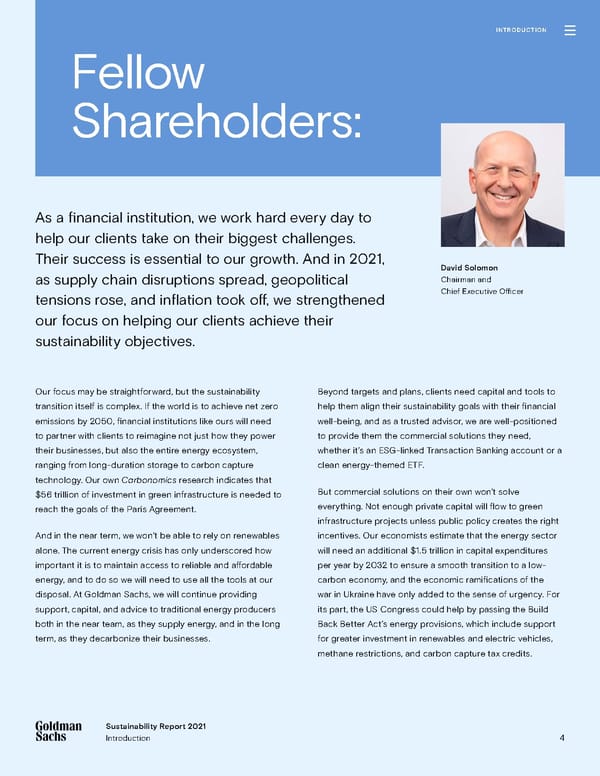
5 Sustainability Report 2021 Introduction INTRODUCTION There’s still a long way to go, but we’ve made good progress: Of our ten-year goal of $750 billion in sustainable finance activity, we’ve achieved approximately $300 billion so far, including $167 billion in climate transition, $50 billion in inclusive growth, and the remainder in multiple themes. Looking ahead, we expect client demand for sustainable solutions to continue to grow. Our clients know that building a more sustainable and inclusive economy is not only the right thing to do, it’s the smart thing to do, especially in a world that’s becoming more competitive. And we’ll be there for them every step of the way. We are, after all, in the midst of a transition. And by taking action now, we can help our clients produce more reliable and affordable energy as well as build a more sustainable and inclusive economy for today’s generation and the next. David Solomon Chairman and Chief Executive Officer It’s the very complexity of the challenge that demands a holistic approach, and what makes ours different is that we’ve integrated sustainability across our business, our operations, and our partnerships with the outside world. One reason our clients turn to us is that we define sustainability broadly, treating climate transition and inclusive growth as two sides of the same coin. Building on our years of work promoting the economic empowerment of women, we’re continuing to make headway with our new initiative, One Million Black Women , and we have a wide range of offerings that advance progress in both climate transition and inclusive growth. For instance, our Asset Management business has invested in a company that is training and hiring unemployed union workers to make buildings more energy efficient and another company that is creating affordable housing options as well as building the world’s most sustainable high-rise apartment building. Every day we are supporting clients as they navigate climate transition and inclusive growth across their portfolios and investments. 5
Sustainability Report 2021 Introduction INTRODUCTION Activating the Power of the Financial System for a Sustainable Future In December, we published our Task Force on Climate-related Financial Disclosures (TCFD) report, Accelerating Transition , in which we shared how we are leveraging the full breadth of our business to help support the low-carbon transition efforts of our clients, as well as our roadmap to deliver on progress for our commitment to align our business with a net zero by 2050 pathway. Our 2020 Sustainability Report tracked our progress in advancing the climate transition and driving inclusive growth — the two holistic pillars that underpin our sustainability efforts as a firm. In this report, we will share how we are continuing to execute on our climate transition and inclusive growth commitments through development of innovative solutions and new commercial capabilities. As we progress toward our own goals, we are supporting our clients on their individual journeys and are driving sustainable change in the real economy. We believe that capital is critical to transform the global economy — yet its full potential is still untapped. At Goldman Sachs, we recognize it takes an interconnected, converging ecosystem of stakeholders, capital, and partnerships to mobilize capital toward sustainable outcomes. Our firm leverages our unique position at the center of global markets to catalyze vital connections at scale across the financial system, in collaboration with our stakeholders. At Goldman Sachs, we have placed sustainability at the core of our business. Building on decades of experience, we have accelerated our commitment to sustainable finance as we continue to put our broader purpose to work: to advance sustainable economic growth and financial opportunity for our clients, people, partners, and communities in which we work. 6
7 Sustainability Report 2021 Introduction INTRODUCTION We remain focused on where we believe we are able to drive the greatest impact — our commercial work with clients. Through market intelligence, financing, and advisory services, we help our clients build the capabilities they need to navigate complex sustainability challenges. With a relentless focus on driving results, a commitment to excellence in service, and a firm fully mobilized to deploy capital and resources at scale, we believe that Goldman Sachs is well-equipped to develop innovative solutions and tools to meet the needs of our clients and the market. Systemic change requires interconnected solutions. Across our work in advancing both the climate transition and inclusive growth, our work with clients is bolstered by collaborations with partners across industries, regions, and disciplines. Sustainable economic growth and the transition to a low-carbon economy cannot be driven in isolation. When we work together, we can drive a greater and more holistic impact. Our collaboration with Bloomberg Philanthropies and the Asian Development Bank on the launch of the Climate Innovation and Development Fund is one example of how we are leveraging partnerships to help address financing gaps in emerging markets, where we must consider region-specific challenges and opportunities to enable and accelerate the climate transition. Our inclusive growth strategy is grounded in our expertise derived from investing in underserved communities, and it is further catalyzed by partnership and philanthropic capital. In order to drive commercial solutions for the communities in which we serve, we have built connections with stakeholders whom we listen to and learn from during an ongoing process. In advancing inclusive growth, we remain focused on increasing access to affordable, quality care and opportunities for members of these communities, whether those communities be large or small. Importantly, we recognize that our people are crucial in driving progress on sustainability, and they underpin all our commercial work with clients and partners. As such, we are continuing to build our capacity as a firm and centralize sustainability, diversity, and inclusivity efforts across our organization. In turn, we leverage the insights gained from our experience to support our clients on their journeys.
Sustainability Report 2021 Introduction 8 Our Strategic Framework At Goldman Sachs, we have identified two imperatives through which we can make the most material impact as a firm: climate transition and inclusive growth. We continue to view these two themes as key drivers of risk and opportunity for our firm and our clients. To advance inclusive growth We’re actively listening to, amplifying, and partnering with people, communities, and organizations to improve accessibility, affordability, and outcomes to help drive more inclusive, sustainable growth. We’re continuing to accelerate our work in this space through signature initiatives, including One Million Black Women, 10,000 Small Businesses, and 10,000 Women . We acknowledge that long-term outcomes will be the true test of our impact in helping to build a more diverse, equitable, and inclusive economy. We also remain focused on the growing impacts of climate change on sustainable, inclusive economic growth. We remain steadfast in our belief that growth that is not inclusive is not sustainable, and we remain committed to supporting an inclusive transition. Our work here is just beginning, and we will continue to report on our areas of focus and impact in this space. To accelerate the climate transition We are expanding the scale and speed of our impact. We look to mobilize capital, accelerate innovation, and fuel the transition to a low-carbon economy at both a client and systemic level, grounded in the insights we gain through partnerships and our flagship research initiatives, such as GS SUSTAIN and Carbonomics . What We’ve Learned Synergies between climate transition and inclusive growth: • Complex, large-scale challenges require interconnected, dynamic, and scalable solutions. • Working with clients, partners, and our people amplifies our impact. INTRODUCTION
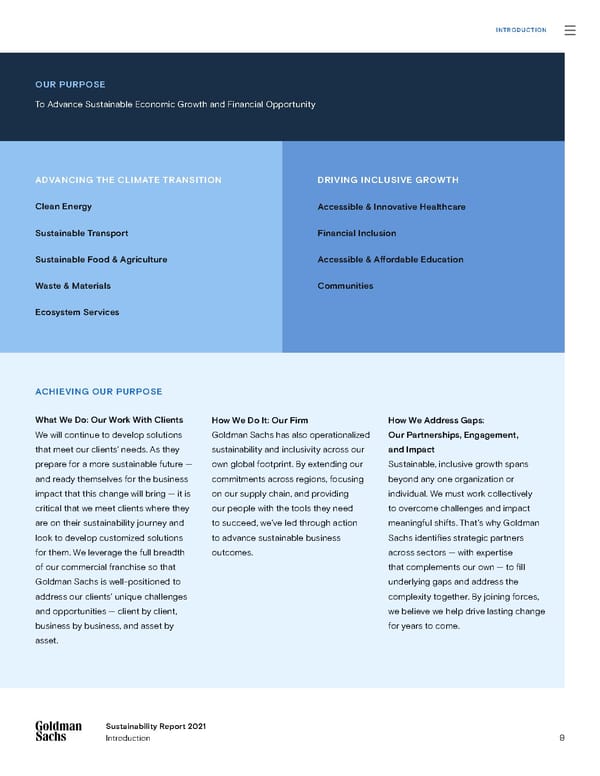
9 Sustainability Report 2021 Introduction INTRODUCTION To Advance Sustainable Economic Growth and Financial Opportunity ACHIEVING OUR PURPOSE What We Do: Our Work With Clients We will continue to develop solutions that meet our clients’ needs. As they prepare for a more sustainable future — and ready themselves for the business impact that this change will bring — it is critical that we meet clients where they are on their sustainability journey and look to develop customized solutions for them. We leverage the full breadth of our commercial franchise so that Goldman Sachs is well-positioned to address our clients’ unique challenges and opportunities — client by client, business by business, and asset by asset. How We Do It: Our Firm Goldman Sachs has also operationalized sustainability and inclusivity across our own global footprint. By extending our commitments across regions, focusing on our supply chain, and providing our people with the tools they need to succeed, we’ve led through action to advance sustainable business outcomes. How We Address Gaps: Our Partnerships, Engagement, and Impact Sustainable, inclusive growth spans beyond any one organization or individual. We must work collectively to overcome challenges and impact meaningful shifts. That’s why Goldman Sachs identifies strategic partners across sectors — with expertise that complements our own — to fill underlying gaps and address the complexity together. By joining forces, we believe we help drive lasting change for years to come. OUR PURPOSE DRIVING INCLUSIVE GROWTH Accessible & Innovative Healthcare Financial Inclusion Accessible & Affordable Education Communities ADVANCING THE CLIMATE TRANSITION Clean Energy Sustainable Transport Sustainable Food & Agriculture Waste & Materials Ecosystem Services
10 Sustainability Report 2021 Introduction INTRODUCTION “Building a sustainable and inclusive economy will be no small challenge, but it’s also a huge opportunity. An energy transition that promotes long-term, equitable growth will require a tremendous amount of investment capital, and that’s why we’re using the full range of our capabilities to create the innovative, commercial solutions our clients need.” Dina Powell McCormick Global Head of Sustainability and Inclusive Growth, Goldman Sachs $750B ~$300B Our Commitment to Drive Sustainable Outcomes As a global financial institution, we recognize that capital is most powerful in advancing sustainable outcomes when deployed with a holistic lens. We understand that there are gaps in how capital is deployed throughout our world’s financial systems, and we seek to both illuminate those gaps and to support clients with capital, knowledge, and resources. In 2019, we crystallized our efforts with a commitment to deploy $750 billion toward sustainable finance, advisory, and investment activities by 2030. We took this step because we recognized that advancing climate transition and inclusive growth challenges will require innovation, mobilization, and united efforts toward systemic change. Since setting our ten-year goal, we’ve achieved approximately $300 billion in commercial activity, including $167 billion in climate transition, $50 billion in inclusive growth, and the remainder in multiple themes. $167B In Climate Transition $50B In Inclusive Growth 10
11 Sustainability Report 2021 Introduction INTRODUCTION In the past year, we achieved meaningful outcomes across a number of key initiatives: $3B+ Deployed in 2021 through our Urban Investment Group, lending and investing in underserved places and people through real estate projects, social enterprises, and lending facilities for small businesses 1,172 Updated our US proxy voting policy to consider director race, ethnicity, and sexual orientation, as well as gender — we voted against directors at 1,172 companies in 2021 due to lack of board diversity 2030 Committed to achieving net zero emissions in our operations and supply chain by 2030 2050 Committed to aligning our business with a net zero by 2050 pathway and shared an initial set of sectoral goals for 2030 $2.2B In January 2021, led Shoals Technology’s IPO, the largest-ever US-listed IPO in the renewables sector 150+ Corporate clients engaged across 12 industry groups through our cross-firm Decarbonization offering 1,000+ Released the Marquee Carbon Portfolio Analytics tool to help clients measure and manage their carbon emissions exposure across their equities and credit portfolios, with more than 1,000 unique users in the first months of launch $1B Global thematic environmental equity- focused strategies topped $1 billion Assets Under Supervision (AUS) in 2021 ~1,800 Transactions reviewed for environmental and social risk $10B Commitment in direct investment capital and $100 million in philanthropic capital over the next decade to address opportunity gaps for at least one million Black women, as part of our One Million Black Women initiative $1B+ Raised to date from Loop Money Market Funds, which shares 10% of net revenues to fund programs focused on housing and education $19M Investment in Wonderschool, a Black- led innovative child care technology company
12 Sustainability Report 2021 Introduction INTRODUCTION Building on Our Work Over the Past 20 Years 2001 Launched our Urban Investment Group 2005 One of the first US banks to develop an Environmental Policy Framework 2007 Launched GS SUSTAIN, which incorporates ESG criteria into the fundamental analysis of companies to identify long-term outperformers 2014 Expanded green bond market — first century green bond, first green energy market securitization, first Latin America renewable project green bond 2018 Committed to 50% global talent represented by women 2020 Met many of our five-year operational sustainability goals early; inaugurated Launch With GS Black and Latinx Cohort 2008 Launched 10,000 Women initiative 2009 Launched 10,000 Small Businesses initiative; committed to achieving carbon neutrality in our operations by 2020 (achieved in 2015) 2012 Inaugural clean energy financing and investment target set 2015 First of our peers to reach carbon neutrality; set new five year operational impact goals for 2020 2019 Established our Sustainable Finance Group; announced $750 billion by 2030 sustainable finance commitment; set 2025 operational goals 2021 / Year-to-date 2022 • Launched One Million Black Women initiative • Issued $800 million inaugural Goldman Sachs Sustainability Bond • Facilitated more than 50 diverse board placements at client organizations • Deployed over $12 billion through our Urban Investment Group since inception • Committed to align our business with a net zero by 2050 pathway and shared our roadmap for progress
13 Sustainability Report 2021 Introduction Operationalizing Our Ambition At Goldman Sachs, we have developed a firmwide commercial model that leverages the full breadth and depth of our franchise, with the goal of bringing the best of Goldman Sachs’ offerings to all our sustainable finance-related efforts. We have operationalized our ambition to meet our targets for shareholders, to retain top talent, and to meet the needs of our clients. With this approach, Goldman Sachs can move nimbly, continually improve our offerings, and better respond to today’s challenges for our clients, our partners, and our people. Following the announcement of our 10- year sustainable finance target, we launched dedicated Sustainability Councils within each of our business segments. Within each business, a divisional Sustainability Council of senior leaders provides the capacity to formulate, streamline, and scale innovation and product development. These councils have become a central point of connectivity for our firm and a catalyst for sustainability-related commercial initiatives across our business. INTRODUCTION
14 Sustainability Report 2021 Introduction To ensure global coverage of our sustainable finance- related efforts, we also have regionally focused Sustainability Councils that partner with our businesses and connect the firm to our clients. This integrated approach has allowed us to deliver OneGS to our clients globally — working across the firm and leveraging the expertise of our people and resources across different areas of our business and regions to provide differentiated, innovative sustainable finance products and offerings. These councils have not only transformed how our clients engage with our firm on sustainable finance, but also how we mobilize our sustainability efforts as a global institution. • Global Markets launched a Carbon Portfolio Analytics offering within Marquee that provides carbon data, tools, and analytics that empower clients. • Consumer and Wealth Management now offers sustainable investing solutions to clients of all sizes, from our consumer to our ultra-high-net-worth business. In our Private Wealth Management business, demand for sustainable investments has been strongest from our largest clients, and this year we launched an ESG diagnostic to help clients identify and work toward their long-term sustainability goals within their public market portfolios. • Investment Banking continues to deliver holistic services to our clients including integrating ESG into their financing activities through green, social, and sustainability bonds; issuing sustainable KPI-linked issuances; and leveraging equity offerings such as IPOs to enhance and accelerate their sustainability missions. • Asset Management facilitated our recent acquisition of NN Investment Partners , a leading sustainable investment manager in Europe. • Leveraging our OneGS model, we launched a new and unique Decarbonization offering that leverages commercial capabilities and capital solutions across the firm. In the following sections of our 2021 Sustainability Report , we’ll dive deeper into our approach and highlight how we are executing on our strategy across climate transition and inclusive growth. INVESTMENT BANKING SUSTAINABILITY COUNCIL ASSET MANAGEMENT SUSTAINABILITY COUNCIL CONSUMER AND WEALTH MANAGEMENT SUSTAINABILITY COUNCIL SUSTAINABLE FINANCE GROUP GLOBAL MARKETS SUSTAINABILITY COUNCIL INTRODUCTION
XX Divider headline 15 15 Climate Transition SECTION 2
16 Sustainability Report 2021 Climate Transition | Executive Summary We take an integrated approach to prioritizing climate transition and inclusive growth across our business — in our work with clients, through our partnerships, and as a firm. In our efforts to effectively mitigate climate risk and to help accelerate the climate transition required to meet the goals of the Paris Agreement, we need to actively engage clients, investors, advocacy groups, and multi-stakeholder organizations working to address the pressing issue of climate change. In executing this holistic engagement strategy, we have identified gaps that need to be addressed to accelerate the transition to a low-carbon economy, and we have channeled our resources toward closing them. In this Climate Transition section, we describe how we continue to deliver on our client, partner, and firmwide initiatives to enable and accelerate the global climate transition — bearing in mind that our work is far from done. At Goldman Sachs, we are investing resources, capital, and expertise to support the decarbonization of our economy. Solving this complex challenge will require the contributions of many businesses, organizations, governments, and individuals. We belong to a greater ecosystem of efforts, and we must all work together to drive real and meaningful shifts. Executive Summary CLIMATE TRANSITION We begin Climate Transition by detailing Our Work With Clients across three key priority areas: • Driving Transition focuses on how we support our clients on their decarbonization goals across all sectors and at every stage of their journeys. • Accelerating Innovation outlines how we partner with companies who are developing innovative solutions that help to accelerate transition in critical sectors of the economy. • Mobilizing Capital explains how we use our research, knowledge, and expertise to drive capital and launch commercial products that support clients and investors achieving their climate alignment and net zero goals. In Closing the Gap Through Partnerships, we address our collaborations with other organizations and describe how we’re jointly navigating massive and complex challenges posed by the climate transition — challenges that no institution can solve alone. Lastly, Driving Sustainability in Our Own Business outlines how we are making steady, incremental progress against our net zero and ESG-related goals for our operations and supply chain.
17 Sustainability Report 2021 Climate Transition | Introduction Introduction Accelerating Climate Transition As climate change continues to impact global economies, businesses, and communities across the world, accelerating the transition to a low- carbon economy is more important than ever. CLIMATE TRANSITION Meeting this challenge will require nothing less than transformative changes across our economy. Goldman Sachs Global Investment Research group estimates that $56 trillion in incremental infrastructure investment is needed to achieve net zero carbon emissions by 2050. Our research estimates that half of the decarbonization required is reliant on access to clean power generation and that the decarbonization of transport, buildings, and industry will require a complex ecosystem of low-carbon technologies, including energy storage and carbon capture alongside the supply of clean power. There is also a significant challenge in that in many parts of the world, inexpensive, reliable, and clean energy is not available at scale. In addition to thoughtful public policy that considers the current dynamics of the energy system, we believe that capital markets and innovation will play a critical role in driving a just and orderly global transition — by both supporting these sectors in transition and investing in the necessary technologies and solutions that may not be available at scale today. We acknowledge that achieving decarbonization in the real economy cannot succeed without a global, united effort, which includes supportive public policy and technological advancement.
18 CLIMATE TRANSITION As a financial institution, we believe the most meaningful role we can play in the global climate transition is to drive decarbonization in the real economy, in partnership with our clients. We see significant opportunities to further mobilize the full breadth of our franchise to support this effort. In 2005, Goldman Sachs was one of the first major banks to acknowledge the scale and urgency of climate change with our Environmental Policy Framework. Since then, we have accelerated our efforts to integrate climate- focused efforts across our business. In early 2021, we made a long-term commitment to align our business with a net zero by 2050 pathway, and we shared our roadmap for progress in December, including an initial set of sectoral goals for 2030. As part of this commitment, we have developed a dynamic model to engage our clients throughout their climate transition. We leverage the breadth of resources and capabilities across our business as well as insights and perspectives from our holistic engagement strategy with clients, civil society, and the public sector. By leveraging our experience managing sustainability and climate transition for our own operations, we can better support clients throughout their journeys. Through these efforts, we’ve developed a differentiated view of the market and can identify potential gaps — all with the aim to drive climate solutions for clients and investors through strategic advice, innovative financing tools, partnership on investment, and other commercial products and capabilities. We also recognize that clients in different industries and regions will face different paths in their decarbonization journeys. We are committed to supporting our clients — particularly those in emerging economies that face a more challenging transition — and tailoring sustainability and climate solutions for each client’s unique circumstance. 0.0% 0.5% 1.0% 1.5% 2.0% 2.5% - 500 1,000 1,500 2,000 2,500 3,000 2021 2022 2023 2024 2025 2026 2027 2028 2029 2030 2031 2032 2033 2034 2035 2036 2037 2038 2039 2040 2041 2042 2043 2044 2045 2046 2047 2048 2049 2050 Annual infrastructure investemts for path consistent with global net zero by 2050 (US$ bn) Power generation Power networks Energy storage (batteries) EV and FCEV charging stations Biorefineries Industry (incl. CCUS) Hydrogen plants Building upgrades/retrofits DACCS as a % of global GDP - RHS ACHIEVING OUR PURPOSE What We Do: Our Work With Clients How We Do It: Our Firm How We Address Gaps: Our Partnerships, Engagement, and Impact Our approach to climate is grounded in the areas where we, as a financial institution, can drive the most material impact: OUR PURPOSE
19 Sustainability Report 2021 Climate Transition | Introduction Our Work With Clients At Goldman Sachs, we leverage our OneGS model to deliver multifaceted client solutions that aim to execute on sustainability commitments. Across teams, divisions, and geographies, we constantly strive to understand the rapidly changing needs of our clients, and we work with them to advocate for comprehensive actions that address today’s pressing need for climate transition while laying the foundation for long-term solutions. We are actively engaging with clients to understand where they are in their journeys and are providing them with guidance, capital, and products curated to their distinct needs — Driving Transition across their businesses. Across our firm, we also work with clients that are at the forefront of Accelerating Innovation , delivering new solutions both within sectors as well as across the broader ecosystem that will be critical as we shift to a low-carbon economy. As we engage across the global economy, we’re also tapping into our analytics and research to identify where, when, and how we can Mobilize Capital and structure unique commercial capabilities and products to drive the greatest impact. CLIMATE TRANSITION 19
20 Sustainability Report 2021 Climate Transition | Driving Transition In our Task Force on Climate-related Financial Disclosures (TCFD) report, Accelerating Transition , we shared an interim roadmap for our long-term commitment to align our business with a net zero by 2050 pathway, including an initial set of ranged targets for 2030 across Power, Oil & Gas, and Auto Manufacturing. These represent sectors of the economy where we see the most impactful opportunities to invest in new commercial solutions to drive decarbonization in the real economy through proactive engagement with our clients and deployment of the capital required for transition. Notably, we recognize that the ability for us and our clients to achieve our climate-related goals will depend on a variety of factors, including supportive public policy, technological advancement, and the ambition of clients’ decarbonization commitments. Driving Transition Sector Metrics 2019 Baseline 2030 Targets % Reduction 2019-30 Oil & Gas gCO 2e / MJ 72 56-60 17%-22% Power kgCO 2e / MWh 417 147-219 48%-65% Auto Manufacturing gCO 2e / km 152 70 -7 7 49%-54% Fueling Transition-related Projects In addition to public sector support and technological advancement, carbon-intensive industries — such as energy and power — will require significant capital to transition to more carbon-efficient sources. In 2021, we helped accelerate capital flows into energy transition-related projects through innovative structures, including sustainability-linked bonds (SLBs), which enable clients to raise capital in a way that is aligned with their decarbonization goals. CLIMATE TRANSITION 2019 BASELINE AND 2030 TARGETS FOR OUR PRIORITY SECTORS As part of our commitment, we have prioritized climate transition in our commercial efforts with clients, leveraging insights from our experience managing climate for our own business and our holistic engagement strategy to develop a comprehensive commercial offering that supports our clients’ low-carbon transition efforts.
21 Sustainability Report 2021 Climate Transition | Driving Transition Energy: Eni Italian multinational energy company Eni — considered one of the major global energy players — was the first major energy business to publish a Sustainability-Linked Financing Framework, affirming its commitment to being fully carbon neutral by 2050 and tying those goals to its financing activity. As joint sustainability structuring agent and joint bookrunner, Goldman Sachs financed the first-ever energy SLB for the company as part of its €1 billion, seven-year commitment. Power: Enel Working with Enel, the global energy company and Europe’s largest utility company by market capitalization, provides us with an opportunity to think bigger about driving sustainable global outcomes. In 2020, Goldman Sachs worked with Enel to issue the first bond linked to the UN’s Sustainable Development Goals. Building on that work in 2021, we acted as an active bookrunner on the largest-to-date SLB issuance to help the organization accelerate its sustainability goals. We continue to work with Enel as it builds toward a full range of KPI-linked transactions to help align various financing efforts and activities with its broader sustainability objectives. Vistra Vistra is an integrated electric power generation and retail company with a diversified generation portfolio, serving more than four million residential, commercial, and industrial customers. By 2030, the company expects to have approximately 90% of its generation capacity comprised of low-to-no carbon-emitting resources. In 2021, we supported the company’s ambition by serving as left lead bookrunner on a $1 billion 7.00% Green Perpetual Preferred Stock offering, the first-ever green perpetual preferred stock issuance for a US corporation. This instrument provides Vistra with capital that achieves rating agency equity credit, and the proceeds will be invested toward a range of sustainability initiatives, including its Vistra Zero zero-carbon generation portfolio. CLIMATE TRANSITION
22 Sustainability Report 2021 Climate Transition | Driving Transition Driving ESG Product Innovation Through Transaction Banking We aim to build a smarter and greener treasury — and by partnering with our clients, we support both their sustainability objectives and our own. Our Transaction Banking Services team introduced an innovative product that links yield to ESG goals — complementing our existing suite of ESG-related finance solutions. Xylem Xylem, a leading water technology company, aims to use 100% process water recycling at all major facilities by 2025. Our Transaction Banking team launched a new ESG-linked Demand Deposit Account — the first of its kind in this space. By linking the yield Xylem earns on its deposits to this recycling goal, the solution encourages the company to focus on its sustainability targets and drive positive outcomes with even broader impact. Advancing Toward a Lower- carbon Future Replacing fossil fuels with lower-carbon alternatives has the potential to make a significant impact on both emissions and energy resource stability. Biofuels, which are widely viewed as low- emitting assets, can help meet increasing energy needs globally. Goldman Sachs has supported a number of transactions geared toward expanding capacity and driving innovation across biofuels development. Restaurant Technologies Innovative, sustainable culinary products and processes have moved to the forefront of the restaurant industry, a prime example being the renewable diesel produced from cooking oil. When Restaurant Technologies — the leading provider of cooking oil management and back-of-house hood- and exhaust-cleaning solutions — was set to have a portion of its business acquired by ECP, Goldman Sachs served as financial advisor to Restaurant Technologies and helped the company with positioning the used cooking oil (UCO) portion of its business within the renewable diesel feedstock market landscape. This helped ensure Restaurant Technologies could create an ESG-friendly process of providing recycled cooking oil for its customers. CLIMATE TRANSITION
23 Sustainability Report 2021 Climate Transition | Driving Transition Decarbonization Offering We’ve leaned into helping clients accelerate their climate-related strategies and objectives. In doing so, Goldman Sachs is developing a new and unique cross-firm Decarbonization offering to cover a full suite of tools, delivered through our holistic, differentiated OneGS model. Our aim is a client solution that leverages commercial capabilities and capital solutions across the firm, including Net Zero Advisory, M&A, Financing, Renewable and Alternative Fuels and Energy, Carbon Capture and Sequestration, Commercialization Strategy, and Carbon Offsets. Recognizing that different geographies, industries, and even clients within each industry are at distinct stages of their decarbonization journey, we strive to customize solutions so they’re most relevant to our clients’ unique path to developing project solutions and net zero emissions. As part of a new cross-firm initiative, we spoke with over 150 corporate clients across 12 industry groups on the entire spectrum of decarbonization solutions in 2021. THE DECARBONIZATION JOURNEY Step 1: Measure and Plan Understand current climate positioning, performance, and forward- looking trajectory; set targets and develop plans to achieve them • We leverage our insight as investors to provide an outside-in view on their climate positioning and stated or prospective targets. • We identify ways to accelerate their journey with M&A and strategic investment solutions. Step 3: Replace Replace traditionally consumed power with renewable clean power • As an active player in power and energy certificate markets, Goldman Sachs supports our clients with power risk management and financing solutions. • Our Renewable Power Group provides investment structures for on- site solar and energy storage facilities so clients can make the switch to renewable power. Step 4: Offset “Offset” and neutralize unavoidable or residual emissions • We support our clients with supply, offtake, and financing solutions in the Voluntary Carbon Markets. • We also develop financial solutions for companies investing in or providing offsets, including nature-based carbon offset project platforms focused on localized social benefits and developing blue- green local economies. Step 2: Reduce Reduce Scope 1 emissions (direct emissions from sources owned by the company); Reduce Scope 2 emissions or improve operational efficiency • We leverage and develop green finance for operational investments. • We raise capital and develop solutions for decarbonization and climate transition projects, including greenfield projects as well as brownfield/transition projects. CLIMATE TRANSITION
24 Sustainability Report 2021 Climate Transition | Driving Transition Spotlight on Carbon Markets: Our Commercial Framework and Approach As an important tool to reduce carbon emissions, carbon markets can drive reductions at the most efficient price. By offering solutions within carbon markets as part of our cross- firm Decarbonization offering, Goldman Sachs can help to better position industries and clients for continued progress in their climate transition journey. For more than 10 years, Goldman Sachs has been active in major compliance carbon markets, such as the European Union Emissions Trading System (EU ETS) and the California Cap and Trade Program. We are also active in the growing global voluntary carbon offset market — and within several industry and advisory bodies. For example, we are members of the “Taskforce on Scaling Voluntary Carbon Markets,” a private sector-led initiative working to scale an effective and efficient voluntary carbon market to help meet the Paris Agreement goals. Within the compliance and voluntary CLIMATE TRANSITION carbon markets, we offer a variety of trading, financing, and risk management solutions to help corporates and investors manage their carbon exposure and meet their sustainability goals. Setting the Scene: Carbon Pricing Initiatives on the Rise Carbon pricing initiatives, of which there are more than 60 globally, are an important tool to achieve the emission reduction ambitions under the Paris Agreement. We believe that a global carbon price can serve as a critical path to advancing global net zero ambitions by incentivizing technological innovation and progress in decarbonization technologies. While carbon pricing and taxes can be an effective policy instrument, market-based mechanisms allow the supply and demand for carbon allowances — or credits — to determine the price of carbon. These voluntary markets can effectively aim to drive finance to activities that reduce emissions.
25 Sustainability Report 2021 Climate Transition | Driving Transition 1—Ecosystem Marketplace: “ State of the Voluntary Carbon Markets 2021 ,” September 2021. 2—Anders Nordeng, Refinitiv: “ Carbon trading: exponential growth on record high ,” February 2022. Demand-Side Trends As corporates set net zero or carbon neutrality targets and increase their sustainability commitments, the demand has increased for carbon offsets. Market Demand for Carbon Offsets Carbon offset demand has increased significantly in the past few years on the back of a rapid expansion in corporate sustainability commitments. However, compared to compliance markets, the voluntary market is still quite small, with current annual trading volumes amounting to around $1 billion 1 compared to roughly $750 billion annually in the EU ETS2 . Supply-Side Trends: Obstacles for Growth Carbon offsets supply remains fragmented due to a wide range of project types and a number of independent standards and associated registries. Registries play an important role in the voluntary carbon market by dictating which methodologies are viable for assessing a carbon offset project, issuing the actual credits, and keeping track of credit ownership. CLIMATE TRANSITION DYNAMICS AND CHALLENGES OF A NASCENT VOLUNTARY CARBON MARKET Our Involvement in Carbon Markets Advocacy Work Goldman Sachs served on a private sector-led task force aimed at scaling global voluntary carbon markets to help meet the goals of the Paris Agreement. The Taskforce on Scaling Voluntary Carbon Markets — launched by Mark Carney, UN Special Envoy for Climate Action and finance advisor to UK Prime Minister Boris Johnson for COP26 — is sponsored by the Institute of International Finance. The task force published its blueprint on creating a large- scale, transparent carbon credit trading market in January 2021. The blueprint included 20 comprehensive and tangible actions, as well as a roadmap for implementing a high- quality, high-integrity voluntary carbon market at pace and scale. Looking Ahead: Additional Learnings from Offset Sourcing Initiatives The availability of carbon offsets from certain projects, particularly nature or technology projects that remove CO 2, is limited. In response, Global Markets has issued requests for removal project proposals that can address client interest in the market as well as meet the firm’s own net zero objectives in offsetting its operational emissions.
Sustainability Report 2021 Climate Transition | Driving Transition Active Engagement With Our Clients, Investors, and Portfolio Companies on Climate Transition We strive to support both clients and companies that we invest in with the resources and knowledge they need to make progress on their climate transition journey, and we actively engage with companies to help drive best practices. Goldman Sachs Asset Management Stewardship Our Global Stewardship Team seeks to promote best practices in ESG and corporate governance at portfolio companies through proxy voting, direct engagement, and industry collaboration. Engaging Next-Generation Investors on Climate In Consumer and Wealth Management, our Client Engagement Team hosted an event called the Next Gen Change Makers program, highlighting the many ways clients can make a difference in their local communities and across the globe. This year’s topic was “Accelerating the Climate Transition,” and both industry experts and Goldman Sachs specialists joined to discuss how consumer behavior, impact investing, and philanthropy can help drive change in sectors like clean energy, sustainable food and agriculture, and waste and ecosystem services. For more information on how Goldman Sachs Asset Management engages with hundreds of companies around the world, please review our Stewardship Report . CLIMATE TRANSITION Examples of the Global Stewardship Team’s initiatives on climate transition include: • Using Proxy Voting and Engagement to Improve Disclosure of Material Emissions Data In 2022, we updated our proxy voting policy to vote against directors at companies not disclosing greenhouse gas emissions considered material to their business. Since October 2020, we have engaged either directly or via letter with 271 companies to encourage disclosure of material emissions data, and through these efforts we aim to push for greater transparency at these companies. • Encouraging Targets to Reduce Greenhouse Gas Emissions We have identified companies across our portfolios that have not yet disclosed a target to reduce emissions, and we seek to engage with these companies to set and disclose targets to reduce GHG emissions. • Managing Risks Related to Biodiversity We are engaging with a targeted group of high- impact companies to understand their approach to key issues such as plastics, packaging and waste, and responsible land use while promoting accountability and best practices. 26
27 Sustainability Report 2021 Climate Transition | Accelerating Innovation The level of effort required to enact systemic change extends beyond any one business, organization, government, NGO, or individual. We must work together, using our respective insights, innovation potential, and perspectives to connect points of leverage so that we’re collectively driving real and meaningful shifts at the system level. Accelerating Innovation CLIMATE TRANSITION While we know that driving change in the short term is a critical input to mitigating the impact of a changing climate, we also take an expansive view — leveraging our resources and financial expertise to help scale emerging innovation across sectors that will be critical to driving economy- wide decarbonization efforts. We support companies that face unique transition-related challenges today, while also supporting emerging markets and sectors that are evolving the way business will be done in the future.
Sustainability Report 2021 Climate Transition | Accelerating Innovation 28 CLIMATE TRANSITION Electrification Value Chain Catalyzing decarbonization across industries will require not only changes at the company level but also at the system level. We’ve seen firsthand this potential for system-level change through our work activating the full life cycle of electrification. In the US, the transportation sector generates the largest portion of greenhouse gas emissions at 29% . Not only can vehicle electrification significantly reduce emissions output, but it can also encourage technological innovation through critical areas of vehicle development, such as batteries and charging networks. Goldman Sachs supports this technology innovation and development at every stage of the value chain — from helping automakers access key metals and manage price risk in production, to advising on acquisitions for emerging electric vehicle (EV) charging network operators, to financing the rapid growth of next-generation battery manufacturers. Price Risk Management: Metals Charging Networks: ChargePoint Battery Manufacturing: Northvolt Battery Materials: Redwood Materials Electrification Value Chain
29 Sustainability Report 2021 Climate Transition | Accelerating Innovation CLIMATE TRANSITION Price Risk Management: Metals Through the direct efforts of our Global Markets Commodities team, Goldman Sachs supports the auto industry in shifting production toward EVs and making them economically viable. We develop risk management strategies for key raw materials — or refined metals — and for batteries, which have a commodity price that can account for 30% of the production cost. Our products allow automakers to mitigate price risks through financial and physical hedging, and we include solutions to streamline sourcing of metals. Battery Manufacturing: Northvolt Our Asset Management group has co-led the last three equity financing rounds for Northvolt AB, the leading independent sustainable lithium ion battery cell supplier in Europe, totaling over $1.6 billion of investment in the company. Northvolt has been able to accelerate its plans to expand manufacturing and reach true scale while bringing sustainable batteries to the automotive and energy storage industries. Charging Networks: ChargePoint We acted as exclusive financial advisor to ChargePoint, a leading EV charging network operating in North America and Europe, during its acquisition of ViriCiti, a provider of electrification for eBus and commercial vehicles. The acquisition accelerates ChargePoint’s electrification of fleets and resulted in the creation of a combined charging-telematics solution designed to ensure operational readiness at a low cost. Battery Materials: Redwood Materials The transition to EVs will require increased battery recycling capacity as well as a rapid increase in battery materials production capacity in the US and Europe. To meet demand, Redwood Materials is recycling batteries, optimizing battery materials, and designing recycling programs and collaborations with both Ford and Volvo. Our Asset Management group invested in Redwood’s Series C equity round in 2021, helping to accelerate their development and further driving the transition to electric vehicles. Financing Micro-Mobility with TIER Goldman Sachs helped TIER, the European micro-mobility leader, raise $60 million to directly deploy e-scooters and its network of battery- charging stations last year. One-third of TIER’s trips replace a car ride 1, with the potential to avoid ~14 kilotons of CO 2 from entering the atmosphere. TIER’s new scooters also contain several hardware improvements, such as swappable batteries, that improve their energy efficiency and result in reduced emissions per trip. “The future of fleets is electric. Adding ViriCiti’s vehicle management capabilities to our fleet portfolio ... underscores the importance of software to EV charging and will ensure operational readiness at low cost as fleets of all types across North America and Europe continue to electrify.” PASQUALE ROMANO President and CEO, ChargePoint 1—YouGov study; SFMTA (2019): San Francisco Municipal Transportation Agency. Powered Scooter Share Mid-Pilot Evaluation. 29
Sustainability Report 2021 Climate Transition | Accelerating Innovation “Through the deployment of our transformative technology ... Energy Vault is redefining the role that energy storage companies can and should play within a circular economic framework.” ROBERT PICONI CEO and Co-founder, Energy Vault Next Phase of Renewables Accelerating the transition to a low-carbon economy will require innovative solutions that catalyze not only renewable energy generation but also improvements in energy efficiency and storage, as well as grid services to shift to a clean energy future. We work with our clients to develop market-based, commercially viable solutions as we look to unlock the next phase of rapid renewable expansion. Marin Clean Energy In 2021, Goldman Sachs executed its first renewable energy prepay transaction with Marin Clean Energy (MCE), leveraging our expertise in municipal prepays and renewables to adapt a transaction structure commonly used to procure natural gas and apply it to enable savings in the procurement of clean energy. This approach will help lower MCE’s procurement costs for existing renewable power purchase agreements over the next six years and is expected to lower energy costs by more than $14 million for the more than one million residents and businesses in the San Francisco Bay Area served by MCE. Hydrostor Energy storage is a key enabler to continued renewable energy penetration on the power grid. The existing energy grid requires significant advancement to add more renewable power to the system. Through a preferred equity financing commitment, our Asset Management group committed to invest $250 million in Hydrostor Inc., a long-duration energy technology company. The company is developing Advanced Compressed Air Energy Storage (A-CAES) technology targeting the growing long-duration energy storage market globally. With A-CAES, Hydrostor leverages existing industrial equipment with established supply chains to evolve the energy grid. CLIMATE TRANSITION Energy Vault Goldman Sachs acted as financial advisor to Energy Vault in its $1.1 billion merger with Novus Capital Corporation II to become a public company. Energy Vault is a creator of gravity- based, grid-scale energy storage solutions that recycle waste products like coal ash and glass fibers from retired wind turbine blades into energy storage. These solutions are key to building needed energy storage infrastructure at locations where lithium battery storage or pumped-storage hydropower may not be feasible. 30
Sustainability Report 2021 Climate Transition | Accelerating Innovation Reliance Industries In October 2021, Goldman Sachs acted as an exclusive financial advisor to Reliance Industries on Reliance New Energy Solar’s acquisition of REC Solar Holdings for an enterprise value of $771 million. REC Solar will be a key part of Reliance’s new energy vision to become a global-scale photovoltaic manufacturing player with industry-leading heterojunction cell technology. The acquisition of REC Solar will help equip Reliance with a ready global platform and the opportunity to expand and grow in key green energy markets globally, including in the US, Europe, Australia, and elsewhere in Asia. Capital Markets Innovation: Building a $1 Billion+ Renewables Business in Japan In the wake of the Fukushima nuclear accident, the Japanese government overhauled its energy policy and implemented a new renewables law to stimulate the Japanese renewables sector. To support that initiative, Goldman Sachs adapted the Green Project Bond Structure used in other countries to Japan’s renewable energy sector in 2013. This helped to provide quality debt financing to non-traditional renewables developers — many of whom did not have a long-standing relationship with Japanese banks. We are proud to have supported a significant contribution to renewables deployment in Japan by having arranged an over JPY100 billion bond issuance for 86 renewable power facilities with a cumulative capacity of 338.9 megawatts. Today — more than ten years after the Fukushima accident — Japan has become a world leader in renewables deployment. GridLiance and NextEra Energy Transmission As a company that’s well-positioned to benefit from the substantial expected renewables growth over the coming years, GridLiance’s core business model is to partner with electric cooperatives, public power, and others to plan for the future of the grid — and invest in transmission infrastructure while improving grid reliability. NextEra Energy Transmission develops, finances, constructs, operates, and maintains transmission assets across North America, and it operates through its regional subsidiaries to integrate renewable energy and strengthen the electric grid. Together, these two companies can unlock opportunities for the next generation of energy creation and delivery. Goldman Sachs served as exclusive financial advisor to Blackstone in its sale of GridLiance to NextEra Energy Transmission for $660 million — including the assumption of debt — which furthered NextEra’s goal to create America’s leading competitive transmission company. Sabre Industries When it comes to planning infrastructure that enables the future of the grid, Sabre is focused on providing highly engineered, mission-critical overhead steel poles, towers, battery storage solutions, and related services for electrical utility and telecom end markets. Sabre Industries’ work is key to modernizing and strengthening the US electrical transmission and distribution grid, safely and efficiently interconnecting rapidly growing renewable generation capacity and battery storage facilities, and expanding 4G and 5G wireless telecom infrastructure for enhanced network reliability and connectivity. In 2021, Goldman Sachs provided financing of $1 billion to Blackstone Energy Partners in its acquisition of Sabre Industries, continuing Blackstone’s focus on investing in companies that support the transition to cleaner, more affordable energy. CLIMATE TRANSITION 31 CLIMATE TRANSITION In addition, Goldman Sachs served as sole arranger on Canadian Solar’s JPY8.1 billion ($75 million) green project bond that combines a dual tenor structure with a multi- asset cross-collateralization scheme to finance three solar projects in Japan, with a peak combined generating capacity of 43MW. The bond was awarded the highest “Green 1” rating under the Japanese Green Bond guidelines by the Japan Credit Rating Agency and also won green Project Bond of the Year as part of Environmental Finance’s Bond Awards 2022.
32 Sustainability Report 2021 Climate Transition | Accelerating Innovation Waste and Materials We believe that advancements in waste and material management will promote sustainable production and consumption, support increased resource efficiency, and drive commercial success. Oikos When Goldman Sachs acquired a majority stake in Oikos — Germany’s second-largest provider of high-quality prefabricated homes — in May 2021, we embarked on a journey toward further accelerating the decarbonization of the housing industry. While traditional brick and mortar homes can cause significant environmental cost and GHG emissions during production, Oikos’ homes are made from environmentally friendly materials with the goal of resulting in lower emissions. Oikos also has a strong sustainability focus along its entire value chain. We helped the company identify numerous initiatives that fully align with the goals in the Paris Agreement — including phasing out diesel-powered production vehicles, investing in new heating systems, installing solar photovoltaic systems on its plants, and extending the environmental commitment along the supply chain through purchasing FSC/PEFC-certified timber from responsibly managed forests. TemperPack Goldman Sachs Asset Management invested in TemperPack, a leading manufacturer of sustainable thermal insulation for cold chain packaging. The new funding will expand TemperPack’s capacity for protective materials technologies, grow its geographic footprint, and extend its customer reach — helping to keep plastic waste out of the environment and reduce carbon emissions. Oikos is accelerating decarbonization in the housing industry with approximately 99% lower CO 2/sqm emissions over traditional houses and approximately 80%–90% environmental cost advantage. CLIMATE TRANSITION Sustainable Food and Agriculture Food and agricultural production drives a significant portion of global emissions today and it is critical to shift to more sustainable global production practices. Our work increases value across the full supply chain — from agricultural production through storage, processing, and distribution — and improves environmental quality control to enable more sustainable outcomes, from farm to table. Miyoko’s Miyoko’s Creamery Inc. is a leading plant milk creamery with artisanal, fermented plant-based butter and cheeses that are loved by chefs, foodies, and consumers. Miyoko’s is a market leader within alternative dairy and has an established presence in the natural retail channel, with efforts underway to expand into conventional (Target, Publix, Walmart), club (Costco), and food service. The company’s mission is to reduce the planetary impact of the human diet through a shift to plant-based foods, which have a significantly lower carbon footprint and require less water relative to animal protein. With their products, the company is also dedicated to reducing the number of animals inhumanely used in our global food system. To support their goals, Goldman Sachs Asset Management invested $12.5 million into Miyoko’s in July 2021 as part of the company’s $40 million Series C financing. Nature’s Fynd Nature’s Fynd, a food technology company, has developed a new protein that is highly nutritious and contains 51% protein by dry mass and all 20 amino acids used by the human body. The protein’s structure is versatile, which allows it to be manufactured into different form factors across meat and dairy. Nature’s Fynd’s protein production is more resource- efficient than that of other proteins, such as soy and pea isolates, with a lower cost at scale, enabling it to produce the protein with a fraction of the land (99% less) and water (99% less) that meat production requires.
Sustainability Report 2021 Climate Transition | Mobilizing Capital Mobilizing Capital Differentiated Insights and Capabilities We leverage proprietary insights and intelligence from our Global Investment Research (GIR) group to drive performance for our clients as they navigate the climate transition. By leveraging our industry-leading research and analysis, our clients are better equipped to make decisions that drive results. GS SUSTAIN Formed in 2007, the GS SUSTAIN team provides thought-leading research, data tools, and analysis that equip investors, companies, and other stakeholders with resources to understand how innovation, regulation, and implementation of ESG factors influence investment outcomes and broader capital flows. Through GS SUSTAIN, our Global Investment Research group has been at the forefront of bringing greater investor attention to the importance of ESG factors as a way of understanding how companies are managing 21st-century business risks. GS SUSTAIN published a thematic outlook for investing as ESG focus shifts “From Aspiration to Action.” GS SUSTAIN provides a mosaic-based approach to assessing ESG under five principal areas: Governance, Operational Environmental and Social Performance, Product Alignment, Controversies, and ESG Fund Holdings. By analyzing data from ESG data providers and GIR equity analysts, the GS SUSTAIN team has identified what it believes to be the most relevant metrics through which to evaluate ESG engagement for more than 7,000 companies. Many of these metrics have been externalized via API so that clients can now analyze their portfolios through GS SUSTAIN’s ESG lenses. In addition, GS SUSTAIN’s offering now includes an assessment of how these companies align with the United Nations (UN) Sustainable Development Goals and the EU Taxonomy, which provides clients with further insight into potential revenue eligibility or alignment. CLIMATE TRANSITION To transition to a low-carbon economy, an estimated $100 trillion to $150 trillion¹ in capital will be required to decarbonize the hardest-to-abate sectors over the next three decades. To support this work, we tap research and analytics tools and teams from across the firm to inform our decisions and our approach to engaging with clients. We also create new products and services across a full range of asset classes to provide differentiated, performance- driven strategies that fit each client’s needs. GIR expects that Green Capex will be the dominant driver of global infrastructure over the next decade, with $6 trillion of investment needed annually to decarbonize the world, address water needs, and shore up transportation and other critical systems. GS SUSTAIN’s 2021 publication, Green Capex: Making Infrastructure Happen , addresses the products and technologies that need investment, what is on track, where there is capacity for additional Green Capex among publicly traded companies, sectors where Green Capex is needed more urgently to help alleviate future supply-chain bottlenecks, and how companies investing in Green Capex have received support from equity markets. 33 33 1—Global Financial Markets Association and Boston Consulting Group: “Climate Finance Markets and the Real Economy ,” December 2020. In concert with the rest of the firm, GS SUSTAIN led our 2021 Global Sustainability Forum, attended virtually by more than 1,000 clients.
34 Sustainability Report 2021 Climate Transition | Mobilizing Capital Carbonomics To guide clients through their transition to a net zero economy, we need to understand the economics that shape it. Carbonomics is Goldman Sachs’ GIR’s flagship research series that focuses on the economics of decarbonization and sustainable growth. Carbonomics’s — “Introducing the GS Net Zero Carbon Models and Sector Frameworks” • A global transition to net zero will require decarbonization across multiple industries and sectors, with existing and emerging clean technologies playing a critical role in driving the pace of decarbonization. In this report, Goldman Sachs Research presents modeling for two paths to net zero carbon, with two global models of decarbonization by sector and technology, leveraging the team’s proprietary Carbonomics cost curve. The report finds a wide range of investment opportunities associated with what GIR believes are the key infrastructure milestones required to achieve net zero emissions by 2050, with an expectation for a cumulative $56 trillion of green infrastructure investments to reach net zero, encompassing >2% of GDP by 2032. • GIR also translates its global net zero models into pathways for emission intensity reduction for 30 key emitting corporate industries, providing alternative energy transition scenarios for investors and corporates to leverage. Carbonomics’s — The Clean Hydrogen Revolution • GIR believes it is now time to revisit the clean hydrogen theme as policy, affordability, and scalability seem to be converging to create unprecedented momentum for the clean hydrogen economy. In this report, GIR analyzes this critical pillar to any aspiring net zero path, aiding the decarbonization of around 15% of global GHG emissions, with an estimated $5.0 trillion worth of cumulative investments required in the clean hydrogen supply chain. The report highlights that clean hydrogen can develop into a major global market, impacting geopolitical patterns in energy supply, and examines the case for international trade, concluding that 30% of global hydrogen volumes CLIMATE TRANSITION have the potential to be involved in cross-border transport, with the total addressable market for hydrogen generation alone having the potential to double to around $250 billion by 2030 and reach over $1 trillion by 2050. On November 16, 2021, we hosted our second Carbonomics: The Green Engine of Economic Recovery Conference virtually from London. With more than 6,000 registered attendees, the conference provided a platform for 40 CEOs of leading corporates as well as key policymakers to speak on their strategies for delivering sustainable growth across key global industries. Marquee Access to data is critical for investors to make sustainable investment decisions. Marquee — Goldman Sachs’ digital marketplace for our institutional investor clients — delivers unparalleled, cross-asset access to global markets. The platform allows us to share the analytics, data, and tools that we use internally with our clients. With the Marquee ESG client portal, our clients gain access to a range of ESG capabilities, tools, and resources — including ESG commentary, thought leadership pieces across asset classes, ESG fund flow analytics, ESG thematic baskets, and ESG datasets. In addition, when equity or corporate credit clients use our pre-trade analytics within Marquee, they can compare the Environmental & Social (E&S) and Governance (G) rating of their portfolio to a benchmark using Goldman Sachs’ proprietary SUSTAIN methodology, which covers more than 7,000 companies and 52 sectors. Carbon Portfolio Analytics on Marquee We recently announced the launch of Carbon Portfolio Analytics on Marquee, which allows clients to analyze their portfolios through a carbon lens. Housed within Marquee’s portfolio analytics ecosystem, Carbon Portfolio Analytics helps clients measure and manage their carbon footprint. Beyond providing carbon data, this new offering provides tools and analytics designed to empower clients to better understand their portfolio risks and opportunities from a carbon perspective — and can even inform their investment decisions.
35 Sustainability Report 2021 Climate Transition | Mobilizing Capital Investing for the Future Beyond insights, the global shift to net zero and expansion of more carbon-efficient resources represents an important investment opportunity. We are committed to developing products and solutions that help our clients and investors capitalize on the opportunities presented by these changes. Bloomberg Goldman Sachs Clean Energy Equity Index In February 2021, our Asset Management group and Bloomberg launched a clean energy equity index, building on the strength of our partnership to direct capital and utilize data in the fight against climate change. We jointly recognize the significant global investments necessary for decarbonization — coupled with declining renewable energy costs and ever-increasing technologies for renewable energy. We developed the index using a proprietary approach informed by insights from BloombergNEF (BNEF) analysts, who identify companies that are active and impactful in their respective sectors as well as assess their exposure to clean energy. This data-driven approach selects securities from the broader Bloomberg World Index, based on BNEF estimates of a company’s value attributable to its activities across the clean energy themes of wind energy, energy storage, clean power, networks, digitalization, bioenergy, solar energy, and hydrogen energy. Global Environmental Impact Strategy Goldman Sachs Asset Management has developed an investment product that seeks to keep investors on the right side of disruption by moving beyond backward-looking benchmarks to identify innovative, attractively valued companies aligned with durable secular growth themes. The product in the US focuses on companies that seek to provide solutions to environmental problems aligned with five key themes: clean energy, resource efficiency, sustainable consumption, the circular economy, and water sustainability. Global thematic environmental equity-focused strategies topped $1 billion AUS in 2021. CLIMATE TRANSITION
Sustainability Report 2021 Climate Transition | Mobilizing Capital ActiveBeta® Paris-Aligned US Large Cap Equity Strategy Goldman Sachs Asset Management has launched a Paris- aligned investment strategy that seeks to align with the goals of the Paris Climate Agreement to combat climate change and its effects. The purpose of our Paris-aligned investment approach is to decarbonize public equity investment portfolios and increase investment in climate solutions in a way that is consistent with a 1.5°C net zero emissions future, in line with the stated goals of the Paris Agreement. The strategy supports many investors’ growing desire to reduce carbon emissions and more deliberately manage the transition to a low-carbon economy through our rules-based and transparent approach. Just Climate In October 2021, Goldman Sachs Asset Management Imprint (“Imprint”) announced its strategic partnership with Generation IM in the foundation of Just Climate. The mission of Just Climate is to limit the global temperature rise to 1.5°C by catalyzing and scaling capital toward the most impactful climate solutions. Our Asset Management group served as a founding strategic partner in Just Climate alongside Microsoft Climate Innovation and Development Fund, Ireland Strategic Investment Fund (ISIF), IMAS Foundation, and Harvard Management Company. Structured Notes Issuance Our structured note issuance in the sustainable space has risen by more than 50% in the past year, with demand continuing to grow as retail investors become increasingly concerned with integrating ESG into their financial investments on indices that can filter and reflect ESG considerations. French accounts led the European demand for products linked to third-party ESG indices, and we’re starting to gauge growing interest from the APAC region. While sector exclusions and absolute scores remain popular, there has been a wider variety of approaches used by clients as they seek out improvers in this space. To help meet the increasing demand for environmental and climate- related products, S&P launched a range of indices that were exclusive to Goldman Sachs and designed to meet Paris Aligned Benchmark and Climate Aligned Benchmark requirements. “This acquisition advances our commitment to put sustainability at the heart of our investment platform. We are excited to welcome the talented team at NN Investment Partners, a center of excellence in sustainable investing, to Goldman Sachs and together we will focus on delivering long-term value to our clients and shareholders.” DAVID SOLOMON Chairman and Chief Executive Officer, Goldman Sachs CLIMATE TRANSITION NN Investment Partners G oldman Sachs anno unced the completion of the acquisition of NN Investment Partners from NN Group N.V. for €1.7 billion. With a heritage dating back alm ost 175 years, NN I nvestment P artners is a leading sustainable investment manager in Europe. NN Investment Partners will be i nteg rate d into Goldman Sachs Asset Management with the company’s mo re tha n 900 professionals joining the Goldman Sachs fami ly. The Netherlands is now an important location in Goldma n S achs’ European business and a center of exce llence for sustainability in public markets investing. The acq uisition brings Goldman Sachs’ assets under supervision t o ap pro ximately $2.8 trillion 1 and affirms its position as a top five active asset manager globally with leading franchises i n fixed i ncome, l iquidity, e quities, a lternatives a nd i ns urance asset m anagement. N N I nvestment P artners has been successful in incorporating Environmental, Social and Governance (ESG) factors across its product range, with ESG criteria integrated into approximately 90% of assets under supervision 2 . Over time, G oldman S achs A sset M anagement intends to leverage the expertise of NN Investmen t Partners to complement i ts e xis ting inves tment processes, h elping t he firm to deepen ESG integration across its produc t range and deliver on c lients’ sus tainable i nvesting priorities. 1—All data as of December 2021. 2—NN Group: “N.V. Annual Report 2021.” 36
37 Sustainability Report 2021 Climate Transition | Closing the Gap Through Partnerships Closing the Gap Through Partnerships The climate challenge is complex and cannot be addressed by any one firm alone. This reality requires partnership, which is why we consistently engage external stakeholders and establish strategic partnerships with other organizations to complement our work with clients. In particular, we look to work collaboratively with partners whose strengths and areas of focus complement our own, such as in regional and emerging markets where there may be varying paths to climate transition. Emerging markets are critical to the overall transition to a net zero future. In the past 10 years, annual global energy transition investment notably increased, from $290 billion in 2011 to $501 billion in 2020. While emerging markets accounted for an increasingly large share of global investment, high-income economies have been pulling ahead in recent years, with high-income markets recording a 24% year-on-year increase in investment, while emerging markets experienced a 21% contraction in 2020 1. We are firmly committed to leveraging our position to drive capital toward regions of the world that have the greatest need, and we are looking for ways to alleviate the financial burden of moving from high-carbon to more sustainable economic solutions. From engagement with external stakeholders to collaborative program development and philanthropic initiatives, we leverage our full toolkit to identify and support growth and opportunity in these areas, creating a wide range of cascading solutions. Among the world’s emerging and regional markets, Asia has tremendous potential for decarbonization but requires the heaviest level of outside investment. According to the Global Financial Markets Association (GFMA) report Climate Finance Markets and the Real Economy , demand for resources and capital in Asia is estimated at $66 trillion — 55% of the total investment required for a complete global climate transition. The largest investment need by sector is for electrification of technologies and processes and the corresponding switch from fossil fuel-based power to renewable power. To achieve this, we need clean energy investment to reach five to eight times the amount of current levels. A lack of urgent action today will result in significantly higher need for climate adaptation and mitigation investments tomorrow. The need is clear: we need more investment, at a faster pace, in emerging markets, such as South and Southeast Asia. We believe that regional partnerships are key to achieving this goal. 1—Climate Finance Leadership Initiative: “ Unlocking Private Climate Finance in Emerging Markets ,” April 2021. CLIMATE TRANSITION Driving Sustainable Growth in Emerging Markets Through Partnerships
Sustainability Report 2021 Climate Transition | Closing the Gap Through Partnerships The Climate Innovation and Development Fund With Bloomberg Philanthropies and the Asian Development Bank (ADB) Last April, we announced the Bloomberg Philanthropies and Goldman Sachs Climate Finance partnership in an effort to drive more capital and develop tools that equip investors to accelerate climate transition and address the needs in emerging markets, such as Asia. Together with the ADB, we launched the Climate Innovation and Development Fund to deploy capital and catalyze investment in clean energy projects across South and Southeast Asia, with a special focus on India and Vietnam. Structured as a blended financing facility, the fund is seeded with $25 million of grant capital and has the potential to unlock up to $500 million in private-sector and governmental investments in critical solutions to accelerate technologies and markets for a net zero future. Managed by the ADB, the fund will target projects with direct, measurable, and positive climate-related outcomes, including clean energy systems, sustainable transportation, and energy efficiency. CLIMATE TRANSITION 38 38 “India and Vietnam are dynamic and growing markets, and both have the potential to lead the way in the global fight against climate change. This fund will give them access to the capital and direct investment they need to do just that, and I’m looking forward to working with our partners at Goldman Sachs and the Asian Development Bank as we expand our efforts in the region and help other countries do the same.” MICHAEL R. BLOOMBERG Founder, Bloomberg LP and Bloomberg Philanthropies
39 Sustainability Report 2021 Climate Transition | Meeting the Net Zero Challenge in Asia Meeting the Net Zero Challenge in Asia As part of a special miniseries on Exchanges at Goldman Sachs, Accelerating Transition , Goldman Sachs Global Head of Climate Strategy Kara Mangone spoke with the Asian Development Bank (ADB) Vice President Ahmed Saeed about a unique effort that connects public and private sectors to leverage capital to accelerate the transition to a net zero future in Asia. What are the key priorities for the Asian Development Bank? What are your top strategic priorities today? We’re working with governments to provide them with the financing they need to do the things they must around building sustainable infrastructure and around mitigation and adaptation planning in a number of different ways. But those sums will simply not be achievable through the public sector alone, and we need the private sector to step up in a big way. Our role as we see it in that process is to become a better collaborator and partner. What does this partnership look like for you? Firstly, the fact that the private sector needs to act doesn’t mean that the private sector has all the tools it needs at its disposal. In particular, the interface with government is absolutely critical. And so multilateral development banks have a very unique role to play in helping the private sector engage government. ... The Climate Innovation and Development Fund with Bloomberg and Goldman Sachs is one example of a very high-impact collaborative model. KM: KM: KM: AS: AS: AS: One of the solutions is going to be pulling together different sources of capital — how do you see this playing out in markets? Decarbonization is development. The single greatest opportunity that countries in Asia and elsewhere in the world will find to mobilize capital — and capital married to skills and technology to come into their countries — is going to be around decarbonization agendas. I really think the biggest opportunity in emerging markets is to pivot from a conversation that this is a price to be paid to a dialogue that says, “Wow, this is an unbelievable opportunity to improve the livelihoods of people.” And I think it happens to be true. “Our role as we see it in that process is to become a better collaborator and partner.” AHMED SAEED Vice President for East Asia, Southeast Asia, and the Pacific, Asian Development Bank CLIMATE TRANSITION 39
40 Sustainability Report 2021 Climate Transition | Meeting the Net Zero Challenge in Asia 40 Partnerships & Commercial Initiatives in India India is the world’s third-largest energy consuming country, driven by rising incomes and improving standards of living. Energy use has doubled since 2000, with 80% of demand still being met by coal, oil, and solid biomass¹. India’s clean energy transition could demonstrate to the world that robust economic expansion can be compatible with emission reduction and achievement of other development goals. As new industrial sectors emerge and clean energy jobs grow, the country will need to ensure that no one is left behind, including regions that are heavily dependent on coal today. 1—International Energy Agency: “ India Energy Outlook 2021: World Energy Outlook Special Report ,” February 2021. Climate Innovation and Development Fund The Climate Innovation and Development Fund will tackle investment opportunities with direct, measurable, and positive climate-related outcomes in the most carbon-intensive areas across India, including sustainable transport. Climate Finance Leadership Initiative (CFLI) The CFLI is an industry-led initiative to unlock private capital to help finance the low-carbon transition in emerging markets. CLFI has piloted a program to strengthen the enabling environment for the climate transition in India and accelerate private capital to drive this transition. We are a founding member of this pilot, and through collaboration with the government of India, the multilateral community, and local stakeholders, CFLI India will seek to accelerate financing for opportunities in enabling infrastructure for renewables; water and waste infrastructure for a circular economy; scaling electric mobility and charging infrastructure; and innovations for decarbonizing difficult-to-abate sectors, including hydrogen. China’s Path to Net Zero China has pledged to achieve net zero carbon by 2060. China’s commitment represents nearly half of global emissions and two-thirds of the global emissions from countries that have pledged to net zero. Reducing carbon emissions could transform China’s economy and critically advance global net zero goals. Through our Carbonomics — China Net Zero: The Clean Tech Revolution report, we modeled the country’s potential path to net zero by sector and technology, laying out $16 trillion of clean-tech infrastructure investments by 2060 that could create 40 million net-new jobs and drive large-scale economic growth. CLIMATE TRANSITION The Green Finance Working Group Goldman Sachs, together with the China-based International Finance Forum (IFF), launched a Green Finance Working Group in December 2021. Co-chaired by John Waldron, President and Chief Operating Officer of Goldman Sachs, and Zhu Xian, Vice President and Secretary-General of the IFF, the group will facilitate dialogue on climate action among senior executives from global corporations and researchers from leading institutions to push forward a solutions-focused dialogue on how best to leverage green finance and capital markets as key tools to mitigate climate change and transition to a low-carbon economy. Goldman Sachs Asia Pacific Sustainability Conference 2021 Goldman Sachs hosted an inaugural Asia Pacific Sustainability Conference last year to help advance regional dialogue on this key area of focus. Singapore Green Finance Center (SGFC) We continue our support and partnership with the SGFC , Singapore’s first research institute dedicated to green finance and talent development for Asia. The only US bank among SGFC’s founding members, we now serve on the Advisory Board, contributing our insights to help guide strategic direction.
Sustainability Report 2021 Climate Transition | Meeting the Net Zero Challenge in Asia Featured Global Industry Partnerships and Memberships To unlock the financial sector’s full capacity to aid in the global climate transition, participants will need to overcome significant data, analytic, and economic gaps. Addressing these challenges will require significant innovation and coordination across the financial sector — and we are leaning in. OS-Climate Goldman Sachs is the founding US bank member of OS- Climate, a cross-industry coalition and open-source platform for climate data and analytical tools that will be critical for clients to achieve their net zero ambitions. This collaborative nonprofit platform will develop open-data and open-source analytics for climate risk management and climate-aligned finance and investing. We look to contribute our expertise in climate risk, product development, and financial reporting to support better tools to help all companies, asset managers, and investors more consistently and effectively evaluate progress against decarbonization goals. GFANZ Net Zero Banking Alliance The Net Zero Banking Alliance is a UN-sponsored and bank- led platform that develops standards for bank commitments to net zero. As an alliance member, Goldman Sachs remains committed to partnering with our clients, industry peers, and policymakers to deliver in the transition to net zero. Sustainable Markets Initiative (SMI) Launched by Prince Charles at the World Economic Forum in 2020, SMI aims to create global engagement, inspire change, and accelerate investments toward sustainable markets. Flagship initiatives include “Terra Carta,” a charter that provides a roadmap to 2030 for businesses to put nature, people, and the planet at the heart of global value creation driven by the private sector. Last year, Goldman Sachs joined the SMI Financial Services Taskforce, which brings together executives from the world’s largest banks to work on meaningful and actionable plans to help accelerate a global transition to a sustainable future. UN Principles for Responsible Banking The UN Principles for Responsible Banking is a platform for partnering with the financial sector to deliver on the Paris Agreement goals. As a member, Goldman Sachs acknowledges the broad, collaborative industry effort required to address climate change. Using this platform to collaborate with our clients, peers, and broader stakeholders, we are committed to setting business-related climate goals. Rocky Mountain Institute and Center for Climate-Aligned Finance We are a founding partner of the Center for Climate-Aligned Finance, which was established by the RMI in July 2020 to help the financial sector transition the global economy toward a zero carbon, 1.5°C future. With deep partnerships in finance, industry, government, and civil society, the center works to develop decarbonization agreements within high-emitting sectors, build global frameworks for climate alignment, and support financial institutions in decarbonizing their lending and investing. 2021 was also a landmark year for sustainable finance regulation in the US and across the world. As we continue to support our clients as they look to adapt to these developments and also assess potential impacts of public policy on our own business, we engage with policymakers and industry associations on issues of importance to our firm, our clients, and the global communities in which we work. We remain focused on advocating for core principles across issues of importance to us and our clients, including carbon pricing and thoughtful policy, which support the private sector’s role in helping to drive the climate transition. CLIMATE TRANSITION 41
42 Sustainability Report 2021 Climate Transition | Driving Sustainability in Our Own Business Early last year and in conjunction with the announcement of our long-term commitment to align our financing activities with a net zero by 2050 pathway, we expanded our operational carbon neutrality commitment with a goal to achieve net zero carbon emissions in our operations and supply chain by 2030. Our net zero carbon strategy focuses on five key areas across our operations and supply chain. These five key areas include increasing energy efficiency in our buildings, sourcing renewable energy, engaging with our vendors, encouraging behavior change among our people, and purchasing carbon offsets for the emissions that we cannot reduce. Increasing energy efficiency in our buildings is paramount to our net zero journey. To do this, we have continued to focus on reducing our energy consumption through LEED certified smart building design and upgrading equipment to maintain ongoing operational efficiency. We also continue to source renewable energy for 100% of our electricity use. In the past year, we signed long-term solar power purchase agreements, which will position us to achieve our 2025 target of sourcing 80% of our renewable energy from long- term, impactful agreements. Engaging with our vendors is an important step in addressing Scope 3 supply chain emissions and is critical to achieving our 2030 net zero carbon commitment. In 2021, to facilitate dialogue with our vendors around their own emissions management programs, we joined CDP Supply Chain as a lead member. Through this program, we engaged with vendors representing a majority of our supply chain emissions to gain a better understanding of their GHG emissions and climate actions. We also integrated standard climate-related RFP and vendor assessment questions in our sourcing and vendor review processes. Combined, this information will allow us to build further dialogue with our vendors to support and catalyze their own decarbonization journeys. Supporting behavior change among our people will contribute to reducing our firm’s emissions footprint by making more sustainable choices in how we work and travel. In Bengaluru, we introduced 40 electric vehicles to our employee commutation program, and we plan to increase this to 150 in the coming year. As part of a developing Green Traveler program, we are exploring ways to provide increased internal transparency on business travel and commuting impacts, which will help our people understand how their actions can support our efforts. We also recognize that a portion of our journey to net zero will require investments in carbon removal offsets to neutralize the emissions we are unable to eliminate through the four strategies above. This has presented an opportunity to partner with our financing and global markets groups to explore carbon removal projects and bring new solutions to the market that we and our clients can leverage. With an increase in corporate net zero commitments over the last year, demand for carbon removal has risen faster than existing projects can supply. Through collaboration, we hope to support the nascent carbon project market challenges by connecting corporate needs and available capital, while navigating developing standards, regulations, and transparency. Driving Sustainability in Our Own Business Our Net Zero Journey: Incremental Progress CLIMATE TRANSITION 42
43 Sustainability Report 2021 Climate Transition | Driving Sustainability in Our Own Business CLIMATE TRANSITION Progress Toward Our 2025 Goals In December 2019, we established a set of 2025 ESG targets with the aim of minimizing the environmental impact of our operations, while enabling collaborative partnerships that help us to drive market transformation. Category 2021 Status 2025 Goal Carbon, Energy, and Business Travel Reduce energy intensity by 20% from a 2017 baseline for offices under operational control -36% -20% Establish a Green Traveler program for Goldman Sachs employees to minimize the environmental impact of business travel In progress Water Achieve 20% reduction in water use for all new construction and major renovation projects In progress Reduce water intensity by 15% from a 2017 baseline for offices under operational control -47% -15% Plastics Remove 100% of plastic beverage bottles and disposables from on- site cafeterias, micro-markets, and vending machines globally In progress 100% Reduce the amount of firm-provided office supplies that contain plastic In progress Sourcing Reduce internal paper use per-capita by 30% from a 2017 baseline -79 % -30% Events/Hospitality Procure 100% green cleaning products for on-site cafeterias globally 40% 100% Procure 50% sustainably sourced food for on-site cafeterias globally 21% 50% Supply Chain Assess 100% of global vendors for ESG risks 60% 100% Increase spending with diverse vendors by 50% from a 2020 baseline 26% 50% PROGRESS TOWARD 2025 ESG AND NET ZERO COMMITMENTS Already met or exceeded commitment On track to meet commitment
Sustainability Report 2021 Climate Transition | Driving Sustainability in Our Own Business CLIMATE TRANSITION • We increased our efforts to advance smarter sourcing choices for the cleaning products used in our offices and the food offered in our cafeterias. Currently, 40% of our cleaning products and 21% of our food are sustainably sourced. These products are either certified by an approved standard or meet outlined criteria to be classified as environmentally preferred. We are continuing to work with key vendors toward meeting our commitment of 100% green cleaning products and 50% sustainably sourced food by 2025. • We continue to progress our strategy to remove 100% of plastic beverage bottles and disposables from on- site cafeterias, micro-markets, and vending machines globally, as well as reduce the amount of firm-provided office supplies that contain plastic by 2025. Over the past year, we have reverted to compostable disposables in our offices following a temporary hiatus in 2020 due to health concerns and supply chain challenges. • With many employees working from home in 2020 and 2021, we achieved a 79% reduction per-capita on our internal paper use, far exceeding our 30% reduction target. We will continue to monitor paper use in offices as our staff fully returns to offices. • In 2021, the energy and water intensity of our offices decreased by 36% and 42%, respectively, from a 2017 baseline. As a result, we have already exceeded our energy intensity target of 20% reduction and our water intensity target of 15% reduction by 2025. We will be closely monitoring performance of these metrics as staff fully returns to our offices. • We continue to procure 100% renewable energy for all of our global electricity consumption — and work toward our commitment to have 80% of this from long-term contracts. • We continue to maintain carbon neutrality for Scope 1, Scope 2, and Scope 3 business travel emissions, and we neutralized these emissions through a combination of carbon removal and avoidance offset credits. We intend to continue working with our investment team to increase our sourcing of carbon removal credits each year as we work toward phasing out carbon avoidance offsets by 2030. • Our Scope 1 and 2 emissions increased by 60% from 2020 to 2021 but are 25% lower than our 2017 baseline. This year-over-year change reflects an increase in activity as our people began to return to offices, and challenges in sourcing market-matched renewable energy in certain locations, specifically Singapore. We continue to seek opportunities for further reductions. • As of 2021, 74% of our global square footage has been LEED certified. All newly certified facilities are LEED Gold or equivalent, with the exception of two LEED Silver certified properties that had leases signed prior to 2021. Also, 100% of our facilities continue to be ISO 14001 certified, and all our on-site events continue to be 100% ISO 20121 certified. Progress Toward Our 2025 Goals 2021 is the first year for reporting progress toward our efforts. While COVID-19 continued to have an impact on our operations and supply chain during the last year, we remained focused on our commitments. 44
45 Sustainability Report 2021 Climate Transition | Driving Sustainability in Our Own Business Sustainable Supply Chain Management Last year, we further enhanced our ESG requirements and controls within both our sourcing and ongoing vendor management processes, developing a suite of ESG standards for all vendors to meet. We made significant progress toward our commitment to assess 100% of vendors for ESG risk, with new risk screening criteria embedded into our vendor management platform, with the aim of identifying vendors with higher inherent ESG risks. This in turn enabled us to conduct deeper ESG assessments focused on our vendors’ controls to prevent environmental, modern slavery, and human trafficking issues. We continue to educate our vendor managers and sourcing professionals on the issue of modern slavery and human trafficking in the supply chain. Last year we invited nonprofit Hope.Inspire.Love to speak to our sourcing teams and provide a better understanding of human trafficking issues in the US, including how to spot the signs of human trafficking and how to take action against it. This year, we will continue to partner with organizations at the forefront of these issues to educate and raise awareness. CLIMATE TRANSITION
46 Sustainability Report 2021 Climate Transition | Looking Ahead Looking Ahead: Climate Change and Biodiversity The climate challenge is complex and will require transformative change across our economy to both mitigate further global warming and establish measures to protect the most vulnerable from the impacts we’re already seeing. Our interim roadmap for net zero and 2030 sectoral targets are a key step forward in our journey to align our financing portfolio to a net zero pathway by 2050. Our initial focus is on building our infrastructure to increase efficiency and scalability of carbon intensity analysis to support our clients’ decarbonization efforts. Over time, we plan to further embed these targets into our business practices and risk management framework — and expand our target-setting framework to include additional sectors that are important to our financing portfolio. As we look forward, our climate commitment extends beyond our long-term net zero pledge. Biodiversity is just one area where we see growing interest from clients, investors, and broader stakeholders from both a risk and opportunity perspective. Forests are critical for the environment and provide livelihoods for people across the world. They also act as carbon sinks, sequestering carbon dioxide from the atmosphere. Deforestation and degradation of forests remain significant challenges in many regions — and both are major contributors to greenhouse gas emissions. In addition, the ocean constitutes the vast majority of habitable space on our planet and contains a significant portion of the world’s biodiversity. The ocean is critical to the functioning of our planet, as this natural resource absorbs carbon dioxide emissions from the atmosphere. Ocean biodiversity is also a crucial source of income for many communities around the world, and the effects of climate change on ocean biodiversity will have economic impacts around the world. CLIMATE TRANSITION
47 Sustainability Report 2021 Climate Transition | Looking Ahead In addition to supporting the health of communities and the planet, nature and biodiversity have significant economic value and are important to driving sustainable growth: • According to the World Economic Forum, more than half of the world’s GDP, $44 trillion of economic value generation, is highly or moderately dependent on nature. • The World Economic Forum also reports that, together, the three largest sectors that are highly dependent on nature generate close to $8 trillion of gross value added (GVA): construction ($4 trillion), agriculture ($2.5 trillion), and food and beverages ($1.4 trillion) 1. For these reasons, Goldman Sachs remains committed to the global effort to protect the world’s forests and oceans and seeks to act responsibly when financing or investing in companies or projects in sectors that have potential impact on nature and biodiversity across both terrestrial and marine ecosystems. Goldman Sachs has a long history of protecting nature and biodiversity, from our conservation efforts establishing the Karukinka preserve in Tierra del Fuego to our recent work with the Conservation Fund. We recognize the importance of critical natural habitats that have high biodiversity value and include areas that are under legal or proposed government protection. We have established related environmental and social risk guidelines as part of our firmwide transactional due diligence process, and we have committed to forgo financing any projects or initiating loans where proceeds would significantly convert or degrade a critical natural habitat. Goldman Sachs is also a member of the forum for the Taskforce on Nature-related Financial Disclosures (TNFD), a new market-led initiative that aims to develop a risk management and disclosure framework for organizations to report and act on evolving nature-related risks and help shift global financial flows toward nature-positive outcomes. Building on the momentum of the Taskforce on Climate- Related Financial Disclosures (TCFD) framework, we believe that quality, reliable information on biodiversity and nature- related impacts, facilitated by better disclosure, will allow corporations and financial institutions to better understand and measure nature-related impacts and ultimately incorporate nature-related risks and opportunities into strategic planning and risk management. 1—World Economic Forum: “ Nature Risk Rising: Why the Crisis Engulfing Nature Matters for Business and the Economy ,” January 2020. CLIMATE TRANSITION
48 Inclusive Growth SECTION 3 48
49 Sustainability Report 2021 Inclusive Growth | Executive Summary INCLUSIVE GROWTH Executive Summary We recognize that growth that is not inclusive is not sustainable. In Inclusive Growth , we explore the challenges of creating a more inclusive, equitable society through our work across the firm. As with the complexity of a transition to a low-carbon economy, advancing inclusive growth cannot be solved by a single policy or single financial institution. Our approach combines experience, learnings from listening to the needs of diverse communities, expertise in activating different organizational capabilities, and partnerships across the financial system to drive solutions that improve affordability, access, and quality of life. Inclusive Growth consists of six sections: 1. The Introduction demonstrates the economic and social imperative for inclusive growth, supported by key insights from Goldman Sachs’ proprietary research. 2. Our History outlines leading initiatives the firm has launched to advance inclusive growth, such as 10,000 Small Businesses and 10,000 Women , and investments led by our Urban Investment Group. Within this section, One Million Black Women highlights how all of the lessons learned throughout our history of investing in underserved communities have culminated in our latest signature inclusive growth initiative, which focuses on increasing opportunity at key moments in Black women’s lives. 3. Defining and Executing on Our Strategy illustrates the ways we are leveraging the breadth of our business and commercial capabilities to help expand access, lower costs, and improve outcomes. 4. Leveraging Partnerships to Close Gaps examines how we partner with and provide grant funding to world-class community organizations to amplify our own impact and build long-term relationships with communities. 5. Driving Change Across Our Firm focuses on how we promote diversity and inclusivity within Goldman Sachs and highlights programs launched by and for our own people. 6. What to Expect Next gives a sense of the work to come, including the ways in which we continue to take a holistic, interconnected approach to our work on climate transition and inclusive growth.
50 Sustainability Report 2021 Inclusive Growth | Introduction Introduction The Economic Imperative for Inclusive Growth Inclusive growth is critical to a healthier, more vibrant economy for all and is a powerful performance driver for companies and investors. We believe that there is an economic and social imperative to close access gaps in emerging markets and low socioeconomic communities. Making these changes is essential to driving long- term inclusive, sustainable outcomes. • While people across all income groups experienced losses during the pandemic, the poorest 20% of the world experienced the steepest decline in incomes 1. • Low-income countries show the highest rates of women’s business startup but lower levels of investment 2. • In a variety of contexts, lower socioeconomic status is associated with more access barriers to healthcare, which is subsequently associated with worse health outcomes 3. • For companies in the top quartile for ethnic and cultural diversity, there is a 36% higher likelihood of industry-leading profitability — and top-quartile companies in gender diversity have a 25% higher likelihood of outperforming on profitability when compared to less diverse companies 4. Yet, women-only founded companies received only 2% of US VC investment, and Black entrepreneurs received just 1.2% in the first half of 2021 5. Our Womenomics research demonstrates the economic case for increasing opportunities for women. • The Womenomics 5.0 report estimates that closing the gender employment gap could lift Japan’s GDP by 15%. • The Investing in EM Womenomics report found that investing in emerging markets with higher gender equality would have yielded outperformance over time. • The Black Womenomics report estimates that reducing the earnings gap for Black women could create 1.2 million to 1.7 million US jobs and raise the annual US GDP by 1.4% to 2.1% each year — which translates to $300 to $450 billion in current dollars. 1—Worldbank: “ 2021 Year in Review in 11 Charts: The Inequality Pandemic ,” December 2021. 2—Global Entrepreneurship Monitor: “ COVID-19 Impacts on Women Entrepreneurs in Emerging Economies: Insights and Indicators ,” February 2022. 3—Frontiers in Public Health: “ Socioeconomic Status and Access to Healthcare: Interrelated Drivers for Healthy Aging ,” June 2020. 4—McKinsey & Company: “ Diversity wins: How inclusion matters ,”May 2020. 5—Crunchbase: “ Black Women Still Receive Just A Tiny Fraction Of VC Funding Despite 5-Year High ,” July 2021. INCLUSIVE GROWTH Growth That Is Not Inclusive Is Not Sustainable
51 Sustainability Report 2021 Inclusive Growth | Introduction We believe that the private sector has tremendous power to drive change and contribute to a more diverse and inclusive economy. By working with our clients, our partners, and our people, and by helping our clients and investors build their capacities to drive impact on inclusive growth, we believe we can make a meaningful and enduring impact. But we also recognize that this work is a journey. As we look to make progress on our commitment to advance inclusive growth, we recognize that we must continue to listen to, learn from, and navigate the evolving sensitivities for the different communities in which we serve. How We’re Responding We are leveraging the lessons from our history of leadership, our work with clients at the core of our business, our own organization and supply chain, and our external partnerships and philanthropy to advance inclusive growth. INCLUSIVE GROWTH
Sustainability Report 2021 Inclusive Growth | Introduction Urban Investment Group (UIG) Leveraging capital and community connection to drive outcomes We established our Urban Investment Group (UIG) in 2001, grounded in the belief that capital markets can and should play an important role in creating opportunities for underserved people and places. Since its inception, UIG has invested more than $12 billion in innovative capital solutions that strengthen communities and promote long-term economic growth. Partnering with local public- and private-sector leaders, UIG makes investments to strengthen the fundamental building blocks of opportunity — including affordable housing, commercial and community facility space in underserved areas, quality education and healthcare, and growth capital for social enterprises and small businesses. Our History of Leadership in Inclusive Growth Our 20-year history of investing in underserved communities serves as the foundation of our work to advance inclusive growth. 52 INCLUSIVE GROWTH
53 Sustainability Report 2021 Inclusive Growth | Introduction Launch With GS Acting on data to expand business opportunities We believe the evidence that diversity is good for business is clear, yet only a small percentage of US venture capital goes to diverse teams. Our $1 billion investment strategy, Launch With GS , aims to increase access to capital and facilitate connections for women, Black, Latinx, and other diverse entrepreneurs and investors. Board Diversity Commitment Driving action through our firm In 2020, we committed to ensuring every company we take public in the US or Western Europe includes at least one diverse board member. Last year, we increased the requirement to two diverse board members, specifying that one must be a woman. We have also helped facilitate more than 50 diverse board placements across our clients. Additionally, we have welcomed a third cohort of our Spotlight initiative, which provides a platform as well as exposure and networking opportunities to a select group of talented, diverse board candidates who have not yet served on public boards — providing them with ease of entry to corporate board service. We are also focused on board diversity within Asset Management, where we have influence on the companies in our portfolios. On the public side, our Global Stewardship team promotes greater levels of board diversity through selected proxy voting rules we have established. On the private side, we have improved board diversity across all of our companies we invest in and achieved our 2020 goal to have a diverse director on 100% of controlled portfolio company boards (those where Asset Management owns 50% or greater of the company). In 2021, we made substantial progress on the private side through our requirements that any portfolio company that goes public and any new controlled portfolio company must have two diverse board members, and that a substantial majority of non-controlled portfolio companies have board-level diversity. 10,000 Women and 10,000 Small Businesses Matching the power of capital with philanthropy to maximize impact In 2008, Goldman Sachs launched 10,000 Women — a global initiative that provides thousands of underserved women entrepreneurs around the world with business and management education. To date, 10,000 Women has supported more than 150,000 women from around the world through a network of 100 academic and nonprofit partners and coaching with Goldman Sachs employees. In 2014, in partnership with the International Finance Corporation (IFC), 10,000 Women launched the Women Entrepreneurs Opportunity Facility (WEOF), a first-of-its-kind global facility dedicated exclusively to expanding access to finance for Small and Medium Enterprises (SMEs) managed by women in developing countries. To date, we have reached over 144,000 women entrepreneurs across 42 markets and have mobilized $2.1 billion. Building on the success of 10,000 Women , in 2010, Goldman Sachs launched 10,000 Small Businesses, a program designed to provide entrepreneurs with business education, access capital, and support services. To date, over 12,350 small businesses have graduated from the education program, and over 37,000 have accessed over $1.6 billion in lending capital through our investments in Community Development Financial Institutions (CDFIs). 10,000 Small Businesses expanded to the United Kingdom in 2010 and to France in 2020, serving over 2,000 entrepreneurs across both countries to date. INCLUSIVE GROWTH
54 Sustainability Report 2021 Inclusive Growth | One Million Black Women Sustainability Report 2021 Inclusive Growth | One Million Black Women 54 One Million Black Women Introduction In partnership with Black women-led organizations and other partners, One Million Black Women commits $10 billion in investment capital and $100 million in philanthropic grants to narrow opportunity gaps for at least one million Black women in the next decade. This initiative seeks to address the dual disproportionate gender and racial biases that Black women have faced for generations and that have only been exacerbated by the pandemic. Our Black Womenomics research has shown that Black women remain heavily disadvantaged across a broad range of economic measures including wealth, earnings, and health. Black women face a 90% wealth gap. Single Black women are 24 times less likely than single white men to own a business. Fifty-five percent of Black women in renting households are rent-burdened — spending 30% or more of their income on rent. Black women are 35% more likely to report fair or poor health, and they have a pregnancy- mortality rate that is more than three times higher than white women. One of the fastest ways to accelerate change and effectively begin to address the racial wealth gap is to listen to and invest in Black women. Investments and philanthropic grants focus on key moments in Black women’s lives from early childhood through retirement. Most importantly, the investments are grounded in the stories, voices, and experiences of Black women. INCLUSIVE GROWTH
55 Sustainability Report 2021 Inclusive Growth | One Million Black Women One Million Black Women builds on the key lessons that we’ve learned through decades of listening, learning, and engaging with Black communities: • Connection with communities is critical. We are focused on making a real impact by listening and learning from lived experiences of the community and building long-term relationships to facilitate sustainable change. • Leveraging our research and voice can make a difference. When our research can both identify opportunity and leverage our voice to mobilize others around that opportunity, we can make a greater impact. • Driving access to capital is important, but it is not enough. Changing the economic disadvantages that Black women face requires a multidimensional commitment across the public and private sector that span education, healthcare, financial health, and communities. • Commercial capital is key, but we also need to leverage the full spectrum of resources available to us — including strategic philanthropy and partnership. With this program, we pair $10 billion in direct investment capital and $100 million in philanthropic capital to drive holistic solutions that help meet our goal of impacting the lives of at least one million Black women. INCLUSIVE GROWTH One Million Black Women focuses on key impact areas to help narrow specific gaps in: • Accessible and Innovative Healthcare • Financial Inclusion: Access to Capital, Job Creation and Workforce Development, and Financial Health • Communities: Affordable and Quality Housing and Digital Connectivity • Accessible and Affordable Education 55 OUR INVESTMENTS WILL FOCUS ON INCREASING OPPORTUNITY ACROSS KEY MOMENTS IN BLACK WOMEN’S LIVES Birth K-12 School College Buying / Renting a Home Saving / Retiring Early Childhood Education Quality Preventative Healthcare Growing a Business / Building a Career Having a Child
56 Sustainability Report 2021 Inclusive Growth | One Million Black Women National Council of Negro Women Power Rising Delta Sigma Theta Sorority Inc. Black Women’s Roundtable, National Coalition on Black Civic Participation Alpha Kappa Alpha Sorority Inc. Zeta Phi Beta Sorority Inc. Sigma Gamma Rho Sorority Inc. Walker’s Legacy Foundation Sistahs in Business Expo The Links Inc. “Through the listening sessions, we’ve heard from Black women all over the country. These women are building nonprofit organizations and companies with their personal savings and loans from family members because they care so deeply about their communities. I am so pleased that we are able to support these phenomenal women, and we can see how transformative their initiatives and projects can be.” 56 ADVISORY COUNCIL To ensure our investments are guided by those in the Black community, we have enlisted the support of an advisory council of notable Black business and community leaders across sectors to help shape, guide, and support the initiative. See more on the individuals supporting our work to radically transform the future of Black women and the community overall. LISTENING AND LEARNING To uphold our commitment to listening to the communities we seek to support before taking action, we connected with Black women across the country, soliciting their perspectives on challenges that could be solved with investment capital. LISTENING SESSIONS BY THE NUMBERS • More than 50 listening sessions • Reached nearly 20,000 Black women and girls • Co-hosted by 10 Black women-led organizations INCLUSIVE GROWTH KEY PARTNERS Implementing Partner Organizations: In addition to support and guidance from across our advisory council, we partnered with 10 Black women-led organizations across the country to design and implement One Million Black Women. “In addition to access to capital, we have to provide Black women with a safe space to learn and grow. This is why I am so proud to be a member of the advisory council. I look forward to sharing the lessons that I’ve learned as an entrepreneur, as well as growing and evolving with the women in this community.” DR. RUTH J. SIMMONS President, Prairie View A&M University and One Million Black Women Advisory Council Member AYESHA CURRY Entrepreneur, TV Host, and Restaurateur and One Million Black Women Advisory Council Member
57 Sustainability Report 2021 Inclusive Growth | One Million Black Women Sustainability Report 2021 Inclusive Growth | One Million Black Women 57 INCLUSIVE GROWTH Sustainability Report 2021 Inclusive Growth | One Million Black Women 57 INCLUSIVE GROWTH Over $870 million of investment capital and more than $9 million in philanthropic capital has been invested alongside Black women to date, laying the groundwork to directly impact the lives over 107,000 Black women across the country. Grameen America For the first time, Goldman Sachs has provided capital for microloans through a new partnership with Grameen. Our $20 million loan will help finance small business loans to low- income Black women entrepreneurs as part of Grameen’s new “Elevating Black Women Entrepreneurs” initiative “Elevate.” Launched in May 2021, “Elevate” is a dedicated program that will offer loan capital, technical assistance, and financial coaching to Black women small business owners. Grameen will partner with local organizations on outreach and recruitment, as well as tailor and strengthen its business and financial education programming to better meet the needs of Black women entrepreneurs. Collab Capital We invested in Collab Capital, an early-stage venture capital fund investing in Black founders. Collab Capital seeks to address the lack of capital access for Black entrepreneurs; currently, approximately 1% of venture capital goes to Black-founded companies while Black Americans represent 14% of the US population. Collab Capital also looks to optimize financial and social capital to help Black founders build profitable and sustainable businesses, investing in tech and tech-enabled companies working on innovative solutions in niche or growth markets. Growing a Business “This significant partnership with Goldman Sachs’ One Million Black Women will meaningfully address funding gaps faced by emerging Black women entrepreneurs. By engaging with and directly lending to communities of color, we are making financial inclusion a reality for tens of thousands of Black women now and far into the future.” ALETHIA MENDEZ Division President for Elevating Black Women Entrepreneurs, Grameen America Driving Impact Through Investments and Philanthropic Partnerships We believe that a combination of commercial and philanthropic capital can be harnessed to create meaningful, lasting impact. In the past year, we’ve focused on a variety of investments, partnerships, and grants that align with important moments in Black women’s lives. Many of our focus areas for these investments and initiatives were identified through our listening sessions.
58 Sustainability Report 2021 Inclusive Growth | One Million Black Women Sustainability Report 2021 Inclusive Growth | One Million Black Women 58 Buying / Renting a Home South Meadows · $75 million investment in the NAHT BDI Commercial real estate remains one of the least diverse industries in the US. We made a commitment to invest $75 million in the National Affordable Housing Trust (NAHT) “Black Developers Initiative,” a fund that will finance affordable housing projects sponsored by primarily Black women-led developers. Through the NAHT “Black Developers Initiative,” Goldman Sachs is providing capital to Laurel Street, a Black woman-led real estate firm, to develop South Meadows, a mixed-use project in Rome, Georgia. South Meadows is a 100% affordable residential development with 80 multifamily units, all of which will be affordable to households earning between 30% and 80% of the area’s median income. South Meadows is adjacent to a community farm providing healthy food in a low-income neighborhood and features a stand-alone learning facility. The housing, educational, and health programming are operated in partnership with the South Rome Alliance, a local nonprofit organization. Building a Career Chime Solutions · $35 million loan Black women entrepreneurs cite limited access to capital as the largest barrier to success. We provided a $35 million loan to Chime Solutions, a Black woman- led human resources and staffing company that provides customer support and outsourced contact center services to blue-chip organizations across the financial services, healthcare, and telecommunications sectors. Chime’s mission is to create jobs with family- sustaining wages and economic opportunity for people in underserved communities while helping its clients deliver high-value customer care solutions. Chime’s offices are located in underserved communities, and they employ over 2,000 professionals, of which a majority are Black Women. Chime also partners with daycare operators to provide on-site subsidized child care services to its employees, a critical need in low- income communities that enables working parents to remain in the workforce. INCLUSIVE GROWTH
59 Sustainability Report 2021 Inclusive Growth | One Million Black Women This funding will support: • Culturally competent and knowledgeable communications training among providers, which can prevent health mismanagement, delays, failure in diagnoses, and poor patient advocacy • Additional training and education for perinatal professionals and initiatives to create a pipeline of more diverse caregivers • Creation of a rural maternity health residency program designed to expand the maternal health workforce in Georgia individuals are gainfully employed, they can make more informed decisions on acquiring healthcare benefits. Those benefits should include prevention and wellness strategies to promote health versus promoting sick care. How does this foundational grant lay the groundwork for MSM to implement sustainable solutions for equitable access to healthcare? Addressing maternal health inequities requires targeted efforts toward modifiable factors grounded in health equity and quality improvement. Our patient-centered training program promotes a culture of equity by addressing implicit bias and individual and systemic racism while also utilizing quality improvement tools and transforming culture. The foundational grant from Goldman Sachs allowed MSM to develop training programs that are aligned with the organizational and leadership priorities of MSM. COVID-19 laid bare the health disparities in Black communities — are you confident these communities will have increased access to quality healthcare going forward? While I remain hopeful, I am not convinced that we will not fall back into our previously held comfort level ... To avoid this, we need to ensure that there continues to be a pathway of access to healthcare. For that to be sustained, one solution is to advance opportunities for more secure employment. I am confident that when Morehouse School of Medicine’s (MSM) Center for Maternal Health Equity This foundational grant directly addresses the disproportionate maternal mortality that Black women face in comparison to white women. The Goldman Sachs Foundation grant funds will help the center to build key partnerships, conduct research, and train clinicians to reduce maternal morbidity and mortality at local, national, and global levels. Quality Preventative Health / Having a Child By working with partner organizations to effect change, we’re better positioned to broaden and deepen our impact among communities close to home and across the globe. Q: Q: A: A: INCLUSIVE GROWTH Goldman Sachs is proud to be a foundational partner for the MSM’s Center for Maternal Health Equity. Below is an excerpt from a conversation with Dr. Valerie Montgomery Rice, President and CEO of the Morehouse School of Medicine and One Million Black Women Advisory Council Member.
60 Sustainability Report 2021 Inclusive Growth | One Million Black Women 60 Echoing Green Echoing Green and Goldman Sachs are accelerating the impact of Black women social innovators by launching a cohort of Echoing Green Fellows, a group of people who are working to positively impact and radically transform the futures of Black women and girls across the US in order to ultimately drive global impact. The fellows will focus on projects that address housing, education, healthcare, digital connectivity, access to capital, workforce development, financial literacy, and climate justice — all critical needs in underserved communities. Goldman Sachs Foundation has committed $1 million to the organization to support development of the cohort. “Through our partnership, we will support the leadership of Black women who leverage social innovation as a tool to create transformative solutions for their communities. One Million Black Women is an exemplar of the tangible and sustained impact the corporate and philanthropic sectors can have in building a world where all people can truly thrive.” CHERYL DORSEY President, Echoing Green “We will now be able to take this program to new heights by developing hundreds of young people who will be inspired to become beloved community leaders by embracing the philosophy of nonviolence as epitomized by my father and mother. Let us all remember to collectively use our platforms to do what my father would do, which is to work tirelessly to ensure that this nation lives up to its promise of democracy, justice, and equity for all.” DR. BERNICE KING CEO, The King Center The King Center Supporting Black women means not only focusing on the leaders of today but also those of tomorrow. This foundational grant supports the launch of The King Center’s reimagined Beloved Community Leadership Academy, designed to help 13- to 18-year-olds grow their leadership skills and learn about nonviolent strategies that can help drive societal change. The partnership will also mark the start of a One Million Black Women cohort in which Black girls from across the country can participate in related programs and access mentorship. Growing a Business Supporting K–12 Students Sustainability Report 2021 Inclusive Growth | One Million Black Women INCLUSIVE GROWTH
61 Sustainability Report 2021 Inclusive Growth | One Million Black Women Sustainability Report 2021 Inclusive Growth | One Million Black Women 61 Supporting Nonprofits Focused on Black Women Goldman Sachs Foundation initiated community grants to Black women-led nonprofits across One Million Black Women areas with both national and local impact. NATIONAL LOCAL The Fund for the School District of Philadelphia Philadelphia, Pennsylvania Increasing the hiring and retention of BIPOC teachers working in Philadelphia schools Columbus Urban League Columbus, Ohio Funding the pilot launch of “Incubate Her,” which will improve the economic health and outlook for Black women in Central Ohio The Women’s Fund of Central Ohio Ohio Funding the “Enduring Progress Initiative” to fill the systemic funding gap faced by nonprofits led by women of color Prosp(a)rity Project Funding the development of the 35*2 Free Initiative, which provides personalized financial coaching and retroactive scholarships for “Prosperettes” to help manage student loan debt and improve socioeconomic trajectories Springboard to Opportunities: Magnolia Mother’s Trust Jackson, Mississippi Funding the next iteration of the Magnolia Mother’s Trust program, which provides Black mothers living in extreme poverty with a $1,000 monthly stipend Corner to Corner Nashville, Tennessee Helping underestimated entrepreneurs in Nashville plan, start, and grow their own small businesses Crittenton Services of Greater Washington Washington, D.C. Supporting the social and emotional skills development of middle- and high-school girls from low-income families to help them complete college and become economically secure INCLUSIVE GROWTH Birth Center Equity Growing and sustaining birth centers led by Black, Indigenous, people of color by innovating full-spectrum capital approaches and building vibrant community birth infrastructure for generations to come Black Girls Breathing Addressing systemic issues impacting Black women’s and girls’ health outcomes by providing free and accessible mental healthcare resources while filling the gap on data and research available on this demographic BlackFem Partnering with governments and communities to dismantle inequities and rebuild policies to maximize the financial potential of Black women and their communities Jeremiah Program Helping single mothers invest in themselves so they can thrive and take steps toward economic mobility through access to higher education, affordable child care, housing, skills training, and career development The Sadie Collective Supporting Black girls’ participation in economics and journey toward becoming economists, leveraging partnerships with the New York Fed and broader community of Black women economists Buy From a Black Woman Providing support for website redevelopment and technical assistance to help promote and amplify Black women-owned businesses
62 Sustainability Report 2021 Inclusive Growth | One Million Black Women In direct response to input received from nearly 20,000 Black women and girls, we announced two new programs as part of One Million Black Women: Black Women Impact Grants, providing multiyear funding for Black women nonprofit leaders, and Black in Business, providing business education for Black women sole proprietors across the US. Black Women Impact (BWI) Grants Program Black Women Impact Grants is a $10 million grant program with an open call application process for Black women-led charitable nonprofits in the US. The program will support community-driven nonprofit organizations created by and for Black women and girls. Fifty Black women-led organizations will receive general operating funding ranging from $50,000 to $250,000 over two years. Black in Business Black in Business leverages our decade-long track record of 10,000 Small Businesses, with which we’ve supported the growth of over 12,000 small businesses across the US. Black in Business is designed specifically to help Black women sole proprietors unlock their future, their power, and their wealth. The program provides Black women sole proprietors with the tools necessary to turn their business potential into business growth. The 12-week education program provides business education, advisory services, and a powerful network of like- minded business owners. INCLUSIVE GROWTH Sustainability Report 2021 Inclusive Growth | One Million Black Women “Across the country we’re seeing that the women who are most impacted by systemic inequities are the very ones spearheading movements to create positive change in our communities. For far too long, these leaders have been under-resourced and underfunded. It’s time for that to change. This new program will provide multiyear funding and resources to lift up Black women-led nonprofits working for lasting change and help to narrow opportunity gaps for Black women across America.” DARREN WALKER President, Ford Foundation, and One Million Black Women Advisory Council Member Growing a Business Black Women Impact Grants and Black in Business Supporting Black women-led nonprofits 62
63 Sustainability Report 2021 Inclusive Growth | Defining and Executing on Our Strategy Defining and Executing on Our Strategy In line with our broader approach to sustainability, our approach to inclusive growth is grounded in the areas where we believe we as a financial institution can drive the most material impact — our work with clients and investments; our own organization, operations, and footprint; and how we tackle gaps we cannot address on our own through partnerships, policy, and philanthropy. INCLUSIVE GROWTH Commercial Work With Clients COMMERCIAL LEVERS TO ADVANCE INCLUSIVE GROWTH THREE CORE ELEMENTS OF INCLUSIVE GROWTH 1 Technology that’s integrated into businesses can enable them to reach more people, at lower cost, with greater speed, and with more impact. 2 Business model innovations can find alternative revenue models to support impactful products or services in cases where communities may not be able to pay for them directly. 3 Supporting the public sector can drive government funding for services or catalyze capital markets innovation for inclusive growth. 4 Power of data can provide new ways to direct capital to traditionally underserved populations or support investors in advancing their goals. 5 Commitment and leadership to set an ambition and apply the drive, resources, and creativity to make progress creates the potential for greater long-term impact. Expanding access Increasing affordability Driving outcomes
Sustainability Report 2021 Inclusive Growth | Defining and Executing on Our Strategy 64 Sustainability Report 2021 Inclusive Growth | Defining and Executing on Our Strategy Building on our long history as a firm and the commercial insights we have gained over the years, we continue to infuse lessons into our own consumer business — where the power of technology, data, and our own leadership and commitment to consumers converge to help democratize consumer finance at scale. In the consumer business, our vision is to build the consumer banking platform of the future to meet the saving, spending, borrowing, and investing needs of our customers. We believe in playing an impactful role in shaping consumers’ wealth, so our products are designed to help power consumers’ financial ambitions and their pursuit of better financial outcomes. We are uniquely positioned to serve our customers by marrying two distinct Goldman Sachs capabilities: our 150+ years of financial expertise and excellence and an interconnected, tech-fueled consumer banking platform. Customers experience our consumer business in two ways: through our direct-to-consumer business Marcus and in the ecosystems of our partners. We use our technology and our expertise to embed powerful financial tools into consumers’ daily lives — meeting them where they are, anticipating their needs, removing friction, and providing insights into their finances. In everything we do, we put customers at the center through a variety of financial products that meet their needs: a high-yield online savings account; certificates of deposit in a variety of terms; no-fee, fixed-rate, unsecured personal loans; financing for small businesses; managed portfolios of of exchange-traded funds (ETFs); and free financial literacy tools all integrated into a digital app experience. Apple Card, launched in 2019 in partnership with Apple, aims to revolutionize the credit card experience and help consumers lead a healthier financial life with features that include: no fees 1 , Daily Cash back, and seamless integration into Apple’s mobile devices. Customers also have access to inventive features, such as Apple Card Family, which allows individuals to build credit together as equals 2 . In January, we launched our second co-branded credit card, GM Card, in partnership Bringing the Power of Goldman Sachs to Consumers with General Motors, furthering our commitment to creating great products within the ecosystems where our consumers spend their time. Being a part of our customers’ financial journey means being there every step of the way — including when customers need us most. With the onset of COVID-19, we were one of the first banks 3 to design and launch a customer assistance program that allowed customers to defer payments at no cost across our lending products and Apple Card. By intertwining an understanding of our customers’ needs with social responsibility and simplicity of design, we worked with Apple to create a practical and useful solution that emphasized empathy and our commitment to customers. Additionally, as a result of our continued focus on customer centricity with Apple Card, this past year, customers recognized Goldman Sachs and Apple Card with the number one ranking in Customer Satisfaction in the Midsize Credit Card Issuers Segment according to J.D. Power — highest in the Midsize Credit Card segment among all of the surveyed factors 4 . Looking ahead, we’re excited to connect with our customers’ everyday money with our Marcus Checking product, which launches later this year. We know that the small decisions consumers make every day have an enormous impact on wealth, which is why we have designed Marcus Checking to focus on growth, rather than fees. We’re just getting started, and we will work to keep up with our customers’ and partners’ ambitions through listening, learning, and co-creating to drive the future of financial services. 1—Variable APRs range from 11.24% to 22.24% based on creditworthiness. Rates as of April 1, 2022. 2—Apple Card will be reported to credit bureaus for each co-owner. Co-owners will have full visibility into all account activity and each co-owner is responsible for the other co-owner’s instructions or requests. Each co-owner is individually liable for all balances as they have joint responsibility for all aspects of the account, including all transactions and payment obligations on the co-owned Apple Card, and each will be reported to credit bureaus as an owner on the account. Credit reporting includes payment history and other information about your Apple Card, including negative items like missed payments. Card usage and payment history may impact each co-owners credit score differently because each individual’s credit history will include information that is unique to them. Either co-owner can close the account at any time but you will still be responsible for paying all balances on the account. For details on account sharing options including some of the risks and benefits, click here . 3—The New York Times: “ Which Consumer Lenders Are (and Aren’t) Helping the Most ,” March 2020. Nerd Wallet: “ How Credit Card Issuers are Responding to COVID-19 ,” October 2021. 4—Apple Newsroom: “Apple Card customers ranked Goldman Sachs and Apple Card No. 1 in customer satisfaction among Midsized Credit Card segment, according to J.D. Power,” August 2021. INCLUSIVE GROWTH
65 Sustainability Report 2021 Inclusive Growth | Defining and Executing on Our Strategy Technology Applying technology to critical services, such as healthcare and child care, can help reach more people at lower costs to both companies and end users. Propel Imprint is supporting Propel in its effort to provide world- class technology to serve low-income Americans. Our investment will contribute to Propel’s mission to remove systemic barriers to financial services for marginalized populations. With a focus on supporting individuals that qualify for Electronic Benefits Transfer (EBT) cards that accompany the Supplemental Nutrition Assistance Program (SNAP), Propel’s platform enables users to manage their EBT benefits, plan their shopping trips, save money on groceries, and connect to other essential resources. Wonderschool and the Care Economy Goldman Sachs has invested in Wonderschool, a Black-led child care technology company that offers cutting-edge software solutions that help deliver value across the child care landscape, from providers, employers, and parents to government and nonprofits. With its robust software platform, Wonderschool seeks to help expand access to those who need it most by enabling critical home- based child care in areas with limited or no availability — particularly in chronically underserved communities of color and among low-income families. “What’s so beautiful about Wonderschool is we truly do serve the entire community. Parents, program directors, and children are all part of the work we do, and they’re the reason we fight so hard for education. ... We’re working so hard to ensure equal opportunities for children, and it’s so exciting to see access expand for all types of communities.” CHRIS BENNETT Co-founder and CEO, Wonderschool 1 INCLUSIVE GROWTH
66 Sustainability Report 2021 Inclusive Growth | Defining and Executing on Our Strategy Mercado Libre Brazil As host to the largest online commerce and payments ecosystem in Latin America, Mercado Libre has a mission to provide tools that contribute to the development of the region’s growing e-commerce community while also fostering entrepreneurship and social mobility. They also provide access to a digital account through Mercado Pago, which allows users to access a centralized money management system to receive, transfer, save, and access credit in one place. We increased Mercado Libre’s credit line to help them support those in the region who have traditionally faced a barrier to credit access. Reach Capital Reach Capital, an Imprint-funded manager, invests in early- to growth-stage impactful education technology companies focused on B2B, B2C, and marketplace solutions. Comprised of former teachers and operators, the Reach team is diverse in both identity and experience, having recently topped the Information’s VC Diversity Index. Reach Capital targets investments across the early childhood, K–12, higher education, workforce development, and human empowerment sectors that may lead to strong financial outcomes in addition to tangible impact across educational access, affordability, quality, and outcomes. This includes investments in Springboard, which provides advanced online courses for students to learn data, design, and coding skills with wraparound support from mentors and community, as well as BookNook, an online learning platform that provides reading and math support through engaging and collaborative technology. Technology 1 INCLUSIVE GROWTH Business Model Innovations Innovative and forward-thinking business models can unlock opportunities and access to services by creating new revenue streams and reducing cost barriers compared to traditional models. EVERFI Using cutting-edge technology and building the infrastructure to provide impact-as-a-service within communities, EVERFI is connecting learning to the real world by delivering research- backed education to more than seven million learners annually and more than 2,000 global customers, making learning scalable and impact measurable. EVERFI’s innovative business model provides free access for students and employees to evidence-based educational curricula, offering high-impact classes for underserved communities that may otherwise face cost barriers. Goldman Sachs acted as an exclusive financial advisor to EVERFI, including on their recent acquisition by social impact computer software organization Blackbaud. 303 Battery by Sustainable Living Innovations (SLI) Goldman Sachs provided a loan for the construction of SLI’s 303 Battery, a 15-story, 112-unit, mixed-use, mixed- income building located in Belltown, one of the most densely populated neighborhoods in Seattle. The technology and design incorporated into 303 Battery’s construction are aimed at producing a high level of energy efficiency. This loan is designed to create new affordable housing by using patented prefabricated, panelized material and technology to reduce construction costs, increase environmental efficiency, and promote safer construction conditions. Moreover, 303 Battery will be a Zero Net Energy residential tower. The project will achieve net climate positive energy by providing at least 105% of all energy consumed via a combination of on-site and off-site clean energy production, allowing additional density and operational cost savings. 2
67 Sustainability Report 2021 Inclusive Growth | Defining and Executing on Our Strategy NextStep NextStep, a portfolio company of an Imprint-funded manager, is a healthcare innovation company that is addressing the dramatic shortage of frontline caregivers, focusing on nursing assistants. NextStep is creating opportunities for low-wage workers and those whose jobs have been displaced by AI or automation to receive technology-enabled training, along with individualized job placement and mentorship services, enabling workers to start a productive career while addressing the biggest business challenge facing long term care providers. Brigit Brigit, a portfolio company of an Imprint-funded manager, is a leading holistic financial health application for millions of underserved Americans that provides its members with budgeting tools, access to early paycheck advances, a credit building and savings product, and opportunities to earn additional income. The company’s business model doesn’t rely on the continuous use of its advances or borrowing in ever larger amounts — instead, Brigit benefits when its members are better able to manage their earnings and expenses and use advances with less frequency. Through its cash flow based engine, which analyzes billions of transactions in real time, Brigit is able to underwrite users without relying on traditional credit scores, while remaining focused on low loss rates. This innovative, machine learning platform also provides personalized financial recommendations and insights to help them improve their finances. Since its launch only three years ago, Brigit has distributed $1 billion in advances, helping more than 3 million users reduce their financial stress, and saving them over $360 million in predatory fees. Cityblock Health To support a shift toward more inclusive healthcare systems, Imprint participated in the $160 million Series C funding round of Cityblock Health. The healthcare provider’s community- and value-based care model aims to bring necessary transformation to Medicaid and lower-income Medicare beneficiaries, some of the most vulnerable and underserved populations in the country. The organization provides members with primary care, behavioral health services, and services to address the social determinants of health, both virtually and in person. 2 Business Model Innovations INCLUSIVE GROWTH
68 Sustainability Report 2021 Inclusive Growth | Defining and Executing on Our Strategy Supporting the Public Sector In complex areas where the risks or costs for private capital are high, the public sector can help to close the gap. Smart Luz In 2021, Brazilian subconcessionare Smart Luz issued approximately $163 million in BRL-denominated 144a/ RegS bonds to finance a street lighting public-private partnership project in Rio de Janeiro. Goldman Sachs acted as sole global coordinator, bookrunner, and sustainability bond structuring agent. Beginning with street lighting, the project will modernize Rio de Janeiro through a “smart city” approach that includes cameras, Wi-Fi points, traffic controllers, and manhole sensors. Rumichaca-Pasto Goldman Sachs was joint global coordinator, bookrunner, and lead arranger on the $798 million-equivalent project financing for Rumichaca-Pasto, a toll road connecting the border crossing point between Colombia and Ecuador, with the city of Pasto, Colombia. Estimated to serve 7 million people, Rumichaca-Pasto will expand a major commercial route to help rural farmers reach larger markets and stimulate the local economy, in addition to generating travel- time savings. The transaction represents the largest social bond tied to an infrastructure project in Latin America. California Statewide Communities Development Authority (CSCDA) Workforce Housing In 2021, Goldman Sachs Investment Banking raised more than $2.7 billion through 12 separate transactions for a CSCDA Community Improvement Authority (CSCDA CIA) public-private partnership program that utilizes governmental ownership and private sector asset management to create and sustain high-quality, affordable housing for middle-income earners (also known as essential or workforce housing). This transaction series included the first social bond issuance in the essential housing sector, and each of the 12 transactions were ultimately designated social bonds pursuant to a social bond framework, which the Goldman Sachs team crafted with the issuer. Republic of Chile In July 2021, Goldman Sachs led a $5.8 billion multi- tranche and multi-currency social bond offering for the Republic of Chile in support of the government’s COVID-19 relief package. The bond offering represented the fourth consecutive transaction Goldman Sachs led for the Republic of Chile in 2021 (amounting to more than $9 billion in proceeds) — and further cemented Chile as the most active sovereign issuer of ESG bonds in Latin America. Chile intends to invest proceeds from the social bonds into projects that may qualify as eligible social expenditures under Chile’s Sustainable Bond Framework. 3 INCLUSIVE GROWTH
69 Sustainability Report 2021 Inclusive Growth | Defining and Executing on Our Strategy Power of Data Data can help to provide critical information to not only identify financing and knowledge gaps in need of further investment but also to empower companies and their customers to make informed decisions and act on new insights. Esusu Esusu, a leading financial technology company, reports on-time rental payments data to credit bureaus on behalf of landlords, with the aim of helping renters access a meaningful credit-building opportunity. Our partnership began in 2019, when we funded a pilot rent-reporting program implemented by Esusu and the Credit Builders Alliance demonstrating how rent reporting can improve credit scores. In 2021, we expanded our partnership, extending Esusu’s rent-reporting data opportunity to thousands of residents in Goldman Sachs properties nationwide. Nova Credit Nova Credit, a portfolio company of a firm with whom clients of Imprint have invested, is a borderless credit bureau that helps newcomers to the US apply for financial services using their international credit histories from countries that include Australia, Brazil, Canada, India, Mexico, Nigeria, South Korea, and the UK. Historically, American underwriters have been unable to access international credit data, thus rendering newcomers to the US “credit invisible” upon arrival, which often prevents them from accomplishing basic tasks, such as securing an apartment lease, cell phone plan, credit card, or student loan. JUST Muni Racial Equity Framework In an effort to evaluate more municipalities for racial equity practices, Goldman Sachs joined JUST Capital to develop a municipal racial equity engagement framework. Goldman Sachs and JUST Capital, along with BlackRock, Lord Abbett, Morgan Stanley Investment Management, and Vanguard, worked together to initiate an open, constructive, and voluntary dialogue with municipal issuers on critical issues surrounding racial equity and inclusion. The framework’s long-term goal is to build a broad partnership that includes municipal issuers, asset managers, and underwriters and improves transparency in a segment of the market where disclosure has been historically limited. Leveraging Machine Learning to Determine Long-term Growth We believe that companies that can effectively attract, deploy, and retain high-quality employees are better positioned for long-term growth. Our Quantitative Equity business deploys Natural Language Processing (NLP) techniques to extract insights from the written portions of employee reviews on Glassdoor, in addition to analyzing the numerical ratings. Our NLP algorithms treat each word, or set of words, in a review as a unique variable and then seek to identify which variables are best distinguished between positive and negative reviews. This approach enables us to use employee satisfaction data to determine the long-term growth potential of a business. 4 “Credit is the building block of financial stability, opportunity, and resiliency in this country. Esusu and Goldman Sachs are working together to help renters access the same credit-building benefits that homeowners have utilized for generations. This partnership, our first with a major financial institution, is groundbreaking for us because we can scale across the Goldman Sachs real estate investment portfolio and its extensive housing footprint while advocating for our shared commitment to removing systemic housing inequalities that negatively impact the financial well- being of under-resourced communities.” ABBEY WEMIMO AND SAMIR GOEL Co-founders, Esusu INCLUSIVE GROWTH
Commitment and Leadership Within our firm and across our broader ecosystem of partners, we have a range of tools designed to advance inclusive growth. However, mobilizing these resources begins with leadership and commitment, which allow us to drive progress in key areas with an aim toward long-term impact. Driving Diversity We identify opportunities with our clients, partners, and companies in which we invest to prioritize diversity among teams, brokers, and boards. Board Diversity Initiative In 2020, we announced that we would take a company public in the US or Western Europe only if it had at least one diverse board member, founded on the belief that diverse leadership at companies leads to stronger performance and better governance. Building on that commitment, we increased this requirement last year to two diverse board members, one of whom must be a woman. We have helped facilitate more than 50 diverse board placements across our clients. Goldman Sachs Asset Management Stewardship Our Global Stewardship Team seeks to promote best practices in ESG and corporate governance at portfolio companies through proxy voting, direct engagement, and industry collaboration. For more information on how Goldman Sachs Asset Management engages with hundreds of companies around the world, please review our Stewardship Report . Promoting Board Diversity We use our voice as shareholders through proxy voting — encouraging greater levels of board diversity at our portfolio companies. Since 2019, we voted against directors at all-male boards in the US, and we are pleased to see that 68% of the 250 companies we voted against in 2019 have since added at least one woman director¹. In 2020, we made our approach global and voted against 898 companies for not having at least one woman director. Twenty-seven percent of these companies now have at least one woman director². In 2021, we updated our US proxy voting policy to consider the composition of boards across race, ethnicity, and sexual orientation, as well as gender, while globally we continued to push for gender representation. We voted against directors at 1,172 companies in 2021 due to lack of board diversity. 5 As part of this initiative, we continue to elevate diverse talent through our networks in the firm, including individuals with relationships across Investment Banking, Private Wealth Management, and Ayco as potential candidates, in addition to external networks. Sustainability Report 2021 Inclusive Growth | Defining and Executing on Our Strategy 1, 2—Figures as of December 31, 2021. 3—McKinsey & Company: “ Closing the tech gender gap through philanthropy and corporate social responsibility .” September 2018. INCLUSIVE GROWTH Trader Interactive In 2017, Goldman Sachs Private Equity group saw an opportunity to support Virginia-based Trader Interactive in its mission to digitalize the search and purchase of non-automobile motor vehicles through its online marketplaces. At this time, Trader Interactive — led by CEO Lori Stacy — was already a diverse company, with 43% of leadership positions held by women (compared to the average 11% in senior leadership roles within technology and media 3 ). Aligned on the importance of diversity in ideas and perspectives, Goldman Sachs has, over the years, advised on recruiting candidates with diverse backgrounds at the executive level, while Trader Interactive prioritized diversity, equity, and inclusion to differentiate their company as the employer of choice and as an innovator in the traditionally male-dominated vehicle and technology sector. By creating an inclusive workplace with 83% diversity at the executive level, Trader Interactive benefits from an engaged employee base — resulting in more stimulating discussions, increased innovation, and less turnover. 70
71 5 Commitment and Leadership INCLUSIVE GROWTH Unlocking More Impact from Capital Through analysis, expertise, and curated sustainable finance solutions, we can deliver even more value for our clients to achieve better outcomes both today and tomorrow. This practical ingenuity ensures we maximize results from capital. Loop Capital To help promote racial equity and build diverse talent, Loop Capital, a Black woman-owned financial services firm, and Goldman Sachs partnered to launch two money market products and offer clients a cash management solution aligned with the goals of One Million Black Women . Google made a $500 million catalytic seed investment and played a foundational role in developing the products. Ten percent of net revenues earned from share classes go toward funding for programs focused on two priorities of One Million Black Women — housing and education — and Goldman Sachs shares a portion of its management fee with Loop Capital for distributing the share class to clients. Marquee for e-Quality Goldman Sachs recently announced the continuation of the Marquee for e-Quality initiative for the second consecutive year. Building on the previous year’s success, we continue to leverage commercial initiatives to scale our impact on inclusive growth. Through the initiative, Goldman Sachs committed to a donation based on FX and Commodities volumes traded on Marquee Trader, as well as FX volumes traded via Passive Currency Overlay, which will go to nonprofit grantees of the Goldman Sachs Fund for Racial Equity. Last year’s inaugural campaign saw $1.1 million raised from more than 56 different countries, supporting the vital work of leading organizations addressing racial injustice, structural inequity, and economic disparity globally. Choosing Who We Work With Diverse Broker Dealers We actively engage with corporate clients on best practices around diversity, equity, and inclusion, most recently providing a comprehensive scorecard to assist with assessing capabilities and authenticity of minority-owned broker dealers. To set an example, our $800 million debut sustainability bond in February 2021 had a syndicate of exclusively minority-led broker dealers. Supporting Diverse Leadership in the Broader Ecosystem Nonprofit Diversity Fund (NDF) The NDF seeks to foster opportunities for commercial and community impact by preparing diverse advisors to become nonprofit leaders through education, cultivation, and integration into the nonprofit community. Goldman Sachs Private Wealth Management has committed $500,000 to cover board membership dues for diverse advisors to join nonprofit boards in their communities, thus decreasing the largest barrier to entry to board membership. “This launch creates a partnership for corporations to use the cash on their balance sheets to further opportunities for Black women and have a real, lasting impact on communities far and wide.” KOURTNEY GIBSON President, Loop Capital Markets
72 Sustainability Report 2021 Inclusive Growth | Defining and Executing on Our Strategy Sterling Employee Ownership Goldman Sachs is partnering with background check firm Sterling as it shares the benefits of company success to drive financial inclusion and build a stronger partnership across the employee base. Goldman Sachs Asset Management has been a controlling shareholder in Sterling for nearly seven years, working with the company’s management team to build Sterling into one of the largest providers of pre-employment background screening and identity services globally. Goldman Sachs acted as lead bookrunning manager for the company’s IPO offering in September 2021, where Sterling granted stock awards to each of its 5,513 employees globally. The companywide stock grant represents a continuing commitment by the company and Goldman Sachs Asset Management as a controlling shareholder to expand access to wealth and ensure every Sterling employee has compensation that grows alongside the company. For most employees granted the IPO stock award, it was their first opportunity to share in company equity. Goldman Sachs Asset Management Joins Ownership Works Consortium In efforts to further our shared ownership program, Goldman Sachs joined a newly-formed coalition led by Ownership Works, a nonprofit focused on partnering with companies and investors to provide employees with the opportunity to build wealth at work. As a founding partner, Goldman Sachs is committing to implement new models of employee ownership within at least three controlled portfolio companies by 2023. • SurvivorSupport ® Ayco’s SurvivorSupport ® provides specialized financial guidance in times of personal crisis and loss, supporting individuals and families through challenging financial decisions. It offers services to more than 130 corporate clients, covering more than 3.2 million employees in the US. During the height of the COVID-19 pandemic, we extended our services to hospital systems on a fee- waived basis. • Diversity and Inclusion Ayco is partnering with our corporate clients’ global diversity and inclusion networks and HR teams to provide diverse communities with group education sessions. Ayco Financial Wellness Goldman Sachs’ Ayco Personal Financial Management’s Wellness Platform is an industry-pioneering digital platform designed to enable a more productive, financially well, and engaged workforce. In partnering with Ayco, organizations can provide their employees with key resourcing, including financial coaching, helpful reports and viewpoints, and tailor- made programs for every career stage. Ayco also works with corporate teams to advance their diversity and inclusion initiatives. We partnered with IBM to support its P-TECH hiring programs. P-TECH is a public-education model that provides high school students from underserved backgrounds with the academic, technical, and professional skills and credentials they need for competitive STEM jobs. SurvivorSupport® is a registered trademark of the Ayco Company, L.P. and is provided exclusively by the Ayco Company, L.P. Empowering Workers We believe that engaged employees will be a driving force in building a more inclusive financial future. 5 Commitment and Leadership INCLUSIVE GROWTH
Sustainability Report 2021 Inclusive Growth | Defining and Executing on Our Strategy 73 Private Wealth Management Inclusive Wealth Initiative We have made a conscious effort to ensure we have accessible and relevant resources for women, the LGBTQ+ community, and ethnically diverse clients, and we are proud to be considered a best-in-class wealth manager for these populations. In the Lead was launched in 2021 to help ultra-high net worth women take the lead in their wealth, philanthropy, legacy, and beyond through a streamlined collection of insights, resources, advice, and an exclusive community of women who build upon each other’s experiences. We will be expanding our efforts to include resources specific to the Black community in 2022. Supporting Inclusive Wealth As diverse populations continue to grow across the world, the face of wealth also continues to change. We see a significant opportunity to help our clients achieve their personal financial goals. 5 Commitment and Leadership INCLUSIVE GROWTH
Sustainability Report 2021 Inclusive Growth | Leveraging Partnerships 74 Leveraging Partnerships to Unlock Sustainable Economic Growth At Goldman Sachs, we deploy our philanthropic capital to support the communities in which we work and live. INCLUSIVE GROWTH “Our approach to investing in communities mirrors our commercial strategy: unlocking economic opportunity and growth. We have been able to differentiate our impact through sustained investment in entrepreneurs, whose success is critical to an inclusive economy.” ASAHI POMPEY Global Head of Corporate Engagement and President, Goldman Sachs Foundation
75 Sustainability Report 2021 Inclusive Growth | Leveraging Partnerships “ 10,000 Small Businesses was a game changer for me. I was able to take lessons I learned and apply them to my business immediately. This program enabled me to refine my business strategy and position my company for growth.” Unlocking Growth Through 10,000 Small Businesses 10,000 Small Businesses in the US 10,000 Small Businesses is delivered in partnership with community colleges and academic institutions across the US. The program is offered to small business owners in all 50 states, Washington D.C., and Puerto Rico. Since 2010, over 12,350 small business owners have graduated from the business education program, and Goldman Sachs has deployed over $1.6 billion of capital through partnerships with Community Development Finance Institutions (CDFIs). 10,000 Small Businesses helps entrepreneurs grow and create jobs by providing business education, access to capital, and business support services. IMPACT AND REACH TO DATE MARC COLEMAN The Tactile Group, Philadelphia, PA 10,000 Small Businesses Graduate More than 12,350 small business owners served across the US 10,000 Small Businesses alumni represent more than $14B in revenue and 200,000 jobs “To this day, the residual effect of Goldman Sachs’ 10,000 Small Businesses is still present and integrated into our business growth, ultimately allowing us to further innovate in our business.” Over $1.6B lending capital deployed 45% of loans in majority-minority areas and 32% in low- to moderate- income areas Over 37,000 small business loans funded across all 50 states through more than 30 mission-driven lending partners and Community Development Finance Institutions Education Access to Capital BRANDI HARLEAUX South Post Oak Recycling Center, Houston, TX 10,000 Small Businesses Graduate INCLUSIVE GROWTH
76 Sustainability Report 2021 Inclusive Growth | Leveraging Partnerships Launching a Workforce Solution: 10,000 Small Businesses Fellows Pilot Nearly 90% of small business owners report difficulty in recruiting qualified candidates for roles in their business 1 . To address this challenge, we launched 10,000 Small Businesses Fellows in 2021, a pilot program to connect more than 250 talented community college students with 10,000 Small Businesses alumni for paid internships. “ 10,000 Small Businesses Fellows was pivotal in helping us make big steps for our business, and I cannot thank Goldman Sachs enough for the opportunity.” TED HILL Life Benefits, Dallas, TX 10,000 Small Businesses Graduate and Fellows Host 10,000 Small Businesses in France and the UK In December 2021, we synthesized insights from one thousand of the UK’s small business leaders and 10,000 Small Businesses UK to create the Engines of Growth report. This report gives a high-level look at small businesses’ contributions to the UK economy and 10,000 Small Businesses UK alumni’s success amid the COVID-19 recovery. In 2020, 10,000 Small Businesse s France launched, and since then, we have welcomed three cohorts — engaging over 200 small businesses. After graduating, participants become part of the alumni community and receive ongoing support through events, coaching, and exclusive access to the global 10,000 Small Businesses community. 10,000 SMALL BUSINESSES U K G R ADUATES LED PANDEMIC-RESILIENT BUSINESSES 47% Of alumni increased the number of people they employ since the start of the pandemic, compared with only 26% of their high-growth peers. 48% Of alumni increased their revenue in the last 12 months, compared with 31% of similar high-growth businesses. 26% Of alumni increased their revenue by more than 20% from the previous year. INCLUSIVE GROWTH 1— 10,000 Small Businesses Voices: “ Survey: The COVID Surge is Slowing the Road to Recovery ,” September 2021.
Sustainability Report 2021 Inclusive Growth | Leveraging Partnerships 10,000 Women To date, 10,000 Women has supported more than 150,000 women globally through business education, access to capital, and support services. Both the online and in-person programs encompass all aspects of business growth, with practical interactive instruction from top business schools and access to a global network of alumni upon graduation. Through the Women Entrepreneurs Opportunity Facility, a global facility dedicated exclusively to expanding access to finance for women SMEs in developing countries, we have reached over 144,000 women entrepreneurs across 42 markets to date, mobilizing $2.1 billion in capital. Womenomics Research As part of the firm’s ongoing Womenomics research series, our Asset Management Strategic Advisory Solutions team authored a global research report titled Womenomics: COVID-19’s Impact on Goldman Sachs 10,000 Women and 10,000 Small Businesses Alumni, which explores the impact of COVID-19 on women entrepreneurs. The report synthesizes the experiences of more than 1,100 women entrepreneurs from our 10,000 Women and 10,000 Small Businesses programs, representing 37 countries. 10,000 Women Growth Fellowship The 10,000 Women Growth Fellowship provides select alumni with a six-month intensive coaching experience designed for business growth. The 2022 Growth Fellowship class include women entrepreneurs from Chile, Argentina, Mexico, Brazil, Nigeria, Tanzania, South Africa, Morocco, Egypt, India, and China. Each fellow was paired with two Goldman Sachs mentors to provide targeted coaching and support throughout the fellowship. “The program has given me so many cross-sector insights and a wide range of networking opportunities, and I have so many actionable ideas and connections that I can leverage in my daily work right away.” LI LING UC Education, Kunming Yunnan, China 10,000 Women Growth Fellow 77 INCLUSIVE GROWTH
Sustainability Report 2021 Inclusive Growth | Leveraging Partnerships Goldman Sachs Market Madness: HBCU Possibilities Program Historically Black Colleges and Universities (HBCUs) play a significant role in social mobility and economic growth in the Black community. As a core component of the firm’s five-year, $25 million commitment to HBCUs, this program provides 125 HBCU students annually with a semester-long introduction to key concepts and careers in finance. Students’ experiences are enriched through mentorship, networking, a $10,000 scholarship, and the chance to interview for a summer internship at Goldman Sachs. In its inaugural year, a case study competition, which featured Procter & Gamble, concluded the program. Students presented to senior leaders at Goldman Sachs, competing for prize donations to their institutions. 78 WINNER: $1 Million Grand Prize Spelman College Prize funding went directly to the competing teams’ HBCUs to support scholarships for future students. All 125 students received a $10,000 academic stipend. Prizes and stipends were funded in the form of grants to the HBCU partners. FINALISTS: $500,000 to $750,000 Prizes Morehouse College Morgan State University North Carolina A&T State University THE 2021 MARKET MADNESS COMPETITION: PROCTER & GAMBLE CASE STUDY EDITION INCLUSIVE GROWTH
Sustainability Report 2021 Inclusive Growth | Driving Change Across Our Firm At Goldman Sachs, we believe diverse perspectives and meaningful engagement deliver the most value for our business, and we are committed to fostering an inclusive, open, and innovative place for our employees to work and thrive. We continue to see the positive impacts of our efforts to create a more diverse workforce. We also leverage our business to drive sustainable and diverse supply chains. Our business operations, in turn, provide business opportunities for others. Since 2000, our Vendor Diversity Program has worked to foster a sustainable, diverse supply chain by increasing market access for small businesses and minority-owned businesses. Driving Change Across Our Firm INCLUSIVE GROWTH
80 Goldman Sachs Gives Goldman Sachs Gives fosters innovative ideas, works to solve economic and social issues, and enables progress in underserved communities globally. Goldman Sachs’ current and retired senior employees work together to recommend grants to qualifying nonprofit organizations to help them achieve their goals. Since 2010, Goldman Sachs Gives has granted more than $2 billion to over 8,000 nonprofits in 100 countries around the world. In 2021, Goldman Sachs Gives deployed over $230 million in grants to support pioneering nonprofit organizations and firm initiatives. Analyst Impact Fund The Analyst Impact Fund has generated more than $2.7 million in grants to 93 nonprofits to date. Teams of analysts each identify a nonprofit tackling a global challenge and pitch Goldman Sachs leadership on an innovative solution, competing to win a grant from Goldman Sachs Gives for their chosen nonprofit. 2021 Winner: Lime Connect In 2021, a team of Goldman Sachs analysts from New York City and Salt Lake City — who proudly identify as either having a disability or being an ally to people with disabilities — pitched Lime Connect to senior leadership and won $250,000. This nonprofit attracts, prepares, and connects people with disabilities to scholarships, internships, and full-time opportunities with leading corporations. To scale Lime Connect’s impact and mission, the team will develop a digital platform that integrates the organization’s existing resources into an accessible, modern framework that supports community building and outcome tracking. Lime Connect has worked with Goldman Sachs for nearly 15 years on disability inclusion. COVID-19 Relief Fund The Goldman Sachs COVID-19 Relief Fund was created to help the world’s hardest-hit communities during the pandemic. This fund has deployed $54 million to more than 300 nonprofits across 31 countries. Last year, this included $10 million to support COVID-19 relief and recovery efforts in India, prioritizing frontline health facilities in key cities, such as Bengaluru, Hyderabad, Mumbai, and New Delhi, with help that include vaccination, mental health, and economic recovery efforts. Relief Efforts for Ukraine Goldman Sachs has been focused on how to effectively help communities impacted by the conflict in Ukraine. Goldman Sachs and its employees have deployed over $3 million in donations to support nonprofit organizations providing Ukrainian families with emergency assistance, such as food, medical care, and essential goods, as people have fled their homes. Sustainability Report 2021 Inclusive Growth | Driving Change Across Our Firm Goldman Sachs Gives has provided more than $2B in grants and partnered with over 8,000 nonprofits in 100 countries. INCLUSIVE GROWTH
81 Employee Engagement Community TeamWorks (CTW) Marking its 25th anniversary in 2021, Goldman Sachs Community TeamWorks (CTW) facilitates relationships between our employees and nonprofits to meaningfully serve people around the world. Our firm’s tradition involves a long-standing culture of service. In 2021, we showed that when called to action, our business and our people often exceeded expectations and helped to drive impact. In 2021, we redoubled our virtual volunteering strategy so we could continue safely serving our communities amid the COVID-19 pandemic. Virtual volunteers worked on projects promoting racial equity and supporting groups disproportionately impacted by the pandemic. In total, CTW volunteers completed more than 215 virtual projects supporting 170 nonprofits globally. Where it was safe to do so, our volunteers showed up in person in the fall of 2021 to build affordable housing, revitalize neighborhoods, and clean parks and green spaces — contributing to 200 projects worldwide. The CTW program in our EMEA offices also launched Count Us In, a three-month challenge to employees to reduce their carbon footprints. Together, more than 2,000 employees saved 279,700 kg of carbon dioxide. In 2021, we doubled down on our virtual volunteering strategy amid the pandemic, and volunteers were able to collectively contribute 29,000 hours to support groups disproportionately impacted by COVID-19 and to help advance racial equity. 25 YEARS OF CTW >470,000 Volunteers 2,800,000 Hours of service >3,000 Nonprofits Together, more than 2,000 employees saved 279,700 kg of carbon dioxide via the Count Us In Climate Challenge. Sustainability Report 2021 Inclusive Growth | Driving Change Across Our Firm INCLUSIVE GROWTH
Sustainability Report 2021 Inclusive Growth | Driving Change Across Our Firm Our People We recognize that the strength of our people drives our success. Our first-ever People Strategy Report , published in 2020, outlines the three pillars to our talent- centric organization: attracting talent; supporting our people and sustaining our culture; and broadening our impact. It demonstrated how we support the firm’s strategic objectives and act as an accelerator to meeting our Investor Day Goals. Upcoming 2021 People Strategy Report It was a challenging year for everyone — our clients, our people, and our communities. But even in an incredibly dynamic market environment, our people came together, we stayed true to our strategy, and we put our clients first. Our people have always been our most important asset, and it is because of them that we delivered exceptional results to our shareholders. Achieving sustainable, inclusive growth for the world’s leading businesses, entrepreneurs, and institutions requires world-class talent thinking collaboratively while navigating complex challenges. The strategy we use to engage with our people is an extension of our overall business strategy and is fundamental to driving success at every level and across every business. We accomplish this by continuing to evolve our people practices with excellence — delivering talent initiatives rooted in our purpose of advancing climate transition and driving inclusive growth; supporting our people’s development; and building the future together. We plan to share further details in our second People Strategy Report , which we will publish in May 2022. 82 INCLUSIVE GROWTH
Sustainability Report 2021 Inclusive Growth | Driving Change Across Our Firm Vendor Diversity Program Spotlight 2021 was another year of significant progress in our efforts to support more small and diverse businesses. Our efforts were underpinned by robust engagement programs and enhanced vendor diversity data tracking and reporting throughout our sourcing and payment systems. We established a firmwide Vendor Diversity Steering Group to drive increased awareness and accountability for our goals, and in partnership with our One Million Black Women initiative, we convened an internal group of ambassadors to focus on identifying more Black women-owned enterprises for our supply chain. Working closely with our teams, we set internal targets across the firm’s key spend categories and included, where possible, small and diverse businesses within our Request for Proposals (RFPs) for vendors. Tier 2 subcontracting opportunities for small and diverse businesses were pursued with our prime vendors. We continued to partner with certifying agencies in different regions, joining MSDUK, taking a seat on WEConnect International’s board, supporting Disability: IN’s mentoring program, and, in partnership with our 10,000 Small Businesses program, providing training to small and diverse businesses on protecting intellectual property. As a result of our efforts, in 2021 we spent over $335 million globally with small and diverse businesses, bringing us more than halfway to our 2025 goal of increasing our spend by 50% from our 2020 baseline. Our addressable spend with small and diverse businesses increased from 5% to 6%. >$265M In 2020 GOODS AND SERVICES PURCHASED FROM SMALL AND DIVERSE VENDORS GLOBALLY 2021 SPEND WITH SMALL & DIVERSE VENDORS 6% Of addressable spend went to small and diverse vendors 32% Went to small businesses >$335M In 2021 68% Went to minority- or women-owned businesses 83 INCLUSIVE GROWTH 30% Was Tier 2 spend
Sustainability Report 2021 Inclusive Growth | Driving Change Across Our Firm Vendor Diversity Program: Global Highlights APAC: Diversifying Campus Support in India At our Bengaluru campus, we introduced a 100% women- managed Starbucks outlet, the first of its kind in South India, and our employee commute program hired 15 women drivers. In Hyderabad, 100% of vendors hired to support ground transportation are small- or medium-enterprises or diverse businesses. EMEA: Experience in Hospitality Program BaxterStorey, our hospitality vendor in London, partnered with the Africa Centre, a London-based charity that celebrates the diversity of Africa and its people. In conjunction with ESG-focused food and beverage pop- ups, we welcomed aspiring chefs and food entrepreneurs to our on-site restaurant over the course of October 2021. Australia: Building and Supplying Workplaces For the recent fit out of our offices in Australia, we contracted with Indigenous-owned companies to supply workstations and manage our office moves. North America: 200 West In 2021, when Goldman Sachs relocated our executive office within the building, small and diverse businesses received more than 40% of overall construction payments and nearly 100% of the furniture orders. Ronda Jackson, a certified Minority and Women-Owned Business Enterprises (MWBE) interior designer, incorporated design items from 10,000 Small Businesses alumni. The pieces were displayed in the firmwide amenity space. As part of our One Million Black Women launch campaign, our marketing team prioritized partnerships with women-owned businesses, including creative agency Hive, Poochie Collins for visual design and photography, and Essence, Blavity, and Ebony as media partners. At The Conrad New York Downtown, we successfully engaged another female 10,000 Small Businesses graduate to repair and replace awnings. “ShadeFLA is grateful for the opportunity to have bid on a Goldman Sachs project in NYC in 2020- 21. As a Goldman Sachs 10,000 Small Businesses graduate, I greatly benefited from participating in the 10,000 Small Businesses program that has taught me to take my business to the next level. Through the Goldman Sachs Vendor Program open to 10,000 Small Businesses alumni, I was able to successfully bid on and win two contracts for shade structures at The Conrad New York Downtown. The timing of these awards was crucial for ShadeFLA’s sales during the pandemic. As a Hispanic-owned business, we appreciated these contracts because they kept our bottom line growing, which provided funds to keep our team employed.” “The 10,000 Small Businesses program has always been about more than just business growth; it’s about building resilient businesses that can weather any storm. This has never been more important than during the pandemic, when so many businesses have been forced to pivot or shut down entirely. The opportunity to work with Goldman Sachs’ projects team benefited my company not just financially, but it allowed me to tap into my optimism, creativity, and support other 10,000 Small Businesses alumni businesses throughout the project. This was very rewarding because community works when we support one another. The pandemic was a difficult time for everyone, but I’m grateful that the project helped me get through it. It reminded me that even in tough times, we can continue to grow, thrive, and create new relationships for future opportunities.” INCLUSIVE GROWTH RONDA JACKSON CID, Serial Entrepreneur and Small Business Advocate, Décor Interior Design Inc. MARGUERITTE RAMOS President, ShadeFLA Inc.
Sustainability Report 2021 Inclusive Growth | What to Expect Next 85 What to Expect Next Our commitment to driving inclusive growth can be successful only if we prioritize longevity, and we see continuous growth and evolution ahead for our key initiatives. Through One Million Black Women, we will strive to be continuously responsive to the challenges, needs, solutions, and desires we uncovered through listening sessions, our partner organizations, and our advisory council. A listening- first approach remains critical as we continue to evaluate areas in which capital and investment can make the biggest difference. However, we also understand the imperative of translating our learnings into action — we continue to focus on implementation and look for opportunities to partner with our clients to deepen our impact together. Importantly, climate change has continued to disproportionately impact low-income and marginalized communities, and we must prepare for the economic and structural changes that will be required to ensure an inclusive transition. We believe thoughtful public policy, in addition to capital, will play a vital role in addressing the disproportionate impacts that these groups face. At Goldman Sachs, the imperative of an inclusive transition sits at the crux of our core sustainability priorities: climate transition and inclusive growth. By connecting our experience as a financial institution with the insights gained through our work with clients and partners and our ongoing engagement with the public sector and the broader community, we believe we can drive capital toward solutions that will help communities not only adapt but also take ownership to drive the transition to a low-carbon economy. Our approach to supporting an inclusive transition will continue to evolve as we address the growing and dynamic needs of our clients, markets, and communities. INCLUSIVE GROWTH CLIMATE TRANSITION INCLUSIVE TRANSITION INCLUSIVE TRANSITION • Climate resilience: lower-income and marginalized communities who are more prepared and protected from the impact of climate change • Workforce development and job training: accessible re-skilling to meet new market demands • Energy access for all groups INCLUSIVE GROWTH
Sustainability Report 2021 Inclusive Growth | What to Expect Next 86 BlocPower Founded in 2012, BlocPower is a Black-led, privately held company that partners with utility companies and governments to identify, finance, and upgrade building energy systems in urban areas. Goldman Sachs provided a loan to BlocPower to finance the acquisition and installation of electric heating and cooling systems and expansion of broadband service across multifamily buildings in New York City, specifically focused on low- and moderate-income neighborhoods. In addition to more cost-efficient and energy-efficient heating and cooling systems, residents in the buildings BlocPower retrofits will benefit from improved air quality and increased temperature control. The retrofits are also expected to help BlocPower customers avoid fines related to limits on greenhouse gas emissions, including those produced by on-site fuel combustion of oil and gas boilers. PosiGen PosiGen, a portfolio company of a firm with whom clients of Imprint have invested in the past, is a provider of renewable energy and efficiency solutions for low- to moderate-income families. PosiGen’s solutions include solar rooftop photovoltaic (PV) and energy efficiency upgrades, such as duct sealing, CFL light bulbs, and programmable thermostats, among others. PosiGen also provides education programs for homeowners that are aimed at reducing overall energy spend. Rooftop solar and other sustainable technologies have had lower relative rates of penetration for these families, given high up-front costs and perceived financing risks for a lower-income population. PosiGen employs proprietary methods to underwrite creditworthiness instead of adhering to a FICO score cutoff, which may help the company provide its products to more households than would receive them under traditional credit writing. Los Angeles Clippers Goldman Sachs led the financing for the Los Angeles Clippers’ arena, the Intuit Dome. The project will fund social and environmental programs in the City of Inglewood, including a $100 million Community Benefits Package as part of the Arena Development Agreement. The project will provide funds for affordable housing, first-time renters’ assistance, emergency support, capacity building for housing-focused nonprofits. Additional funds will go toward the installation of 1,000 electric charging units in the city, and the arena is being built to be fully electrified and operates a zero-waste program using composting and recycling technologies. INCLUSIVE GROWTH We expect that our work to support an inclusive transition, in partnership with our clients, the public sector, and broader stakeholders, will continue to be an important area of focus for our firm as we look forward. As we look toward the future, we also look to learn from our recent experience deploying capital and financing solutions for companies that are driving progress toward both inclusive growth and climate-related goals.
XX Divider headline 87 87 Governance SECTION 4
88 Sustainability Report 2021 Governance We seek to responsibly manage our business and fulfill our commitments to do what is best for the firm, our people, and the global community. This work is supported by strong governance structures, from our board of directors at the highest level and throughout our management structure. By integrating risk oversight into our centralized governance structures, we’re able to manage a broad spectrum of financial and nonfinancial risks across our businesses. Throughout all levels of the firm, we recognize that responsibly managing our business is paramount, and that our people are critical to that effort. We focus on providing our people with the tools and resources they need to effectively identify and escalate potential risks in their day-to-day activities, which includes training with respect to environmental and social risk. Board of Directors Our board and its committees are responsible for overseeing the management of the firm’s most significant risks, with a strong focus on reputational risk and long-term operations. Oversight of sustainability, climate-related risks, and social risks are interdisciplinary by nature, and as such, the board carries out its oversight directly, at the full board level, as well as through its committees, including its Public Responsibilities and Risk Committees. At Goldman Sachs, the way we do business is informed by our purpose: to advance sustainable economic growth and financial opportunity. This purpose applies to our entire firm — from our work with clients and partners to how we manage environmental and social risk. Governance at Our Firm GOVERNANCE Senior Management Various committees and groups oversee our transaction selection decisions and risk management processes. With respect to risk management, for example, we have a Firmwide Reputational Risk Committee (FRRC), with Management Committee-level representation, which is responsible for assessing reputational risks arising from transactions that have been identified as having potential heightened reputational risk pursuant to the criteria established by the Firmwide Reputational Risk Committee and as determined by committee leadership. Our Physical Commodities Review Group ensures that we maintain a consistent approach to evaluating and managing environmental, health, and safety (EHS) risks associated with engaging in, investing in, or financing physical commodity- related activities. On a larger scale, our Firmwide Climate Steering Group, which convenes key senior stakeholders, including those from the Executive Office, Risk, Controllers, Investment Banking, Asset Management, and Global Markets divisions, provides oversight for key climate-related risk and opportunity decisions, including the interim goal- setting needed to achieve our net zero by 2050 pathway commitment. This Steering Group also reviews progress and provides feedback on climate strategy, risk management, integration, and capabilities on a broad level. This includes oversight of climate-related targets and climate reporting, related commercial engagement and integration strategy, and updates on climate risk management frameworks and capabilities.
89 Sustainability Report 2021 Governance Policy, Process, and Key Groups Risk management is critical to the way we run our business, and it is deeply ingrained in our culture and business practices. For environmental and social risk, we proactively and publicly manage and report the material impacts of sustainability-related risks to our firm — a business that spans an array of sectors and regions. Policy Our policies on sustainability are informed by perspectives of our stakeholders, including investors, non-governmental organizations, and regulators — and they help us to better advise our clients in terms of how to improve environmental and social practices. Examples of our firm’s policies include our Environmental Policy Framework , Code of Business Conduct and Ethics , the Goldman Sachs Statement on Human Rights , and the Goldman Sachs Vendor Code of Conduct . Notably, our Environmental Policy Framework (EPF) guides our overall approach to sustainability issues — including management of environmental and social risk across a broad scope of sectors and products. Process Our advisory, financing, and direct investing teams include environmental and social due diligence as integral parts of their process. Transactions that may have significant environmental or social risks, including reputational risks, are elevated for enhanced review and business selection discussion. GOVERNANCE Key Groups Within our Executive Office, our Sustainable Finance Group (SFG) serves as the centralized group that drives climate strategy and sustainability efforts across our firm, including commercial efforts alongside the firm’s businesses — all with the goal of advancing the success of our clients and promoting sustainable, inclusive growth and accelerating the climate transition. The SFG also engages with our stakeholders to stay abreast of and assist with environmental and social risk management and related guidelines. In addition, teams within our Legal and Compliance divisions broadly examine legal, regulatory, reputational, environmental, social, and governance risks, and review potential transactions through a risk-management lens. At an operational level, in-house specialist teams within our Risk division guide environmental, health, and safety standards for our investing activities. The teams also perform EHS due diligence on proposed investment transactions, helping business teams identify and mitigate potential risk. With respect to climate risk specifically, the Risk division is responsible for the development of the firm’s climate risk program, including setting and evaluating risk appetite, assessing climate risk, and integrating that risk into business and risk management practices.
90 Sustainability Report 2021 Governance | 2021 Transaction Breakdown and Highlights 2021 Transaction Breakdown and Highlights In 2021, the Sustainable Finance Group reviewed approximately 1,800 transactions for environmental and social risks. We identified and managed EHS risks in several potential transactions and portfolio companies — and in some cases, decided to forgo participation due to the high levels of risk that could not be mitigated or that did not align with our policies or sustainability commitments. GOVERNANCE Note: “Other” includes agriculture, cryptocurrency, carbon, consumer retail, financial sponsor, palm oil, and TMT 700 600 500 400 300 200 100 0 TRANSACTION REVIEW — SECTOR TYPE CHEMICALS BIOFUELS FORESTRY INFRASTRUCTURE METALS & MINING OIL & GAS OTHER POWER GENERATION TRANSPORTATION WATER 47 174 25 150 238 658 100 336 48 12
91 Sustainability Report 2021 Governance | 2021 Transaction Breakdown and Highlights In 2021, we declined to participate in a number of transactions due to heightened environmental and social risk. For example, we passed on an opportunity related to financing of a thermal coal mining company with no public diversification strategy. With additional due diligence, we were unable to get comfortable with the company’s stated plans and declined the opportunity. As another example, we also declined to invest in an industrial steam business where the company’s supply of steam was primarily derived from coal power with no carbon capture and storage or equivalent carbon emissions reduction technologies in place. We also strive to ensure our approach to environmental and social risk management emphasizes constructive engagement. We work with business teams and our clients to help navigate considerations around environmental and social impacts, as well as community health and safety, for transactions across the firm, and we advise on best practices. We also assist with investments in companies that offer innovative technologies; provide guidance to improve environmental practices and disclosure; and advise on sustainable sourcing, supply chain standards, and other related areas. These teams and considerations were included in our review to finance a transaction for a mining company that focused on sourcing minerals critical to the transition to a low-carbon economy. We worked with the team and the company to review commitments related to water usage, as well as demonstrated commitments to engaging and consulting with Indigenous peoples. In another example, we have continued to engage with a manufacturing company on their EHS-related program over the years, which has resulted in improvements to safety performance and contamination- related issues. For our firm, putting people and practices in places that allow us to take a deliberate approach to responsible risk management across our firm is a critical driver of success. GOVERNANCE
92 Sustainability Report 2021 Governance | 2021 Transaction Breakdown and Highlights Our scope and definitions of climate risks include: • Transition risk emerges from climate-related policy, legal, technology, and market changes as the economy shifts toward lower carbon usage. • Physical risk is the risk to Goldman Sachs properties, collateral, or investments due to specific weather events and longer-term shifts in the climate. Physical risk has the potential to reduce the financial value of assets. Risks related to the physical impacts of climate change include acute risks and chronic risks. As included in our Task Force on Climate-related Financial Disclosures report, Accelerating Transition , we have developed methodologies for both physical and transition risk, and these methodologies serve as a foundation for measurement and integration of climate risk into business and risk processes across the firm. Integrating climate risk into the firm’s overall approach to risk management continues to be a priority. The following are examples of how we are integrating climate risk: In our risk identification process, climate risks are identified and classified, and then stressed in physical and transition risk stress-testing methodologies. • Climate risks are incorporated into the firm’s internal risk taxonomy. • Physical risk is assessed across our own operational risk footprint and at all stages of our global real estate strategy — from site selection and building design through occupancy and facilities management. • We also assess physical risk for the firm’s real estate positions, including equity investments and lending positions. • As we integrate climate risk into broader risk management, we have begun incorporating climate risk into credit evaluations and underwriting processes for select transactions, including considering climate risk factors and mitigants. • As appropriate, we are integrating climate risk considerations into appropriate frameworks and policies. Climate Risk Management We are continuing to integrate climate risk into broader business and risk management practices, and we shared an update on our progress in the recent Task Force on Climate-related Financial Disclosures report, Accelerating Transition . GOVERNANCE
XX Divider headline Key Metrics & Indicators SECTION 5 93 93
94 Sustainability Report 2021 Key Metrics & Indicators | Environmental Indicators Sustainability Report 2021 Key Metrics & Indicators Environmental Indicators Below we provide an overview of selected key metrics. For a complete list of our sustainability-related resources and disclosures, please visit our Resource Guide . Trend 2020-2021 1 2021 2020 2019 Organization Global Facilities Reported 267 266 271 Revenues ($M) $59,339 $44,560 $36,546 Operational Rentable Square Feet (million sq. ft.) 10.3 10.5 12.0 Employees 43,900 40,500 38,300 Occupied Seats 2 49,700 44,500 48,800 Certification ◊ LEED Certified Buildings (% of sq. ft.) 3 74% 71% 63% ◊ ISO 14001 Certified Operations (% of sq. ft.) 100% 100% 100% ◊ ISO 20121 Certified Sustainable Event Management — On-site Events (%) 100% 100% 100% Energy Global Direct Energy Consumption (MWh) 4 42,742 32,446 45,281 Natural Gas 71% 89% 93% Other Fuels 4 29% 11% 7% Global Intermediate Energy Consumption (MWh) 434,525 413,435 489,908 Purchased Electricity 96% 97% 96% Purchased Steam & Chilled Water 4% 3% 4% Global Direct and Intermediate Energy Consumption (MWh) 477, 267 445,881 535,189 Reduction in Global Energy Consumption from Baseline (%) -12% -17% -1% KEY METRICS & INDICATORS Note 1: Many metrics trending upward from 2020 to 2021 are primarily due to lifting COVID-19 restrictions and employees returning to the office. Note 2: “Occupied Seats” represents the number of people expected in the office, including both contingent workers and employees. Note 3: This symbol ◊ before an indicator denotes an environmental commitment through Goldman’s 2025 ESG and Net Zero Commitments and ongoing 2020 Operational Commitments. Net Emissions noted as zero represents achievement of the firm’s carbon neutral commitment across operations and business travel. Reductions are from a 2017 baseline, except plastics which are from a 2021 baseline or where otherwise noted. Note 4: Other fuels includes jet fuel and fuel oil. Historical data points may be adjusted to reflect new information and/or changes to protocols.
95 Sustainability Report 2021 Key Metrics & Indicators | Environmental Indicators Sustainability Report 2021 Key Metrics & Indicators KEY METRICS & INDICATORS Note 1: Many metrics trending upward from 2020 to 2021 are primarily due to lifting COVID-19 restrictions and employees returning to the office. Note 3: This symbol ◊ before an indicator denotes an environmental commitment through Goldman’s 2025 ESG and Net Zero Commitments and ongoing 2020 Operational Commitments. Net Emissions noted as zero represents achievement of the firm’s carbon neutral commitment across operations and business travel. Reductions are from a 2017 baseline, except plastics which are from a 2021 baseline or where otherwise noted. Note 4: Other fuels includes jet fuel and fuel oil. Note 5: The firm sourced renewable electricity equivalent to 100% of global electricity consumption. 96% is in line with RE100 market boundary criteria. Note 6: This includes charter air, rail, bus, ferry, car, and hotels. Historical data points may be adjusted to reflect new information and/or changes to protocols. Trend 2020-2021 1 2021 2020 2019 Energy (Cont.) Energy Use Intensity for Offices (kWh/sq. ft.) 21.3 20.7 26.5 ◊ Reduction in Energy Use Intensity for Offices from Baseline (%) 3 -36% -38% -20% Global Renewable Energy Consumption (MWh) 416,660 399,572 460,455 ◊ Percent Renewable Energy 5 100% 100% 98% Greenhouse Gas (GHG) Emissions Scope 1 — Direct (metric tons CO 2 equivalent [tCO 2e]) 4 12,166 9,647 12,673 Natural Gas 51% 61% 68% Other Fuels 4 25% 9% 6% HFC Refrigerants 24% 30% 26% Scope 2 (location) — Indirect (tCO 2e) 143,797 141,583 166,249 Purchased Electricity 98% 98% 98% Purchased Steam & Chilled Water 2% 2% 2% Scope 2 (market) — Indirect (tCO 2e) 10,148 4,283 9,109 Purchased Electricity 67% 39% 64% Purchased Steam & Chilled Water 33% 61% 36% Scope 3: Category 6 — Business Travel (tCO 2e) 23,802 29,295 135,473 Commercial Air 68% 69% 83% Other Travel 6 32% 31% 17% Total Emissions: Scopes 1 & 2 (location) (tCO 2e) 155,963 151,230 178,922 Total Emissions: Scopes 1 & 2 (market) (tCO 2e) 22,314 13,930 21,782 Total Emissions: Scopes 1 & 2 (market), and Scope 3: Category 6 (tCO 2e) 46,116 43,225 157, 255 ◊ Net Emissions: Scopes 1 & 2 (market), and Scope 3: Category 6 (tCO 2e) 3 0 0 0
96 Sustainability Report 2021 Key Metrics & Indicators | Environmental Indicators Sustainability Report 2021 Key Metrics & Indicators KEY METRICS & INDICATORS Note 1: Many metrics trending upward from 2020 to 2021 are primarily due to lifting COVID-19 restrictions and employees returning to the office. Note 3: This symbol ◊ before an indicator denotes an environmental commitment through Goldman’s 2025 ESG and Net Zero Commitments and ongoing 2020 Operational Commitments. Net Emissions noted as zero represents achievement of the firm’s carbon neutral commitment across operations and business travel. Reductions are from a 2017 baseline, except plastics which are from a 2021 baseline or where otherwise noted. Note 7: Metrics are normalized using Scope 1 & Scope 2 (location) emissions. Note 8: Metric includes only emissions from Scope 1 & Scope 2 (location) from rentable square footage; jet fuel is excluded. Note 9: The firm has diverted 100% business waste from landfill where alternative disposal methods exist. Currently no alternatives exist in Hong Kong, China, Australia, New Zealand, and parts of India. Note 10: The firm began tracking refurbished material as separate from recycled material in 2019. Historical data points may be adjusted to reflect new information and/or changes to protocols. Trend 2020-2021 1 2021 2020 2019 Greenhouse Gas (GHG) Emissions (Cont.) Verified Carbon Avoidance Offsets (tCO 2e) 3 26,116 43,225 157, 255 Verified Carbon Removals (tCO 2e) 3 20,000 0 0 Revenues (tCO 2e/$M) 7 2.6 3.4 4.9 Rentable Square Feet (kgCO 2e/sqft) 7 , 8 14.9 14.4 14.9 Employee (tCO 2e/employee) 7 3.6 3.7 4.7 Water Global Water Withdrawal (m 3) 802,231 810,529 1,093,979 Reduction in Global Water Withdrawal from Baseline (%) -20% -19% 9% Water Use Intensity for Offices (m 3/occupied seat) 11.1 12.6 17. 5 ◊ Reduction in Water Use Intensity for Offices from Baseline (%) 3 -42% -34% -8% Waste Global Business Waste (metric tons) 2,820 2,485 5,990 Recycled/Composted Material 58% 67% 64% ◊ Landfilled Material 9 3% 3% 1% Waste to Energy 39% 30% 35% Global e-Waste (metric tons) 321 301 243 Refurbished and Reused Material 10 0% 0% 14% Recycled Material 100% 100% 86% Global Construction Waste (metric tons) 158 1,621 3,395 Recycled/Composted Material 84% 61% 90% Landfilled Material 16% 39% 10% Waste to Energy 0% 0% 0%
97 Sustainability Report 2021 Key Metrics & Indicators | Environmental Indicators Sustainability Report 2021 Key Metrics & Indicators KEY METRICS & INDICATORS Note 1: Many metrics trending upward from 2020 to 2021 are primarily due to lifting COVID-19 restrictions and employees returning to the office. Note 3: This symbol ◊ before an indicator denotes an environmental commitment through Goldman’s 2025 ESG and Net Zero Commitments and ongoing 2020 Operational Commitments. Net Emissions noted as zero represents achievement of the firm’s carbon neutral commitment across operations and business travel. Reductions are from a 2017 baseline, except plastics which are from a 2021 baseline or where otherwise noted. Note 11: 2021 is the new baseline year for single-use plastic since data boundary has increased and data collection has improved. Note 12: All newly onboarded vendors must attest to the Vendor Code of Conduct. All vendors are screened for inherent ESG risks. Note 13: All vendors who we deem to have an inherently higher ESG risk and are over our material spend threshold are now required to complete an ESG questionnaire within 60 days of onboarding. Note 14: In 2019, 2020, and 2021, the firm’s CDP response was recognized for leadership as part of CDP’s Supplier Engagement Rating (SER). Historical data points may be adjusted to reflect new information and/or changes to protocols. Trend 2020-2021 1 2021 2020 2019 Sourcing Paper Consumption (million sheets) 42 48 139 New Fibers (FSC/SFI) 96% 92% 66% Post-consumer Recycled 3% 5% 19% New Fibers 1% 3% 15% Paper Consumption/Employee (sheets) 965 1,177 3,634 ◊ Reduction in Paper Consumption/Employee from Baseline (%) 3 -79 % -74% -21% Plastics Single-use Plastics (tons) 11 28 N/A N/A ◊ Plastic Beverage Bottles and Disposable Plastics 95% N/A N/A Office Supplies 5% N/A N/A Events and Hospitality ◊ Green Cleaning Products (%) 40% 43% N/A ◊ Sustainably Sourced Foods (%) 21% N/A N/A Supply Chain Vendor Code of Conduct 12 100% 100% 100% ◊ Vendors With Inherently Higher ESG Risk Who Have Been Assessed (%) 13 60% N/A N/A ◊ Spend With Diverse Vendors (%) 26% N/A N/A CDP Climate Change Survey: Score A- A A- Climate Change Survey: Leadership Recognition 14 SER A List A List / SER A List SER A List
98 Sustainability Report 2021 Key Metrics & Indicators | Recognition Recognition Awards and Rankings Each year, Goldman Sachs earns awards across categories, including employer of choice , diversity and inclusion , sustainability , and business and innovation . Select awards from the past year are shown below. Employer of Choice Forbes World’s Best Employer Fortune World’s Most Admired Companies The Times Top 50 Employers for Women Social Mobility Foundation Employer Index Universum World’s Most Attractive Employers Diversity and Inclusion Bloomberg Gender-Equality Index Disability:IN Disability Equality Index Equileap Top 100 Companies for Gender Equality Globally Euromoney Awards for Excellence • Best Bank for Diversity & Inclusion Hispanic Association on Corporate Responsibility (HACR) • Corporate Inclusion Index Human Rights Campaign Foundation • Corporate Equality Index • Best Places to Work for LGBTQ+ Equality Seramount • 100 Best Companies for Working Parents • Best Companies for Dads Work With Pride Index KEY METRICS & INDICATORS
99 Sustainability Report 2021 Key Metrics & Indicators | Recognition Sustainability Report 2021 Key Metrics & Indicators Sustainability Carbon Disclosure Project (CDP) • Supplier Engagement Leaderboard • Climate Change A-List Environmental Finance Bond Awards • Green Project Bond of the Year Forbes Green Growth 50 Global Finance World’s Best Private Banks • Best Private Bank for Sustainable Investing, North America JUST Capital America’s 100 Most Just Companies Leadership in Energy and Environmental Design (LEED) • Gold Certifications in 5 additional office locations around the world US Environmental Protection Agency • Green Power Partnership National Top 100 Business and Innovation Aite-Novarica Impact Innovation Awards in Cash Management and Payments • Global Disruptor Award Celent Model Awards • Model Bank for Business Model Evolution • Model Sell Side for Data, Analytics, and AI Innovation Euromoney Awards for Excellence • Best Bank for Markets, Global • Best Bank for Financing, Global • Financial Innovation of the Year, Global • Best Investment Bank, Asia • Best Investment Bank, Australia • Best Investment Bank, Chile • Best Investment Bank, China • Best Investment Bank, New Zealand FinTech Futures Banking Tech Awards • Best Use of Cloud • Best FinTech Partnership Global Finance World’s Best Digital Bank Awards • Best Integrated Corporate Banking Site, North America • Best Online Treasury Services, North America Global Finance World’s Best Investment Banks • Best in the Technology Sector, Global • Best Equity Bank, Global • Best Investment Bank, Global • Best Investment Bank, North America • Best M&A Bank, North America • Best M&A Bank, Western Europe International Financing Review (IFR) Awards • Bank of the Year • M&A Adviser • Equity House, North America Equity House and Asia-Pacific Equity House • Bank for Financial Institutions • Loan House and Americas Loan House • Structured Equity House, Americas Structured Equity House, and Asia-Pacific Structured Equity House • North America High-yield Bond House J.D. Power US Credit Card Satisfaction Study • Apple Card and Goldman Sachs ranked No. 1 in Customer Satisfaction among Midsize Credit Card Segment Juniper Research Future Digital Awards • Platinum for Banking Platform Innovation MONEY Best High-yield Savings Account NerdWallet Best-of Awards • Best Savings Account • Best Bank for CDs • Best Personal Loan from a Bank Private Equity International Awards • Deal of the Year, Americas • Deal of the Year, Asia • Deal of the Year, Europe • Secondaries Firm of the Year, Americas KEY METRICS & INDICATORS
100 Sustainability Report 2021 Key Metrics & Indicators | SASB Index Sustainability Report 2021 Key Metrics & Indicators SASB Index This report is evidence of our ongoing commitment to provide disclosures under the Sustainability Accounting Standards Board (SASB) standards. We have included the below disclosures related to the three sectors that are most closely aligned to our mix of businesses: Asset Management and Custody Activities, Investment Banking and Brokerage, and Commercial Banks. Disclosures that appeared in more than one of these sector standards are included in a separate section at the top. Unless otherwise noted, all data and descriptions apply to our entire firm, not just the businesses relevant to that sector. We do not currently disclose all metrics included in the standards for these three sectors, but we will continue to evaluate them in the future. Topic Accounting Metric Category Code Response Disclosures included in multiple sectors’ standards Diversity & Inclusion Percentage of gender and racial/ ethnic group representation for (1) executive management, (2) non-executive management, (3) professionals, and (4) all other employees Quantitative FN-AC-330a.1 FN-IB-330a.1 US Workforce Demographics As part of our commitment to improving diversity at the firm, we have also published diversity goals here . We plan to share further details in our People Strategy report, to be published in May 2022. Business Ethics Description of whistleblower policies and procedures Discussion and Analysis FN-AC-510a.2 FN-IB-510a.2 FN-CB- 510a.2 Raising Integrity Concerns Code of Business Conduct and Ethics Total amount of monetary losses as a result of legal proceedings associated with: • Marketing and communication of financial product-related information to new and returning customers; • Fraud, insider trading, anti- trust, anti-competitive behavior, market manipulation, malpractice, or other related financial industry laws or regulations; and • Professional integrity, including duty of care Quantitative FN-AC- 270a.2 FN-AC-510a.1 FN-IB-510a.1 FN-IB-510b.3 FN-CB-510a.1 During 2021, our total net provisions for all litigation and regulatory proceedings were $534 million. KEY METRICS & INDICATORS
101 Sustainability Report 2021 Key Metrics & Indicators | SASB Index Sustainability Report 2021 Key Metrics & Indicators Topic Accounting Metric Category Code Response Disclosures included in multiple sectors’ standards (Cont.) Systemic Risk Management Global Systemically Important Bank (G-SIB) score, by category Quantitative FN-IB-550a.1 FN-CB-550a.1 The G-SIB surcharge is updated annually based on financial data from the prior year and is generally applicable for the following year. The G-SIB surcharge is calculated using two methodologies, the higher of which is reflected in the firm’s risk-based capital requirements. The first calculation (Method 1) is based on the Basel Committee’s methodology, which, among other factors, relies upon measures of the size, activity, and complexity of each G-SIB. The second calculation (Method 2) uses similar inputs but includes a measure of reliance on short-term wholesale funding. Further information about Method 1 can be found on the Bank for International Settlement’s website , and further information about Method 2 can be found on the Federal Reserve Board’s website . We are bound by Method 2, and our applicable G-SIB buffer is 2.5%. Please see pages 12, 84-85, and 192-193 of our 2021 Form 10-K for further information. Further information about the indicators that factor into the calculation can be found in our FR Y-15 filing, which can be accessed here . Description of approach to incorporation of results of mandatory and voluntary stress tests into capital adequacy planning, long-term corporate strategy, and other business activities Discussion and Analysis FN-IB-550a.2 FN-CB- 550a.2 We conduct various scenario analyses as part of the Comprehensive Capital Analysis and Review and Dodd-Frank Act Stress Tests, as well as our resolution and recovery planning. Please see pages 14-18 and 82-84 of our 2021 Form 10-K. KEY METRICS & INDICATORS
102 Sustainability Report 2021 Key Metrics & Indicators | SASB Index Sustainability Report 2021 Key Metrics & Indicators Topic Accounting Metric Category Code Response Asset management & custody activities Transparent Information & Fair Advice for Customers Description of approach to informing customers about products and services Discussion and Analysis FN-AC- 270a.3 We believe our clients are best served by having a clear understanding of how we work together, the capacities in which we act, and the fees we charge. In addition to contracts for products and services, as well as regulatory disclosures, we provide Wealth Management clients a comprehensive brochure outlining the services we provide and the related fee structures, including how their advisor is compensated for each type of service and fee. Please also refer to the Business Standards Committee Impact Report and Code of Business Conduct and Ethics and Risk Factors detailed on pages 29–55 of our 2021 Form 10-K for additional firmwide information. Incorporation of ESG Factors in Investment Management and Advisory Amount of assets under management, by asset class, that employ (1) integration of environmental, social, and governance (ESG) issues, (2) sustainability-themed investing, and (3) screening Quantitative FN-AC-410a.1 As of December 31, 2021, Goldman Sachs Asset Management supervises $302.9 billion in strategies where ESG or sustainability factors are an important component, and $94 billion in separate accounts with values-driven screens, bringing our total fee-based AUS to $396.9 billion in ESG and impact strategies. See our website for further information. Description of approach to incorporation of environmental, social, and governance (ESG) factors in investment and/or wealth management processes and strategies Discussion and Analysis FN-AC-410a.2 Please refer to the Goldman Sachs Asset Management Statement on ESG and Impact Investing , which outlines Asset Management’s commitment to ESG and impact investing, the approaches taken across asset classes and investment strategies, and our capabilities we bring to bear for our clients. Description of proxy voting and investee engagement policies and procedures Discussion and Analysis FN-AC-410a.3 Goldman Sachs Asset Management Stewardship Report KEY METRICS & INDICATORS
103 Sustainability Report 2021 Key Metrics & Indicators | SASB Index Sustainability Report 2021 Key Metrics & Indicators Topic Accounting Metric Category Code Response Asset management & custody activities (Cont.) Systemic Risk Management Description of approach to incorporation of liquidity risk management programs into portfolio strategy and redemption risk management Discussion and Analysis FN-AC- 550a.2 Goldman Sachs Asset Management (GSAM) oversees liquidity risk management for the funds and client portfolios for which it serves as fund manager/investment advisor. GSAM monitors liquidity risk associated with a portfolio’s ability to meet potential cash outflows related to investor redemptions/withdrawals or potential liabilities related to derivative positions and secured funding trades, as well as changes in the liquidity of positions within the portfolio. GSAM manages the liquidity of its portfolios in line with the investment strategy of each portfolio, applicable regulatory requirements, potential investor redemption requests, and broader macro market conditions, at all times in the context of GSAM’s obligations and its role as a fiduciary, where applicable. Total exposure to securities financing transactions Quantitative FN-AC- 550a.3 As of December 2021, we had $34.5 billion of credit exposure from securities financing transactions. Please see page 113 of our 2021 Form 10-K for further information. Net exposure to written credit derivatives Quantitative FN-AC- 550a.4 As of December 2021, written credit derivatives had a total gross notional amount of $510.2 billion, and purchased credit derivatives had a total gross notional amount of $569.3 billion, for total net notional purchased protection of $59.1 billion. Please see page 146 of our 2021 Form 10-K for further information. N/A (1) Total registered and (2) total unregistered assets under management (AUM) Quantitative FN-AC-000.A N/A Total assets under custody and supervision Quantitative FN-AC-000.B $2.5T Assets Under Supervision. Please see page 75 of our 2021 Form 10-K for further information. Registered Assets Under Supervision $629B Unregistered Assets Under Supervision $1,841B KEY METRICS & INDICATORS
104 Sustainability Report 2021 Key Metrics & Indicators | SASB Index Sustainability Report 2021 Key Metrics & Indicators Topic Accounting Metric Category Code Response Investment banking and brokerage Incorporation of ESG Factors in Investment Banking & Brokerage Activities Description of approach to incorporation of environmental, social, and governance (ESG) factors in investment banking and brokerage activities Discussion and Analysis FN-IB-410a.3 Environmental Policy Framework (Updated in 2019) Please see page 47 of our Task Force on Climate-related Financial Disclosures (TCFD) report, Accelerating Transition , which highlights targets for sectors that are material to our financing portfolio. We also continue to expand governance around our Decarbonization offering, particularly as it relates to green financing transactions captured in our underwriting methodology. Professional Integrity Description of approach to ensuring professional integrity, including duty of care Discussion and Analysis FN-IB-510b.4 The firm maintains a Code of Business Conduct and Ethics and requires employees to annually certify they have reviewed and will comply with the code. See the Business Standards Committee Impact Report and our Business Principles for further information. Employee Incentives and Risk Taking Percentage of total remuneration that is variable for Material Risk Takers (M R Ts) Quantitative FN-IB-550b.1 MRT is a regulatory term applied in the UK, but it is not a concept we apply to our global workforce. Within our UK workforce only, 53% of total remuneration awarded to MRTs for 2020 performance was variable. Note that we apply a pay-for-performance philosophy across our organization. Please see our Compensation Principles for further information. Percentage of variable remuneration of Material Risk Takers (MRTs) to which malus or clawback provisions were applied Quantitative FN-IB-550b.2 All equity-based awards granted to employees are subject to robust forfeiture and clawback provisions. Please see page 54 of our 2022 Proxy Statement for further information. Discussion of policies around supervision, control, and validation of traders’ pricing of Level 3 assets and liabilities Discussion and Analysis FN-IB-550b.3 Please see pages 60-61 of our 2021 Form 10-K. KEY METRICS & INDICATORS
105 Sustainability Report 2021 Key Metrics & Indicators | SASB Index Sustainability Report 2021 Key Metrics & Indicators Topic Accounting Metric Category Code Response Investment banking and brokerage (Cont.) N/A (1) Number and (2) value of (a) underwriting, (b) advisory, and (c) securitization transactions Quantitative FN-IB-000.A Per Dealogic, our transaction volumes for 2021 were: Please see page 68 of our 2021 Form 10-K for further information. N/A (1) Number and (2) value of proprietary investments and loans by sector Quantitative FN-IB-000.B The table below presents the concentration of our $55.9B of firmwide gross corporate loans by industry: The table below presents the asset class breakdown of our $18.9B of equity securities at fair value (substantially all reported within our Asset Management and Investment Banking segments): For further information about loans and investments, please see pages 110 and 149, respectively, of our 2021 Form 10-K. Announced mergers and acquisitions $1,851B Completed mergers and acquisitions $1,581B Equity and equity- related offerings $141B Debt offerings $332B Consumer & Retail 8% Diversified Industrials 13% Financial Institutions 8% Funds 21% Healthcare 7% Natural Resources & Utilities 9% Real Estate 8% Technology, Media, & Telecom 18% Other (incl. Special Purpose Vehicles) 8% Corporate 78% Real Estate 22% KEY METRICS & INDICATORS
106 Sustainability Report 2021 Key Metrics & Indicators | SASB Index Sustainability Report 2021 Key Metrics & Indicators Topic Accounting Metric Category Code Response Commercial banks Data Security Description of approach to identifying and addressing data security risks Discussion and Analysis FN-CB- 230a.2 Please refer to our Client Security Statement , which provides an overview of the firm’s approach to information security and its practices to secure data, systems, and services, similarly aligned around the five functions of the National Institute of Standards and Technology (NIST) Cybersecurity Framework (CSF). Financial Inclusion & Capacity Building (1) Number and (2) amount of loans outstanding qualified to programs designed to promote small business and community development Quantitative FN-CB-240a.1 As of December 2021, our Urban Investment Group had $0.95 billion of debt assets outstanding from 82 transactions and $2.2 billion of equity assets outstanding from 195 transactions. See our Urban Investment Group’s website for further information. Please also refer to our programs 10,000 Small Businesses , which provides entrepreneurs in the US and UK access to education, capital, and business support services, and 10,000 Women , a global initiative providing women entrepreneurs with a business and management education, mentoring and networking, and access to capital. Number of participants in financial literacy initiatives for unbanked, underbanked, or underserved customers Quantitative FN-CB- 240a.4 Please refer to our One Million Black Women : Black in Business program, which provides access to business education, networking, and support services for Black women entrepreneurs who are sole proprietors. KEY METRICS & INDICATORS
107 Sustainability Report 2021 Key Metrics & Indicators | SASB Index Sustainability Report 2021 Key Metrics & Indicators Topic Accounting Metric Category Code Response Commercial banks (Cont.) Incorporation of ESG Factors in Credit Analysis Commercial and industrial credit exposure, by industry Quantitative FN-CB-410a.1 Credit Exposure from Firmwide Corporate Loans and Lending Commitments by Industry: Please see page 110 of our 2021 Form 10-K for further information. Description of approach to incorporation of environmental, social, and governance (ESG) factors in credit analysis Discussion and Analysis FN-CB-410a.2 Environmental Policy Framework (Updated in 2019) Please see page 36 of our Task Force on Climate-related Financial Disclosures (TCFD) report, Accelerating Transition , which notes that we are updating our credit risk polices to reflect climate risk considerations. N/A (1) Number and (2) value of loans by segment: (a) personal, (b) small business, and (c) corporate Quantitative FN-CB-000.B The table below presents firmwide information by loan type: Please see page 155 of our 2021 Form 10-K for further information. Consumer & Retail 12% Diversified Industrials 15% Financial Institutions 7% Funds 8% Healthcare 9% Natural Resources & Utilities 14% Real Estate 6% Technology, Media, & Telecom 23% Other (incl. Special Purpose Vehicles) 6% Corporate $55.9B Wealth Management $44B Commercial Real Estate $25.9B Residential Real Estate $15.9B Installment $3.7B Credit Cards $8.2B Other $8.5B KEY METRICS & INDICATORS
REPORT NAME LOREM IPSUM Report title goes here Sustainability Issuance Report 2021
2 109 Contents 110 Introduction 113 Sustainability Is suance Framework 114 Governance 115 B y the Numbers 117 R eporting and External Assurance 118 S ustainability Issuances 124 K PI Reporting 126 Fe atured Investments 136 T hird Party Attestation
110 Introduction SECTION 1
111 Sustainability Report 2021 Sustainability Issuance Report | Introduction At Goldman Sachs, our firmwide approach to sustainability is driven by our purpose: to advance sustainable economic growth and financial opportunity for our clients, our partners, and our communities. As a core focus for the past two decades, sustainability is embedded in our firm’s business strategy and fundamental to supporting long-term growth. To achieve material change, sustainability commitments must be tied to powerful economic outcomes. We’re focused on two core pillars of sustainable finance that we believe continue to be key drivers of market risk and opportunity: climate transition and inclusive growth. We have catalyzed our commitment to sustainability by setting a target of $750 billion of financing, investing, and advisory activity, grounded in our two key pillars and spanning nine impact themes by 2030. Our inaugural Sustainability Bond and Goldman Sachs Sustainability Issuance Framework , launched in early 2021, are aligned with these same themes. The Framework expands upon our firmwide commercial model of driving capital and supporting innovation that encourages progress on climate transition and inclusive growth, and it builds upon years of experience designing and issuing Green, Social, and Sustainability financial products. As an advisor, financier, and investor, we leverage the full range of our expertise and services as we look to develop innovative sustainability solutions. From supporting sustainable infrastructure projects to investing in companies powering critical innovation in clean energy and transport, we continue to remain focused on our ability to drive capital. With a keen eye toward achieving long-term, sustainable impact, we seek to ensure a thriving future for our clients, our firm, and our communities.
112 Clean Energy Enable renewable energy generation, energy efficiency, and grid services. Sustainable Transport Shift modes of transit through electric vehicles, connected services, autonomous driving, and public transportation development. Sustainable Food and Agriculture Enable green agricultural production, storage, processing, and distribution to feed the world. Waste and Materials Promote sustainable production and consumption, along with responsible waste management. Ecosystem Services Contribute to the sustainable management of natural resources and monetize the value of forests, water, and biodiversity. Accessible and Innovative Healthcare Enable the use of digital technology, advanced devices, and diagnostics for better outcomes. Financial Inclusion Advance financial inclusion for all, including underserved populations, by promoting access to capital, financial technology, and products that increase access, support financial health, and drive more equitable economic growth. Accessible and Affordable Education Enable greater access to education, improve learning outcomes, and help close opportunity gaps for learners of all ages. Communities Enable infrastructure development, affordable housing, and livelihood advancement. OVERVIEW OF SUSTAINABILITY THEMES Advancing the Climate Transition Driving Inclusive Growth We’ve structured our commitment around nine key priority areas that we’ve identified as having the most impact.
113 Sustainability Issuance Framework SECTION 2
Governance Our framework for selecting projects and executing investment decisions is rigorous and multilayered in nature, reflecting the scale and importance of executing on our sustainable finance commitment. As a baseline, all projects and assets under consideration for financing must meet the standards set by our existing environmental and social risk management procedures, including the Goldman Sachs Environmental Policy Framework , which provides guidance on financing in certain environmentally and socially sensitive sectors. The firm's broader risk management covers broader risk factors such as potential legal, regulatory, and governance risks. The Sustainable Asset Working Group consists of cross- divisional stakeholders from the Sustainable Finance Group, Investor Relations, Corporate Treasury, Legal, Controllers, Compliance, and relevant business teams. The group reviews and confirms eligible projects and assets for funding with proceeds from Green, Social, or Sustainability issuance. 114 Sustainability Report 2021 Sustainability Issuance Report | Sustainability Issuance Framework Proceeds from Goldman Sachs’ Green, Social, or Sustainability issuances will be prioritized to finance new projects or assets that meet the criteria of the respective type of issuance and will aim to allocate all proceeds within two years following the issuance. Additionally, loans and investments that qualify under the relevant criteria made up to one year prior to the issuance are also eligible for refinancing with its proceeds. For further information on eligibility and exclusion criteria for our Green, Social, and Sustainability Issuances, please refer to our Framework.
8 Sustainability Report 2021 Introduction 115 of sustainability issuances of funding allocated to new investments and loans affordable/specialized housing units built or rehabilitated 3 clean energy projected to be produced 2 1 Key Performance Indicators represent aggregate metrics across all investments where data was available, as provided directly by the relevant companies. 2 Represents a projection for the expected amount of energy to be produced (MWh). MWh represents megawatt hours. loans to LMI individuals 4 > 90% ~ 3,330 ~ 730k MWh ~ 38,500 ~ $1 B 6 sustainability issuances BY THE NUMBERS – 2021 PROGRESS ¹ 3 Represents the number of affordable/specialized housing units that Goldman Sachs provided financing for the construction and/or rehabilitation of and may still be under development. 4 Low-to-moderate income (LMI) households are defined as having income levels lower than 80% of the area median income.
116 Sustainability Report 2021 Sustainability Issuance Report | Sustainability Issuance Framework 1 To ensure issuance proceeds are fully allocated, the total amount of investments and loans allocated funding exceeds the total amount raised through each issuance. 2021 ALLOCATIONS BY REGION 1 Asia Pacific $40 M Americas $748 M Multi-Region $99 M Europe $157 M Region Sum of Amount, $M Americas $748 Asia Pacific $40 Europe $157 Multi-Region $99 G rand Total $1,044 2021 ALLOCATIONS BY IMPACT THEME 1 Waste & Materials $58 M Sustainable Transport $66 M Accessible and Innovative Healthcare $12 M Ecosystem Services $2 M Accessible and Affordable Education $117 M Communities $251 M Inclusive Growth $695 M Clean Energy $223 M Financial Inclusion $315 M Climate Transition $349 M Impact Theme Sum of Amount, $M Communities $251 Financial Inclusion $315 Clean Energy $223 Accessible and Affordable Education $117 Sustainable Transport $66 Waste & Materials $58 Accessible and Innovative Healthcare $12 Ecosystem Services $2 G rand Total $1,044
117 Sustainability Report 2021 Sustainability Issuance Report | Sustainability Issuance Framework Reporting For our sustainability-related commitments, we are committed to measuring and providing transparency on our progress. Annual updates regarding the allocation of the proceeds under our Framework will include details on the expected and realized qualitative and, where possible, quantitative environmental and social impacts. Reports will be published on our website and annually renewed until the proceeds of any outstanding sustainable instrument are fully allocated to eligible assets, and as promptly as practicable in case of any material changes in the proceeds allocation thereafter. External Assurance Goldman Sachs engages an independent auditor to provide external assurance of our allocation on an annual basis until the proceeds of each issuance is fully allocated to eligible assets. The auditor’s responsibilities include: • A ssurance that assets have been appropriately identified as eligible for inclusion. • A ssurance that the allocation of funds from each issuance went to eligible green and social projects.
118 Sustainability Issuances SECTION 3
Sustainability Issuances¹ , ² TOTAL BREAKDOWN 119 Sustainability Report 2021 Sustainability Issuance Report | Sustainability Issuances As of December 31, 2021, Goldman Sachs has issued a total of $1,009,119,400 of sustainability issuances, including our inaugural $800 Million 5NC4-year benchmark bond, issued in February 2021. Throughout 2021, Goldman Sachs issued over $1 billion of sustainability issuances, with all proceeds fully allocated to new or existing investments and loans. Eligible categories are based on our nine key investment themes that are the foundation to our overarching 10-year, $750 billion sustainable finance commitment. ¹All $ figures on the following pages are in Million unless otherwise noted. ²To ensure issuance proceeds are fully allocated, the total amount of investments and loans allocated funding exceeds the total amount raised through each issuance. ³USD equivalent amount uses spot Foreign Exchange rate on issuance date. 4 $1,009,119,400 represents gross issuance size. Issuance size net of underwriting fees is $1,003,644,304, however proceeds have been allocated by the firm to investments and loans based on gross issuance size. Funding Allocation ISSUANCE DATE CURRENCY ISSUANCE SIZE ISSUANCE SIZE, USD EQUIVALENCE 3 MATURITY DATE IDENTIFIER FEB 12, 2021 USD 800,000,000 800,000,000 FEB 12, 2026 US38141GXS82 APR 16, 2021 EUR 40,000,000 48,000,000 APR 15, 2026 GB00BLRXCW41 JUL 02, 2021 USD 75,000,000 75,000,000 JAN 02, 2031 XS2042706270 OCT 14, 2021 SGD 19,560,000 14,474,400 JAN 20, 2023 XS2383587792 OCT 18, 2021 JPY 7,500,000,000 66,000,000 DEC 27, 2028 XS2105928142 NOV 30, 2021 EUR 5,000,000 5,645,000 DEC 07, 2027 XS2403696300 $1,009,119,400 ⁴
120 Benchmark Issuance On February 12, 2021, Goldman Sachs issued our inaugural sustainability bond; $800 Million 5NC4yr fixed-to-floating rate benchmark notes. Funding has been allocated to $819.4 Million of eligible investments and loans. Our inaugural bond also had a syndicate of exclusively minority-led broker dealers, demonstrating our continued commitment to elevating diversity and inclusion in considering partners and choosing the counterparties we work with. Funding Allocation Impact theme Americas Europe Asia Pacific Multi- Region Total Financial inclusion $289.4 $26.1 $315.5 Clean energy $209.2 $7.1 $216.3 Accessible and Affordable Education $98.9 $98.9 Sustainable transport $65.6 $65.6 Communities $62.8 $62.8 Waste and materials $58.6 $58.6 Ecosystem services $1.7 $1.7 Grand total $563.1 $157. 4 $0.0 $98.9 $819.4 Related to: · Mobile point of sale provider for small and medium-sized enterprises · E-commerce platform provider connecting merchants to marketplaces in Brazil · Loans through Goldman Sachs' consumer business, Marcus Related to: · Educational software provider serving people with learning disabilities Related to: · Lithium-ion battery supplier Related to: · Prefabricated homes manufacturer Related to: · Sustainable stormwater infrastructure Related to: · Historic Negro League Ballpark and community facility · 100% affordable, multi-family residential and mixed use developments¹ Related to: · Meter asset provider for residential electricity and gas meters for cleaner, efficient, sustainable energy · Consulting and engineering services company serving land and power end markets · Wind farm development in Texas Sustainability Report 2021 Sustainability Issuance Report | Sustainability Issuances ¹Affordable housing is defined in this context as housing that is affordable to tenants earning up to 80% of the area median income. For additional details on eligibility criteria associated with relevant green and social project categories, please refer to our Sustainability Issuance Framework (p. 2-6)
121 Sustainability Report 2021 Sustainability Issuance Report | Sustainability Issuances Second Issuance On April 16, 2021, Goldman Sachs issued €40 Million ($48 Million) five-year autocallable certificates. Funding has been allocated to $49.5 Million of eligible investments and loans. Funding Allocation Impact theme Americas Europe Asia Pacific Multi- Region Total Communities $31.0 $31.0 Accessible and Innovative Healthcare $12.0 $12.0 Clean energy $6.5 $6.5 Total $49.5 $0.0 $0.0 $0.0 $49.5 Related to: · Mixed-use, transit-oriented development Related to: · Support for NYC hospitals Related to: · Solid state cooling solutions company Third Issuance On July 2, 2021, Goldman Sachs issued $75 Million of 9.5NC1yr fixed-rate notes. Funding has been allocated to $83 Million of eligible investments and loans. Funding Allocation Impact theme Americas Europe Asia Pacific Multi- Region Total Communities $48.2 $34.8 $83.0 Total $48.2 $0.0 $34.8 $0.0 $83.0 Related to: · Mixed-use, transit-oriented development · 100% affordable, multi-family residential developments¹ · Modular home construction company ¹Affordable housing is defined in this context as housing that is affordable to tenants earning up to 80% of the area median income. For additional details on eligibility criteria associated with relevant green and social project categories, please refer to our Sustainability Issuance Framework (p. 2-6)
Fourth Issuance On October 14, 2021, Goldman Sachs issued SGD19.6 Million ($14.5 Million) of 15-month autocallable notes. Funding has been allocated to $18 Million of eligible investments and loans. 122 Sustainability Report 2021 Sustainability Issuance Report | Sustainability Issuances Funding Allocation Impact theme Americas Europe Asia pacific Multi- Region Total Accessible and Affordable Education $18.0 $18.0 Total $18.0 $0.0 $0.0 $0.0 $18.0 Related to: · Platform facilitating educational childcare programs Fifth Issuance On October 18, 2021, Goldman Sachs issued JPY7.5 Billion ($66 Million) of 7NC6yr fixed rate credit-linked notes. Funding has been allocated to $68.6 Million of eligible investments and loans. Funding Allocation Impact theme Americas Europe Asia Pacific Multi- Region Total Communities $63.6 $5.0 $68.6 Total $63 .6 $0.0 $5.0 $0.0 $68.6 Related to: · 100% affordable, senior housing and multi-family housing projects, some serving formerly homeless seniors¹ · Housing developer serving people with disabilities · Outsourced business processing company committed to business and job creation in underserved communities ¹Affordable housing is defined in this context as housing that is affordable to tenants earning up to 80% of the area median income. For additional details on eligibility criteria associated with relevant green and social project categories, please refer to our Sustainability Issuance Framework (p. 2-6)
Sixth Issuance On November 30, 2021, Goldman Sachs issued €5 Million ($5.6 Million) of six-year autocallable certificates. Funding has been allocated to $6 Million of eligible investments and loans. Funding Allocation Impact theme Americas Europe Asia Pacific Multi- Region Total Communities $6.0 $6.0 Total $6.0 $0.0 $0.0 $0.0 $6.0 123 Sustainability Report 2021 Sustainability Issuance Report | Sustainability Issuances Related to: · Settlement house community center · 100% affordable multi-family project¹ ¹Affordable housing is defined in this context as housing that is affordable to tenants earning up to 80% of the area median income. For additional details on eligibility criteria associated with relevant green and social project categories, please refer to our Sustainability Issuance Framework (p. 2-6)
SECTION 4 KPI Reporting 124
KPI REPORTING ¹ 1 Key Performance Indicators (KPIs) represent aggregate metrics across all investments where data was available, as provided directly by the relevant companies. KPIs provided by companies pertain to total project impact. 2 Represents a projection for the expected amount of energy to be produced (MWh). MWh represents megawatt hours. 3 tCO 2 e represents tonnes (t) of carbon dioxide (CO 2 ) equivalent (e) 4 Represents the number of affordable/specialized housing units that Goldman Sachs provided financing for the construction and/or rehabilitation of and may still be under development. 5 Represents the number of childcare programs projected to be created by end of 2022. 6 Low-to-moderate income (LMI) households are defined as having income levels lower than 80% of the area median income. Theme KPI Metric Clean energy Clean energy projected to be produced (MWh) 2 ~ 730,000 Annual carbon reduction (tCO 2 e) 3 resulting from household energy savings ~ 256,000 Ecosystem services Gallons of stormwater capacity ~ 8,457,000 Communities # of affordable/specialized housing units built or rehabilitated 4 ~ 3,330 Square feet of community space ~ 19,000 Accessible and Affordable Education # of childcare programs projected to be on the platform by end of 2022 5 ~ 2,800 Financial inclusion # of small/mid-sized businesses served ~1,900,000 # of loans to LMI 6 individuals ~ 38,500 Accessible and Innovative Healthcare # of jobs created/preserved ~ 5,500 125
126 Featured Investments SECTION 5
At Goldman Sachs, we are committed to aligning our business with a net zero by 2050 pathway, and we seek to drive decarbonization in the real economy, in partnership with our clients and companies that we invest in. Meeting the goals of the Paris Agreement and preventing the worst impacts of climate change will require capital, innovation, and coordination across both the public and private sector as businesses across regions and sectors seek to implement low-carbon solutions — and communities everywhere adapt to an increasingly warming world. Climate Transition 127 Sustainability Report 2021 Sustainability Issuance Report | Featured Investments Clean Energy CASE STUDY: Phononic Goldman Sachs invested in Phononic, a global leader in solid-state cooling technology. The company seeks to reform cooling using unique semiconductor technology to improve energy efficiency and reduce carbon emissions relative to traditional mechanical compression incumbents. Through its technology platform, Phononic’s innovations could support the transformation of the ways data is communicated; automobiles "see"; grocers merchandise and deliver food; vaccines and drugs are stored and protected; and residential houses and office buildings are cooled. We believe Phononic furthers Goldman Sachs’ broader sustainability commitments, and their solid-state technology is delivering solutions that have not historically been available through legacy thermoelectric or compressor incumbents. Our investment aims to help grow and expand their capabilities to meet anticipated demand. Phononic’s technology and products are important to the way we communicate; feed our families; safeguard and transport life-saving vaccines; and even shop for our favorite ice cream snacks. We believe that this investment is an important example of how innovation and capital can together help support transformative environmental impact.
When Goldman Sachs acquired a majority stake in Oikos, Germany’s second-largest provider of high-quality prefabricated homes in May 2021, we embarked on a journey seeking to further accelerate the decarbonization of the housing industry – an industry with a traditionally considerable carbon footprint. According to the World Green Building Council, the traditional building sector accounts for 36% of all emissions, 40% of energy consumption, and 50% of raw material extraction in the EU 1 . While traditional brick and mortar homes can cause significant environmental cost and greenhouse gas emissions during production of the required input factors, Oikos’ homes’ walls and ceiling structures are made from environmentally friendly wood and enjoy around 99% lower CO₂/sqm emissions over traditional houses and around 80-90% environmental cost advantage. Within the prefabricated housing industry, Oikos has long been positioned as one of the leaders not just in terms of a state-of-the-art, high-quality modular product range, but also for its sustainability focus along the entire value chain. Starting with the company’s structured assessment of its already high baseline performance in each subcategory of ESG, we identified numerous other initiatives that we believe fully align the company with the emissions reduction goals of the Paris Agreement. For example, by phasing out diesel-powered production vehicles, investing in new heating systems, installing solar photovoltaic systems on its plants, and extending the environmental commitment along the supply chain through purchasing Forestry Stewardship Council / Programme for the Endorsement of Forest Certification-certified timber from responsibly managed forests, Oikos could further reduce its carbon Waste and Materials CASE STUDY: Oikos Group 128 Sustainability Report 2021 Sustainability Issuance Report | Featured Investments emissions and is targeting a reduction of 15% Scope 1 and 2 carbon emissions per delivered house by 2025 (vs. 2020). The company is also committed to maintaining its current level of 100% renewable energy sourcing. Additionally, Oikos is now actively tracking and reporting production waste per delivered house and is working on initiatives, including a boost in photovoltaic panels adoption within its customer base, to further reduce life cycle CO 2 emissions after handing over completed houses to customers. We believe that this continuous improvement on ESG metrics will continue to help differentiate Oikos’ sustainable offering versus its competitors. 1 ¹ World Green Building Council: " A sustainable built environment at the heart of Europe's future ," June 2019.
As electric vehicles and renewable energy proliferate, one of the biggest hurdles to mass adoption has been scaling battery manufacturing in a sustainable way. In 2018, we identified that Northvolt, a Stockholm, Sweden-based lithium-ion battery manufacturer, had the potential to bring a new level of sustainability to manufacturing the batteries that power electric vehicles and provide customized energy storage solutions. We believe that the company has a differentiated value proposition: a focus on delivering batteries with a significantly lower carbon footprint than those produced by others, realized through a combination of factories fully powered by hydropower and a vertically integrated production cycle that recycles many of the minerals and raw materials required by lithium-ion batteries. Over the course of a year, we conducted deep diligence on the company and team. Importantly, the company’s CEO and Sustainable Transport CASE STUDY: Northvolt 129 Sustainability Report 2021 Sustainability Issuance Report | Featured Investments COO were heavily involved in the construction of Tesla’s first “Gigafactory” in the US, bringing critical experience to bear and providing a clear vision for company development. In 2019, we teamed with Volkswagen to lead a $1 billion Series D financing round. As Northvolt executed on its strategy, we helped the company raise $1.6 billion of non-recourse, first- and second-lien debt in 2020 — the first such financing for a battery manufacturer. In 2021, we again partnered with Volkswagen, along with other investors, to invest an additional $2.75 billion of equity — the largest private capital raise in Europe’s history — to help fuel the company’s global expansion and increase capacity at its factory in the far north of Sweden. Thanks to our close relationship with Northvolt, we were able to help the company navigate multiple complex financing transactions at key points in its development.
Through a partnership with the Milwaukee Metropolitan Sewage District, Goldman Sachs provided a loan to Corvias Infrastructure Solutions to finance the development of green stormwater infrastructure systems. The loan is the first closing through a facility that is intended to support Corvias’ construction of similar green stormwater infrastructure in partnership with municipalities across the US. Corvias is a leading developer of public-private partnership infrastructure and real estate projects across the US, and the company previously retrofitted over 2,000 acres of land as part of work associated with the EPA Clean Water Act. Built in response to federal municipal requirements under the EPA Clean Water Act, the stormwater infrastructure systems provide additional capacity that helps to prevent unwanted pollutants from filtering into groundwater during storm surges. The majority of the systems will be located in low-to-moderate income geographies, and they are expected to help avoid untreated stormwater runoff from polluting these areas. In addition, Corvias is targeting participation by subcontractors that are small, minority, and women-owned businesses. Ecosystem Services CASE STUDY: Corvias Infrastructure Solutions 130 Sustainability Report 2021 Sustainability Issuance Report | Featured Investments
Affordable housing is a critical part of strengthening communities and building resilience for generations to come. Goldman Sachs provided financing for Phase 1 of the development project consisting of 208 affordable housing units plus community facility space in East Harlem, New York. Of the 208 affordable units in Phase 1, 25% will be set aside for formerly homeless households, 17% will be affordable to households earning up to 30% of area median income (AMI), 25% up to 50% of AMI, and the remaining 33% up to 60% of AMI. Phase 1 is part of the broader Sendero Verde project, a 348- unit mixed-use development that is being built in response to a public request for proposals issued by the New York City Department of Housing Preservation and Development to develop a formerly vacant lot. Sendero Verde is being built with the goal of achieving “Passive House” energy efficiency standards. Upon completion, Sendero Verde is expected to be the largest fully affordable Passive House development in the world. In addition to the affordable units, the overall project includes community facility space that will be leased to: • Harlem Children’s Zone: a local nonprofit organization focused on breaking the cycle of intergenerational poverty through its charter school and preschool programs; and • East Harlem Council for Community Improvement: a local nonprofit organization focused on community advocacy and providing supportive services. Communities CASE STUDY: Sendero Verde 131 Sustainability Report 2021 Sustainability Issuance Report | Featured Investments We recognize that growth must be inclusive to be sustainable. As with the complexity of a transition to a low- carbon economy, the inclusive growth challenge is far from simple and cannot be solved by a single financial institution. Our approach combines over 20 years of experience investing in underserved communities, learnings from connecting with and listening to the needs of a wide range of diverse communities and partnerships to help drive solutions that improve affordability, access, and quality of life. Inclusive Growth
Built in 1932, Hinchliffe Stadium was a 10,000-seat baseball stadium known most prominently as the home of the New York Black Yankees in the 1930s and 1940s. Goldman Sachs provided a loan through the Passaic County Investment Authority to finance the rehabilitation of Hinchliffe Stadium, an important New Jersey historic and cultural landmark that had fallen into disrepair, as well as the new construction of 75 units of affordable senior housing for households earning up to 60% of AMI. The rehabilitation is targeted at providing a significant benefit to the Paterson School District and broader Paterson community by enabling Hinchliffe Stadium to once again be used as a sporting event space and cultural hub for residents of the surrounding geography. Goldman Sachs provided financing for the ground- up construction of 475 Bay Street, a 100% affordable development located in the Stapleton neighborhood of Staten Island, New York. The planned development is a 12-story residential building containing 270 units, 51% of which are to be set aside for formerly homeless seniors. The development will include supportive services, in addition to 9,900 square feet of ground-floor retail space. The development falls within New York City’s Bay Street Corridor Neighborhood Plan, which is part of Housing New York and seeks to create a new mixed-use district that both builds and preserves affordable housing and provides a range of retail and services in the former manufacturing district. The project was awarded a subsidy from New York State’s Empire State Supportive Housing Initiative that will provide funding for rental subsidies, operating costs, and other costs associated with the supportive services to be provided by Selfhelp Community Services, an 85-year-old organization that provides housing stability for seniors. Together with NYC Department of Homeless Services, Selfhelp will help tenants adjust to independent living, which includes upfront onboarding and ongoing needs assessments, organizing wellness activities, and referring to service providers. Communities CASE STUDY: Hinchliffe Stadium CASE STUDY: 475 Bay Street 132 Sustainability Report 2021 Sustainability Issuance Report | Featured Investments
133 Sustainability Report 2021 Sustainability Issuance Report | Featured Investments In April 2021, Goldman Sachs invested in Olist, a one-stop- shop platform that aims to enable small and mid-sized merchants and brands to sell online by functioning as the storefront to these merchants in the main marketplaces in Brazil. Olist seeks to address the fragmentation, operational complexities, and integration burdens experienced by small and mid-sized merchants in existing marketplaces by offering full stack operational support to merchants through its management of product catalogs, inventory, pricing, fulfillment, customer service, and payments in a single integrated platform. Goldman Sachs participated in the Series E funding that closed in December 2021, where the new capital enabled the company to offer a fulfillment operation as well as financial services. Retailers on Olist already have access to credit lines for working capital, and the company plans to expand that technology to include risk management, accelerated sales, and internal credit models for merchants. The company recently began operations in Mexico and intends to expand its footprint across Latin America. In a public-private partnership with the New York City Economic Development Corporation (NYC EDC), Goldman Sachs financed the NYC COVID-19 Hospital Loan Fund to support COVID-19 related staffing and expenses – including wages, child care, and protective equipment – and vaccination efforts at New York City’s safety net hospitals, which are primarily located in low-income neighborhoods and tend to serve the city’s poorest and most vulnerable residents. The loan facility helped enable these recipient safety net hospitals to meet the increasing demand for COVID-19 care by making available funds that could be used to increase the number of staff available to treat COVID-19 surges and administer vaccinations to their patients. While the safety net hospitals are expected to qualify for FEMA Public Assistance reimbursements, the loans helped the hospitals to bridge the timing gap between immediate financing needs and future reimbursements. NYC Emergency Management (NYCEM) and Community Preservation Corporation, a local non-profit Community Development Financial Institution, were both part of the partnership. Financial Inclusion CASE STUDY: Olist Accessible and Innovative Healthcare CASE STUDY: NYC COVID-19 Safety Net Hospitals Staffing and Vaccine Loan Facility
Founded in 2016, Wonderschool is an early childhood education startup founded by Chris Bennett, who knows firsthand the challenges of finding childcare outside of major US cities. Through its Childcare Management Software platform, Wonderschool offers tech-based solutions to core players of the childcare sector. Among many capabilities, the company’s technology platform helps create care solutions for disproportionately disadvantaged families living in childcare deserts. Sixty- three percent of childcare programs currently on the platform are located in minority communities, and over forty percent are located in low-to-moderate income communities.¹ Wonderschool’s care solutions are aimed at providing early childhood education opportunities for children who may otherwise have none, seeking to reduce education gaps in LMI communities, and allowing parents to return to the workforce. Wonderschool also seeks to create an economic opportunity for adults to become home-based care providers. Accessible and Affordable Education CASE STUDY: Wonderschool 134 Sustainability Report 2021 Sustainability Issuance Report | Featured Investments ¹ Low-to-moderate (LMI) households are defined as having income levels lower than 80% of the area median income.
135 Third Party Attestation SECTION 6
136 Sustainability Report 2021 Sustainability Issuance Report | Third Party Attestation Third Party Attestation PricewaterhouseCoopers LLP, 300 Madison Avenue New York NY 10017 T: 646 -471 -3000, F: 813 -286 -6000, www.pwc.com Rep ort of In dependen t Accountants To th e Managemen t o f Th e Goldman Sachs Group , Inc. We have examined the management assertion of The Goldman Sachs Group, Inc. that an amount equal to the total net proceeds of $1,003,644,304, consisting of the net proceeds from (i) the $800,000,000 February 2021 Fixed-t o-Floating Rate Notes due 2026, (ii) the €40,000,000 ($48,000,000) April 2021 Autocallable Certificates due 2026, (iii) the $75,000,000 July 2021 Fixed Rate Notes due 2031, (iv) the SGD 19,560,000 ($14,474, 4 00) October 2021 Autocallable Notes due 2023, (v) the JPY 7,500,000,000 ($66,000,000) October 2021 Fixed Rate Credit-Linked Notes due 2028, and (vi) the €5,000,000 ($5,645,000) November 2021 Autocallable Certificates due 2027, were used up to one year prior to issuance through December 31, 2021 to finance or refinance eligible green and social projects based on the assessment criteria described on pages 12- 16 of this Sustainability Issuance Report 2021 . The Goldman Sachs Group, Inc. ’s management is responsible for its assertion. Our responsibility is to express an opinion on mana gement’s assertion based on our examination. Our examination was conducted in accordance with attestation standards established by the American Institute of Certified Public Accountants (AICPA). Those standards require that we plan and perform the examination to obtain reasonable assurance about whether management's assertion is fairly stated, in all material respects. An examination involves performing procedures to obtain evidence about management’s assertion. The nature, timing, and extent of the procedures selected depend on our judgment, including an assessment of the risks of material misstatement of management’s assertion, whether due to fraud or error. We believe that the evidence we obtained is sufficient and appropriate to provide a reasonable basis for our opinion. We are required to be independent and to meet our other ethical responsibilities in accordance with relevant ethical requirements related to the engagement. Only the net proceeds of $1,003,644,304 and the related criteria included on pages 12-1 6 of this Sustainability Issuance Report 2021 is part of The Goldman Sachs Group, Inc.’s management assertion and our examination engagement. The other information in the Sustainability Issuance Report 2021 and The Goldman Sachs Group, Inc. Sustainability Report 2021 has not been subjected to the procedures applied in our examination engagement, and accordingly, we make no comment as to its completeness and accuracy and do not express an opinion or provide any assurance on such information. In our opinion, management’s as sertion is fairly stated, in all material respects. New York, New York April 22 , 202 2
Sustainability Report 2021 This document is not a product of Goldman Sachs Global Investment Research. This document should not be used as a basis for trading in the securities or loans of the companies named herein or for any other investment decision. This document does not constitute an offer to sell the securities or loans of the companies named herein or a solicitation of proxies or votes and should not be construed as consisting of investment advice. This material is not intended to be used as a general guide to investing, or as a source of any specific investment recommendations. Goldman Sachs is not providing any financial, economic, legal, accounting, or tax advice or recommendations. This material does not purport to contain a comprehensive overview of Goldman Sachs products and offering and may differ from the views and opinions of other departments or divisions of Goldman Sachs and its affiliates. The use of third party logos is purely for informational purposes. No affiliation, sponsorship or endorsement by or for any third party trademark owner is hereby expressed or implied. We have included in this report statements that may constitute “forward looking statements.” Forward-looking statements are not historical facts or statements of current conditions, but instead represent only our beliefs regarding future events, many of which, by their nature, are inherently uncertain and outside our control. These statements are not guarantees of future results or performance and involve certain known and unknown risks, uncertainties and assumptions that are difficult to predict and are often beyond our control. These statements relate to, among other things, our goals, targets, aspirations and objectives, and include the use of projections in connection with aggregated key performance indicator (KPI) metrics provided by third parties, and actual outcomes and results may differ materially from those expressed in, or implied by, any of these forward looking statements, including KPI projections. Factors that could cause our results to differ from the forward-looking statements include global socio-demographic and economic trends, energy prices, technological innovations, climate-related conditions and weather events, legislative and regulatory changes, and other unforeseen events or conditions. For more information, see “Forward-Looking Statements” in Part 1, Item 1 of our Annual Report on Form 10-K for the year ended December 31, 2021 (2021 10-K) and in our subsequent reports filed with the Securities and Exchange Commission (SEC). In addition, important factors that generally affect our business and operations can be found under “Risk Factors” in Part I, Item 1A of our 2021 10-K, and in subsequent reports filed with the SEC. Our approach to the disclosures included in this report differs from our approach to the disclosures we include in our mandatory regulatory reports, including our filings with the SEC. This report is intended to provide information from a different perspective and in more detail than that required to be included in other regulatory reports, including our filings with the SEC.