

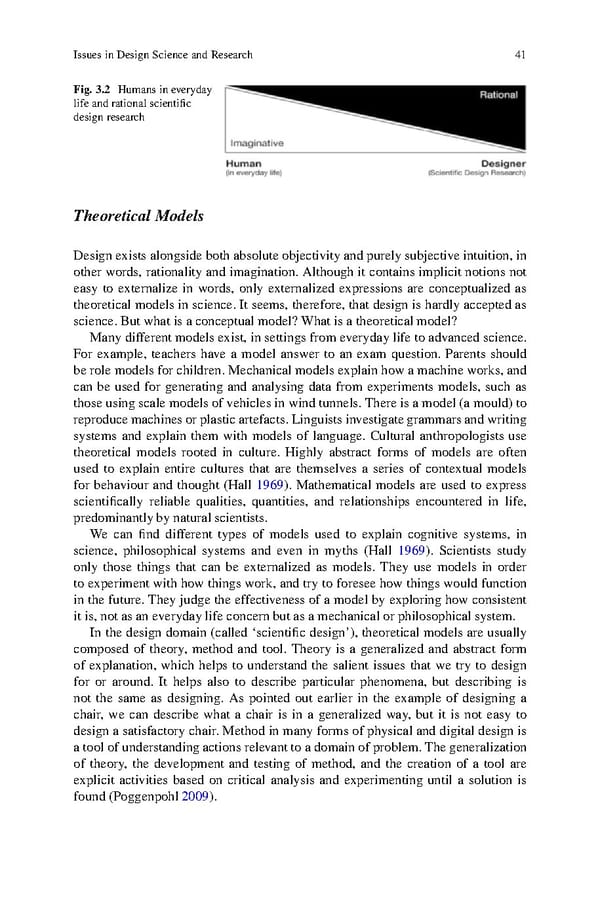
Issues in Design Science and Research 41 Fig. 3.2 Humans ineveryday life and rational scientific design research Theoretical Models Design exists alongside both absolute objectivity and purely subjective intuition, in other words, rationality and imagination. Although it contains implicit notions not easy to externalize in words, only externalized expressions are conceptualized as theoretical models in science. It seems, therefore, that design is hardly accepted as science. But what is a conceptual model? What is a theoretical model? Manydifferentmodels exist, in settings from everyday life to advanced science. For example, teachers have a model answer to an exam question. Parents should be role models for children. Mechanical models explain how a machine works, and can be used for generating and analysing data from experiments models, such as those using scale models of vehicles in wind tunnels. There is a model (a mould) to reproducemachinesorplasticartefacts. Linguists investigategrammarsand writing systems and explain them with models of language. Cultural anthropologists use theoretical models rooted in culture. Highly abstract forms of models are often used to explain entire cultures that are themselves a series of contextual models for behaviour and thought (Hall 1969). Mathematical models are used to express scientifically reliable qualities, quantities, and relationships encountered in life, predominantlyby natural scientists. We can find different types of models used to explain cognitive systems, in science, philosophical systems and even in myths (Hall 1969). Scientists study only those things that can be externalized as models. They use models in order to experiment with how things work, and try to foresee how things would function in the future. They judge the effectiveness of a model by exploring how consistent it is, not as an everyday life concern but as a mechanical or philosophical system. In the design domain (called ‘scientific design’), theoretical models are usually composed of theory, method and tool. Theory is a generalized and abstract form of explanation, which helps to understand the salient issues that we try to design for or around. It helps also to describe particular phenomena, but describing is not the same as designing. As pointed out earlier in the example of designing a chair, we can describe what a chair is in a generalized way, but it is not easy to design a satisfactory chair. Method in many forms of physical and digital design is a tool of understandingactions relevant to a domain of problem. The generalization of theory, the development and testing of method, and the creation of a tool are explicit activities based on critical analysis and experimenting until a solution is found(Poggenpohl2009).
 Human Experiential Design of Presence in Everyday Page 49 Page 51