

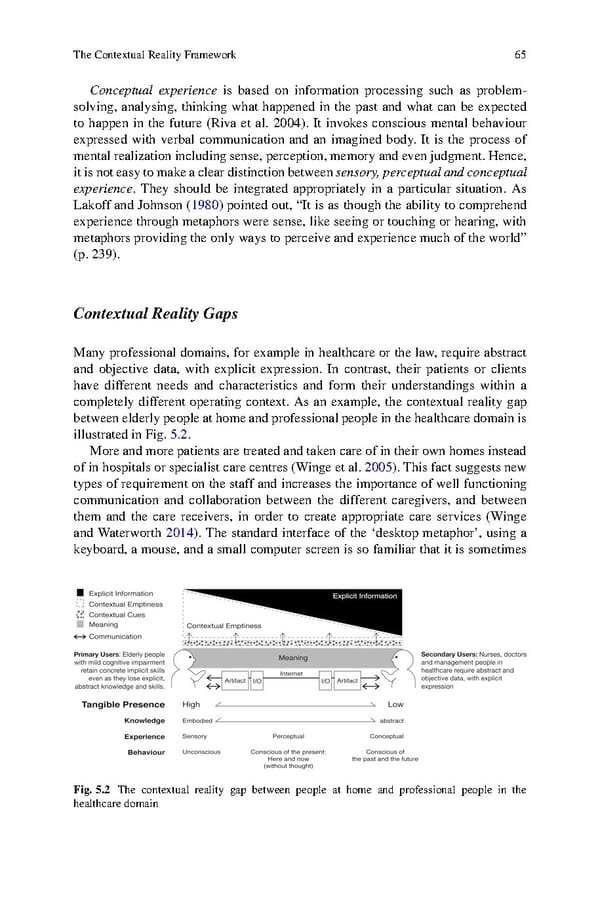
TheContextual Reality Framework 65 Conceptual experience is based on information processing such as problem- solving, analysing, thinking what happened in the past and what can be expected to happen in the future (Riva et al. 2004). It invokes conscious mental behaviour expressed with verbal communication and an imagined body. It is the process of mentalrealization including sense, perception, memory and even judgment. Hence, it is not easy to make a clear distinction between sensory, perceptualandconceptual experience. They should be integrated appropriately in a particular situation. As Lakoff and Johnson (1980) pointed out, “It is as though the ability to comprehend experience through metaphors were sense, like seeing or touching or hearing, with metaphorsproviding the only ways to perceive and experience much of the world” (p. 239). Contextual Reality Gaps Manyprofessional domains, for example in healthcare or the law, require abstract and objective data, with explicit expression. In contrast, their patients or clients have different needs and characteristics and form their understandings within a completely different operating context. As an example, the contextual reality gap betweenelderlypeopleat homeandprofessionalpeopleinthehealthcaredomainis illustrated in Fig. 5.2. Moreandmorepatientsaretreated andtaken care of in their own homesinstead of in hospitals or specialist care centres (Winge et al. 2005). This fact suggests new types of requirement on the staff and increases the importance of well functioning communication and collaboration between the different caregivers, and between them and the care receivers, in order to create appropriate care services (Winge and Waterworth 2014). The standard interface of the ‘desktop metaphor’, using a keyboard, a mouse, and a small computer screen is so familiar that it is sometimes Fig. 5.2 The contextual reality gap between people at home and professional people in the healthcare domain
 Human Experiential Design of Presence in Everyday Page 72 Page 74