

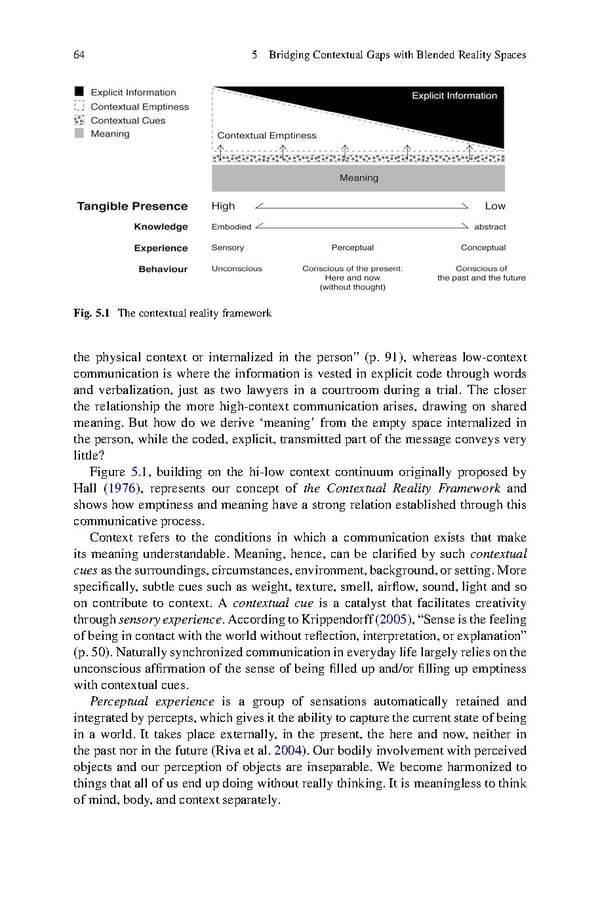
64 5 BridgingContextual Gaps withBlended Reality Spaces Fig. 5.1 The contextual reality framework the physical context or internalized in the person” (p. 91), whereas low-context communication is where the information is vested in explicit code through words and verbalization, just as two lawyers in a courtroom during a trial. The closer the relationship the more high-context communication arises, drawing on shared meaning. But how do we derive ‘meaning’ from the empty space internalized in the person, while the coded, explicit, transmitted part of the message conveys very little? Figure 5.1, building on the hi-low context continuum originally proposed by Hall (1976), represents our concept of the Contextual Reality Framework and shows how emptiness and meaning have a strong relation established through this communicativeprocess. Context refers to the conditions in which a communication exists that make its meaning understandable. Meaning, hence, can be clarified by such contextual cuesasthesurroundings,circumstances,environment,background,orsetting.More specifically, subtle cues such as weight, texture, smell, airflow, sound, light and so on contribute to context. A contextual cue is a catalyst that facilitates creativity throughsensoryexperience.AccordingtoKrippendorff(2005),“Senseisthefeeling of being in contact with the world without reflection, interpretation, or explanation” (p. 50). Naturally synchronizedcommunicationin everydaylife largelyreliesonthe unconscious affirmation of the sense of being filled up and/or filling up emptiness with contextual cues. Perceptual experience is a group of sensations automatically retained and integrated by percepts, which gives it the ability to capture the current state of being in a world. It takes place externally, in the present, the here and now, neither in the past nor in the future (Riva et al. 2004). Our bodily involvement with perceived objects and our perception of objects are inseparable. We become harmonized to things that all of us end up doing without really thinking. It is meaningless to think of mind, body, and context separately.
 Human Experiential Design of Presence in Everyday Page 71 Page 73