

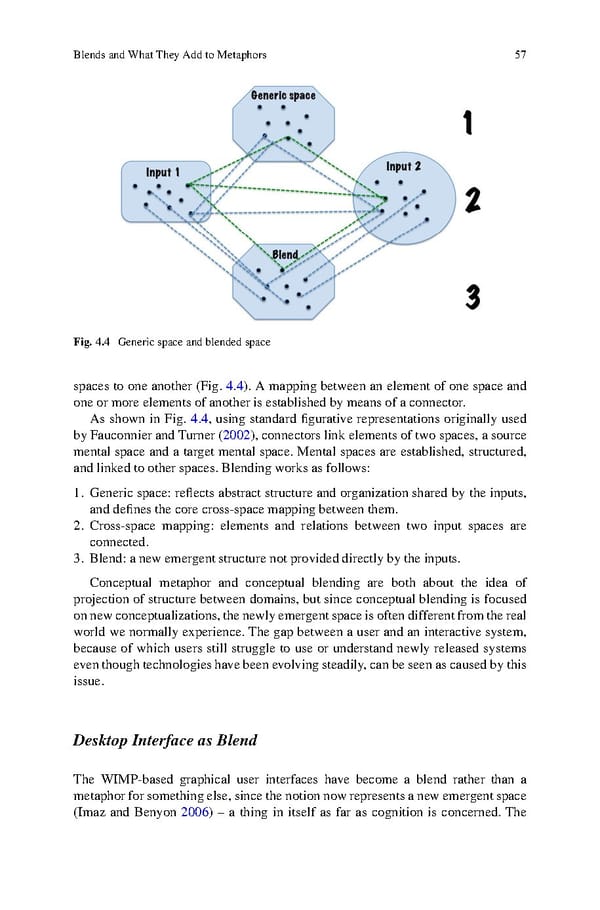
Blends and What They Add to Metaphors 57 Fig. 4.4 Generic space and blended space spaces to one another (Fig. 4.4). A mapping between an element of one space and oneormoreelementsofanotherisestablished by meansof a connector. As shown in Fig. 4.4, using standard figurative representations originally used byFauconnierandTurner(2002),connectorslink elements of two spaces, a source mental space and a target mental space. Mental spaces are established, structured, andlinked to other spaces. Blending works as follows: 1. Generic space: reflects abstract structure and organization shared by the inputs, and defines the core cross-space mapping between them. 2. Cross-space mapping: elements and relations between two input spaces are connected. 3. Blend: a new emergentstructure not provideddirectly by the inputs. Conceptual metaphor and conceptual blending are both about the idea of projection of structure between domains, but since conceptual blending is focused onnewconceptualizations,thenewlyemergentspaceisoftendifferentfromthereal world we normally experience. The gap between a user and an interactive system, because of which users still struggle to use or understand newly released systems eventhoughtechnologieshavebeenevolvingsteadily,canbeseenascausedbythis issue. Desktop Interface as Blend The WIMP-based graphical user interfaces have become a blend rather than a metaphorforsomethingelse,sincethenotionnowrepresentsanewemergentspace (Imaz and Benyon 2006) – a thing in itself as far as cognition is concerned. The
 Human Experiential Design of Presence in Everyday Page 65 Page 67