

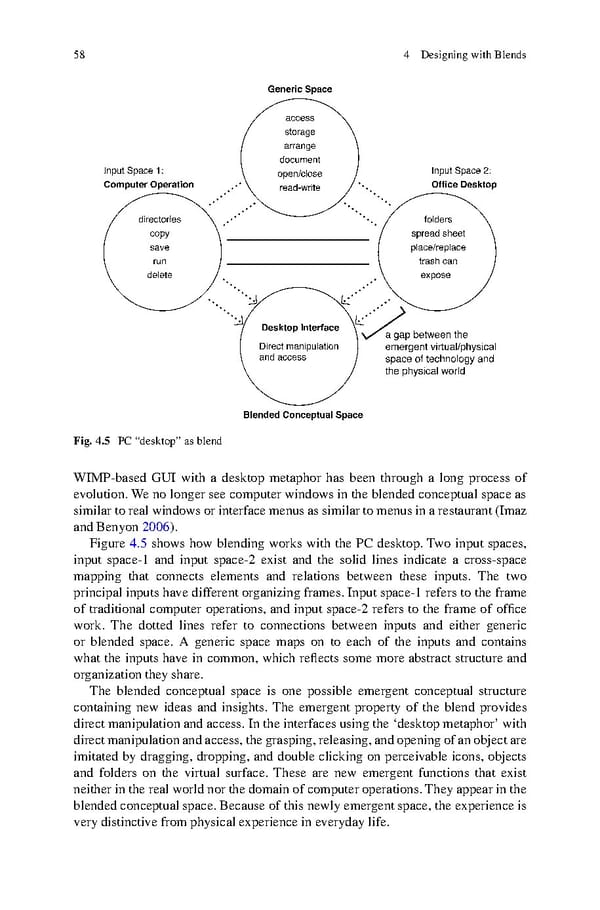
58 4 Designing with Blends Fig. 4.5 PC “desktop” as blend WIMP-based GUI with a desktop metaphor has been through a long process of evolution. We no longer see computer windows in the blended conceptual space as similar to real windows or interface menusas similar to menus in a restaurant (Imaz andBenyon2006). Figure 4.5 shows how blending works with the PC desktop. Two input spaces, input space-1 and input space-2 exist and the solid lines indicate a cross-space mapping that connects elements and relations between these inputs. The two principal inputs have different organizing frames. Input space-1 refers to the frame of traditional computer operations, and input space-2 refers to the frame of office work. The dotted lines refer to connections between inputs and either generic or blended space. A generic space maps on to each of the inputs and contains what the inputs have in common, which reflects some more abstract structure and organizationthey share. The blended conceptual space is one possible emergent conceptual structure containing new ideas and insights. The emergent property of the blend provides direct manipulation and access. In the interfaces using the ‘desktop metaphor’ with direct manipulationandaccess, thegrasping,releasing,andopeningofanobjectare imitated by dragging, dropping, and double clicking on perceivable icons, objects and folders on the virtual surface. These are new emergent functions that exist neither in the real world nor the domain of computer operations. They appear in the blended conceptual space. Because of this newly emergent space, the experience is very distinctive from physical experience in everyday life.
 Human Experiential Design of Presence in Everyday Page 66 Page 68