

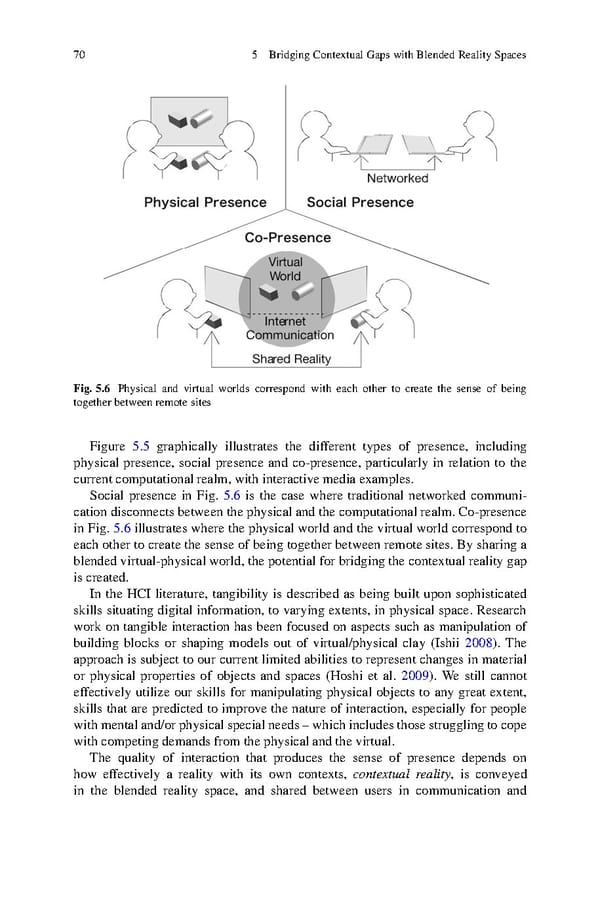
70 5 BridgingContextual Gaps withBlended Reality Spaces Fig. 5.6 Physical and virtual worlds correspond with each other to create the sense of being together between remote sites Figure 5.5 graphically illustrates the different types of presence, including physical presence, social presence and co-presence, particularly in relation to the current computational realm, with interactive media examples. Social presence in Fig. 5.6 is the case where traditional networked communi- cation disconnects between the physical and the computational realm. Co-presence in Fig. 5.6 illustrates where the physical world and the virtual world correspond to each other to create the sense of being together between remote sites. By sharing a blended virtual-physical world, the potential for bridging the contextual reality gap is created. In the HCI literature, tangibility is described as being built upon sophisticated skills situating digital information, to varying extents, in physical space. Research work on tangible interaction has been focused on aspects such as manipulation of building blocks or shaping models out of virtual/physical clay (Ishii 2008). The approach is subject to our current limited abilities to represent changes in material or physical properties of objects and spaces (Hoshi et al. 2009). We still cannot effectively utilize our skills for manipulating physical objects to any great extent, skills that are predicted to improve the nature of interaction, especially for people withmentaland/orphysicalspecialneeds–whichincludesthosestrugglingtocope with competingdemandsfromthephysicalandthe virtual. The quality of interaction that produces the sense of presence depends on how effectively a reality with its own contexts, contextual reality, is conveyed in the blended reality space, and shared between users in communication and
 Human Experiential Design of Presence in Everyday Page 77 Page 79