

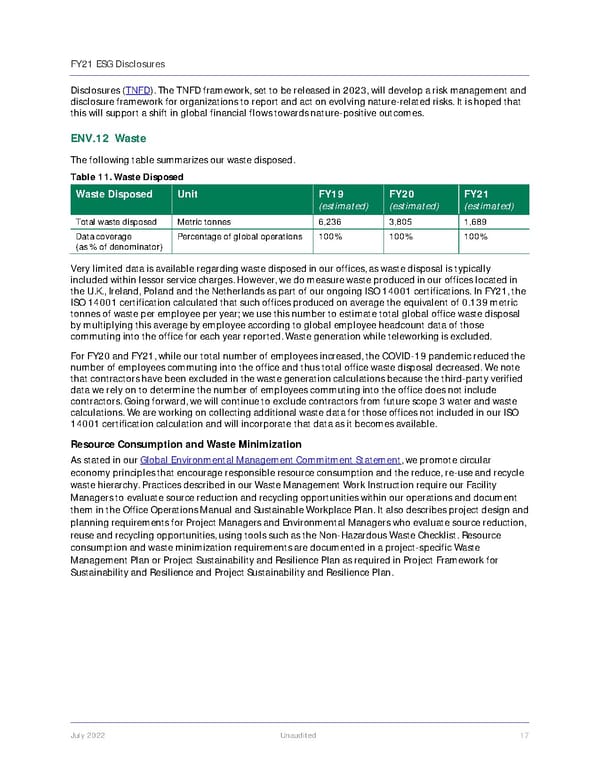
FY21 ESG Disclosures July 2022 Unaudited 17 Disclosures ( TNFD ). The TNFD framework, set to be released in 2023, will develop a risk management and disclosure framework for organizations to report and act on evolving nature-related risks. It is hoped that this will support a shift in global financial flows towards nature-positive outcomes. ENV.12 Waste The following table summarizes our waste disposed. Table 11. Waste Disposed Waste Disposed Unit FY19 (estimated) FY20 (estimated) FY21 (estimated) Total waste disposed Metric tonnes 6,236 3,805 1,689 Data coverage (as % of denominator) Percentage of global operations 100% 100% 100% Very limited data is available regarding waste disposed in our offices, as waste disposal is typically included within lessor service charges. However, we do measure waste produced in our offices located in the U.K., Ireland, Poland and the Netherlands as part of our ongoing ISO 14001 certifications. In FY21, the ISO 14001 certification calculated that such offices produced on average the equivalent of 0.139 metric tonnes of waste per employee per year; we use this number to estimate total global office waste disposal by multiplying this average by employee according to global employee headcount data of those commuting into the office for each year reported. Waste generation while teleworking is excluded. For FY20 and FY21, while our total number of employees increased, the COVID-19 pandemic reduced the number of employees commuting into the office and thus total office waste disposal decreased. We note that contractors have been excluded in the waste generation calculations because the third-party verified data we rely on to determine the number of employees commuting into the office does not include contractors. Going forward, we will continue to exclude contractors from future scope 3 water and waste calculations. We are working on collecting additional waste data for those offices not included in our ISO 14001 certification calculation and will incorporate that data as it becomes available. Resource Consumption and Waste Minimization As stated in our Global Environmental Management Commitment Statement , we promote circular economy principles that encourage responsible resource consumption and the reduce, re-use and recycle waste hierarchy. Practices described in our Waste Management Work Instruction require our Facility Managers to evaluate source reduction and recycling opportunities within our operations and document them in the Office Operations Manual and Sustainable Workplace Plan. It also describes project design and planning requirements for Project Managers and Environmental Managers who evaluate source reduction, reuse and recycling opportunities, using tools such as the Non-Hazardous Waste Checklist. Resource consumption and waste minimization requirements are documented in a project-specific Waste Management Plan or Project Sustainability and Resilience Plan as required in Project Framework for Sustainability and Resilience and Project Sustainability and Resilience Plan.
 Jacobs Engineering Group ESG Disclosures Page 17 Page 19