

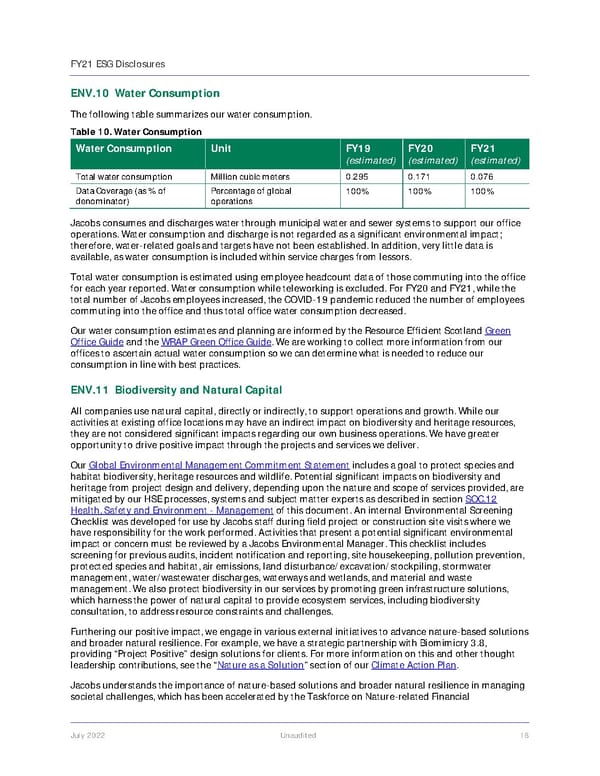
FY21 ESG Disclosures July 2022 Unaudited 16 ENV.10 Water Consumption The following table summarizes our water consumption. Table 10. Water Consumption Water Consumption Unit FY19 (estimated) FY20 (estimated) FY21 (estimated) Total water consumption Million cubic meters 0.295 0.171 0.076 Data Coverage (as % of denominator) Percentage of global operations 100% 100% 100% Jacobs consumes and discharges water through municipal water and sewer systems to support our office operations. Water consumption and discharge is not regarded as a significant environmental impact; therefore, water-related goals and targets have not been established. In addition, very little data is available, as water consumption is included within service charges from lessors. Total water consumption is estimated using employee headcount data of those commuting into the office for each year reported. Water consumption while teleworking is excluded. For FY20 and FY21, while the total number of Jacobs employees increased, the COVID-19 pandemic reduced the number of employees commuting into the office and thus total office water consumption decreased. Our water consumption estimates and planning are informed by the Resource Efficient Scotland Green Office Guide and the WRAP Green Office Guide . We are working to collect more information from our offices to ascertain actual water consumption so we can determine what is needed to reduce our consumption in line with best practices. ENV.11 Biodiversity and Natural Capital All companies use natural capital, directly or indirectly, to support operations and growth. While our activities at existing office locations may have an indirect impact on biodiversity and heritage resources, they are not considered significant impacts regarding our own business operations. We have greater opportunity to drive positive impact through the projects and services we deliver. Our Global Environmental Management Commitment Statement includes a goal to protect species and habitat biodiversity, heritage resources and wildlife. Potential significant impacts on biodiversity and heritage from project design and delivery, depending upon the nature and scope of services provided, are mitigated by our HSE processes, systems and subject matter experts as described in section SOC.12 Health, Safety and Environment - Management of this document. An internal Environmental Screening Checklist was developed for use by Jacobs staff during field project or construction site visits where we have responsibility for the work performed. Activities that present a potential significant environmental impact or concern must be reviewed by a Jacobs Environmental Manager. This checklist includes screening for previous audits, incident notification and reporting, site housekeeping, pollution prevention, protected species and habitat, air emissions, land disturbance/excavation/stockpiling, stormwater management, water/wastewater discharges, waterways and wetlands, and material and waste management. We also protect biodiversity in our services by promoting green infrastructure solutions, which harness the power of natural capital to provide ecosystem services, including biodiversity consultation, to address resource constraints and challenges. Furthering our positive impact, we engage in various external initiatives to advance nature-based solutions and broader natural resilience. For example, we have a strategic partnership with Biomimicry 3.8, providing “Project Positive” design solutions for clients. For more information on this and other thought leadership contributions, see the “ Nature as a Solution ” section of our Climate Action Plan . Jacobs understands the importance of nature-based solutions and broader natural resilience in managing societal challenges, which has been accelerated by the Taskforce on Nature-related Financial
 Jacobs Engineering Group ESG Disclosures Page 16 Page 18