

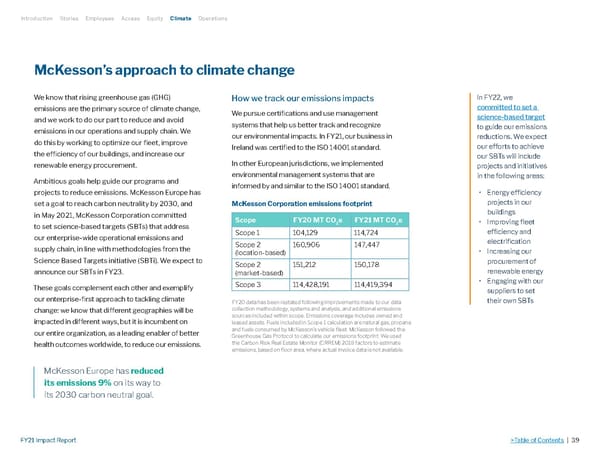
McKesson’s approach to climate change We know that rising greenhouse gas (GHG) emissions are the primary source of climate change, and we work to do our part to reduce and avoid emissions in our operations and supply chain. We do this by working to optimize our fleet, improve the efficiency of our buildings, and increase our renewable energy procurement. Ambitious goals help guide our programs and projects to reduce emissions. McKesson Europe has set a goal to reach carbon neutrality by 2030, and in May 2021, McKesson Corporation committed to set science-based targets (SBTs) that address our enterprise-wide operational emissions and supply chain, in line with methodologies from the Science Based Targets initiative (SBTi). We expect to announce our SBTs in FY23. These goals complement each other and exemplify our enterprise-first approach to tackling climate change: we know that different geographies will be impacted in different ways, but it is incumbent on our entire organization, as a leading enabler of better health outcomes worldwide, to reduce our emissions. McKesson Europe has reduced its emissions 9% on its way to its 2030 carbon neutral goal. How we track our emissions impacts We pursue certifications and use management systems that help us better track and recognize our environmental impacts. In FY21, our business in Ireland was certified to the ISO 14001 standard. In other European jurisdictions, we implemented environmental management systems that are informed by and similar to the ISO 14001 standard. McKesson Corporation emissions footprint Scope FY20 MT CO 2 e FY21 MT CO 2 e Scope 1 104,129 114,724 Scope 2 (location-based) 160,906 147,447 Scope 2 (market-based) 151,212 150,178 Scope 3 114,428,191 114,419,394 In FY22, we committed to set a science-based target to guide our emissions reductions. We expect our efforts to achieve our SBTs will include projects and initiatives in the following areas: • Energy efficiency projects in our buildings • Improving fleet efficiency and electrification • Increasing our procurement of renewable energy • Engaging with our suppliers to set their own SBTs Introduction Stories Employees Access Equity Climate Operations FY20 data has been restated following improvements made to our data collection methodology, systems and analysis, and additional emissions sources included within scope. Emissions coverage includes owned and leased assets. Fuels included in Scope 1 calculation are natural gas, propane and fuels consumed by McKesson’s vehicle fleet. McKesson followed the Greenhouse Gas Protocol to calculate our emissions footprint. We used the Carbon Risk Real Estate Monitor (CRREM) 2018 factors to estimate emissions, based on floor area, where actual invoice data is not available. >Table of Contents | 39 FY21 Impact Report
 McKesson ESG Report Page 38 Page 40