

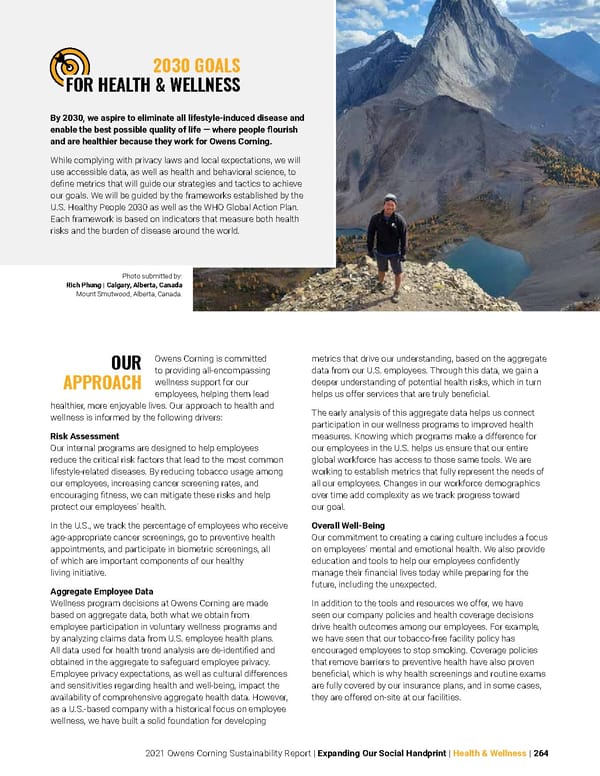
2021 Owens Corning Sustainability Report | Expanding Our Social Handprint | Health & Wellness | 264 Owens Corning is committed to providing all-encompassing wellness support for our employees, helping them lead healthier, more enjoyable lives. Our approach to health and wellness is informed by the following drivers: Risk Assessment Our internal programs are designed to help employees reduce the critical risk factors that lead to the most common lifestyle-related diseases. By reducing tobacco usage among our employees, increasing cancer screening rates, and encouraging fitness, we can mitigate these risks and help protect our employees’ health. In the U.S., we track the percentage of employees who receive age-appropriate cancer screenings, go to preventive health appointments, and participate in biometric screenings, all of which are important components of our healthy living initiative. Aggregate Employee Data Wellness program decisions at Owens Corning are made based on aggregate data, both what we obtain from employee participation in voluntary wellness programs and by analyzing claims data from U.S. employee health plans. All data used for health trend analysis are de-identified and obtained in the aggregate to safeguard employee privacy. Employee privacy expectations, as well as cultural differences and sensitivities regarding health and well-being, impact the availability of comprehensive aggregate health data. However, as a U.S.-based company with a historical focus on employee wellness, we have built a solid foundation for developing By 2030, we aspire to eliminate all lifestyle-induced disease and enable the best possible quality of life — where people flourish and are healthier because they work for Owens Corning. While complying with privacy laws and local expectations, we will use accessible data, as well as health and behavioral science, to define metrics that will guide our strategies and tactics to achieve our goals. We will be guided by the frameworks established by the U.S. Healthy People 2030 as well as the WHO Global Action Plan. Each framework is based on indicators that measure both health risks and the burden of disease around the world. OUR APPROACH metrics that drive our understanding, based on the aggregate data from our U.S. employees. Through this data, we gain a deeper understanding of potential health risks, which in turn helps us offer services that are truly beneficial. The early analysis of this aggregate data helps us connect participation in our wellness programs to improved health measures. Knowing which programs make a difference for our employees in the U.S. helps us ensure that our entire global workforce has access to those same tools. We are working to establish metrics that fully represent the needs of all our employees. Changes in our workforce demographics over time add complexity as we track progress toward our goal. Overall Well-Being Our commitment to creating a caring culture includes a focus on employees’ mental and emotional health. We also provide education and tools to help our employees confidently manage their financial lives today while preparing for the future, including the unexpected. In addition to the tools and resources we offer, we have seen our company policies and health coverage decisions drive health outcomes among our employees. For example, we have seen that our tobacco-free facility policy has encouraged employees to stop smoking. Coverage policies that remove barriers to preventive health have also proven beneficial, which is why health screenings and routine exams are fully covered by our insurance plans, and in some cases, they are offered on-site at our facilities. Photo submitted by: Rich Phung | Calgary, Alberta, Canada Mount Smutwood, Alberta, Canada. 2030 GOALS FOR HEALTH & WELLNESS
 Owens Corning Sustainability Report Page 263 Page 265