

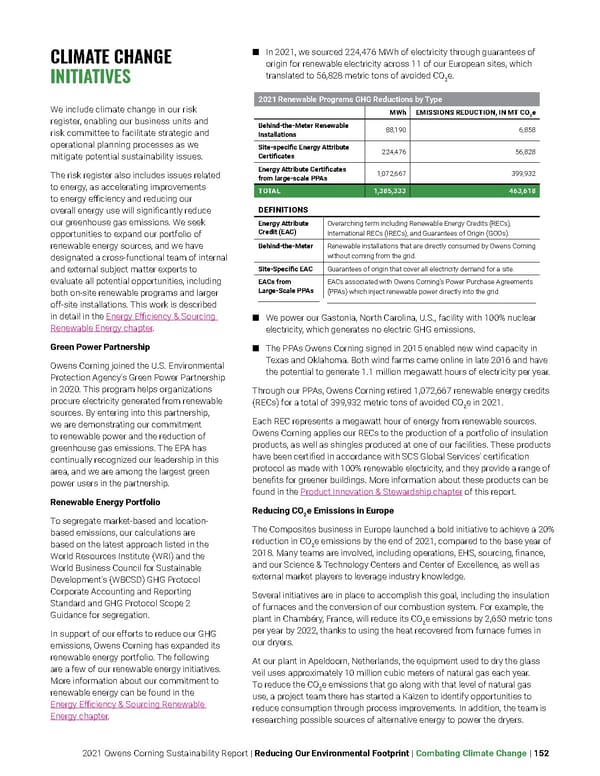
2021 Owens Corning Sustainability Report | Reducing Our Environmental Footprint | Combating Climate Change | 152 CLIMATE CHANGE INITIATIVES We include climate change in our risk register, enabling our business units and risk committee to facilitate strategic and operational planning processes as we mitigate potential sustainability issues. The risk register also includes issues related to energy, as accelerating improvements to energy efficiency and reducing our overall energy use will significantly reduce our greenhouse gas emissions. We seek opportunities to expand our portfolio of renewable energy sources, and we have designated a cross-functional team of internal and external subject matter experts to evaluate all potential opportunities, including both on-site renewable programs and larger off-site installations. This work is described in detail in the Energy Efficiency & Sourcing Renewable Energy chapter . Green Power Partnership Owens Corning joined the U.S. Environmental Protection Agency’s Green Power Partnership in 2020. This program helps organizations procure electricity generated from renewable sources. By entering into this partnership, we are demonstrating our commitment to renewable power and the reduction of greenhouse gas emissions. The EPA has continually recognized our leadership in this area, and we are among the largest green power users in the partnership. Renewable Energy Portfolio To segregate market-based and location- based emissions, our calculations are based on the latest approach listed in the World Resources Institute (WRI) and the World Business Council for Sustainable Development’s (WBCSD) GHG Protocol Corporate Accounting and Reporting Standard and GHG Protocol Scope 2 Guidance for segregation. In support of our efforts to reduce our GHG emissions, Owens Corning has expanded its renewable energy portfolio. The following are a few of our renewable energy initiatives. More information about our commitment to renewable energy can be found in the Energy Efficiency & Sourcing Renewable Energy chapter . ■ In 2021, we sourced 224,476 MWh of electricity through guarantees of origin for renewable electricity across 11 of our European sites, which translated to 56,828 metric tons of avoided CO 2 e. ■ We power our Gastonia, North Carolina, U.S., facility with 100% nuclear electricity, which generates no electric GHG emissions. ■ The PPAs Owens Corning signed in 2015 enabled new wind capacity in Texas and Oklahoma. Both wind farms came online in late 2016 and have the potential to generate 1.1 million megawatt hours of electricity per year. Through our PPAs, Owens Corning retired 1,072,667 renewable energy credits (RECs) for a total of 399,932 metric tons of avoided CO 2 e in 2021. Each REC represents a megawatt hour of energy from renewable sources. Owens Corning applies our RECs to the production of a portfolio of insulation products, as well as shingles produced at one of our facilities. These products have been certified in accordance with SCS Global Services’ certification protocol as made with 100% renewable electricity, and they provide a range of benefits for greener buildings. More information about these products can be found in the Product Innovation & Stewardship chapter of this report. Reducing CO 2 e Emissions in Europe The Composites business in Europe launched a bold initiative to achieve a 20% reduction in CO 2 e emissions by the end of 2021, compared to the base year of 2018. Many teams are involved, including operations, EHS, sourcing, finance, and our Science & Technology Centers and Center of Excellence, as well as external market players to leverage industry knowledge. Several initiatives are in place to accomplish this goal, including the insulation of furnaces and the conversion of our combustion system. For example, the plant in Chambéry, France, will reduce its CO 2 e emissions by 2,650 metric tons per year by 2022, thanks to using the heat recovered from furnace fumes in our dryers. At our plant in Apeldoorn, Netherlands, the equipment used to dry the glass veil uses approximately 10 million cubic meters of natural gas each year. To reduce the CO 2 e emissions that go along with that level of natural gas use, a project team there has started a Kaizen to identify opportunities to reduce consumption through process improvements. In addition, the team is researching possible sources of alternative energy to power the dryers. 2021 Renewable Programs GHG Reductions by Type MW h EMISSIONS REDUCTION, IN MT CO 2 e Behind-the-Meter Renewable Installations 88,190 6,858 Site-specific Energy Attribute Certificates 224,476 56,828 Energy Attribute Certificates from large-scale PPAs 1,072,667 399,932 TOTAL 1,385,333 463,618 DEFINITIONS Energy Attribute Credit (EAC) Overarching term including Renewable Energy Credits (RECs), International RECs (IRECs), and Guarantees of Origin (GOOs). Behind-the-Meter Renewable installations that are directly consumed by Owens Corning without coming from the grid. Site-Specific EAC Guarantees of origin that cover all electricity demand for a site. EACs from Large-Scale PPAs EACs associated with Owens Corning’s Power Purchase Agreements (PPAs) which inject renewable power directly into the grid.
 Owens Corning Sustainability Report Page 151 Page 153