

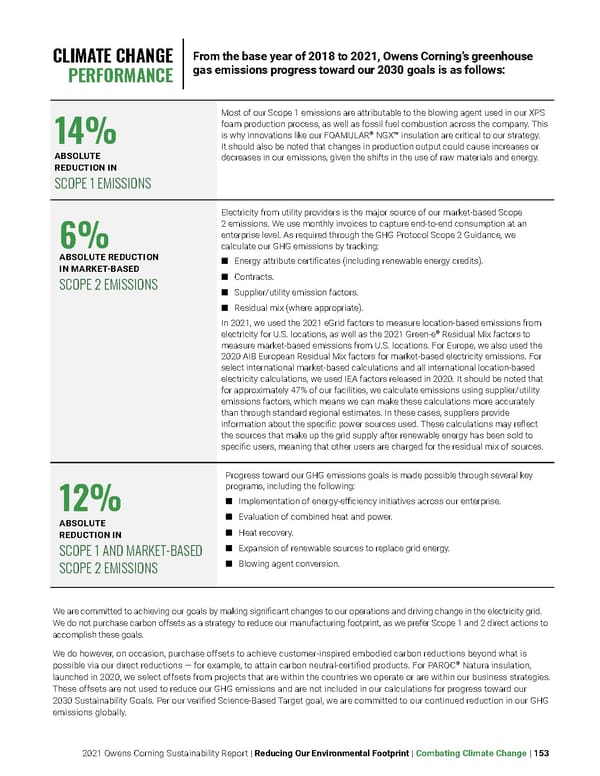
2021 Owens Corning Sustainability Report | Reducing Our Environmental Footprint | Combating Climate Change | 153 CLIMATE CHANGE PERFORMANCE From the base year of 2018 to 2021, Owens Corning’s greenhouse gas emissions progress toward our 2030 goals is as follows: 14% ABSOLUTE REDUCTION IN SCOPE 1 EMISSIONS Most of our Scope 1 emissions are attributable to the blowing agent used in our XPS foam production process, as well as fossil fuel combustion across the company. This is why innovations like our FOAMULAR ® NGX™ insulation are critical to our strategy. It should also be noted that changes in production output could cause increases or decreases in our emissions, given the shifts in the use of raw materials and energy. 6% ABSOLUTE REDUCTION IN MARKET-BASED SCOPE 2 EMISSIONS Electricity from utility providers is the major source of our market-based Scope 2 emissions. We use monthly invoices to capture end-to-end consumption at an enterprise level. As required through the GHG Protocol Scope 2 Guidance, we calculate our GHG emissions by tracking: ■ Energy attribute certificates (including renewable energy credits). ■ Contracts. ■ Supplier/utility emission factors. ■ Residual mix (where appropriate). In 2021, we used the 2021 eGrid factors to measure location-based emissions from electricity for U.S. locations, as well as the 2021 Green-e ® Residual Mix factors to measure market-based emissions from U.S. locations. For Europe, we also used the 2020 AIB European Residual Mix factors for market-based electricity emissions. For select international market-based calculations and all international location-based electricity calculations, we used IEA factors released in 2020. It should be noted that for approximately 47% of our facilities, we calculate emissions using supplier/utility emissions factors, which means we can make these calculations more accurately than through standard regional estimates. In these cases, suppliers provide information about the specific power sources used. These calculations may reflect the sources that make up the grid supply after renewable energy has been sold to specific users, meaning that other users are charged for the residual mix of sources. 12% ABSOLUTE REDUCTION IN SCOPE 1 AND MARKET-BASED SCOPE 2 EMISSIONS Progress toward our GHG emissions goals is made possible through several key programs, including the following: ■ Implementation of energy-efficiency initiatives across our enterprise. ■ Evaluation of combined heat and power. ■ Heat recovery. ■ Expansion of renewable sources to replace grid energy. ■ Blowing agent conversion. We are committed to achieving our goals by making significant changes to our operations and driving change in the electricity grid. We do not purchase carbon offsets as a strategy to reduce our manufacturing footprint, as we prefer Scope 1 and 2 direct actions to accomplish these goals. We do however, on occasion, purchase offsets to achieve customer-inspired embodied carbon reductions beyond what is possible via our direct reductions — for example, to attain carbon neutral-certified products. For PAROC ® Natura insulation, launched in 2020, we select offsets from projects that are within the countries we operate or are within our business strategies. These offsets are not used to reduce our GHG emissions and are not included in our calculations for progress toward our 2030 Sustainability Goals. Per our verified Science-Based Target goal, we are committed to our continued reduction in our GHG emissions globally.
 Owens Corning Sustainability Report Page 152 Page 154