

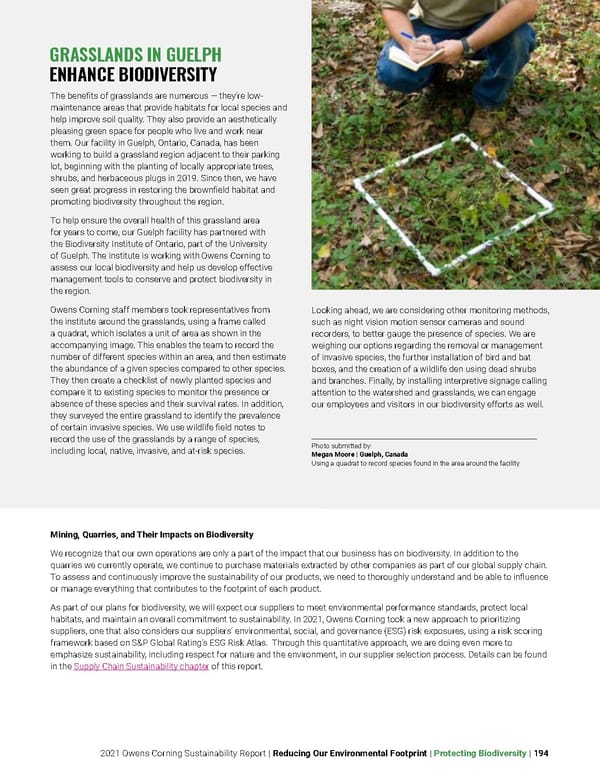
2021 Owens Corning Sustainability Report | Reducing Our Environmental Footprint | Protecting Biodiversity | 194 Mining, Quarries, and Their Impacts on Biodiversity We recognize that our own operations are only a part of the impact that our business has on biodiversity. In addition to the quarries we currently operate, we continue to purchase materials extracted by other companies as part of our global supply chain. To assess and continuously improve the sustainability of our products, we need to thoroughly understand and be able to influence or manage everything that contributes to the footprint of each product. As part of our plans for biodiversity, we will expect our suppliers to meet environmental performance standards, protect local habitats, and maintain an overall commitment to sustainability. In 2021, Owens Corning took a new approach to prioritizing suppliers, one that also considers our suppliers’ environmental, social, and governance (ESG) risk exposures, using a risk scoring framework based on S&P Global Rating’s ESG Risk Atlas. Through this quantitative approach, we are doing even more to emphasize sustainability, including respect for nature and the environment, in our supplier selection process. Details can be found in the Supply Chain Sustainability chapter of this report. GRASSLANDS IN GUELPH ENHANCE BIODIVERSITY The benefits of grasslands are numerous — they’re low- maintenance areas that provide habitats for local species and help improve soil quality. They also provide an aesthetically pleasing green space for people who live and work near them. Our facility in Guelph, Ontario, Canada, has been working to build a grassland region adjacent to their parking lot, beginning with the planting of locally appropriate trees, shrubs, and herbaceous plugs in 2019. Since then, we have seen great progress in restoring the brownfield habitat and promoting biodiversity throughout the region. To help ensure the overall health of this grassland area for years to come, our Guelph facility has partnered with the Biodiversity Institute of Ontario, part of the University of Guelph. The institute is working with Owens Corning to assess our local biodiversity and help us develop effective management tools to conserve and protect biodiversity in the region. Owens Corning staff members took representatives from the institute around the grasslands, using a frame called a quadrat, which isolates a unit of area as shown in the accompanying image. This enables the team to record the number of different species within an area, and then estimate the abundance of a given species compared to other species. They then create a checklist of newly planted species and compare it to existing species to monitor the presence or absence of these species and their survival rates. In addition, they surveyed the entire grassland to identify the prevalence of certain invasive species. We use wildlife field notes to record the use of the grasslands by a range of species, including local, native, invasive, and at-risk species. Photo submitted by: Megan Moore | Guelph, Canada Using a quadrat to record species found in the area around the facility. Looking ahead, we are considering other monitoring methods, such as night vision motion sensor cameras and sound recorders, to better gauge the presence of species. We are weighing our options regarding the removal or management of invasive species, the further installation of bird and bat boxes, and the creation of a wildlife den using dead shrubs and branches. Finally, by installing interpretive signage calling attention to the watershed and grasslands, we can engage our employees and visitors in our biodiversity efforts as well.
 Owens Corning Sustainability Report Page 193 Page 195