

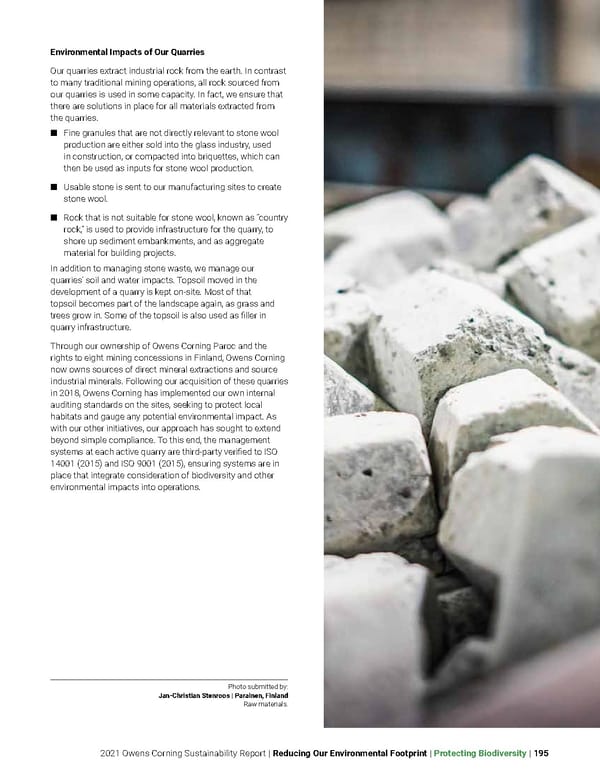
2021 Owens Corning Sustainability Report | Reducing Our Environmental Footprint | Protecting Biodiversity | 195 Environmental Impacts of Our Quarries Our quarries extract industrial rock from the earth. In contrast to many traditional mining operations, all rock sourced from our quarries is used in some capacity. In fact, we ensure that there are solutions in place for all materials extracted from the quarries. ■ Fine granules that are not directly relevant to stone wool production are either sold into the glass industry, used in construction, or compacted into briquettes, which can then be used as inputs for stone wool production. ■ Usable stone is sent to our manufacturing sites to create stone wool. ■ Rock that is not suitable for stone wool, known as “country rock,” is used to provide infrastructure for the quarry, to shore up sediment embankments, and as aggregate material for building projects. In addition to managing stone waste, we manage our quarries’ soil and water impacts. Topsoil moved in the development of a quarry is kept on-site. Most of that topsoil becomes part of the landscape again, as grass and trees grow in. Some of the topsoil is also used as filler in quarry infrastructure. Through our ownership of Owens Corning Paroc and the rights to eight mining concessions in Finland, Owens Corning now owns sources of direct mineral extractions and source industrial minerals. Following our acquisition of these quarries in 2018, Owens Corning has implemented our own internal auditing standards on the sites, seeking to protect local habitats and gauge any potential environmental impact. As with our other initiatives, our approach has sought to extend beyond simple compliance. To this end, the management systems at each active quarry are third-party verified to ISO 14001 (2015) and ISO 9001 (2015), ensuring systems are in place that integrate consideration of biodiversity and other environmental impacts into operations. Photo submitted by: Jan-Christian Stenroos | Parainen, Finland Raw materials.
 Owens Corning Sustainability Report Page 194 Page 196