

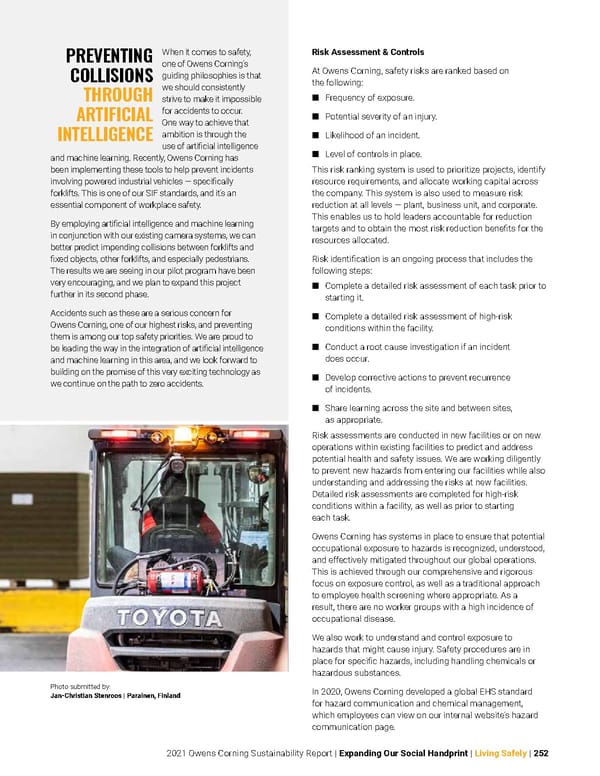
2021 Owens Corning Sustainability Report | Expanding Our Social Handprint | Living Safely | 252 Risk Assessment & Controls At Owens Corning, safety risks are ranked based on the following: ■ Frequency of exposure. ■ Potential severity of an injury. ■ Likelihood of an incident. ■ Level of controls in place. This risk ranking system is used to prioritize projects, identify resource requirements, and allocate working capital across the company. This system is also used to measure risk reduction at all levels — plant, business unit, and corporate. This enables us to hold leaders accountable for reduction targets and to obtain the most risk reduction benefits for the resources allocated. Risk identification is an ongoing process that includes the following steps: ■ Complete a detailed risk assessment of each task prior to starting it. ■ Complete a detailed risk assessment of high-risk conditions within the facility. ■ Conduct a root cause investigation if an incident does occur. ■ Develop corrective actions to prevent recurrence of incidents. ■ Share learning across the site and between sites, as appropriate. Risk assessments are conducted in new facilities or on new operations within existing facilities to predict and address potential health and safety issues. We are working diligently to prevent new hazards from entering our facilities while also understanding and addressing the risks at new facilities. Detailed risk assessments are completed for high-risk conditions within a facility, as well as prior to starting each task. Owens Corning has systems in place to ensure that potential occupational exposure to hazards is recognized, understood, and effectively mitigated throughout our global operations. This is achieved through our comprehensive and rigorous focus on exposure control, as well as a traditional approach to employee health screening where appropriate. As a result, there are no worker groups with a high incidence of occupational disease. We also work to understand and control exposure to hazards that might cause injury. Safety procedures are in place for specific hazards, including handling chemicals or hazardous substances. In 2020, Owens Corning developed a global EHS standard for hazard communication and chemical management, which employees can view on our internal website’s hazard communication page. When it comes to safety, one of Owens Corning’s guiding philosophies is that we should consistently strive to make it impossible for accidents to occur. One way to achieve that ambition is through the use of artificial intelligence and machine learning. Recently, Owens Corning has been implementing these tools to help prevent incidents involving powered industrial vehicles — specifically forklifts. This is one of our SIF standards, and it’s an essential component of workplace safety. By employing artificial intelligence and machine learning in conjunction with our existing camera systems, we can better predict impending collisions between forklifts and fixed objects, other forklifts, and especially pedestrians. The results we are seeing in our pilot program have been very encouraging, and we plan to expand this project further in its second phase. Accidents such as these are a serious concern for Owens Corning, one of our highest risks, and preventing them is among our top safety priorities. We are proud to be leading the way in the integration of artificial intelligence and machine learning in this area, and we look forward to building on the promise of this very exciting technology as we continue on the path to zero accidents. PREVENTING COLLISIONS THROUGH ARTIFICIAL INTELLIGENCE Photo submitted by: Jan-Christian Stenroos | Parainen, Finland
 Owens Corning Sustainability Report Page 251 Page 253