

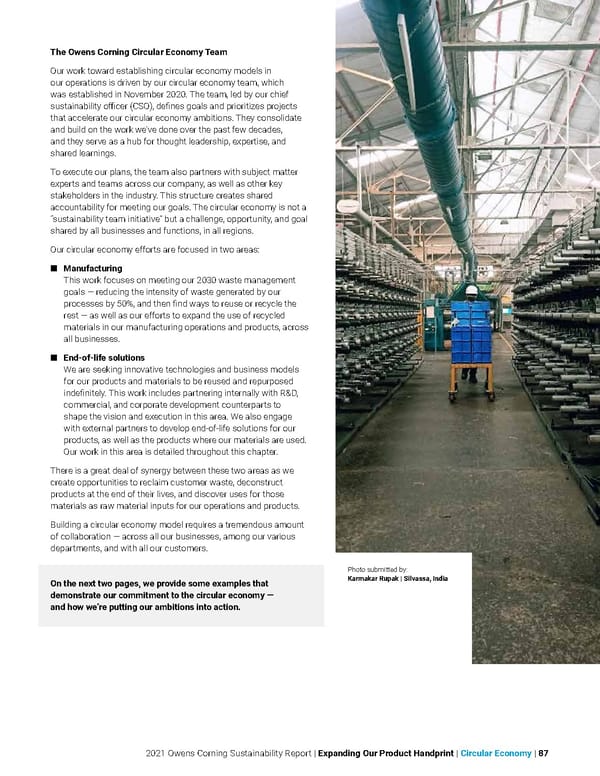
2021 Owens Corning Sustainability Report | Expanding Our Product Handprint | Circular Economy | 87 The Owens Corning Circular Economy Team Our work toward establishing circular economy models in our operations is driven by our circular economy team, which was established in November 2020. The team, led by our chief sustainability officer (CSO), defines goals and prioritizes projects that accelerate our circular economy ambitions. They consolidate and build on the work we’ve done over the past few decades, and they serve as a hub for thought leadership, expertise, and shared learnings. To execute our plans, the team also partners with subject matter experts and teams across our company, as well as other key stakeholders in the industry. This structure creates shared accountability for meeting our goals. The circular economy is not a “sustainability team initiative” but a challenge, opportunity, and goal shared by all businesses and functions, in all regions. Our circular economy efforts are focused in two areas: ■ Manufacturing This work focuses on meeting our 2030 waste management goals — reducing the intensity of waste generated by our processes by 50%, and then find ways to reuse or recycle the rest — as well as our efforts to expand the use of recycled materials in our manufacturing operations and products, across all businesses. ■ End-of-life solutions We are seeking innovative technologies and business models for our products and materials to be reused and repurposed indefinitely. This work includes partnering internally with R&D, commercial, and corporate development counterparts to shape the vision and execution in this area. We also engage with external partners to develop end-of-life solutions for our products, as well as the products where our materials are used. Our work in this area is detailed throughout this chapter. There is a great deal of synergy between these two areas as we create opportunities to reclaim customer waste, deconstruct products at the end of their lives, and discover uses for those materials as raw material inputs for our operations and products. Building a circular economy model requires a tremendous amount of collaboration — across all our businesses, among our various departments, and with all our customers. On the next two pages, we provide some examples that demonstrate our commitment to the circular economy — and how we’re putting our ambitions into action. Photo submitted by: Karmakar Rupak | Silvassa, India
 Owens Corning Sustainability Report Page 86 Page 88