

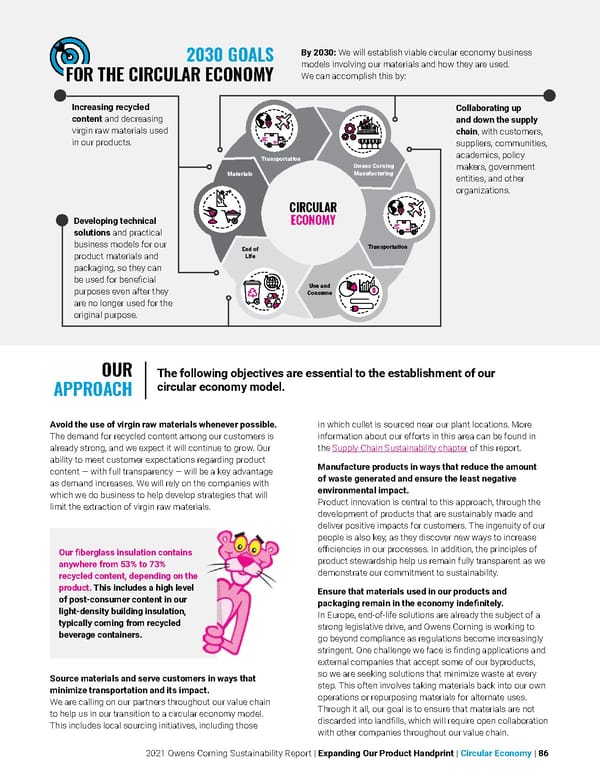
2021 Owens Corning Sustainability Report | Expanding Our Product Handprint | Circular Economy | 86 By 2030: We will establish viable circular economy business models involving our materials and how they are used. We can accomplish this by: The following objectives are essential to the establishment of our circular economy model. OUR APPROACH Avoid the use of virgin raw materials whenever possible. The demand for recycled content among our customers is already strong, and we expect it will continue to grow. Our ability to meet customer expectations regarding product content — with full transparency — will be a key advantage as demand increases. We will rely on the companies with which we do business to help develop strategies that will limit the extraction of virgin raw materials. Source materials and serve customers in ways that minimize transportation and its impact. We are calling on our partners throughout our value chain to help us in our transition to a circular economy model. This includes local sourcing initiatives, including those in which cullet is sourced near our plant locations. More information about our efforts in this area can be found in the Supply Chain Sustainability chapter of this report. Manufacture products in ways that reduce the amount of waste generated and ensure the least negative environmental impact. Product innovation is central to this approach, through the development of products that are sustainably made and deliver positive impacts for customers. The ingenuity of our people is also key, as they discover new ways to increase efficiencies in our processes. In addition, the principles of product stewardship help us remain fully transparent as we demonstrate our commitment to sustainability. Ensure that materials used in our products and packaging remain in the economy indefinitely. In Europe, end-of-life solutions are already the subject of a strong legislative drive, and Owens Corning is working to go beyond compliance as regulations become increasingly stringent. One challenge we face is finding applications and external companies that accept some of our byproducts, so we are seeking solutions that minimize waste at every step. This often involves taking materials back into our own operations or repurposing materials for alternate uses. Through it all, our goal is to ensure that materials are not discarded into landfills, which will require open collaboration with other companies throughout our value chain. Owens Corning Manufacturing Use and Consume End of Life Materials Transportation CIRCULAR ECONOMY Transportation 2030 GOALS FOR THE CIRCULAR ECONOMY Our fiberglass insulation contains anywhere from 53% to 73% recycled content, depending on the product. This includes a high level of post-consumer content in our light-density building insulation, typically coming from recycled beverage containers. Collaborating up and down the supply chain , with customers, suppliers, communities, academics, policy makers, government entities, and other organizations. Increasing recycled content and decreasing virgin raw materials used in our products. Developing technical solutions and practical business models for our product materials and packaging, so they can be used for beneficial purposes even after they are no longer used for the original purpose.
 Owens Corning Sustainability Report Page 85 Page 87