

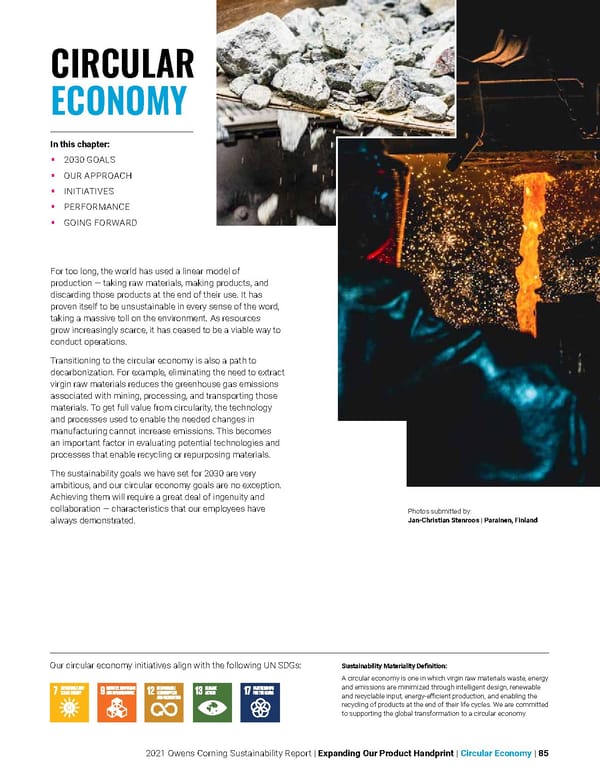
2021 Owens Corning Sustainability Report | Expanding Our Product Handprint | Circular Economy | 85 CIRCULAR ECONOMY In this chapter: ƒ 2030 GOALS ƒ OUR APPROACH ƒ INITIATIVES ƒ PERFORMANCE ƒ GOING FORWARD For too long, the world has used a linear model of production — taking raw materials, making products, and discarding those products at the end of their use. It has proven itself to be unsustainable in every sense of the word, taking a massive toll on the environment. As resources grow increasingly scarce, it has ceased to be a viable way to conduct operations. Transitioning to the circular economy is also a path to decarbonization. For example, eliminating the need to extract virgin raw materials reduces the greenhouse gas emissions associated with mining, processing, and transporting those materials. To get full value from circularity, the technology and processes used to enable the needed changes in manufacturing cannot increase emissions. This becomes an important factor in evaluating potential technologies and processes that enable recycling or repurposing materials. The sustainability goals we have set for 2030 are very ambitious, and our circular economy goals are no exception. Achieving them will require a great deal of ingenuity and collaboration — characteristics that our employees have always demonstrated. Photos submitted by: Jan-Christian Stenroos | Parainen, Finland Our circular economy initiatives align with the following UN SDGs: Sustainability Materiality Definition: A circular economy is one in which virgin raw materials waste, energy and emissions are minimized through intelligent design, renewable and recyclable input, energy-efficient production, and enabling the recycling of products at the end of their life cycles. We are committed to supporting the global transformation to a circular economy.
 Owens Corning Sustainability Report Page 84 Page 86